Why ChatGPT doesn't recommend your brand
ChatGPT SEO fix: six reasons ChatGPT names competitors instead of you, ranked by frequency across 1,000+ FixAEO scans — with a fix for each and a 30/60/90 day plan.

On this page

You ask ChatGPT "best [your category]" and it confidently lists three competitors. Your brand isn't even mentioned. You've done the SEO work — you rank top 5 on Google. Why doesn't ChatGPT see you?
I've watched this exact scenario play out for hundreds of founders. The one that stuck with me was a marketing-automation startup with 400 paying customers, first-page Google rankings, and clean product-market fit. Their CEO asked me to check their ChatGPT visibility as a favor. Zero mentions in twenty tested prompts. Their four main competitors owned every answer. Two hours of diagnostics later, we'd found three of the six causes below on their site. Three weeks after fixing them, they were showing up in ChatGPT for eight of the same twenty prompts.
We've analyzed 1,000+ scans on FixAEO and the answer is almost always one of six specific problems. This post lists them in descending order of frequency, with the exact fix for each — and a 30/60/90 day plan for when you're facing more than one.
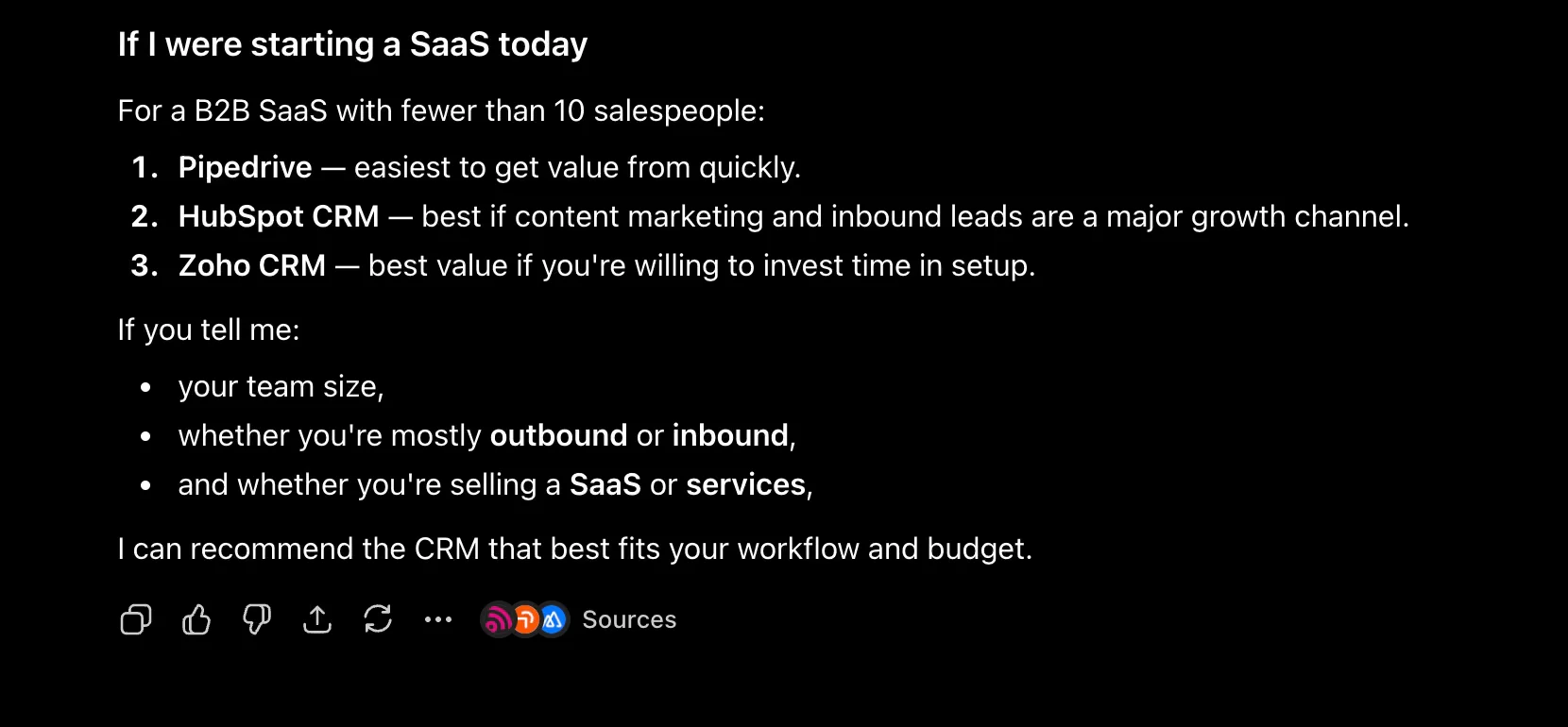
Ask ChatGPT "best CRM for a small B2B sales team" and it confidently ranks three named brands, with sources. If you sell a CRM and you're not one of them, you don't exist for that question.
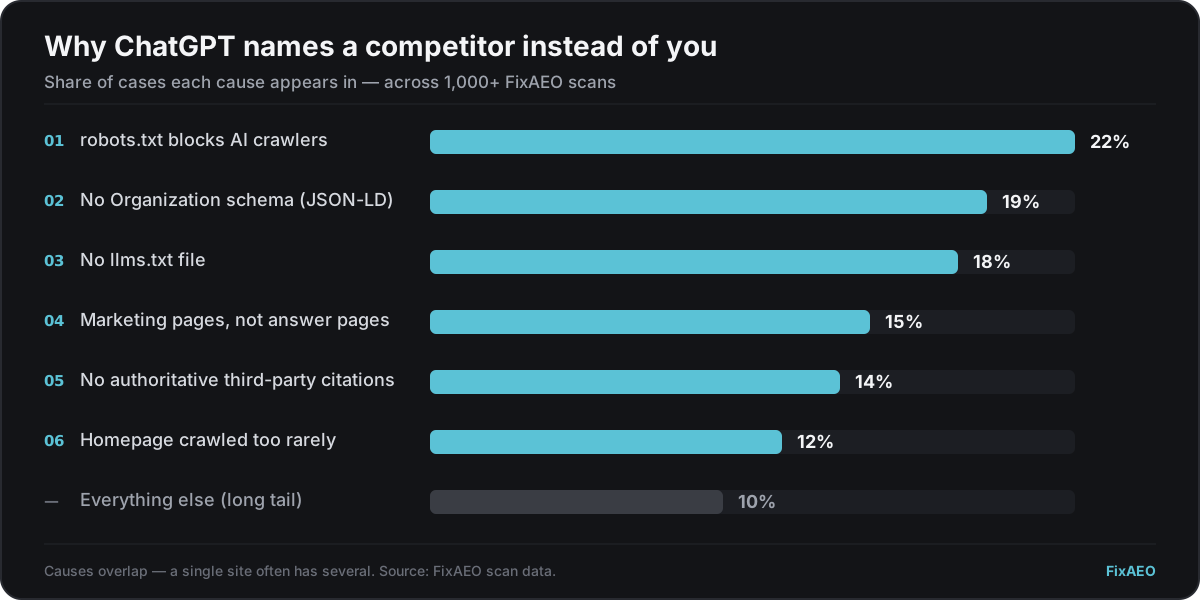
The six causes, ranked by how often each shows up across 1,000+ FixAEO scans. Most sites have more than one.
What people call "ChatGPT SEO" — and why we use the AEO frame
Most teams searching for "ChatGPT SEO" are looking for the same thing: how to land in ChatGPT's recommendations. The terminology hasn't settled — "ChatGPT SEO", "ChatGPT optimization", "AEO", and "AI search optimization" all point at the same practice. We use AEO (Answer Engine Optimization) here because the same playbook applies to Claude, Copilot, Gemini, Perplexity, Grok, and DeepSeek too. But if you came here from a ChatGPT SEO search, the six causes below are exactly what you're after.
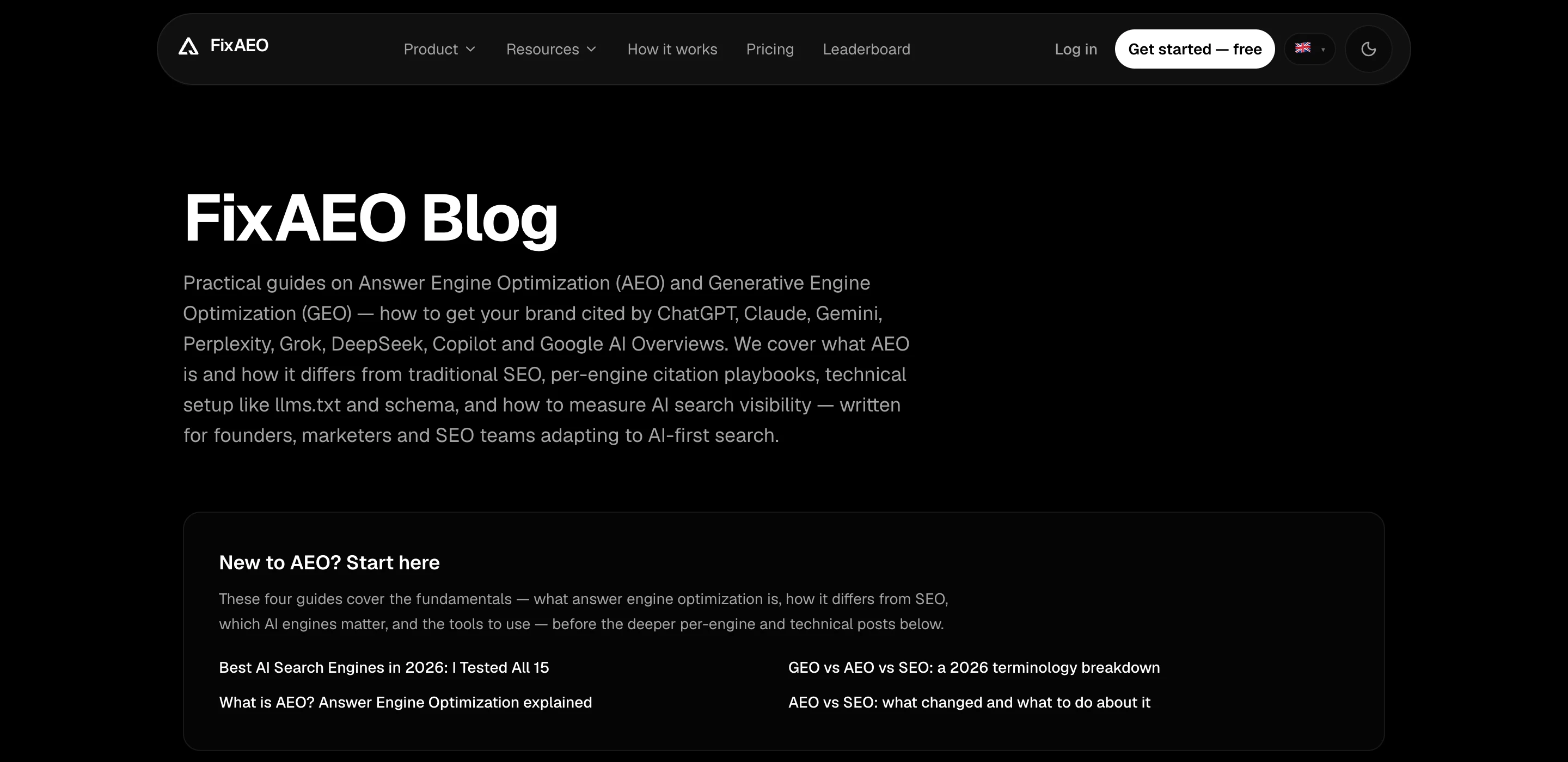
The full FixAEO knowledge base sits on the blog. If ChatGPT isn't recommending you, the fixes are in these guides — start with the four 'New to AEO' picks.
What ChatGPT actually does when someone asks about your category
Before diagnosing the problem, it helps to understand what ChatGPT does behind the scenes. When a user asks "best CRM for a small B2B team," here's roughly what happens:
- Query interpretation. The model parses the intent: category (CRM), constraints (small, B2B), audience (sales team).
- Retrieval. For queries with a browsing component, ChatGPT queries a real-time index (Bing's, primarily) plus its own retrieval layer over trained knowledge.
- Source aggregation. It pulls a set of candidate pages — often comparison articles, review sites, Wikipedia, and vendor sites.
- Ranking. It weighs each candidate brand mention by frequency, authority of the source, and relevance to the query constraints.
- Synthesis. It composes an answer, typically naming 3–7 brands with a short justification for each.
Six things determine whether you end up in step 5: whether ChatGPT can crawl your site, whether it understands what you are, whether third-party sources cite you, whether your content matches the query shape, whether you're findable via llms.txt, and whether your homepage is reliably reachable.
That's not a hidden ranking algorithm. That's a stack of technical and content signals that any team can influence. Here's how to fix each one.
1. Your robots.txt blocks AI crawlers (≈22% of cases)
The #1 cause of AEO invisibility — and the most embarrassing one — is a site that explicitly tells GPTBot, ClaudeBot, Google-Extended, or PerplexityBot to go away.
Many sites added these blocks in 2023 during the brief "AI is stealing our content" panic. Most teams never removed them. The result: a site Google indexes happily but that ChatGPT literally cannot read.
The fix. Check your robots.txt:
curl -s https://yoursite.com/robots.txt
If you see lines like User-agent: GPTBot\nDisallow: /, delete them.1 The default User-agent: * already allows AI crawlers; explicit blocks are the trap.
How to verify it worked. Wait a week, then use Agent Analytics to confirm GPTBot is actually fetching your pages. If crawler visits stay at zero, either your fix didn't propagate or another layer (Cloudflare, your CDN, a WAF) is still blocking. The FixAEO free robots.txt checker at /robots-txt-checker/ walks through the standard 24 AI + search crawlers and tells you which ones are green and which ones are blocked.
2. No JSON-LD Organization schema on the homepage (≈19%)
When an AI assistant lands on your homepage for the first time, it has to figure out what your company actually is from scratch. If you have no structured data, it has to guess from your H1, meta description, and OG tags — which are often marketing copy, not factual descriptions.
Guessing leads to weak recommendations. "FixAEO is some kind of SEO product?" instead of "FixAEO is an Answer Engine Optimization checker that audits how brands appear across ChatGPT, Claude, Copilot, Gemini, Perplexity, Grok, DeepSeek, and Google AI Overviews."
The fix. Add this JSON-LD block to your <head> (substitute your details):
<script type="application/ld+json">
{
  "@context": "https://schema.org",
  "@type": "Organization",
  "name": "Your Brand",
  "url": "https://yoursite.com",
  "logo": "https://yoursite.com/logo.png",
  "description": "[one-sentence factual description]",
  "email": "hello@yoursite.com",
  "sameAs": [
    "https://linkedin.com/company/yourbrand",
    "https://x.com/yourbrand",
    "https://github.com/yourbrand"
  ]
}
</script>
Validate it at schema.org validator before shipping.
Bonus multipliers. Once Organization is in place, add Product schema for your main offering and SoftwareApplication if you're a SaaS. Each additional schema type reduces AI ambiguity about what you sell and how to slot you into a category. Use the free FixAEO schema generator — twelve schema types, JSON-LD output, copy-paste ready.
3. Your site has no llms.txt (≈18%)
Sites without llms.txt are not automatically excluded from AI answers, but having one moves you up the retrieval ranking when models do a comparative lookup.2 It's also the file Anthropic's Claude specifically cites in their documentation as a preferred artifact.
The fix. Ten-minute job — follow this step-by-step llms.txt tutorial. The blockquote line at the top of the file is the sentence AI engines quote back when someone asks "what is [your brand]?" — spend disproportionate time on it.
4. Your top SEO pages are product-marketing pages, not answer pages (≈15%)
This is the subtle one. Your homepage probably has an H1 like "The simplest CRM for teams" — strong brand positioning, weak retrieval bait. AI assistants tend to surface pages whose content pre-answers the user's prompt.
Compare:
| Bad (marketing H1) | Good (answer H1) |
|---|---|
| The simplest CRM for teams | What is the best CRM for a 5-person team? |
| AI-powered code review | How do I get AI-assisted code review in my CI pipeline? |
| Beautiful expense tracking | What's the easiest expense tracker for an indie SaaS founder? |
When a user asks ChatGPT "best CRM for a 5-person team", the model's retrieval layer looks for pages whose content literally answers that question. If yours doesn't, your competitor wins.
The fix. Pick your three highest-intent SEO keywords. For each, publish a comparison post or how-to whose H1 is the question itself. You don't have to demote your existing homepage; just give the retrieval layer something better to find.
The multiplier trick. Comparison pages ("X vs Y", "alternatives to Z") work disproportionately well here because they name multiple entities in a single page — which is exactly the shape of answer AI engines assemble. If you're new to the AEO game, comparison pages are the fastest content type to move visibility on.
5. No authoritative third-party citations (≈14%)
AI models cross-reference. When you claim "the best CRM for indie SaaS" on your own site, that's a self-citation — weak signal. When Indie Hackers, Hacker News, and a Wikipedia paragraph also mention you in that context, the model's confidence increases sharply.
The most powerful third-party citations, in roughly this order:3
- Wikipedia (if you're eligible for a page)
- High-authority industry publications (NYT, WSJ, TechCrunch tier for B2C; trade pubs for B2B)
- Curated lists (Awesome lists on GitHub, 10 best X roundups by recognised reviewers)
- Forum threads with high upvote/award counts (Reddit, Hacker News, Stack Overflow)
- Niche subreddits with active moderation (very high signal for B2B SaaS)
The fix. Pick one. Don't try to do all five at once. Reddit AMAs and well-written tutorial blog posts that other sites cite are the fastest path for most companies.
The Wikipedia caveat. Wikipedia editors will remove your brand's article if it fails their notability standards. Don't create the page yourself — get a real third-party journalist to write about you, then let a Wikipedia editor create the page based on that coverage. Self-created Wikipedia pages get deleted almost universally.
6. Your homepage hasn't been crawled recently (≈12%)
This is rare but devastating when it happens. Modern AI assistants use retrieval-augmented generation (RAG) — they fetch fresh pages at query time.4 If your site returns 5xx errors, redirects in a loop, or has a robots.txt drive-by block, the model falls back to its training data — which is likely 6-18 months stale.
The fix. Check:
curl -sI https://yoursite.com
# Expect: HTTP/2 200
If you see a redirect, make sure it's a single 301 to the canonical URL — not a chain. If your site is behind a heavy bot-protection layer (e.g., Cloudflare's strictest WAF), you may be soft-blocking AI crawlers without realising it.
The surer check is to watch the crawlers themselves: Agent Analytics shows whether GPTBot, ClaudeBot, and PerplexityBot are actually landing on your pages — and whether those visits succeed — so you stop guessing whether the engines can even see you.
The remaining ≈ 10% — long tail
A scatter of less common but real causes:
- Negative sentiment in training data — if Reddit threads from 2024 trashed your brand, the model has absorbed that. Hard to fix; counteract by publishing better, more recent third-party coverage.
- Brand name collision — "Stripe" is unambiguous; "Vibes" matches a hundred products. Disambiguate with category context in your
llms.txtand Organization schema. - Site is single-page React/Vue with no SSR — older AI crawlers don't always execute JavaScript. Most do now, but verify by curling your URL and checking that your H1 and key content are in the raw HTML.5
- You renamed your product — models lag on rebrands by 12+ months. Update llms.txt, schema, and try to earn a citation that includes both names ("Foo (formerly Bar)").
- Category positioning is diluted — if your homepage claims you're three things at once (CRM + marketing automation + sales tool), AI engines don't know which category to slot you in. Pick the one you'll win and lead with it; the others become secondary product angles.
Common misdiagnoses I see
Founders reach for the wrong fix all the time. Three misdiagnoses that waste months.
Misdiagnosis 1: "We need to write more blog posts." More content is not the answer if your existing content is marketing-shaped. Ten new "look how great we are" posts do less than one comparison page. Fix the shape of your top three pages before publishing anything new.
Misdiagnosis 2: "We need more backlinks." Backlinks help SEO but they're a smaller factor for AI recommendation than citations in retrievable sources (Wikipedia, Reddit threads, third-party comparison articles). A team that's been running link-building for six months and hasn't moved AI visibility is chasing the wrong metric.
Misdiagnosis 3: "We should hire an AEO agency to make ChatGPT recommend us." Agencies help with execution capacity, but the underlying fixes are the six above. Anyone selling you a bespoke ChatGPT ranking service without diagnosing which of the six causes you have is selling smoke. Do the diagnostic first, then decide whether you need help executing.
What "getting cited" actually looks like when you win
Here's what changes when the six causes above get fixed and ChatGPT starts naming you.
The first sign is retrieval. Before any fix, ChatGPT (with browsing on) doesn't consult your site. After the crawlability + schema fixes, you'll see fetches from GPTBot in your server logs within days. The engine can see you now. That's the pre-condition.
The second sign is category slotting. When you ask ChatGPT "what does [your brand] do," it stops hedging ("I'm not sure — it looks like some kind of software?") and gives the clean noun-phrase description you shipped in your Organization schema and llms.txt. That's the model understanding you as an entity.
The third sign is inclusion. ChatGPT names you in a list of category alternatives — usually as the 4th or 5th entry at first, before the incumbents but after the biggest names. This is where you'll notice it happening: someone asks "best X for Y" and your logo shows up in the response.
The fourth sign is preference. ChatGPT starts recommending you first for prompts that match your specific positioning. This takes months and depends on how well you've differentiated in third-party sources.
The fifth sign is defensibility. ChatGPT continues to recommend you even when competitors publish content targeting the same prompts. This is the compounding phase — you've built enough entity presence and cited-in-third-party-sources signal that new competitor content doesn't dislodge you.
Most teams that ship the 30/60/90 plan below hit signs 1–3 within a quarter. Signs 4 and 5 take 6–18 months and require sustained investment in content and citations.
The 30/60/90 day AEO plan
If you found three or four of the six causes on your site, don't try to fix everything at once. Here's the order I'd recommend.
Days 1–7: quick wins. Fix robots.txt (cause 1) and add Organization schema (cause 2). Both are one-PR fixes. Ship llms.txt (cause 3) too — it's a ten-minute job. By end of week 1, you've addressed three of the six causes and should see visibility move within 14 days.
Days 8–30: content restructuring. Rewrite your top three pages to be answer-shaped (cause 4). Add FAQ schema to each. Publish two comparison pages targeting queries where your competitors currently own the AI answer. This is the biggest content lift, but the payoff compounds because you're producing pages that keep getting cited.
Days 31–60: entity presence. Begin the third-party citation work (cause 5). Pitch one industry publication, do one Reddit AMA in a relevant subreddit, submit to two credible directory-style lists. Set up monitoring — a tool like FixAEO or a weekly manual check — so you know when a new citation lands.
Days 61–90: cadence and iteration. By now you should have baseline data. Rescan weekly. Identify prompts where you're still missing and either (a) publish a new page targeting that prompt, or (b) earn a new third-party citation that names you in that context. This is the "compound" phase — the work you do in this window keeps paying off for years.
Most teams see a visibility score movement of 20–40 points across the first 90 days if they execute the plan consistently. If you're not seeing movement by day 60, something is wrong with the execution — either you didn't actually fix what you thought you did, or you missed a cause. Re-run the diagnostic.
How to find which one is hurting you
Run a free FixAEO scan. It checks each of these heuristics, then asks Gemini live whether it actually recognises your brand. You get a 0-100 score plus a ranked list of fixes in 30 seconds.
If you'd rather diagnose manually:
curl -s https://yoursite.com/robots.txt— look for AI crawler blocks- View source on your homepage — search for
application/ld+json. Zero blocks = problem. curl -sI https://yoursite.com/llms.txt— 404 = problem.- Look at your top 3 page titles. Are they marketing or are they questions? Marketing = problem.
- Search "yourbrand site:reddit.com OR site:news.ycombinator.com" on Google. Zero results = problem.
- Check GA4 or server logs for GPTBot user-agent hits in the last 30 days. Zero = problem.
Each fix takes 5-60 minutes. None require a developer for more than a single PR.
FAQ
How long until ChatGPT updates after I fix something?
For retrieval-based fixes (llms.txt, schema, robots.txt) — within days. For training-data fixes (Wikipedia mention, new citations) — 6 to 12 months for the next training cycle, but immediately for retrieval-augmented queries.
Does this work for Claude and Gemini too?
Yes. The six causes apply across all major AI assistants. The relative weights differ slightly (Gemini leans harder on schema; Perplexity leans harder on real-time retrieval) but the diagnostic list is the same.6
Is there a way to "prompt my way" into AI answers?
Not really. You can occasionally bait models with very specific prompts ("according to FixAEO…"), but recommendations from generic "best X" queries are driven by the six factors above, not prompt engineering.
How often should I re-audit?
Monthly. AI engines change their retrieval models constantly. A site that scored 90 in January can drift to 70 by June if a competitor publishes 10 new citations.
What's the single highest-leverage fix?
For most sites: adding Organization JSON-LD (cause #2). It's 10 minutes of work and almost universally missing. Wikipedia mentions are higher-impact but much harder to engineer.
My site ranks #1 on Google but ChatGPT doesn't cite me. Why?
Because ChatGPT and Google rank differently. Google rewards backlinks, on-page relevance, and click-through rate. ChatGPT rewards entity clarity, third-party citations, and answer-shaped content. A page can be #1 on Google (great backlinks, good CTR) and invisible to ChatGPT (unclear entity, no citations). The two systems are correlated but not the same.
Do I need a dedicated AEO tool, or can I do this myself?
You can do the diagnostic yourself in an afternoon. The real challenge is tracking visibility across nine engines over time and knowing which competitor is eating your share on which prompt. That's the job a dedicated tool is built for. Start with a free scan; upgrade if the numbers justify it.
What if I'm in a very specific niche where ChatGPT has no data?
That's actually a big opportunity. If ChatGPT is guessing at your category because no one has established a canonical answer yet, be the first. Publish a definitive comparison of the top tools in your niche, get it referenced by other sites, and you'll own that category's AI answer for years.
Should I run this diagnostic on my competitors?
Yes — and it's often more useful than running it on yourself. If you know which of the six causes your competitor got right (schema, citations, comparison pages), you know exactly what template to copy. The AEO Quick Check Chrome extension does the diagnostic in one click.
When to stop diagnosing and start executing
I've watched teams get stuck in analysis paralysis running scan after scan without shipping anything. Here's the rule I give founders: after the second diagnostic, stop diagnosing. Pick the top three causes on your list and ship the fixes this week. You'll learn more from watching the score respond to a change than from another audit.
The exception is when your first fix produces no signal within 30 days. That's when you re-diagnose, because either (a) your fix didn't actually deploy, (b) another layer is blocking (CDN, WAF, plugin), or (c) you misidentified the primary cause. But if things are moving even slightly, keep shipping. Diagnostics are a means, not a job.
In one paragraph
ChatGPT doesn't recommend your brand because of one of six fixable problems: blocked crawlers, missing schema, no llms.txt, marketing-shaped (vs answer-shaped) content, no third-party citations, or a flaky homepage. Each has a concrete fix; most take under an hour. Run a free FixAEO scan and we'll tell you exactly which ones are biting you — then watch the fixes land with the ChatGPT rank tracker.
Footnotes
-
Google Search Central: Introduction to robots.txt. Read the robots.txt guide. ↩
-
llmstxt.org: The /llms.txt file. Read the spec. ↩
-
Stanford Web Credibility Project: How do users evaluate web credibility? Read the findings. ↩
-
Lewis et al.: Retrieval-Augmented Generation for Knowledge-Intensive NLP Tasks. Read the RAG paper. ↩
-
Google Search Central: Understand JavaScript SEO basics. Read the JavaScript SEO guide. ↩
-
Anthropic: Claude's content sources. Read the policy. ↩
Related reading
What Is AI Visibility (and Why It Matters in 2026)
AI visibility measures whether ChatGPT, Gemini, and other AI engines mention, recommend, or cite your brand — and why tracking it matters in 2026.
14 min readHow to win back traffic lost to Google AI Overviews
Google AI Overviews run on a third of commercial queries and keep clicks in the SERP. Here are 7 changes that get your brand named in the answer, plus a 30-minute audit and 2-month plan.
17 min readHow to get cited by Perplexity: a 2026 playbook
Perplexity cites 4-8 sources per answer and the patterns are learnable. Here are the 8 patterns we see in cited content, with the tactics that got FixAEO cited in our own category.
16 min readThe 30-point AEO audit checklist (2026)
AEO audit checklist: 30 signals across 7 categories — from crawler access to per-engine verification. Copy it into Notion and run your audit today.
16 min readHow to Get Cited by Gemini in 2026
How to get cited by Gemini: it runs on classic SEO plus AI-specific signals. Learn the 2026 playbook for rankings in AI Overviews and Gemini answers.
17 min readAgent Analytics: See Which AI Crawlers Are Actually Reading Your Site
Before ChatGPT or Perplexity can recommend you, an AI crawler has to read your pages. Agent Analytics shows which bots visit, what they read, and whether the visit worked — the top of the AEO funnel.
8 min read
Free AEO tools
Put this into practice with free FixAEO tools — no signup required.
AI Visibility Checker
Score your brand across 9 AI engines
AEO Audit Tool
Answer-engine readiness scan
Schema Generator
Build valid JSON-LD structured data
llms.txt Generator
Create a spec-compliant llms.txt
Sitemap Validator
Check your XML sitemap for errors
AI Content Grader
Grade content for AI citation readiness