Hall AI Review (2026): Features, Pricing, Pros & Cons
An honest Hall AI review — what it does, its 9 engines including Meta AI, the sales-led pricing with no public numbers, citation forensics, pros, cons, and who should look elsewhere. Verified July 2026.

On this page
Hall AI is one of the most technically impressive tools in AI-search visibility — backed by Blackbird Ventures (Australia's largest VC), deep enough to show you the exact snippet an AI pulled from your page, and one of the few trackers that follows product visibility into ChatGPT's shopping answers. It's also, as of mid-2026, one of the harder tools to actually buy: every plan on its pricing page reads "Contact sales," there are no dollar amounts anywhere on the site, and the homepage leads with "Talk to sales" rather than a sign-up button. This review is the honest version — what Hall actually does, what's verifiable about its pricing (less than you'd hope), where it's genuinely excellent, where it isn't, and who should look elsewhere.
Disclosure: I build FixAEO, a free-to-start AEO tool that competes with Hall AI. So read this knowing that — I'll point out plainly where Hall beats us, and it does in several places. Every fact below was checked against Hall's own pages (the usehall.com homepage, pricing, and company pages) on 2026-07-19. Where Hall doesn't publish something — and it doesn't publish prices — I cross-checked third-party reviews and labeled those figures as reported, not confirmed. If you've seen an older comparison quoting Hall at "8 engines" or "$199/mo," treat those as stale — Hall's live site now shows 9 engines and no public prices at all.
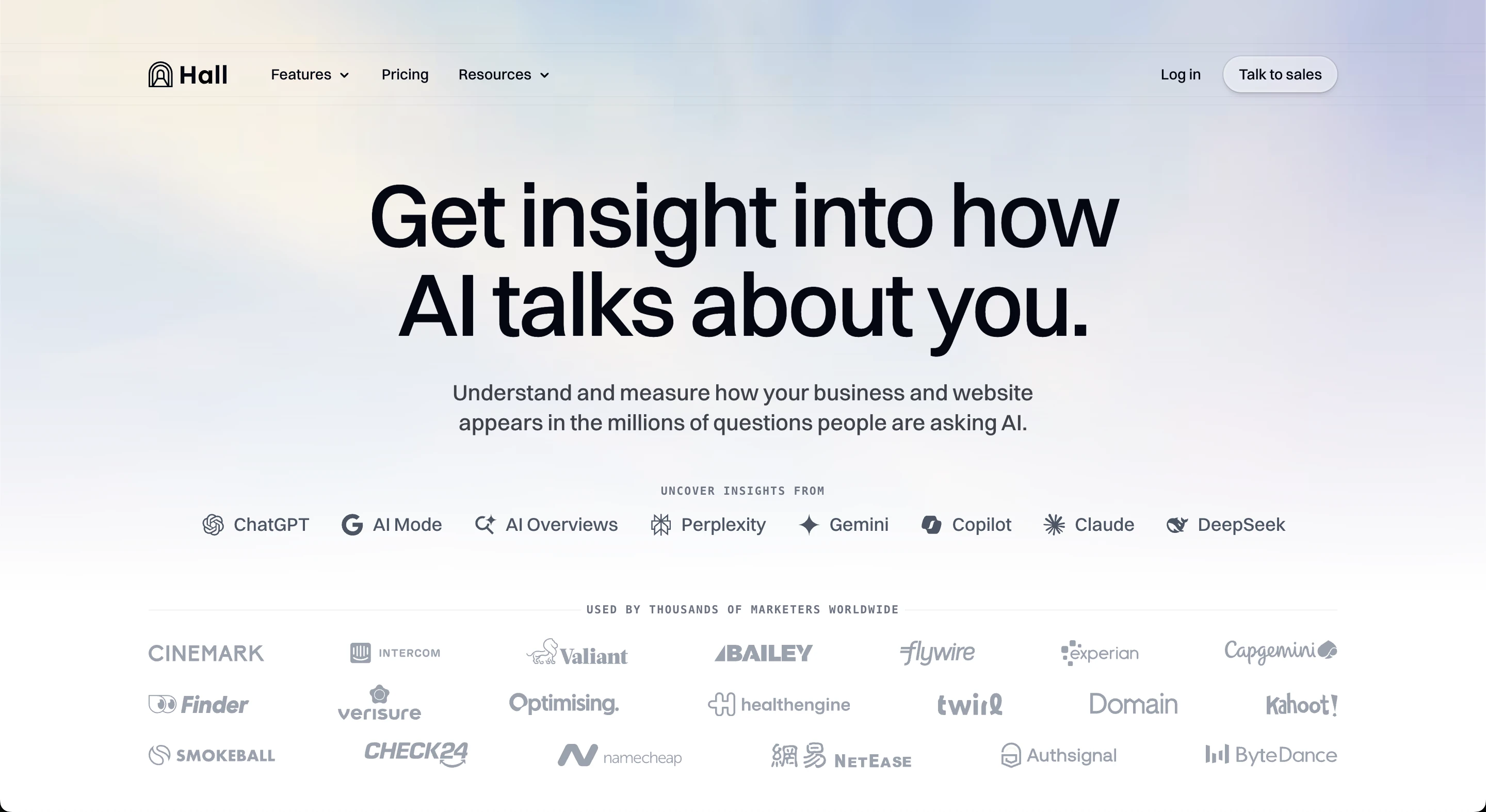
Hall AI's homepage, July 2026 — measuring how your business shows up across ChatGPT, Perplexity, Gemini, Copilot, Claude and more.
Key takeaways
- What it is: a citation-forensics-first AI-visibility platform — it shows the exact page and snippet the AI pulled from.
- Price: "Contact sales" on every tier — no public prices (third-party reports ~$199–$1,499+/mo); a historical free "Lite" tier exists behind signup.
- Engines: 9, including Meta AI (no Grok).
- Best for: enterprise and e-commerce teams that need forensic citation detail, big capacity, and ChatGPT-Shopping tracking.
- The catch: sales-gated, with no visible pricing or confirmable on-site free plan.
- Our score: 4.0/5.
The quick verdict
Hall AI is a deep, VC-backed GEO/AEO platform with the best citation forensics in the category — held back for most buyers by a sales-led model with no public pricing and no confirmable free plan on the site today. It tracks 9 engines (including Meta AI, which almost nobody else does), shows the exact page and snippet each AI cited, and follows your products into conversational-commerce answers. But you can't just put in a card and start: paid tiers route through "Contact sales," and the free "Lite" plan that third-party reviews describe isn't shown on Hall's own pricing page anymore.
- Buy it if: you're an enterprise or e-commerce team that needs forensic citation detail, ChatGPT-Shopping product tracking, and big capacity (45k–120k answers analyzed a month), and a sales call plus a custom quote is normal procurement for you.
- Skip it if: you're a solo founder or small team who wants to see a price, swipe a card, and start today — Hall's sales-led funnel and unpublished pricing make that hard (if a free, self-serve start is the blocker, FixAEO — ours — fills it; more below).
- Our score: 4.0/5 — the capabilities scorecard further down breaks down why.
What is Hall AI?
Hall AI (usehall.com) is a GEO/AEO visibility platform — Generative Engine Optimization / Answer Engine Optimization. In plain terms: it measures whether AI engines like ChatGPT, Perplexity, Gemini, and Google's AI answers mention and cite your brand when they answer questions in your space, and then it goes unusually deep on the why behind each citation.
The category exists because buyers increasingly ask an AI assistant for recommendations instead of scrolling Google's ten blue links — and those answers name a handful of brands rather than listing everyone. If you're not one of the named few, you're invisible, and a classic rankings report won't warn you. Tools like Hall exist to measure that new surface: are you in the answer, for the questions your buyers actually ask, and which of your pages earned the mention?
Hall's distinguishing quality is depth. Most trackers tell you whether you were cited; Hall tells you which page, in what context, and with what snippet the AI used. It's built by Hall Technologies Pty. Ltd. in Sydney, Australia, founded by Kai Forsyth (previously at Atlassian and Intercom), and it's a measurement platform — not a content generator or a classic SEO suite.
Hall AI at a glance
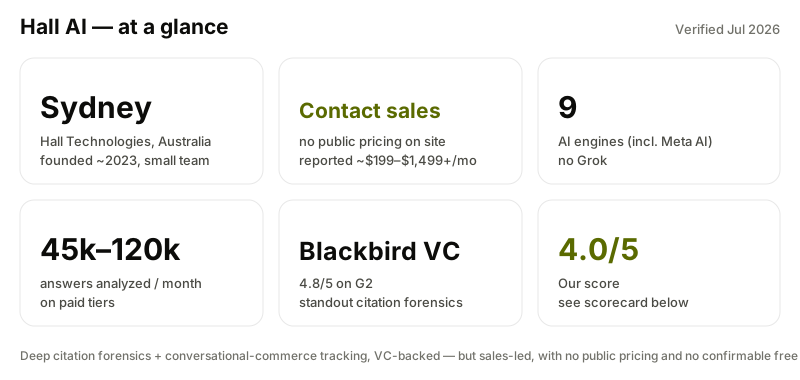
Hall's copyright reads "© 2023–2026," which implies it started around 2023, though the exact founding year and total funding amount aren't disclosed on its own site. What is clear: it's backed by Blackbird Ventures — described as Australia's largest VC with "$7B+ in assets under management" — carries a 4.8/5 on G2, and is run by a small team (around four people shown on the company page). So Hall is neither a weekend project nor a mega-corp: it's a credibly funded, focused startup with real institutional backing. Where it's exposed for most buyers is accessibility — the sales-led funnel and unpublished pricing — not the quality of the product.
What Hall AI does — the full feature set
Citation-context forensics
This is Hall's signature and the thing few rivals match. Beyond "you were cited," Hall shows the exact page the AI pulled from, the surrounding context, and the specific snippet the model used to build its answer. That turns a vague "we're not showing up" into an actionable "this competitor's comparison page won the citation, here's the paragraph the model quoted." If your job is to close citation gaps rather than just count them, this depth is the reason to look at Hall.
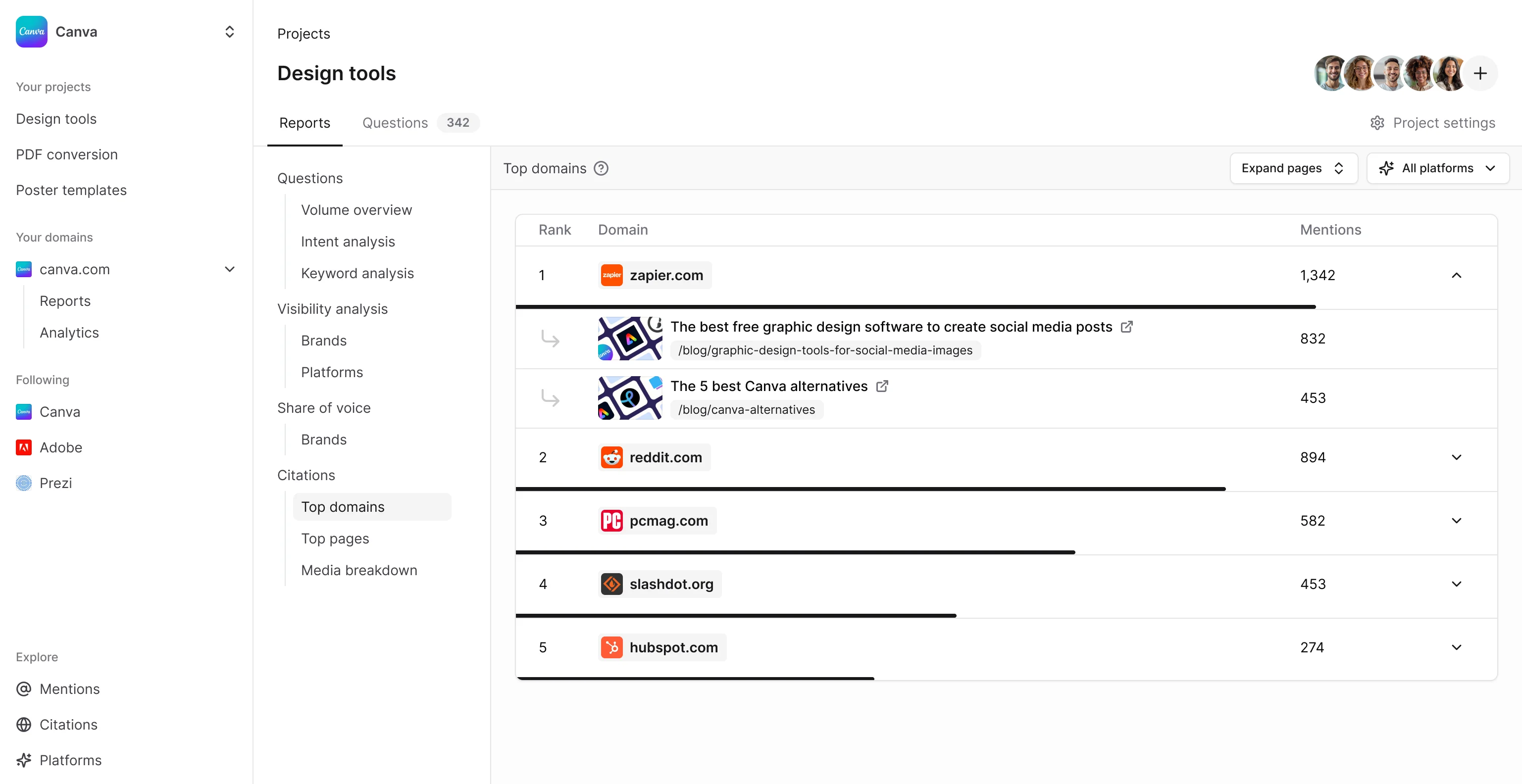
Hall's citation view — the domains and exact pages the models pulled from, drilled down to the prompts behind each citation.
Generative answer insights (mentions + sentiment)
Hall tracks how often your brand is mentioned across AI conversations and how it's described — the sentiment layer, not just a raw mention count. For brand and comms teams, that framing view is often the point: the difference between "are we mentioned" and "are we mentioned well."
Website citation insights
A page-level view of which of your URLs get referenced in AI answers, so you can see which content is actually earning you AI airtime and double down on it.
Agent analytics (AI crawler tracking)
Hall tracks how AI agents and crawlers interact with your site. Worth flagging honestly for anyone comparing tools: AI-crawler tracking is not a FixAEO-only feature — Hall has it too, so I won't pretend it's a point in our favor over Hall.
Conversational commerce
Hall tracks e-commerce / ChatGPT-Shopping product visibility — whether your products surface in the shopping-style answers the engines are rolling out. Very few tools in this category do this, and it's a genuine differentiator for retail and DTC brands. (FixAEO does not track this at all.)
Ranking and competitor visibility
Hall benchmarks you against a competitor set so you can see who the models default to recommending in your category, and who's gaining or losing that airtime over time.
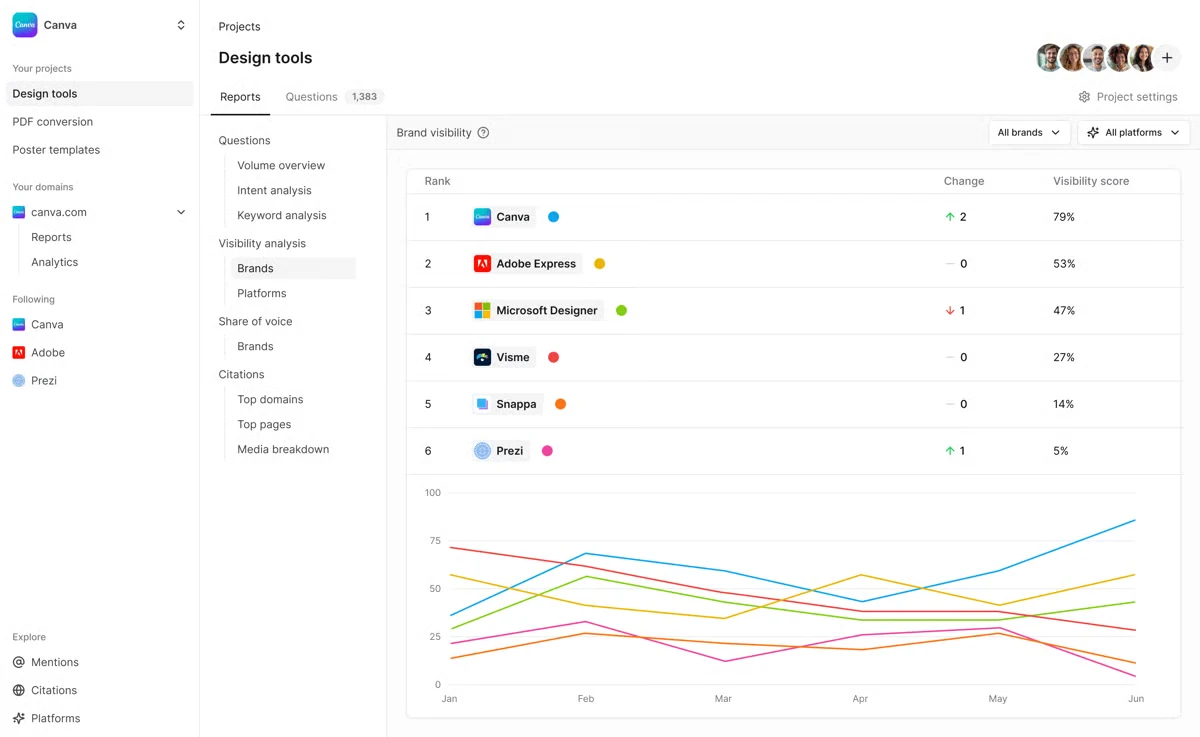
Hall's visibility ranking — where you sit versus competitors in AI answers, and who's gaining or losing airtime over time.
Reporting, access, and API
CSV export is available, paid tiers include unlimited viewers, and the Enterprise tier adds API access, enterprise-grade security, access management with an audit log, and unlimited historical data. One honest caveat: Hall is measurement-and-monitoring focused. I found no content generation, no classic Google rank tracking, and no first-party GA4/traffic or revenue attribution mentioned anywhere on the vendor site — so like most of the category, you'll pair it with other tools to actually act on the data. (Their site doesn't explicitly say those are absent; I'm inferring from what's documented.)
How Hall AI collects its data
Hall runs a tracked set of questions across the engines and rolls the results into trends, then layers its citation-forensics view on top. On paid tiers the data refreshes daily (the free Lite tier updates weekly, per third-party reviews). Capacity is one of Hall's real strengths: paid tiers analyze 45,000 to 120,000 answers per month across 20–50 projects, which is far more raw coverage than most self-serve trackers offer.
Hall doesn't publish its exact capture method, and the category splits here: some tools read model APIs, others capture what a logged-in user sees in the product UI, and those can differ. If that distinction matters for your category, put it to Hall directly — I couldn't verify their method from public pages, so I won't assert one.
Setting up Hall AI
Because Hall now leads with a sales motion, setup starts with a conversation rather than a self-serve checkout. Roughly what it looks like:
- Talk to sales (or log in, if you already have access) — the homepage CTAs are "Talk to sales" and "Log in," not "Start free."
- Create a project for your brand and domain.
- Add your tracked questions — the buyer queries you want to monitor (25 on the reported free tier, up to 500–1,000 on paid).
- Add competitors to benchmark against.
- Let it run — Hall populates mentions, sentiment, cited pages, the snippet-level citation context, and (for e-commerce) product visibility, refreshing daily on paid tiers.
- Report out — read the dashboard, export CSV, and add viewers (unlimited on paid) for stakeholders.
The product itself is well-regarded (that 4.8/5 G2 rating isn't nothing), but the access path is the friction: there's no "see a price, swipe a card, go" flow the way there is with self-serve tools.
Which AI engines Hall AI tracks
Hall confirms 9 engines on its own homepage and pricing page. Here's the full list, with the one notable gap:
| AI engine | Tracked by Hall? |
|---|---|
| ChatGPT | Yes |
| Perplexity | Yes |
| Google AI Overviews | Yes |
| Google AI Mode | Yes |
| Gemini | Yes |
| Microsoft Copilot | Yes |
| Claude | Yes |
| DeepSeek | Yes |
| Meta AI | Yes — few rivals cover this |
| Grok | No — not covered |
Two things to internalize. First, Hall tracks Meta AI, which is genuinely rare — most competitors (FixAEO included) don't. Second, Hall does not track Grok, which FixAEO does. So both tools land at 9 engines with different rosters; neither strictly "tracks more" than the other. Hall's site does not break engines out per tier or list any per-engine add-ons. Third-party reviews say the free Lite tier is limited to just ChatGPT + Perplexity + Google AI Overviews (3 engines) — but that per-tier split is not confirmable on Hall's own site, so treat it as reported.
Hall AI pricing
Here's the honest headline: Hall does not publish prices. The pricing page's title still reads "Free Generative Engine Optimization (GEO) platform tool," but the page itself shows three plans — Starter, Business, Enterprise — every one marked "Contact sales," with no dollar amounts and no free-plan card. The dollar figures below come only from third-party 2026 reviews and may be stale; the caps for the paid tiers are vendor-confirmed from the pricing page (verified 2026-07-19).
| Plan | Price (vendor site) | Projects | Tracked questions | Answers analyzed/mo | Updates | Reported price* |
|---|---|---|---|---|---|---|
| Lite (free) * | not shown on site | 1* | 25* | 300* | weekly* | Free* |
| Starter | Contact sales | 20 | 500 | 45,000 | daily | ~$199/mo* |
| Business | Contact sales | 50 | 1,000 | 120,000 | daily | ~$499–599/mo* |
| Enterprise | Contact sales | custom | custom | custom | daily | ~$1,499+/mo* |
* Everything marked with an asterisk is third-party or reported, not confirmed on Hall's site. The entire Lite (free) row is described by 2026 reviews (rankability, tryanalyze, scalevisible, geoscout) but is not displayed on Hall's current pricing page. The paid-tier project/question/answer caps and the daily-update cadence are vendor-confirmed; the dollar prices are not.
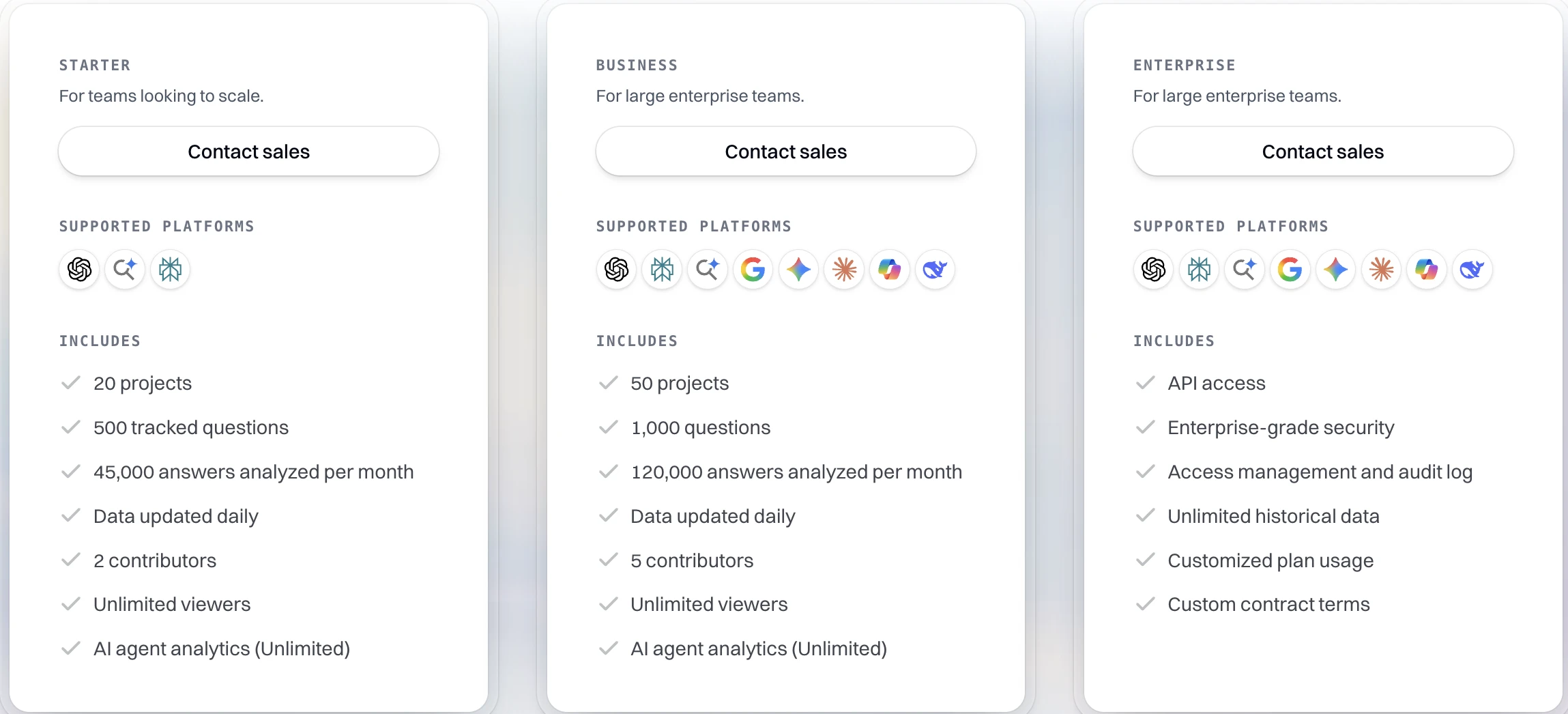
Hall's pricing page, July 2026 — every tier is "Contact sales"; the caps are shown, the prices are not.
A few honest notes:
- No prices are shown. Every paid tier is "Contact sales." If a published, predictable price is important to you, that's a real friction with Hall today.
- The free "Lite" tier is ambiguous. Hall has historically offered a permanent free tier (third-party caps: 1 project, 25 tracked questions, 300 answers/mo, weekly updates, 1 contributor + unlimited viewers, no credit card, ~3 months history, 60 days of agent analytics, 3 engines). It likely still exists behind signup — but it is not presented or confirmable on the vendor's own pricing page as of 2026-07-19, which now leads with sales-only paid tiers.
- Enterprise unlocks the governance layer — API access, enterprise security, access management with an audit log, unlimited historical data, and custom contract terms.
- An annual discount (our older post cited ~16%) is not shown on the current pricing page — treat it as unverified.
Because Hall's free tier has existed historically, I won't claim any tool's free plan is "unique" here — but I also can't hand you Hall's free terms as a live on-site fact. Both caveats matter.
Hall AI capabilities, scored
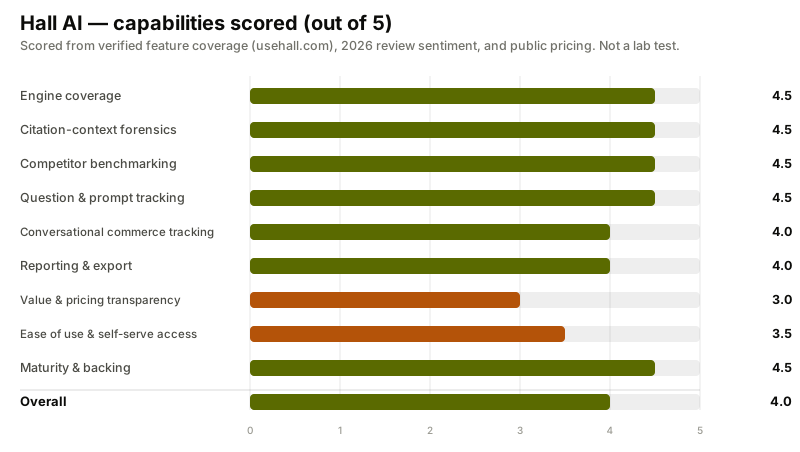
The scores above come from verified feature coverage on usehall.com, its company page, and 2026 review sentiment — not a lab benchmark, and I've shown the rubric so you can argue with it. The shape is clear: Hall is excellent on citation depth and coverage, and weakest on pricing transparency and self-serve access — the "Contact sales" wall and unpublished prices are what drag the number down.
Two scores deserve a word. Citation-context forensics (4.5) is Hall's signature — the deepest citation view in the category. Value and pricing transparency (3.0) is the drag: you genuinely cannot see what it costs, and there's no confirmable free plan on the site. Ease of use and self-serve access (3.5) reflects the sales-led funnel — the product is well-rated, but you can't self-serve your way in.
Hall AI pros
- The deepest citation forensics in the category — the exact page, context, and snippet the AI used, not just a mention count.
- 9 engines including Meta AI — a surface almost no other tracker covers.
- Conversational commerce / ChatGPT-Shopping tracking — rare, and a real edge for e-commerce and DTC brands.
- Big capacity — 45k–120k answers analyzed per month across 20–50 projects, with unlimited viewers on paid tiers.
- AI-crawler / agent analytics — see how AI bots interact with your site.
- Daily data refresh on paid tiers — no waiting a week between updates.
- Genuinely funded and well-reviewed — Blackbird Ventures backing and a 4.8/5 on G2. Low roadmap risk.
- Enterprise governance — API, enterprise security, access management with audit log, unlimited history.
Hall AI cons
- No public pricing — every paid tier is "Contact sales," with no dollar amounts on the site.
- No confirmable free tier on the site today — the historical free "Lite" plan isn't shown on the current pricing page.
- No self-serve — you can't swipe a card and start; it's a sales conversation first.
- No Grok — Hall covers 9 engines, but Grok isn't one of them.
- Monitoring-only — no content generation, no classic rank tracking, and (as far as the site documents) no GA4/traffic or revenue attribution to prove AI visibility turned into clicks.
- Data-retention caps — the free tier reportedly keeps ~3 months of history; a long baseline lives on the paid tiers.
- MCP, GSC, and Looker Studio are unconfirmed — none are mentioned on the current vendor site (our older post claimed Looker on Business+; I can't verify that today).
Who Hall AI is for — and who should skip it
Enterprises are the sweet spot. If you need forensic citation detail, conversational-commerce tracking, API access, enterprise security, an audit log, and unlimited history — and a sales call plus a custom quote is normal for you — Hall is built for exactly this. The capacity (45k–120k answers/mo, 20–50 projects) is enterprise-grade.
Agencies are a strong fit too: 20–50 projects with unlimited viewers covers a real client roster, and the "Contact sales" motion suits agency procurement. The catch is that unpublished pricing makes it hard to model per-client margin up front — get the quote before you pitch it to clients.
Startups and small teams are a mixed bag. The depth is appealing, but the jump from a hard-to-find free tier to a sales call for the paid plans is friction when you just want to test whether AI search moves your numbers. Many will want to prove the value on a cheaper, self-serve tool first. FixAEO's Lite ($29/mo) and Growth ($79/mo) tiers are built for exactly that self-serve middle (disclosure: that's us; more below).
Solo founders and indie marketers should mostly skip Hall for now — sales-led onboarding and no visible price are the opposite of what a solo buyer wants. Start with a free, self-serve tool, and only move to Hall if and when its citation depth or e-commerce tracking becomes the specific thing you're missing.
Hall AI vs the alternatives
Hall sits in the deep, enterprise-leaning lane: more forensic than the scrappy trackers, more sales-led than the self-serve ones. Rough entry pricing, mid-2026 (verify each on the vendor's page; see best AEO tools for the full field):
| Tool | Entry price | Free option | Engines (entry tier) | Best for |
|---|---|---|---|---|
| Hall AI | Contact sales (reported ~$199+/mo) | historical free "Lite" (not on-site now) | 9 (incl. Meta AI; no Grok) | enterprise citation forensics + e-commerce |
| FixAEO (us) | Free + from $29/mo | permanent free scan | 6 on Lite (9 on Enterprise) | self-serve SMBs & founders |
| Profound | from $99/mo | none | 1–10 by tier | enterprise demand data |
| AthenaHQ | ~$295/mo | capped free tier | 8–9 | enterprise governance + BI |
| Scrunch AI | ~$300/mo (est.) | none | multi-engine | enterprise brand monitoring |
A quick lane-by-lane read:
- vs FixAEO (us): we're free to start and self-serve from $29/mo, with published prices and a card-and-go checkout — the exact opposite of Hall's sales-led funnel. Our Lite plan covers 6 mainstream engines (ChatGPT, Gemini, Perplexity, Copilot, Google AI Overviews, Google AI Mode), and our full roster reaches 9 on Enterprise (adding Claude, Grok, DeepSeek). Where Hall clearly pulls ahead: citation-context forensics (the snippet-level detail), Meta AI coverage, conversational-commerce / ChatGPT-Shopping tracking, far larger paid capacity, and institutional backing. Honest symmetry: both of us track AI crawlers, so that's not a FixAEO edge; and both have offered a free tier, so neither's is "unique." Disclosure applies — I build FixAEO.
- vs Profound: both lean upmarket. Profound's edge is real AI-conversation demand data (Prompt Volume); Hall's is citation depth. Both gate their best features to higher tiers. See our Profound alternatives breakdown.
- vs AthenaHQ: the closest enterprise-governance comparison — SOC 2, SSO, BI connectors, published pricing from ~$295/mo. If procurement needs a security review and you want to see a price, AthenaHQ is the lane; see AthenaHQ alternatives.
- vs Scrunch AI: another enterprise brand-monitoring option at a similar tier; neither publishes cheap self-serve pricing. Read our Scrunch AI review for the head-to-head.
The honest read: if forensic citation depth and e-commerce tracking are what you're buying, Hall is genuinely differentiated. If you want to start free, see a price, and self-serve, we (FixAEO) and a few others fit better. See our full Hall AI alternatives guide for the wider field.
Hall AI vs FixAEO — the honest head-to-head
Since I build FixAEO, here's the straight comparison (disclosure applies):
| Hall AI | FixAEO (us) | |
|---|---|---|
| Entry price | "Contact sales" (reported ~$199+/mo) | Free, then $29/mo |
| Free tier | Historical "Lite," not shown on-site | Yes — 1 Gemini scan/day + 22 free tools |
| Engines (entry paid) | 9 (incl. Meta AI, no Grok) | 6 on Lite (9 on Enterprise) |
| Best for | enterprise & e-commerce, citation forensics | self-serve SMBs & founders |
| Standout | citation-context forensics, ChatGPT-Shopping, capacity | transparent price, real-browser + geo-aware capture, MCP server |
Hall wins on citation-context depth, raw capacity, ChatGPT-Shopping tracking, and — at its paid entry — more engines than our Lite plan. FixAEO wins on transparent, self-serve pricing and a genuine free start (Hall makes you talk to sales). If forensic citation detail is the job, Hall is strong; if you want to see a price and start free today, we fit better. See our Hall AI alternatives for the wider field.
If you'd rather start free (disclosure: that's us)
I'll be straight, since I flagged it up top: FixAEO is our tool, so weigh this accordingly. But if the thing keeping you off Hall is the "Contact sales" wall and not being able to see a price, that's exactly the gap we built for. FixAEO runs a free scan — no signup, about 60 seconds — so you can find out whether AI search even moves the needle for your brand before you talk to anyone. Paid Lite is $29/mo ($25 annual) and covers 6 mainstream engines with no add-ons; Growth is $79/mo ($68 annual) with the same 6 engines plus daily rescans, 5 brands, and 50 tracked prompts. All prices are published; checkout is self-serve.
A couple of honest edges beyond price: FixAEO ties GA4 attribution to AI-referral traffic and integrates Google Search Console, so you can connect visibility to actual clicks and revenue — Hall appears monitoring-only on this (inferred from its site, not vendor-confirmed). We also ship an MCP server on the $29 plan, letting you query your AI-visibility data straight from Claude, Cursor, or ChatGPT — Hall doesn't mention an MCP server anywhere, though MCP is not unique in the category (Peec, Profound, and Otterly have one too). And we read answers through real browser sessions on residential IPs, with location-aware tracking by region and a Chrome extension for spot-checks.
Where Hall is genuinely stronger, in fairness: citation-context forensics (it shows the exact snippet; we report where you appear, not that forensic detail), Meta AI coverage, conversational-commerce tracking, much larger paid capacity, and institutional maturity (Blackbird backing, 4.8/5 G2). We also concede data cadence at the entry paid tier: Hall Starter refreshes daily, while FixAEO Lite rescans every 72 hours — we only match daily on Growth and up. If that depth and capacity are your priorities, Hall earns its (unpublished) price. If a free, self-serve start with published pricing matters more, run a free scan and judge for yourself.
Do you need Hall's citation depth, or a lighter option?
Fair question before you book a sales call. Hall is built for teams that need to know not just that they're missing from AI answers but which competitor page won the citation and what snippet the model used — and for e-commerce brands that need product visibility in shopping answers. If that's you, the depth earns the price. But if AI visibility is something you check monthly to steer content, a lighter or free-first tool covers the same core job (are we in the answer, for the questions our buyers ask) without a sales conversation. The honest distinction isn't quality — Hall is a good product — it's fit: pay for the forensic depth and capacity if you'll use them; don't if you won't. That's true of Hall and, honestly, of us.
Is Hall AI worth it? The verdict
Buy it if you're an enterprise or e-commerce team that needs forensic citation detail, ChatGPT-Shopping product tracking, big capacity, and enterprise governance — and a sales call plus a custom quote is normal procurement. It's genuinely differentiated on depth, and my score reflects that (4.0/5).
Skip it if you're a solo founder or small team who wants to see a price, swipe a card, and start today. The sales-led funnel, unpublished pricing, and the missing free plan on the site are real friction for the smaller, self-serve buyer.
Hall is a well-built, well-backed product whose main catch is accessibility, not capability: the "Contact sales" wall and lack of visible pricing put it out of easy reach for the founders and small teams who make up most of this market. For enterprises and e-commerce brands that need the depth, it's a strong recommendation; for everyone else, start with a free, self-serve tool and move up to Hall if and when its forensic depth becomes the thing you're missing.
How I researched this
No sponsorship, no affiliate link. I verified Hall's features, engine list, and pricing shape against its own pages — the homepage, pricing, and company pages — on 2026-07-19. Hall publishes no prices, so every dollar figure here comes from third-party 2026 reviews (rankability.com, tryanalyze.ai, scalevisible.com, geoscout.pro) and is flagged as reported; the paid-tier project/question/answer caps and daily cadence are vendor-confirmed, the prices are not. The free "Lite" tier and its caps are third-party, not on Hall's current pricing page. Founding year and total funding aren't disclosed on Hall's site, so I've labeled those as reported too. Where I couldn't confirm something — the data-capture method, MCP, GSC, GA4, Looker Studio — I said so rather than assert it. And I build a competing tool, which is disclosed above.
FAQ
What is Hall AI?
Hall AI is a GEO/AEO (Generative/Answer Engine Optimization) visibility platform. It measures how often your brand is mentioned and cited across AI answer engines like ChatGPT, Perplexity, Gemini, and Google's AI answers, and goes unusually deep — showing the exact page, context, and snippet each AI used. It also tracks competitors, AI crawlers, and e-commerce product visibility in shopping-style answers.
How much does Hall AI cost?
Hall doesn't publish prices. Its pricing page shows three plans — Starter, Business, and Enterprise — all marked "Contact sales," with no dollar amounts. Third-party 2026 reviews report roughly $199/mo (Starter), ~$499–599/mo (Business), and ~$1,499+/mo (Enterprise), but none of those figures appear on Hall's own site. The vendor-confirmed caps are 20–50 projects, 500–1,000 tracked questions, and 45,000–120,000 answers analyzed per month on the paid tiers.
Does Hall AI have a free plan?
It's ambiguous today. Hall has historically offered a permanent free "Lite" tier (reportedly 1 project, 25 tracked questions, 300 answers/mo, weekly updates, no credit card, 3 engines), and it likely still exists behind signup. But that free plan is not shown on Hall's current pricing page as of 2026-07-19 — the page displays only sales-led paid tiers. So Hall probably still has a free option, but you can't confirm it or its terms on the vendor site.
How many AI engines does Hall AI track?
Nine, confirmed on Hall's own site: ChatGPT, Google AI Mode, Google AI Overviews, Perplexity, Gemini, Copilot, Claude, DeepSeek, and Meta AI. Hall does not break these out per tier, and third-party reviews say the free Lite tier is limited to just 3 (ChatGPT, Perplexity, Google AI Overviews) — but that split isn't confirmable on the vendor site.
Does Hall AI track Grok?
No. Hall covers 9 engines, but Grok isn't one of them. It's the one notable gap in an otherwise broad roster. (For the record, FixAEO — our tool — does track Grok, but only on its Enterprise tier; Hall, in turn, tracks Meta AI, which FixAEO doesn't. Both land at 9 engines with different rosters.)
Does Hall AI track Meta AI?
Yes — and that's rare. Meta AI is one of the 9 engines Hall confirms on its site, and very few competitors cover it. If Meta AI visibility is on your must-have list, that's a real point in Hall's favor.
What makes Hall AI different from other AEO tools?
Its citation-context forensics. Most trackers tell you whether you were cited; Hall shows which page the AI pulled from, the surrounding context, and the exact snippet it used. Add Meta AI coverage and conversational-commerce (ChatGPT-Shopping) tracking, and Hall is one of the deepest tools in the category — which is why it fits enterprise and e-commerce buyers best.
Does Hall AI have GA4, traffic, or GSC integration?
Not that I could find. Hall's site documents AI-visibility monitoring, citation forensics, competitor tracking, and agent analytics — but no GA4/traffic attribution, revenue tie, or Google Search Console integration are mentioned. It appears to be monitoring-only, so you can't (from the site) connect AI visibility to actual clicks or revenue inside Hall. That's inferred from the documentation, not a vendor confirmation. (FixAEO does offer GA4 attribution and GSC integration on paid tiers.)
Does Hall AI have an MCP server?
Not that's documented. There's no mention of an MCP server anywhere on Hall's site, so I can't confirm one exists. MCP isn't unique in the category, though — FixAEO (on its $29 plan), Peec, Profound, and Otterly all offer one. If querying your visibility data from Claude or Cursor matters, confirm with Hall directly before buying.
Is Hall AI worth it?
For enterprise and e-commerce teams that need forensic citation detail, ChatGPT-Shopping tracking, big capacity, and enterprise governance — yes, it's one of the deepest tools in the category, and we scored it 4.0/5. For solo founders and small teams who want a visible price and self-serve checkout, the "Contact sales" model and lack of an on-site free plan make it hard to justify over a free-first, self-serve alternative.
What are the best Hall AI alternatives?
Depends on the lane: FixAEO (free to start, published pricing, 6 engines on Lite at $29/mo, self-serve) for the affordable self-serve middle; Profound for real AI-conversation demand data; AthenaHQ for enterprise governance with published pricing; Scrunch AI for enterprise brand monitoring. See our full Hall AI alternatives comparison for the head-to-heads.
Hall AI vs FixAEO — which should I pick?
Different buyers. Hall is the deep, VC-backed, sales-led option: 9 engines (including Meta AI, no Grok), forensic citation detail, conversational-commerce tracking, and big capacity — but no public pricing and no on-site free plan. FixAEO (ours) is free to start and self-serve from $29/mo, with published prices, GA4 attribution, GSC integration, and an MCP server on the paid plan; its Lite tier covers 6 mainstream engines (all 9 on Enterprise, adding Claude, Grok, DeepSeek). Pick Hall for citation depth, Meta AI, e-commerce tracking, and enterprise capacity; pick FixAEO to see a price, start free, and self-serve. Both track AI crawlers, and both have offered a free tier, so neither wins on those.
Related reading
8 Best Hall AI Alternatives for AI Search Visibility (2026)
8 Hall AI alternatives compared on price, engine coverage, and free tiers. An honest buyer's guide that fills Hall's free-to-$199 gap.
19 min read9 Best AthenaHQ Alternatives in 2026 (Tested & Priced)
9 AthenaHQ alternatives compared on engines, price, and free tiers — honest picks by budget. Most cost a fraction of AthenaHQ's $295/mo for real multi-engine use.
18 min read7 Best Profound Alternatives & Competitors in 2026
7 Profound alternatives compared on price, engine coverage, and free tiers — an honest buyer's guide for teams priced out of enterprise AEO.
20 min read12 Best Answer Engine Optimization Tools (2026)
12 answer engine optimization tools compared — engines covered, entry price, free tier — with honest takes on which to pick by stage and budget.
19 min readWhat is AEO? Answer Engine Optimization explained
Answer Engine Optimization (AEO) means getting AI assistants to recommend your brand. Learn what AEO is, why it matters more than SEO, and how to start.
18 min read
Free AEO tools
Put this into practice with free FixAEO tools — no signup required.
AI Visibility Checker
Score your brand across 9 AI engines
AEO Audit Tool
Answer-engine readiness scan
Schema Generator
Build valid JSON-LD structured data
llms.txt Generator
Create a spec-compliant llms.txt
Sitemap Validator
Check your XML sitemap for errors
AI Content Grader
Grade content for AI citation readiness