Peec AI Review: Pricing, Limits & Who It Fits (2026)
An independent Peec AI review covering pricing, its 3-model self-serve limit, 13-model Enterprise coverage, new reporting tools, pros, cons, and best-fit teams.

On this page
Peec AI is one of the most polished names in AI-search visibility — Series A funded, used by thousands of marketing teams, and genuinely nice to use. It's also one of the pricier ways in: $95/month minimum, no free tier, and a three-model cap on every plan below Enterprise that quietly pushes real costs higher. This review is the honest version: what Peec actually does, what it costs in 2026, where it's excellent, where it isn't, and who should look elsewhere.
Disclosure: I build FixAEO, a free-to-start AEO tool that competes with Peec. So read this knowing that — I'll point out plainly where Peec beats us (it does, in a few places). Prices, product features, limits, and model coverage were rechecked against Peec's own live pricing page on 2026-09-13.
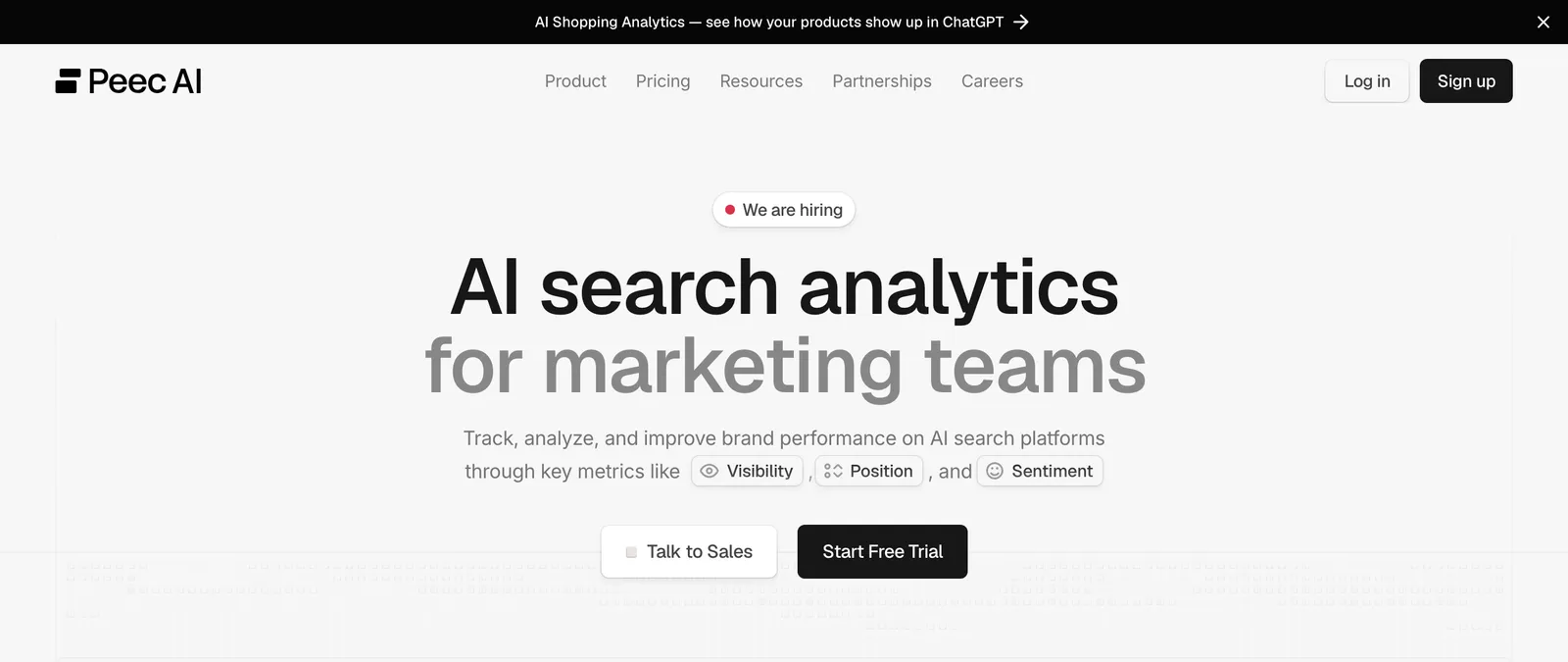
Peec AI's homepage, July 2026 — the pitch is clean, BI-style analytics for how your brand shows up in AI answers.
Key takeaways
- What it is: a polished, Series-A-funded AI-visibility tracker built for marketing teams.
- Price: from $95/mo (Starter); no free tier; 15% off annual.
- Engines: 6 mainstream models, choose 3 per self-serve tier (up to 13 on Enterprise) — extra self-serve models are paid add-ons.
- Best for: funded marketing teams and agencies that want daily data and Looker reporting.
- The catch: no free tier and a three-of-six model cap, so real coverage costs more than the sticker.
- Our score: 4.1/5.
The quick verdict
Peec AI is a polished, well-funded AI-visibility tracker that marketing teams genuinely enjoy using — held back mainly by price and a three-model entry cap. For $95/month (Starter) you get 50 tracked prompts, a clean dashboard, competitor benchmarking, citation analysis, and daily tracking — but only three of the six mainstream models, with each extra model an add-on. It's an easy recommendation for funded teams that value polish and want their numbers in Looker Studio.
- Buy it if: you're a funded marketing team or agency that wants a mature, good-looking tracker with BI export, and the budget isn't the constraint.
- Skip it if: you're a solo founder or small team, you want a permanent free tier, or the three-of-six model cap and per-model add-ons don't fit your budget (if a free start is what's stopping you, FixAEO — ours — is the free-first alternative; more below).
- Our score: 4.1/5 — the capabilities scorecard below breaks down why.
Now the full review.
What is Peec AI?
Peec AI (peec.ai) is an AI search analytics platform — the category people call AEO (Answer Engine Optimization) or GEO (Generative Engine Optimization). In plain terms: it measures how often your brand is mentioned, cited, and recommended when tools like ChatGPT, Gemini, and Perplexity answer questions in your space, and benchmarks that against competitors.
The category exists because search is splitting. More buyers now ask ChatGPT, Gemini, or Perplexity for recommendations instead of scrolling Google's ten blue links — and those answers name a handful of brands rather than listing everyone. If you're not one of the named few, you're invisible, and a traditional rankings report won't warn you, because AI answers don't map neatly to positions. Tools like Peec exist to measure that new surface: are you in the answer, for the questions your buyers actually ask?
Peec's distinguishing quality is polish and focus. Where some tools bury you in features, Peec keeps a deliberately simple loop: set up your prompts, watch your visibility, act on the top citations. That restraint is a real selling point — reviewers repeatedly praise how quickly a non-technical marketer can read the dashboard. It's a measurement-and-reporting tool, not a content generator or a rank tracker.
Peec AI at a glance
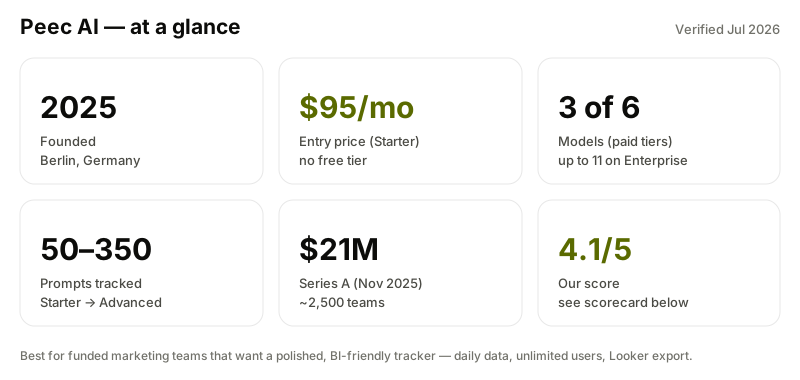
Founded in 2025 in Berlin and spun out of Antler's Berlin cohort, Peec is led by co-founders Marius Meiners, Tobias Siwonia, and Daniel Drabo. It's raised fast — a €7M seed followed by a $21M Series A in November 2025 at a reported ~$100M valuation — and now says it's trusted by 3,000+ brands and agencies, with named SEO voices (Lily Ray among them) endorsing it. So unlike a lot of tools in this space, Peec is neither young nor scrappy: it's a funded, fast-scaling company with a real brand in the SEO community. Where it's exposed is pricing accessibility, not maturity.
What Peec AI does — the full feature set
Prompt tracking and Share of Voice
The core loop is prompt-based. You add the prompts your buyers actually ask ("best CRM for startups," "Notion alternatives"), Peec runs them across your chosen models on a daily cadence, and reports how often you're named, your position versus rivals, and a visibility trend over time. Prompts are the unit you buy — 50 on Starter, 150 on Pro, 350 on Advanced — and they can be shared across projects and brands in your account, which is a nice touch for teams juggling several.
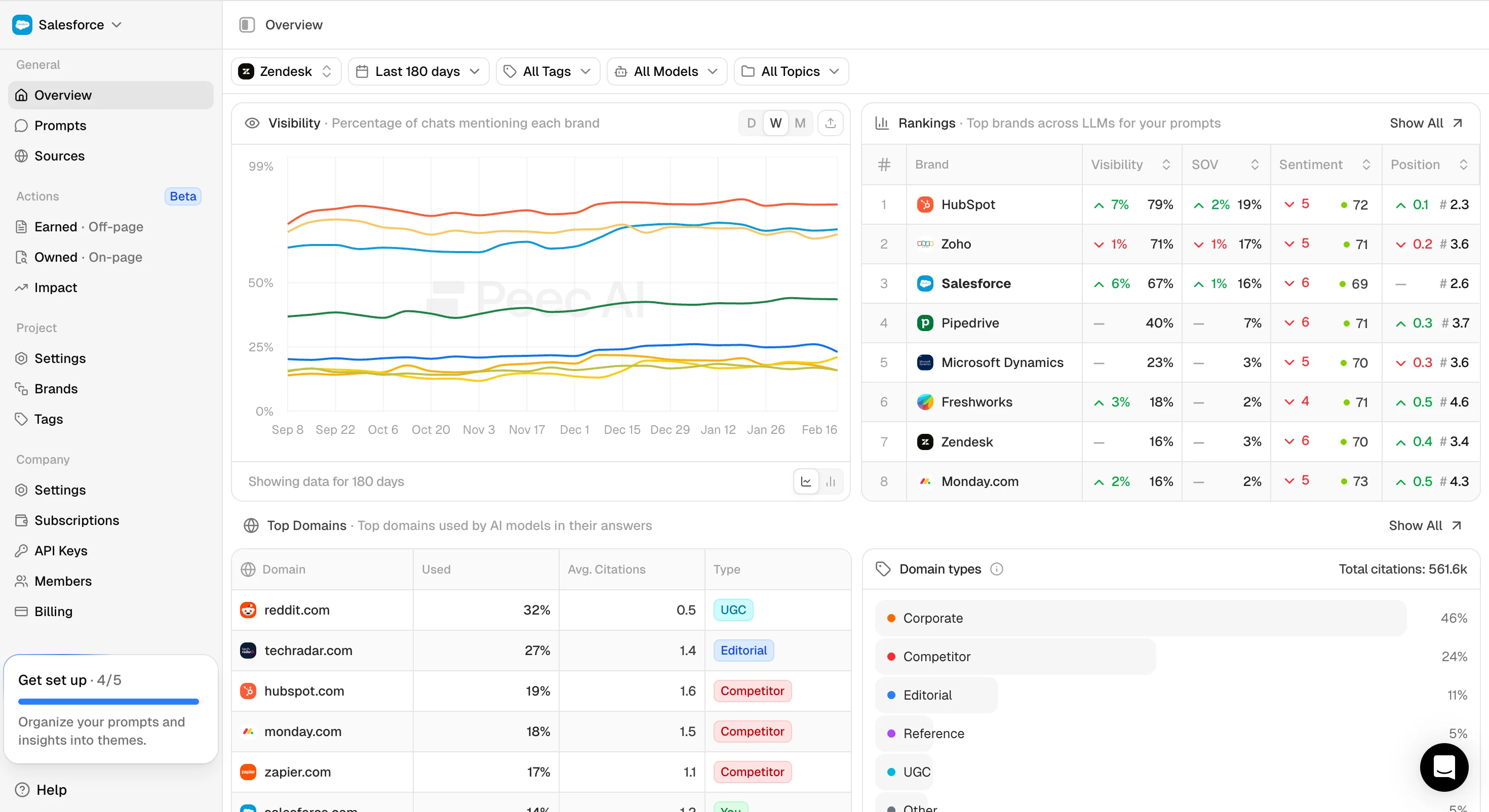
Peec's Overview — Share of Voice and per-competitor rankings in one clean view (Peec's own example data).
Competitor benchmarking
Define a competitor set and Peec shows who the models default to recommending in your category, who's gaining, and who's losing. This is where a tool like this earns its keep for positioning work — you can see, per topic, exactly which rival owns the AI airtime you want, then go close that gap. Peec's version is clean and legible, which matters when you're putting it in front of a client or an exec.
Citation and source analysis
Peec tracks the domains the AI leans on to build its answers and surfaces your top citations. That's the practical heart of AEO: the models assemble answers from third-party pages far more than from your own site, so knowing which sources they trust in your category tells you where to go earn a mention — a Reddit thread, a review roundup, an industry publication — rather than guessing. Peec's stated philosophy is to keep this focused: "see your AI visibility, act on top citations," without drowning you in secondary metrics.
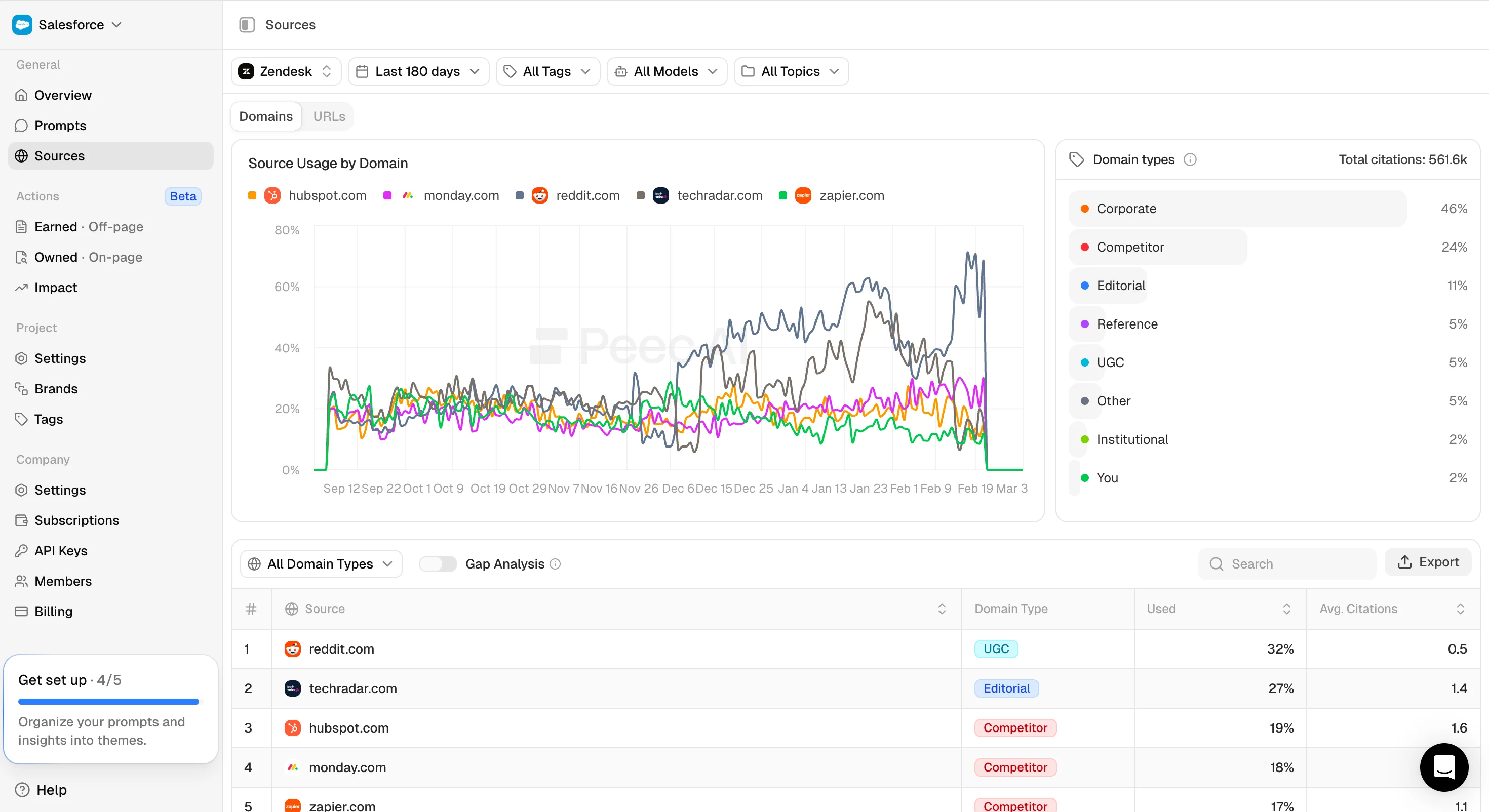
Peec's Sources view — the domains the models lean on, ranked by usage and average citations, so you know where to earn a mention.
Sentiment and brand perception
Beyond presence, Peec tracks how your brand is described in AI answers — the perception layer, not just the mention count. For brand and comms teams (Peec explicitly courts "SEO comms" roles), that framing view is often the point: it's the difference between "are we mentioned" and "are we mentioned well."
BI export and Looker Studio
Peec is built to feed a reporting stack. Looker Studio integration lands on the Advanced tier, and API access arrives at Enterprise, so agencies and in-house teams can pipe visibility numbers into the dashboards leadership already reads. If your job involves monthly reporting to stakeholders, this is a genuine strength — Peec treats reporting as a first-class feature, not an afterthought.
AI Shopping, actions, and traffic reporting
Peec now lists AI Shopping with product-catalog imports, SKU-level visibility, merchant reporting, shopping query fan-outs, and shopping-source visibility. It also goes further than the July version of this review reflected: gap analysis, ranked recommended actions, agent-generated actions, visibility-lift reporting, and a crawlability audit are all on the current feature grid.
The old version of this review said Peec had no first-party traffic attribution. That is no longer accurate. Peec now advertises AI referrals from assistants, AI-bot crawl insights, Google Analytics integration, and CDN/log-provider connections. It still is not a classic Google rank tracker or a general-purpose content generator, but it now covers more of the path from diagnosis to action and reporting.
How Peec AI collects its data
Peec runs your prompts across the engines on a daily cadence (every paid tier, which is genuinely good — some rivals refresh weekly) and rolls the results into trend lines. It doesn't publish its exact capture method in fine detail, and the category splits on this: some tools read model APIs, others capture what a logged-in user actually sees in the product UI. Those can differ — an API response isn't always identical to the answer a real person gets in ChatGPT or Perplexity. If that distinction matters for your category, it's a fair question to put to Peec directly before you buy; I couldn't fully verify their method from public pages, so I won't assert one.
What's clearly strong: daily tracking on every tier, multi-country coverage from Pro up (and unlimited regions at Enterprise, at no per-region charge), and a "one chat result per model per prompt" accounting that Peec explains plainly in its own FAQ.
Setting up Peec AI: what using it actually looks like
Peec's setup is deliberately gentle — this is one of its best qualities:
- Create your project with your brand and domain.
- Choose your models — you pick 3 from the six available (ChatGPT, Google AI Mode, Google AI Overviews, Copilot, Perplexity, Gemini) during onboarding.
- Add your prompts — the buyer questions you want to track. Peec shares your prompt allowance across projects, so you can split it between brands.
- Add competitors to benchmark against.
- Let it run daily. Peec populates your Share of Voice, position, sentiment, and cited sources, and refreshes them every day.
- Report out — read the dashboard, or (on Advanced+) pipe it into Looker Studio for stakeholders.
The learning curve is the lightest in the category — that's the whole design philosophy, and it holds up. The friction is entirely at the pricing edges, not the product: the three-model choice forces a trade-off on day one, and the prompt allowance fills faster than you'd expect once you add competitors and topics.
Which AI engines Peec AI tracks
Here's where the nuance lives, so read carefully. Peec offers six mainstream models, and on Starter, Pro, and Advanced you choose three of them:
| Tier | Models you get |
|---|---|
| Starter / Pro / Advanced | Choose 3 of: ChatGPT, Google AI Mode, Google AI Overviews, Microsoft Copilot, Perplexity, Gemini |
| Enterprise | Up to 13 — the six above plus Claude Sonnet 4, GPT-5 Search, Grok, DeepSeek, Qwen, Mistral, and Meta Spark (several via API) |
Two things to internalize. First, Claude, Grok, DeepSeek, Qwen, Mistral, and Meta Spark are Enterprise-only — Peec's current pricing grid does not offer them as self-serve add-ons. Second, even the six mainstream self-serve options are capped at three per plan unless you pay for additional-model add-ons: $35/mo each on Starter, $85/mo on Pro, $165/mo on Advanced. So "full six-model coverage" on Starter is really $95 + 3×$35 = $200/mo; on Advanced it's $495 + 3×$165 = $990/mo. The sticker price and the real coverage cost are two different numbers — that's the single most important thing to understand about Peec's pricing.
To Peec's credit, it does cover Google AI Mode, a distinct surface from AI Overviews that several competitors don't track yet. If AI Mode is on your must-have list, Peec has it (so do we).
Peec AI pricing
Pricing is public, but the model rewards a close read. The monthly prices, add-on prices, plan limits, and feature availability below were visually rechecked on peec.ai/pricing on 2026-09-13:
| Plan | Price | Prompts | Models | Projects | Notable |
|---|---|---|---|---|---|
| Starter | $95/mo | 50 | choose 3 | 1 | daily tracking, unlimited users |
| Pro | $245/mo | 150 | choose 3 | 2 | 3 countries/project |
| Advanced | $495/mo | 350 | choose 3 | 5 | multi-country, Looker Studio |
| Enterprise | Custom | custom | up to 13 | unlimited | API, SSO, MCP, dedicated support |
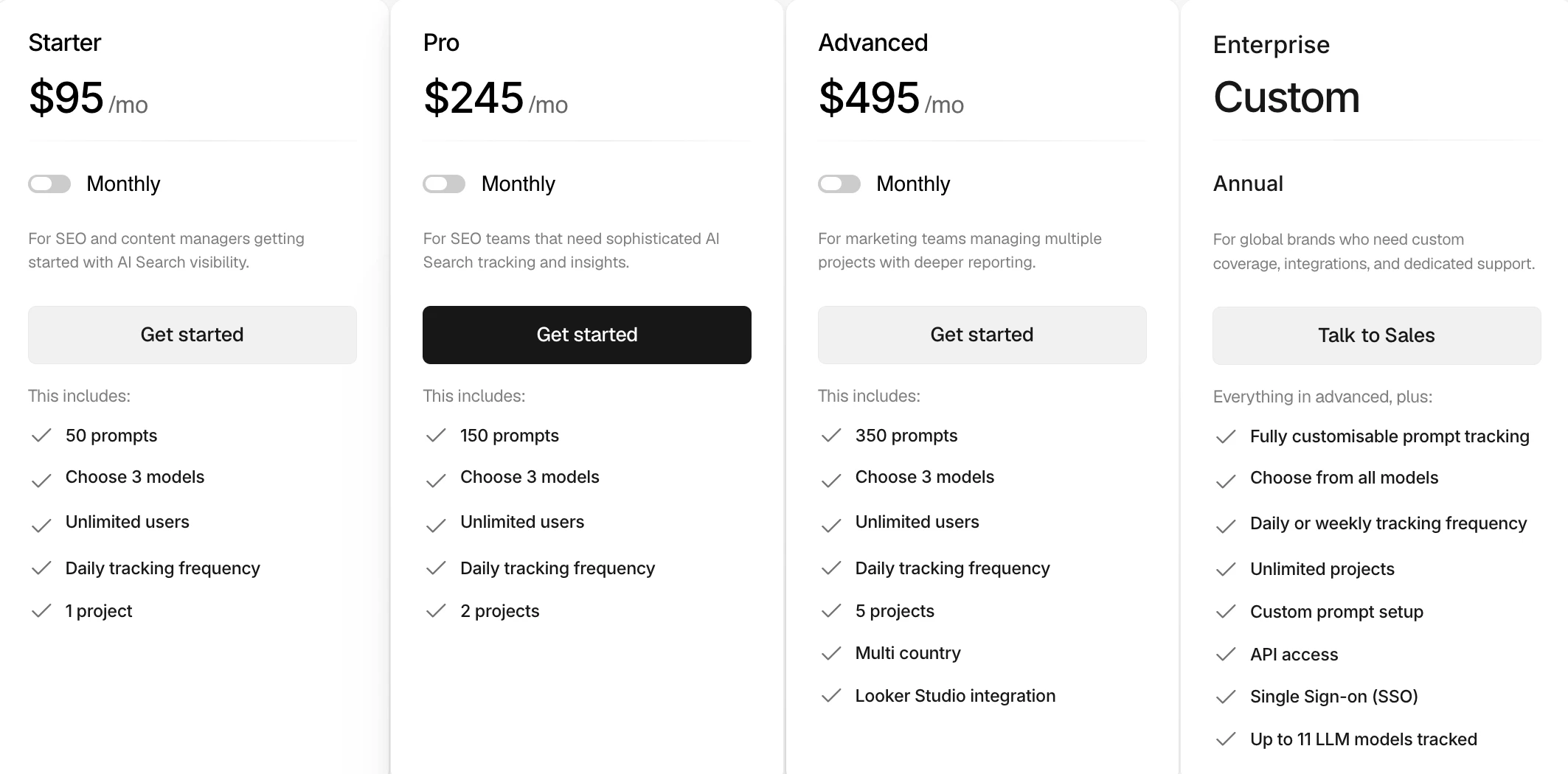
Peec's live pricing, July 2026 — note "Choose 3 models" on every self-serve tier; extra models are paid add-ons.
A few honest notes:
- There is no free tier. Peec is a paid product from the first day — $95/mo minimum. That's the single biggest difference between Peec and the free-first tools in this category.
- The three-model cap plus add-ons is the real story. Budget for the add-on math above ($35–$165/mo per extra model) — not the headline price — if you need broad coverage.
- Unlimited users on every tier is genuinely generous and unusual — most rivals charge per seat.
- Enterprise unlocks everything — up to 13 models, API, SSO, and MCP integration — but pricing is sales-led and unpublished.
- Annual billing saves 15%. There's an agency pricing track too, for teams tracking many brands.
Peec AI capabilities, scored
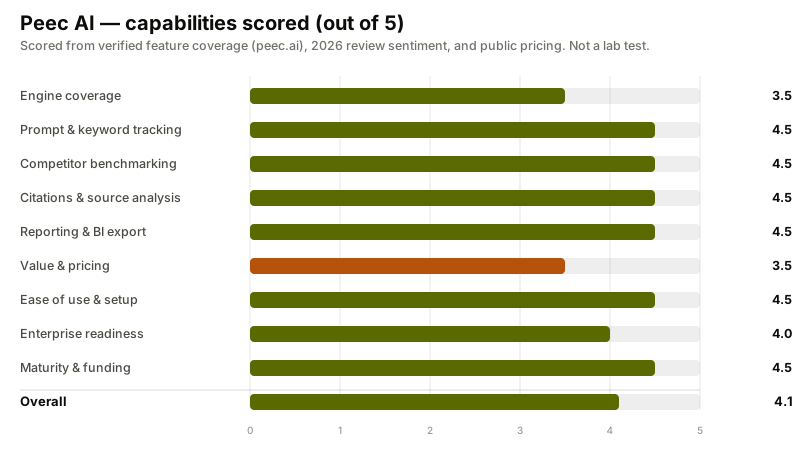
The scores above come from verified feature coverage on peec.ai, 2026 review sentiment, and public pricing — not a lab benchmark, and I've shown the rubric so you can argue with it. The shape is clear: Peec is excellent on usability, maturity, and reporting, and weakest on value — the $95 floor, no free tier, and the three-model cap are what drag the number down.
Two scores deserve a word. Ease of use (4.5) is Peec's signature — the simplest dashboard in the category, by design. Value (3.5) is the drag: the product is worth the money for a funded team, but the entry cost and add-on math put it out of reach for the solo and small-team buyers who make up most of this market. Engine coverage (3.5) reflects the split — broad at Enterprise (up to 13 models), but capped at three below it.
Peec AI pros
- The cleanest, most approachable dashboard in the category — a non-technical marketer is productive in minutes.
- Daily tracking on every tier — no waiting a week for a refresh.
- Unlimited users on all plans — no per-seat tax, which is rare and great for teams.
- Strong BI story — Looker Studio (Advanced) and API (Enterprise) make stakeholder reporting first-class.
- Genuinely mature and funded — Series A, 3,000+ brands and agencies, named SEO endorsements. Low roadmap risk.
- AI referral and crawler reporting — the current product connects visibility to assistant visits and bot activity.
- Recommended and agent-generated actions — more help turning findings into a work queue than the earlier product offered.
- Covers Google AI Mode — a surface several rivals miss.
- Sentiment and brand-perception tracking, not just mention counts.
- Prompt sharing across projects/brands and a dedicated agency track.
Peec AI cons
- No free tier — you can't run an occasional audit or kick the tires long-term without paying $95/mo.
- Three-model cap below Enterprise — and each extra model is a $35–$165/mo add-on, so real coverage costs far more than the sticker.
- Claude, Grok, DeepSeek, Qwen, Mistral, and Meta Spark are Enterprise-only — no self-serve path to those models.
- Expensive entry for solos and small teams — $95/mo is a steep floor next to free-first tools.
- Not an all-in-one SEO suite — no classic Google rank tracking or broad content-production workspace.
- Prompt caps can feel tight — 50 on Starter fills quickly once you add competitors and topics.
Who Peec AI is for — and who should skip it
Funded marketing teams are the sweet spot. If polish, a legible dashboard, daily data, and Looker reporting matter more than the price tag, Peec is an easy yes — it's built to make you look good in a stakeholder meeting.
Agencies get real value from the unlimited-users model, prompt sharing across brands, and the dedicated agency pricing track — though the per-brand economics still add up, so price the full client roster before committing.
Brand and comms teams benefit from the sentiment/perception layer and the "SEO comms" framing Peec leans into — it's more than a mention counter.
Enterprises that need all 13 models, SSO, API, and MCP have a clear (if unpublished) path via the Enterprise tier.
Skip it (for now) if you're a solo founder or indie marketer on a budget — $95/mo with no free tier is a hard sell before you've confirmed AI search even moves your numbers; a small team that wants more than three engines without paying the $35–$165/mo per-model add-ons; or anyone who wants to start free. That last gap — a permanent free tier — is exactly where a free-first tool like FixAEO fits (my disclosure applies; details below). If you specifically need Claude, Grok, or DeepSeek on a self-serve plan, neither Peec nor FixAEO currently fits; Rankscale is one option that does.
Peec AI vs the alternatives
Peec sits in the funded-team, BI-friendly lane: pricier than the scrappy trackers, cheaper and more self-serve than the true enterprise platforms. Rough entry pricing, mid-2026 (verify each on the vendor's page; see best AEO tools for the full field):
| Tool | Entry price | Free option | Engines (entry tier) | Best for |
|---|---|---|---|---|
| Peec AI | $95/mo | none | 3 of 6 (11 at Enterprise) | funded marketing teams, BI reporting |
| FixAEO (us) | Free + from $29/mo | permanent free scan | 6 on Lite (9 on Enterprise) | self-serve SMBs & founders |
| Profound | from $99/mo | none | 1–3 (10 at Enterprise) | enterprise, demand data |
| AthenaHQ | ~$295/mo ($95 annual) | capped free tier | 8–9 | enterprise compliance + BI |
| Otterly | from $29/mo | trial only | 4 core | content teams |
| Rankscale | ~$20/mo (metered) | trial only | 8+ | max engine breadth |
A quick lane-by-lane read:
- vs FixAEO (us): we're free to start, $29/mo paid, and our Lite plan includes all 6 mainstream engines — ChatGPT, Gemini, Perplexity, Copilot, Google AI Overviews, and Google AI Mode — with no three-model cap and no per-model add-ons. That's the same six self-serve options Peec offers, except we give you all six for $29 while Peec gives you three for $95. Where Peec pulls ahead: it is more polished and mature, and its Enterprise tier now lists up to 13 models. One honest symmetry — both products reserve Claude, Grok, and DeepSeek for their top tier; if you need those self-serve, neither fits (Rankscale does). Disclosure applies — I build FixAEO.
- vs Profound: both lean upmarket; Profound has deeper demand data (Prompt Volume) but a similar "headline features gated to Enterprise" pattern. See our Profound alternatives breakdown.
- vs AthenaHQ: AthenaHQ goes further on enterprise compliance (SOC 2, SSO) and BI connectors, at a higher floor. If procurement needs a security review, that's the lane — see AthenaHQ alternatives.
- vs Otterly / Rankscale: both undercut Peec on price; Otterly adds a pre-publish citation predictor, Rankscale stacks the broadest engine list on metered pricing. Neither matches Peec's polish.
The honest read: if polish and BI reporting are what you're buying, Peec is worth its price. If you want to start free or need broad engine coverage without add-ons, we (FixAEO) and a couple of others fit better; if you need enterprise governance, AthenaHQ- and Profound-class tools do. See our full Peec AI alternatives guide for the wider field.
Peec AI vs FixAEO — the honest head-to-head
Since I build FixAEO, here's the straight comparison (disclosure applies):
| Peec AI | FixAEO (us) | |
|---|---|---|
| Entry price | $95/mo, no free tier | Free, then $29/mo |
| Free tier | None (paid from day one) | Yes — 1 Gemini scan/day + 22 free tools |
| Engines (entry paid) | 3 of 6 (add-ons for more) | 6, all included (ChatGPT, Gemini, Perplexity, Copilot, AI Overviews, AI Mode) |
| Best for | funded marketing teams, BI reporting | self-serve SMBs & founders |
| Standout | polish, Looker export, maturity | free start, real-browser + geo-aware capture, MCP server |
Peec wins on polish, maturity, and Looker/BI depth; FixAEO wins on a free start and all six mainstream engines for $29 with no add-on math. Both of us gate Claude and DeepSeek to our top tier, so neither is the pick if you need those self-serve. Full breakdown: FixAEO vs Peec AI.
If you'd rather start free (disclosure: that's us)
I'll be straight, since I flagged it up top: FixAEO is our tool, so weigh this accordingly. But if the thing keeping you off Peec is the $95/mo with no free tier, that gap is exactly what we built for. FixAEO runs a free scan — no signup, about 60 seconds — so you can find out whether AI search even moves the needle for your brand before you pay anyone. Paid Lite is $29/mo ($25 annual) and includes all 6 mainstream engines — ChatGPT, Gemini, Perplexity, Copilot, Google AI Overviews, and Google AI Mode — with no three-model cap and no per-model add-ons, so you skip Peec's model math entirely. Need more room? Growth is $79/mo ($68 annual) with the same 6 engines but daily rescans, 5 brands, and 50 tracked prompts.
A few differences remain. FixAEO includes its MCP server on the $29 plan, while Peec lists MCP under Enterprise. We read what a logged-in user actually sees through real browser sessions on residential IPs, with location-aware tracking by region, and offer a Chrome extension plus 22 free standalone tools (schema, llms.txt, robots.txt generators, audits, validators). Peec now also advertises AI-referral, crawler, and Google Analytics reporting, so those are no longer honest category-level differences.
Where Peec is genuinely stronger, in fairness: it is more polished and mature, its Enterprise tier lists more distinct models than ours (up to 13 versus 9), and it has a deeper BI/Looker export pipeline. We match it on Google AI Mode; FixAEO's advantage is price, a free tier, and all six mainstream engines without add-ons. If polish and BI depth are your priorities, buy Peec. If a free start and the mainstream engines without add-on math matter more, run a free scan and judge for yourself.
Do you need Peec's depth, or a lighter option?
Fair question before you commit to $95/mo. Peec is built for teams that report AI visibility upward — to a CMO, a client, a board. If that's you, the polish and the Looker pipeline earn the price. But if AI visibility is something you check monthly to steer content, a lighter or free-first tool covers the same core job (are we in the answer, for the questions our buyers ask) at a fraction of the cost. The honest distinction isn't quality — Peec is a good product — it's fit: pay for the reporting depth if you'll use it; don't if you won't. That's true of Peec and, honestly, of us; it's the category, not the vendor.
Is Peec AI worth it? The verdict
Buy it if you're a funded marketing team or agency that wants the most polished, approachable tracker in the category, with daily data and Looker reporting, and the budget isn't the blocker — it's genuinely good, and my score reflects that (4.1/5).
Skip it if you're a solo founder or small team, you want a permanent free tier, or the three-of-six model cap and per-model add-ons don't fit your budget. Those are real gaps for the smaller buyer, not nitpicks.
Peec is a well-built, well-funded product whose main catch is accessibility: the price floor and the three-model cap put it out of reach for the founders and small teams who make up most of this market. For funded teams it's an easy recommendation; for everyone else, start with a free-first tool and move up to Peec if and when the reporting depth becomes the thing you're missing.
How I researched this
No sponsorship, no affiliate link. I visually rechecked Peec's prices, feature grid, model list, plan limits, and stated customer count against its own homepage and pricing page on 2026-09-13. Founding and funding details were cross-checked against secondary sources and are flagged as reported where Peec does not publish them. I could not independently verify Peec's exact data-capture method; where I could not confirm something, I said so rather than assert it. And I build a competing tool, which is disclosed above.
FAQ
What is Peec AI?
Peec AI is an AI-search visibility (AEO/GEO) analytics platform. It measures how often your brand is mentioned, cited, and recommended across AI answer engines like ChatGPT, Gemini, and Perplexity, tracks sentiment and competitors, and reports it in a clean dashboard built for marketing teams — with Looker Studio export on higher tiers.
How much does Peec AI cost?
Four tiers: Starter $95/mo (50 prompts, 3 models, 1 project), Pro $245/mo (150 prompts, 2 projects), Advanced $495/mo (350 prompts, 5 projects, Looker Studio), and Enterprise (custom — up to 13 models, API, SSO, MCP). Prices and plan limits were visually rechecked on 2026-09-13. Extra self-serve models cost $35–$165/mo each.
Does Peec AI have a free plan?
No. Peec is paid from the first day — $95/mo minimum, with a 15% annual discount. There's no permanent free tier. If a free start is what you need, free-first tools like FixAEO (our tool — one free scan, no signup) fill that gap.
How many AI engines does Peec AI track?
Six mainstream models are available — ChatGPT, Google AI Mode, Google AI Overviews, Microsoft Copilot, Perplexity, and Gemini — and you choose three on Starter, Pro, and Advanced. Enterprise lists up to 13, adding Claude Sonnet 4, GPT-5 Search, Grok, DeepSeek, Qwen, Mistral, and Meta Spark. Extra models on the self-serve tiers are paid add-ons.
Why is Peec AI more expensive than it looks?
Because of the three-model cap plus add-ons. The sticker ($95/$245/$495) covers three models; each additional model costs $35/$85/$165/mo depending on tier. Full six-model coverage is roughly $200/mo on Starter and $990/mo on Advanced — so budget the coverage you need, not the headline price.
Is Peec AI worth it?
For funded marketing teams and agencies that value polish, daily data, and BI reporting, yes — it's one of the nicest tools in the category and we scored it 4.1/5. For solo founders and small teams on a budget, the $95 price floor and the three-of-six model cap make it hard to justify over a free-first alternative.
What are the best Peec AI alternatives?
Depends on the lane: FixAEO (free to start, 6 engines on Lite at $29/mo, no add-ons), Otterly and Rankscale (cheaper), AthenaHQ and Profound (enterprise). See our full Peec AI alternatives comparison for the head-to-heads.
Peec AI vs FixAEO — which should I pick?
Different buyers. Peec is the polished, funded, BI-friendly option from $95/mo with no free tier and a three-model cap below Enterprise. FixAEO (ours) is free to start, $29/mo paid, and its Lite plan includes all 6 mainstream engines — ChatGPT, Gemini, Perplexity, Copilot, Google AI Overviews, and Google AI Mode — with no three-model cap and no add-ons, plus AI-crawler tracking, GA4 attribution, and an MCP server on the paid plan. Both of us gate Claude, Grok, and DeepSeek to our top tier. Pick Peec for polish, maturity, and deep Looker reporting; pick FixAEO to start free and get all six mainstream engines without the add-on math. See the FixAEO vs Peec AI breakdown.
Does Peec AI track Google AI Mode?
Yes — Google AI Mode is one of Peec's six selectable models, alongside AI Overviews. It's a distinct surface from AI Overviews, and not every competitor tracks it yet, so it's a real point in Peec's favor over some tools. (For the record, FixAEO covers Google AI Mode too, on its Lite plan.)
Does Peec AI have an API and MCP?
Both, but at the Enterprise tier. API access and MCP integration are listed as Enterprise features, along with SSO. The self-serve tiers (Starter, Pro, Advanced) don't include API or MCP access.
Is Peec AI good for agencies?
It can be. Unlimited users on every tier, prompt sharing across brands, and a dedicated agency pricing track all help. The caveat is per-brand cost — price your full client roster with the models each client needs (remembering the add-on math) before committing, and compare against tools with flatter multi-brand pricing.
Is Peec AI legit and safe to use?
Yes — it's a real, well-funded product (Berlin, founded 2025, $21M Series A in late 2025) with public pricing, thousands of reported users, and named industry endorsements. Nothing about signing up is unusual for a SaaS tool. The caveats here are about cost and coverage limits, not legitimacy.
Related reading
8 Best Peec AI Alternatives in 2026 (Hands-On Tested)
8 Peec AI alternatives compared — engines, entry price, free tier — with honest picks by budget. One has a real free tier Peec doesn't.
23 min read7 Best Profound Alternatives & Competitors in 2026
7 Profound alternatives compared on price, engine coverage, and free tiers — an honest buyer's guide for teams priced out of enterprise AEO.
20 min read9 Best AthenaHQ Alternatives in 2026 (Tested & Priced)
9 AthenaHQ alternatives compared on engines, price, and free tiers — honest picks by budget. Most cost a fraction of AthenaHQ's $295/mo for real multi-engine use.
18 min read12 Best Answer Engine Optimization Tools (2026)
12 answer engine optimization tools compared — engines covered, entry price, free tier — with honest takes on which to pick by stage and budget.
19 min readWhat is AEO? Answer Engine Optimization explained
Answer Engine Optimization (AEO) means getting AI assistants to recommend your brand. Learn what AEO is, why it matters more than SEO, and how to start.
18 min read
Free AEO tools
Put this into practice with free FixAEO tools — no signup required.
AI Visibility Checker
Score your brand across 9 AI engines
AEO Audit Tool
Answer-engine readiness scan
Schema Generator
Build valid JSON-LD structured data
llms.txt Generator
Create a spec-compliant llms.txt
Sitemap Validator
Check your XML sitemap for errors
AI Content Grader
Grade content for AI citation readiness