Can ChatGPT Search the Web? How to Use Search
Yes, ChatGPT can search the live web and cite sources. Follow the current Search steps, fix a missing Search option, and verify cited answers.

On this page
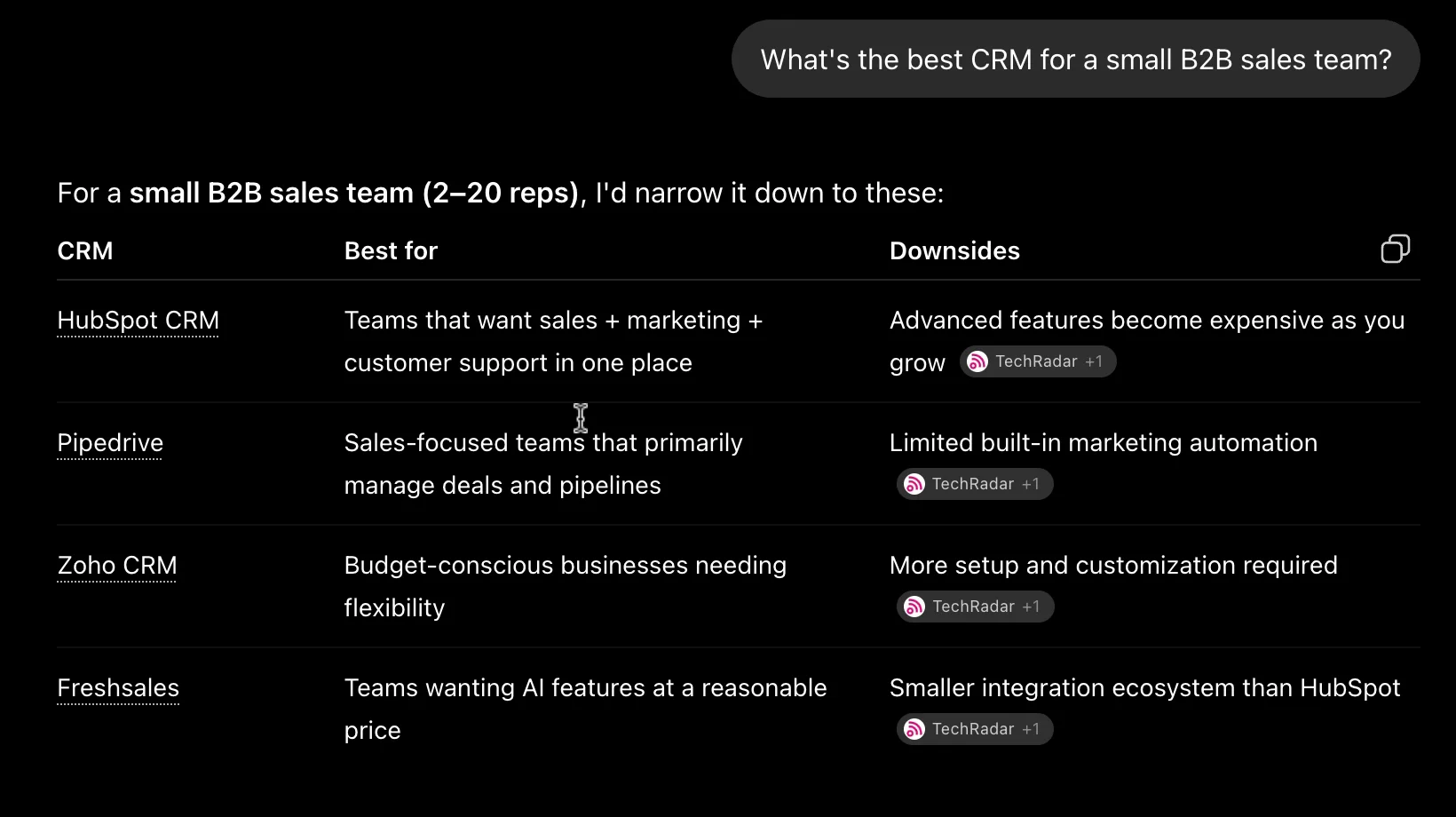
Short answer: yes, ChatGPT can search the live web. It can decide to search automatically when fresh information would help, or you can explicitly select Search from the tools menu. A searched answer may include inline citation chips and a Sources panel so you can inspect the pages behind its claims.
| ChatGPT surface | Can it use the live web? | What the user sees |
|---|---|---|
| Normal ChatGPT chat | Yes, when Search is triggered | A search-status step, inline citations, and sometimes a Sources panel |
| Manually selected Search | Yes | A web-grounded answer for the current prompt |
| Deep Research | Yes | A research plan, progress view, long report, citations, and source history |
| OpenAI API with web search | Yes, when the tool is enabled | Search actions and URL citations that developers render in their product |
| Model answer without retrieval | Not necessarily | An answer based on model knowledge and the context supplied in the chat |
Reviewed September 13, 2026 against OpenAI's current ChatGPT Search, Deep Research, crawler, publisher, and API documentation. Product screenshots are labeled with their capture dates.
The important word is can. ChatGPT does not search for every response, and polished prose is not proof that it checked the internet. If freshness matters, look for citations, explicitly request web search, and open the supporting pages before relying on the answer.
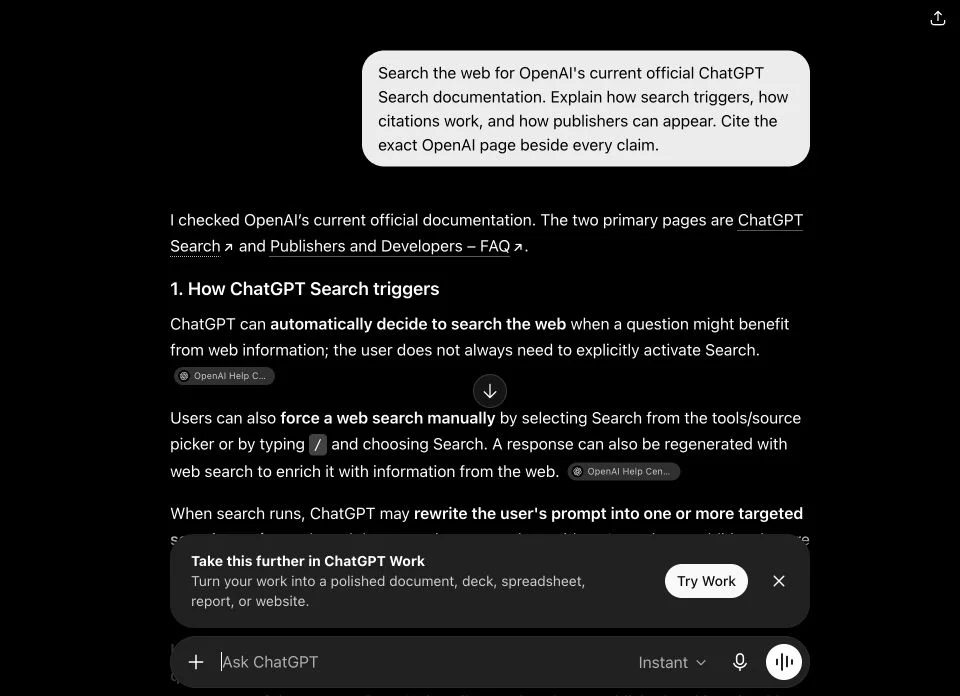
Fresh capture from ChatGPT on August 11, 2026. The prompt requests current official OpenAI documentation and a source beside every claim.
What is ChatGPT Search?
ChatGPT Search is a retrieval layer inside the ChatGPT conversation. Instead of answering only from the model's learned patterns and the text already in the chat, ChatGPT can form search queries, retrieve current web information, and use that evidence while composing its response.
OpenAI's ChatGPT Search help page says ChatGPT may search automatically when a question could benefit from web information. A user can also force the choice by selecting Search from the tools menu or typing / and choosing Search. OpenAI first announced the feature in October 2024 and later expanded availability to everyone in regions where ChatGPT is available, including logged-out users.
That makes Search different from a conventional search-results page. A search engine usually returns ranked documents and asks you to choose. ChatGPT often does more work after retrieval: it reads snippets or pages, reconciles information, writes a direct answer, and connects claims to sources. The output is easier to consume, but that synthesis step also introduces another place for mistakes.
The useful mental model is:
- Intent: ChatGPT decides whether the question needs current or external evidence.
- Querying: it creates one or more search queries, which may differ from your original wording.
- Retrieval: search providers and OpenAI's systems return candidate pages.
- Selection: the system chooses material that appears relevant and reliable.
- Synthesis: the model writes a conversational answer.
- Attribution: source links are attached to claims or collected in the Sources interface.
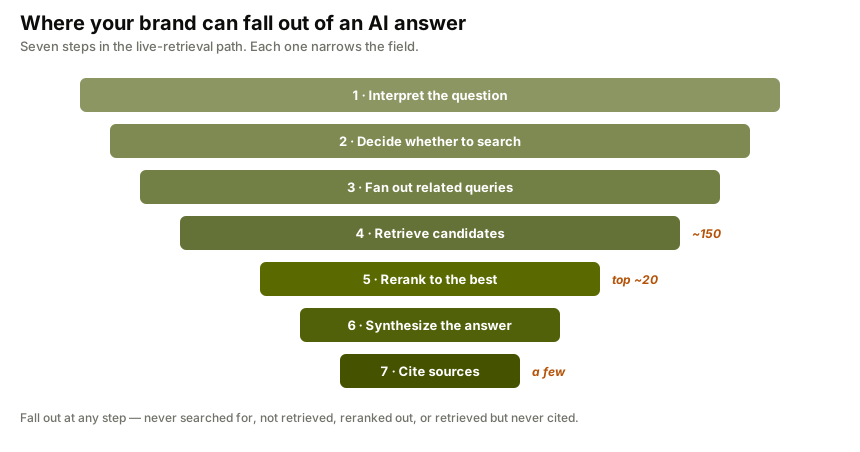
This distinction explains why two people can get different answers to the same question. Location, language, account context, memory settings, query rewriting, newly indexed pages, and the pages available at that moment can change the evidence before the model even starts writing.
When does ChatGPT search the web?
OpenAI does not publish a deterministic trigger formula. Its help documentation gives the practical rule: ChatGPT searches automatically when a question might benefit from web information. That commonly includes news, prices, schedules, recent product releases, live sports, current regulations, local recommendations, and requests about a specific page or report.
| Prompt type | Search value | Example |
|---|---|---|
| Fast-changing fact | Very high | “What changed in OpenAI's API pricing this month?” |
| Latest announcement or news | Very high | “Summarize today's official release and cite it.” |
| Named page or document | High | “Compare these two current pricing pages.” |
| Local and time-sensitive request | High | “Which museums near me are open tonight?” |
| Stable explanation | Lower | “Explain what a neural network is.” |
| Writing or transformation | Usually low | “Make this email shorter and friendlier.” |
This is a guide to likely value, not a promise about internal routing. ChatGPT can search for an apparently stable topic when it wants evidence, and it can sometimes answer a current-sounding prompt without visible retrieval. If the distinction matters, do not leave it implicit.
Use a prompt with four constraints:
Search the web for information current as of September 13, 2026. Use primary sources wherever possible. Put a citation beside every date, number, price, or product-status claim. If reliable sources disagree or you cannot verify a claim, say so.
That wording defines the time boundary, source hierarchy, citation coverage, and uncertainty policy. It will not make every output correct, but it makes unsupported confidence easier to spot.
How to make ChatGPT search manually
- Open a new or existing ChatGPT conversation.
- Select View all tools beside the message field.
- Choose Search.
- Enter the question and send it.
In interfaces that support the slash menu, type / and choose Search. ChatGPT can also search automatically when a question would benefit from current information, and a direct request such as “Search the web and cite current primary sources” makes the requirement explicit. OpenAI documents these controls in its current ChatGPT Search help page.
If Search is missing, start a new conversation, update the desktop or mobile app or try ChatGPT on the web, and confirm that you are using the intended account or workspace. Search availability can also depend on usage limits and workspace administrator settings. Do not assume an uncited answer used live retrieval.
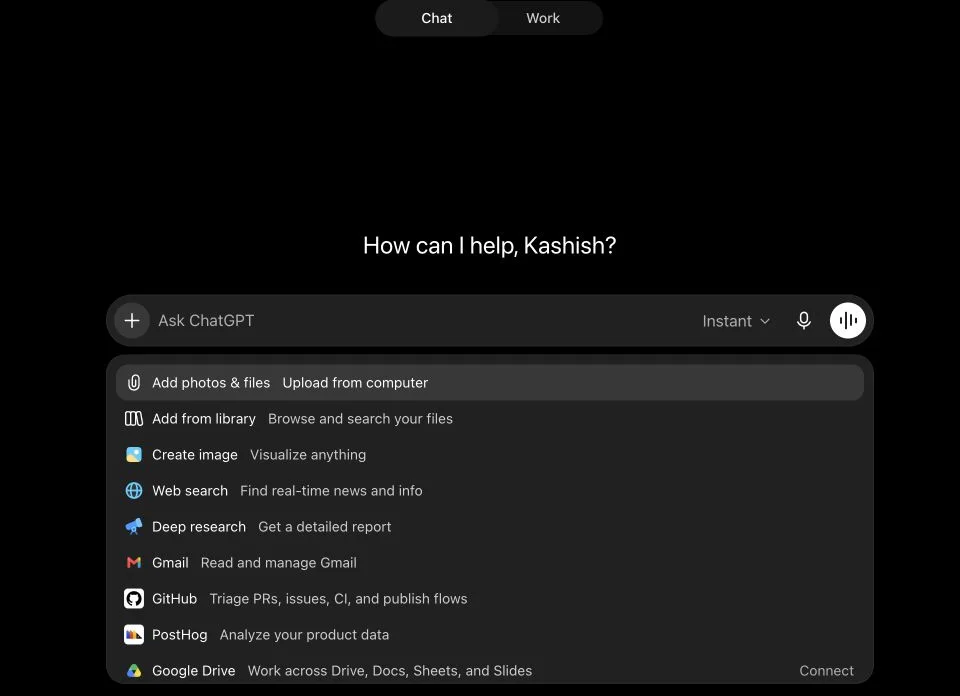
Web search is the quick retrieval tool. Deep research is a separate mode for larger, multi-step investigations.
Make the request auditable. “What is the best CRM?” leaves the system to infer the country, company size, budget, date, and meaning of “best.” A better prompt might be:
Search current official pricing and product documentation for HubSpot, Pipedrive, and Zoho CRM. Compare entry price, minimum seat rules, contact limits, and native email features for a five-person US sales team. Cite the relevant vendor page beside every cell and mark any detail you cannot verify.
Specific prompts produce better searches because they expose the variables that matter. They also reduce the chance that the answer quietly combines an annual price from one vendor with a monthly price from another.
How ChatGPT Search queries differ from your prompt
OpenAI says ChatGPT may rewrite a user's request into one or more targeted queries and send them to third-party search providers. The provider receives the query, not your ChatGPT account details or IP address. OpenAI may share a general location derived from your IP to improve local results. If Memory is enabled, relevant memories can influence how the query is rewritten.
This query-rewriting layer is powerful. A conversational request such as “Is the new rule active for my small shop in Berlin?” may become searches for the regulation's formal name, effective date, Germany-specific implementation, and small-business exemptions. The user does not have to know the legal vocabulary in advance.
It also creates risk. If ChatGPT infers the wrong product, jurisdiction, date, or meaning, it can retrieve a coherent set of pages that answers a different question. For high-stakes work, state the exact entity and scope in the prompt, then inspect whether the cited sources match it.
OpenAI's help article lists Bing and Shopify as examples of third-party search providers, but that list is not presented as a complete map of every source or routing decision. It is more accurate to say ChatGPT uses OpenAI's search systems, its own search crawler, and third-party providers than to reduce all ChatGPT Search results to one external index.
How citations and the Sources panel work
When a response uses Search, ChatGPT can place citation chips beside sourced statements. Hovering over or selecting a chip exposes the linked page. A Sources control, when available, opens a panel containing cited pages and other relevant links associated with the answer. Images returned through search can have their own attribution as well.
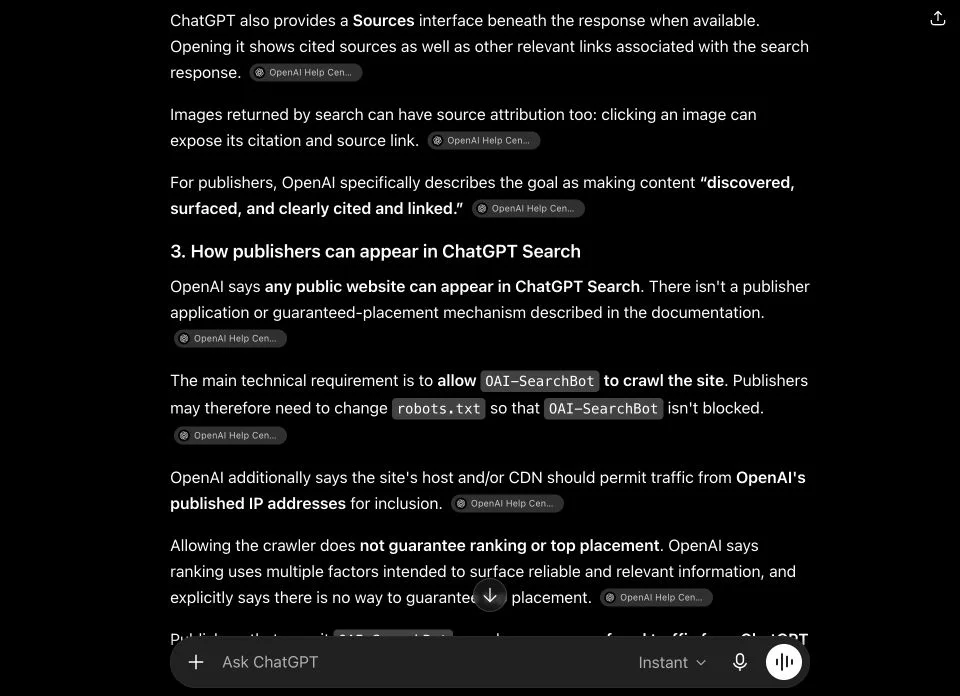
A citation is evidence metadata, not a correctness badge. Check three things:
- Authority: Is this the primary owner of the fact, a reputable independent source, or an unverified summary?
- Entailment: Does the page actually support the exact sentence beside the citation?
- Scope: Does the source use the same date, geography, plan, model, sample, and definition as the answer?
ChatGPT may attach one source to a paragraph containing several claims. The page might support the first sentence but not the inference that follows. OpenAI's own guidance on inaccurate or fabricated citations recommends verifying important quotes, data, references, and external links.
For consequential decisions, use a two-column review: copy every material claim into the left column and the exact supporting passage into the right. A missing passage means the claim is unverified even if the citation looks plausible.
ChatGPT Search vs Deep Research
Search is optimized for a quick current answer. Deep Research is designed for a question that needs a plan, many sources, iteration, and a report.
| Capability | ChatGPT Search | Deep Research |
|---|---|---|
| Typical job | Fact check, current explanation, recommendation | Market map, literature review, policy or competitor investigation |
| Time | Usually seconds | Often several minutes |
| Process | One or more searches inside a chat response | Editable plan, multi-step browsing, progress, and synthesis |
| Sources | Public web results | Public web, uploaded files, connected apps, and selected sites |
| Output | Conversational answer with citations | Structured cited report with source and activity history |
| Export | Copy/share the answer | Download as Markdown, Word, or PDF where available |
OpenAI's Deep Research help page says the mode can use the public web, uploaded files, connected apps, and sites you specify. It proposes a plan that can be reviewed before research begins, displays progress, and returns a structured report with citations and the sources used.
Use Search for “What changed in this documentation today?” Use Deep Research for “Compare how six AI assistants retrieve sources, document the crawler rules for each, identify conflicting publisher guidance, and produce a prioritized implementation plan.” The second question requires decomposition, not merely freshness.
Deep Research is still a model-driven research process. More pages do not guarantee better evidence. A long report can amplify a mistaken assumption across many sections, so review its plan before it runs and audit its strongest conclusions afterward.
ChatGPT web search vs the model's knowledge cutoff
A model's knowledge cutoff is the latest broad point in time represented in its training knowledge. Search is a separate, runtime capability. It can retrieve a page published today even when the selected model's built-in knowledge ends earlier.
| Answer mode | Main information source | Main limitation |
|---|---|---|
| No web retrieval | Trained knowledge plus chat context | May be stale or incomplete |
| ChatGPT Search | Current retrieved pages plus model reasoning | Retrieval and synthesis can both fail |
| Deep Research | Multi-step retrieval across selected sources | A polished report can still misinterpret evidence |
| Uploaded or connected data | Files and services available to the chat | Access, version, and document quality constrain the result |
Web access does not erase the cutoff. The model's prior knowledge still shapes what it searches for, which result seems plausible, and how it explains the evidence. Search reduces stale-data risk; it does not make the system a neutral database.
For provider-published dates and clearly labeled estimates, use FixAEO's maintained AI knowledge cutoff reference. Do not use a current-sounding answer as proof that a search occurred.
How developers give an OpenAI model web access
Web search is also available as a tool in OpenAI's API. Developers declare the web-search capability in a Responses API request, and the model can call it when it needs current information. The response can include search actions and URL citation annotations that should be displayed to the end user.
OpenAI's current web search API guide is the source of truth for request shape, supported models, location settings, source restrictions, and citation rendering. Those details change too quickly to copy blindly from an old tutorial.
A robust application should retain:
- the original user request;
- whether web search was invoked;
- search-query or action metadata exposed by the API;
- the URLs and titles attached to citations;
- the exact generated span each citation supports;
- model and tool versions; and
- request time and user-visible answer.
That record helps separate four failures. Trigger failure: the model did not search when it should. Retrieval failure: it searched but missed the best page. Synthesis failure: it found the right evidence but wrote the wrong conclusion. Rendering failure: the application received citation data but did not show it clearly.
Developers should make citations obvious and clickable. Hiding sources behind a generic “AI generated” label removes the evidence trail that makes web-grounded answers reviewable.
How can a website appear in ChatGPT Search?
OpenAI says any public website can appear in ChatGPT Search. There is no published application that guarantees inclusion and no way to buy the top citation. The technical prerequisite is allowing OAI-SearchBot to crawl the site and allowing traffic from OpenAI's published crawler IP ranges through the host or CDN.
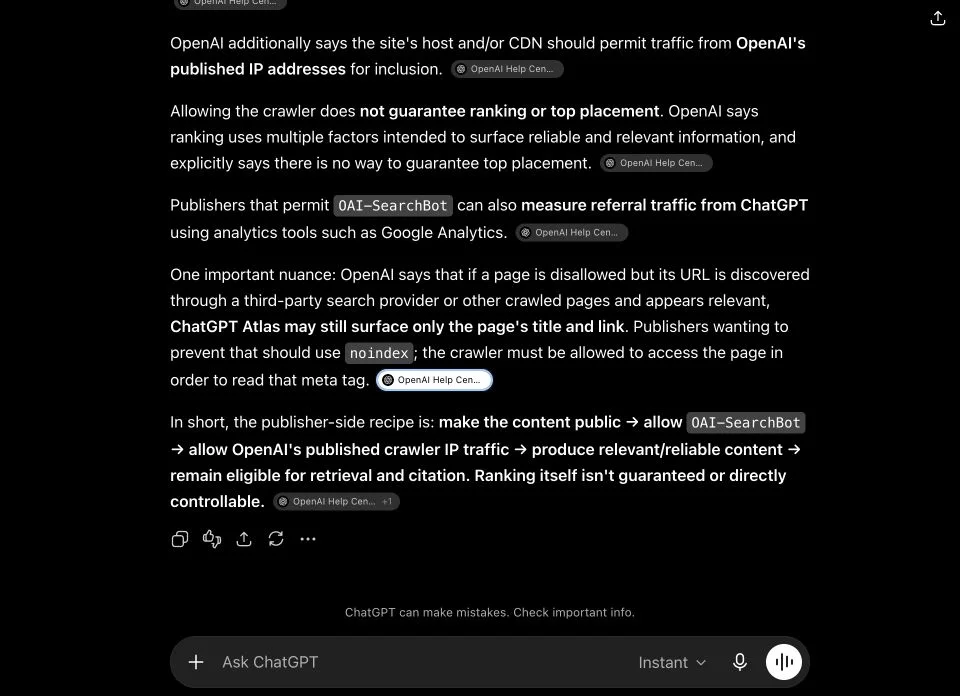
The live answer correctly separates crawl access from ranking. Being eligible does not guarantee a citation.
A minimal robots.txt rule that allows search discovery is:
User-agent: OAI-SearchBot
Disallow:
An empty Disallow: means the agent is allowed. Check for broader wildcard rules, CDN bot protection, Web Application Firewall challenges, authentication, geoblocking, and JavaScript-only content that may still prevent useful access. OpenAI publishes crawler user-agent details and IP ranges in its crawler documentation.
Access only creates eligibility. OpenAI says ranking uses multiple factors intended to surface reliable and relevant information and explicitly does not guarantee placement. A useful page still needs to answer the query, be understandable without hidden context, state who published it, expose dates, and support claims with primary evidence.
OAI-SearchBot, GPTBot, and ChatGPT-User are different
Publishers often block the wrong agent because three OpenAI web identities are treated as one “AI bot.” They serve different purposes.
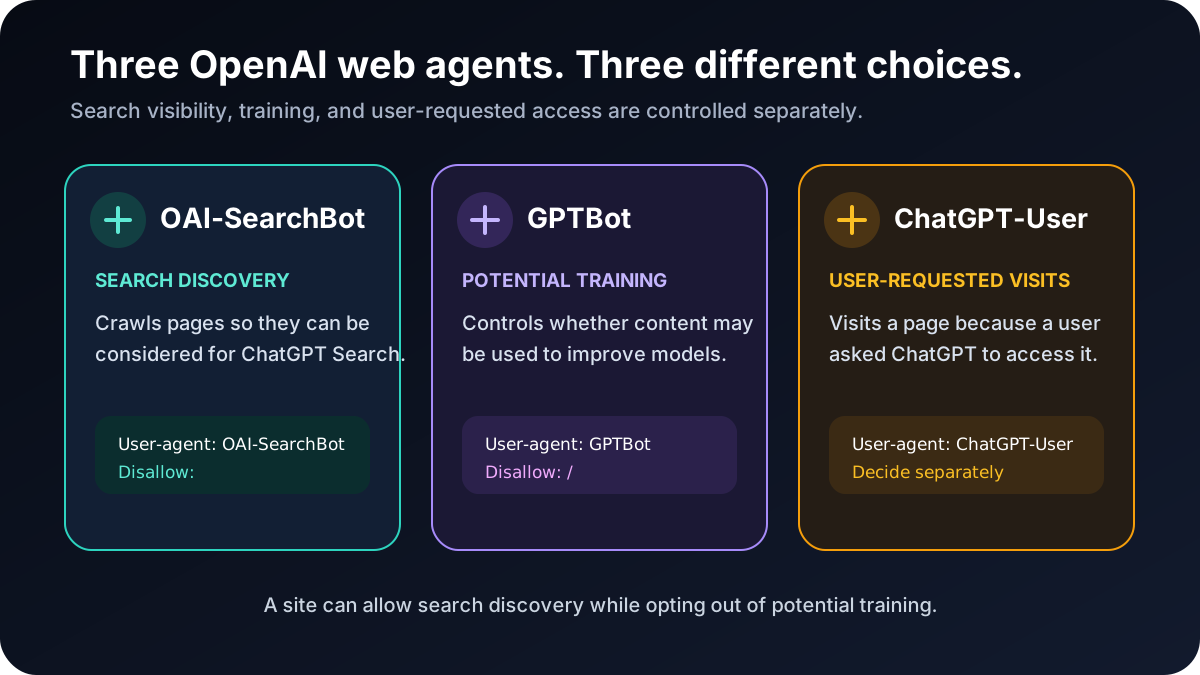
| User agent | Main purpose | Publisher decision |
|---|---|---|
OAI-SearchBot | Discover and surface pages for ChatGPT Search | Allow if you want search eligibility |
GPTBot | Crawl content that may be used to improve generative models | Allow or block based on your training policy |
ChatGPT-User | Visit a page in response to a user's request | Decide separately based on on-demand access needs |
This means a publisher can allow OAI-SearchBot while blocking GPTBot. Search visibility and potential model training are separate controls.
# Stay eligible for ChatGPT Search
User-agent: OAI-SearchBot
Disallow:

# Optional: opt out of potential training use
User-agent: GPTBot
Disallow: /
Do not copy a crawler policy without checking its business impact. A support site, paywalled publisher, public documentation portal, and private customer area should not share one automatic rule. Protect non-public paths with real authentication; robots.txt is a crawler instruction, not an access-control system.
The noindex nuance publishers miss
Blocking crawl access is not always the same as preventing a URL from being mentioned. OpenAI's Publishers and Developers FAQ says a disallowed URL discovered through a third-party provider or another crawled page may still appear as a title and link in certain OpenAI browsing experiences when relevant.
If the goal is to keep a public URL out of search-style results, OpenAI recommends noindex. The crawler must be allowed to access the page to read that directive. Blocking the crawler and adding noindex can therefore be self-defeating: the agent cannot observe the instruction.
<meta name="robots" content="noindex">
For truly private information, do not rely on noindex either. Require authentication and remove public links, feeds, and sitemaps that expose the resource.
How to measure traffic from ChatGPT
OpenAI says referral URLs from ChatGPT include utm_source=chatgpt.com. In analytics, create a channel or segment for that parameter and retain the landing page, campaign fields, conversion events, and revenue or activation outcome.
Useful metrics include:
- sessions from
utm_source=chatgpt.com; - landing pages receiving those sessions;
- signup, demo, purchase, or activation conversion rate;
- assisted conversions where ChatGPT appears earlier in the journey;
- cited prompt coverage for the same landing pages; and
- changes after a technical or content update.
Referral traffic is only the visible portion of AI influence. A user can read a recommendation, remember the brand, and later arrive through a branded search or direct visit. Combine analytics with repeated prompt testing to measure both clicks and answer visibility.
Do not claim a content change “caused” a traffic increase from one before-and-after screenshot. Search answers vary. Use a fixed prompt set, a stable measurement window, competitor controls, and an annotation log for crawl, content, PR, and product changes.
Why ChatGPT can search and still miss your page
Eligibility is not selection. A page can be public, crawlable, and indexed yet never appear for the prompt you care about.
Common reasons include:
- The page answers a keyword, not the buyer's question. A title can match while the body never gives a concise decision-ready answer.
- The evidence is weaker than a competitor's. Unsupported claims lose to documentation, data, standards, or independently corroborated coverage.
- The key fact is buried. A crawler should not need to execute a complex app or interpret a decorative chart to find the conclusion.
- The page is stale. Missing dates, old screenshots, discontinued plans, and broken links reduce trust.
- The entity is ambiguous. The product name, company, category, and relationship between them are not stated consistently.
- The page is isolated. Few internal links, references, mentions, or authoritative backlinks make discovery and validation harder.
- The prompt has a different intent. “Best for enterprise security” and “best free option for a freelancer” require different evidence.
This is why generic “AI SEO” checklists underperform. The optimization unit is not merely a page. It is a specific question, a defensible answer, evidence that supports it, technical access, and enough external corroboration for a retrieval system to trust the page.
A 30-day experiment to improve ChatGPT visibility
Treat visibility as a measurable retrieval problem, not a one-time submission.
Week 1: establish the baseline
Choose 20–40 prompts your buyers genuinely ask. Include category discovery, alternatives, comparisons, use cases, objections, pricing, implementation, and “best for” prompts. Run them in ChatGPT Search, record whether your brand appears, capture cited competitors, and save the source URLs.
Audit robots.txt, status codes, canonical tags, noindex, CDN rules, server logs, sitemaps, and rendered page content. Confirm OAI-SearchBot is not blocked on public pages you want discovered.
Week 2: build the missing evidence
Group prompts by the evidence required. A comparison question may need a transparent feature matrix. A trust question may need a security page and independent proof. A statistics question needs a dated methodology, sample size, and downloadable data. Publish the smallest set of pages that closes several prompt gaps at once.
Give each page a direct answer near the top, descriptive headings, stable definitions, named author or organization, update date, primary-source links, and clear caveats. Add internal links from relevant high-authority pages.
Week 3: strengthen corroboration
Earn references where the audience already learns: industry publications, partner pages, integration directories, original research roundups, podcasts with transcripts, and real expert contributions. Avoid bulk low-quality directory links. Retrieval systems need corroboration, not a pile of interchangeable profiles.
Week 4: rerun and diagnose
Use the same prompt set. Separate changes in brand mention, citation, answer sentiment, competitor share, and linked URL. If a page is never retrieved, investigate access, indexing, entity language, and external authority. If it is retrieved but not cited, improve answer clarity and evidence. If it is cited but sends no useful traffic, improve the promise and next step on the landing page.
FixAEO automates this repeated test across major AI search engines. Run the free AI visibility checker to see which brands and sources appear, then review the FixAEO methodology before interpreting the score.
Seven ways a web-grounded answer can still be wrong
- Search did not trigger. The answer came from model knowledge even though the question was time-sensitive.
- The rewritten query changed the question. Retrieval focused on the wrong product, date, market, or definition.
- The best page was inaccessible. Robots rules, bot protection, authentication, or rendering prevented retrieval.
- An outdated page won. An older URL had stronger authority or clearer text than the current source.
- A secondary source displaced the primary source. A recap ranked ahead of the regulator, company, or original study.
- The model over-combined evidence. Sources described different plans, regions, versions, or samples.
- The citation did not entail the whole claim. The source supported part of the sentence while the answer added an unsupported conclusion.
Use a verification ladder: first confirm that Search ran, then inspect the source, locate the supporting passage, check the date and scope, compare against a primary source, and preserve the citation in your notes. For medical, legal, financial, security, or public-reporting decisions, use qualified human review.
ChatGPT vs Gemini, Claude, and Perplexity web search
These assistants share a retrieval-and-synthesis pattern, but they do not see or rank an identical web.
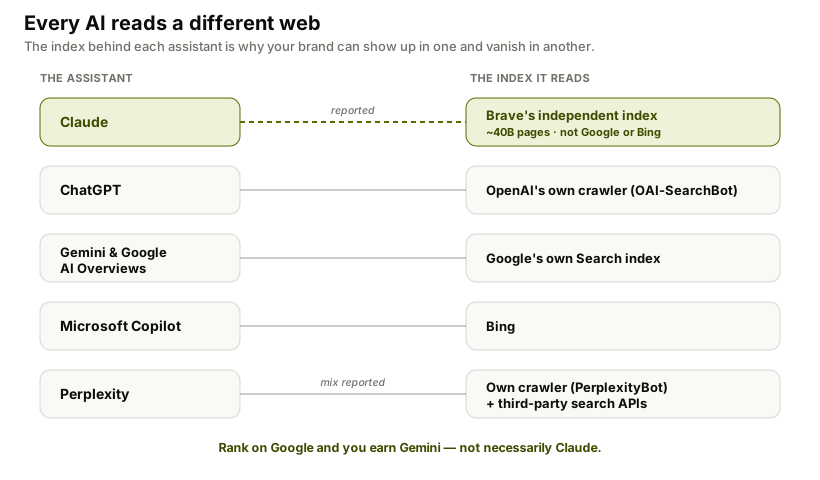
| Assistant | Web-search relationship | Practical implication |
|---|---|---|
| ChatGPT | OpenAI search systems, OAI-SearchBot, and third-party providers | OpenAI crawler access and source selection matter |
| Gemini | Grounding with Google Search | Google indexing is central to discoverability |
| Claude | A web-search tool with Brave strongly evidenced as provider | Google visibility does not guarantee Claude visibility |
| Perplexity | Retrieval-first answers using its crawler and other search infrastructure | Citations are central to the default experience |
A page cited by Gemini is not automatically cited by ChatGPT. Each system rewrites queries, retrieves candidates, and selects evidence differently. Test the same high-value prompts across engines instead of treating “AI visibility” as one universal ranking.
For product-specific controls, read how Gemini searches the web, how Claude searches the web, and how Grok searches the web and X.
FAQ
Can ChatGPT browse the internet in real time?
Yes. ChatGPT Search can retrieve current web information at response time. It may search automatically when fresh information would help, or the user can select Web search manually. Real-time access does not mean every answer is searched or perfectly current.
Is ChatGPT Search free?
OpenAI's current help documentation says ChatGPT Search is available to Free, Plus, Team, Edu, and Enterprise users, and to logged-out users where ChatGPT is available. Usage limits and interface details can change, so check the current help page for account-specific behavior.
How do I know whether ChatGPT searched the web?
Look for a search-status step, inline source chips, and the Sources control. If freshness matters and those signals are absent, ask ChatGPT to search explicitly and cite each material claim. Do not assume an answer searched simply because it mentions a recent date.
What search engine does ChatGPT use?
OpenAI describes a mix rather than one exclusive public index. It operates OAI-SearchBot and may send rewritten queries to third-party search providers; its help page gives Bing and Shopify as examples. The exact routing and source mix can depend on the query and product experience.
Can I force ChatGPT to search?
Yes. Choose Search from the tools menu, use the Search slash command where available, or explicitly request current web research with citations. You can also regenerate an answer with web search.
Does ChatGPT always cite its sources?
No. Search responses can include inline citations and a Sources interface, but not every ChatGPT answer uses Search or displays sources. Ask for citations and verify important claims on the linked pages.
How do I get my website into ChatGPT Search?
Keep the desired pages public and useful, allow OAI-SearchBot, permit OpenAI's published crawler IP ranges through your host or CDN, and publish relevant evidence that answers the query clearly. Technical access creates eligibility; it does not guarantee ranking or citation.
Can I block model training but remain visible in ChatGPT Search?
Yes. OpenAI documents GPTBot and OAI-SearchBot as separate controls. A publisher can block GPTBot for potential training use while allowing OAI-SearchBot for search discovery.
How can I track visitors from ChatGPT?
OpenAI says ChatGPT referral URLs include utm_source=chatgpt.com. Segment that parameter in your analytics and measure landing pages, conversions, and assisted journeys. Pair referral data with prompt monitoring because many AI-influenced visits will not preserve a direct click.
Is Deep Research the same as ChatGPT Search?
No. Search is the faster tool for current answers. Deep Research creates and follows a multi-step plan, can work across the public web, files, connected apps, and specified sites, and returns a longer cited report with source history.
Can ChatGPT Search be wrong even with citations?
Yes. It can retrieve an outdated or weak page, misunderstand the source, merge incompatible contexts, or attach a citation that supports only part of a claim. Citations make verification possible; they do not replace it.
The bottom line
ChatGPT can search the web, and web-grounded answers are much easier to audit than memory-only responses. But the reliable workflow is not “ask once and trust the citations.” It is: request fresh retrieval, define source quality, inspect the evidence, preserve scope, and repeat the test over time.
For publishers, the parallel workflow is just as concrete: allow the correct search crawler, separate search visibility from training policy, publish answer-ready evidence, earn corroboration, and measure whether the pages actually appear for buyer questions. Start with a free FixAEO visibility scan to see where your brand is mentioned and which competitors ChatGPT cites instead.
Related reading
Can Microsoft Copilot Search the Web? How Bing Grounding Works
Yes, Microsoft Copilot searches the web through Bing and cites sources. Learn how Search mode, grounding, Researcher, privacy, and indexing work.
20 min readCan Perplexity Search the Web? How Live Search Works
Yes, Perplexity searches the live web and cites its sources. Learn how Search, Pro Search, Research, APIs, and Perplexity's web crawlers work in 2026.
20 min readCan Gemini Search the Web? How to Use Google Search
Yes, Gemini can use Google Search, show sources, and run Deep Research. Follow the steps to request current results and verify every citation.
20 min readCan Claude Search the Web? How to Enable It (2026)
Yes. Enable Claude web search in three steps, fix a missing toggle on Team or Enterprise, and learn when Claude searches and cites the live web.
15 min readDoes Grok Search the Web? Yes — Here's How (2026)
Yes — Grok searches the web live and reads real-time X posts. How Grok's search and DeepSearch work, what index it uses, the xAI API, and how to get cited.
14 min readBest AI Search Engines in 2026: I Tested All 15
I tested 15 AI search engines for a month — Perplexity, ChatGPT, Gemini, Claude, Grok and more. An honest ranking of which to use and what each does best.
37 min read
Free AEO tools
Put this into practice with free FixAEO tools — no signup required.
AI Visibility Checker
Score your brand across 9 AI engines
AEO Audit Tool
Answer-engine readiness scan
Schema Generator
Build valid JSON-LD structured data
llms.txt Generator
Create a spec-compliant llms.txt
Sitemap Validator
Check your XML sitemap for errors
AI Content Grader
Grade content for AI citation readiness