What is a conversational search engine? Examples and how it works
A conversational search engine answers in plain language, not ten blue links. What it is, the top examples, how it works, and why it matters for brands.

On this page

A conversational search engine answers your question in plain language, in a back-and-forth, instead of handing you ten blue links to sort through yourself. You ask "what's the best CRM for a small B2B sales team," it gives you a direct answer with a few sources, and you can follow up with "which of those is cheapest" without starting over. ChatGPT, Perplexity, and Google's AI answers all work this way, and they are the most visible face of the broader shift to AI search engines.
That shift, from a list of links to a single answer, is in my view the biggest change in how we search since Google launched. Here's what a conversational search engine actually is, the ones that matter, how they work under the hood, and why it should change how you think about getting found.
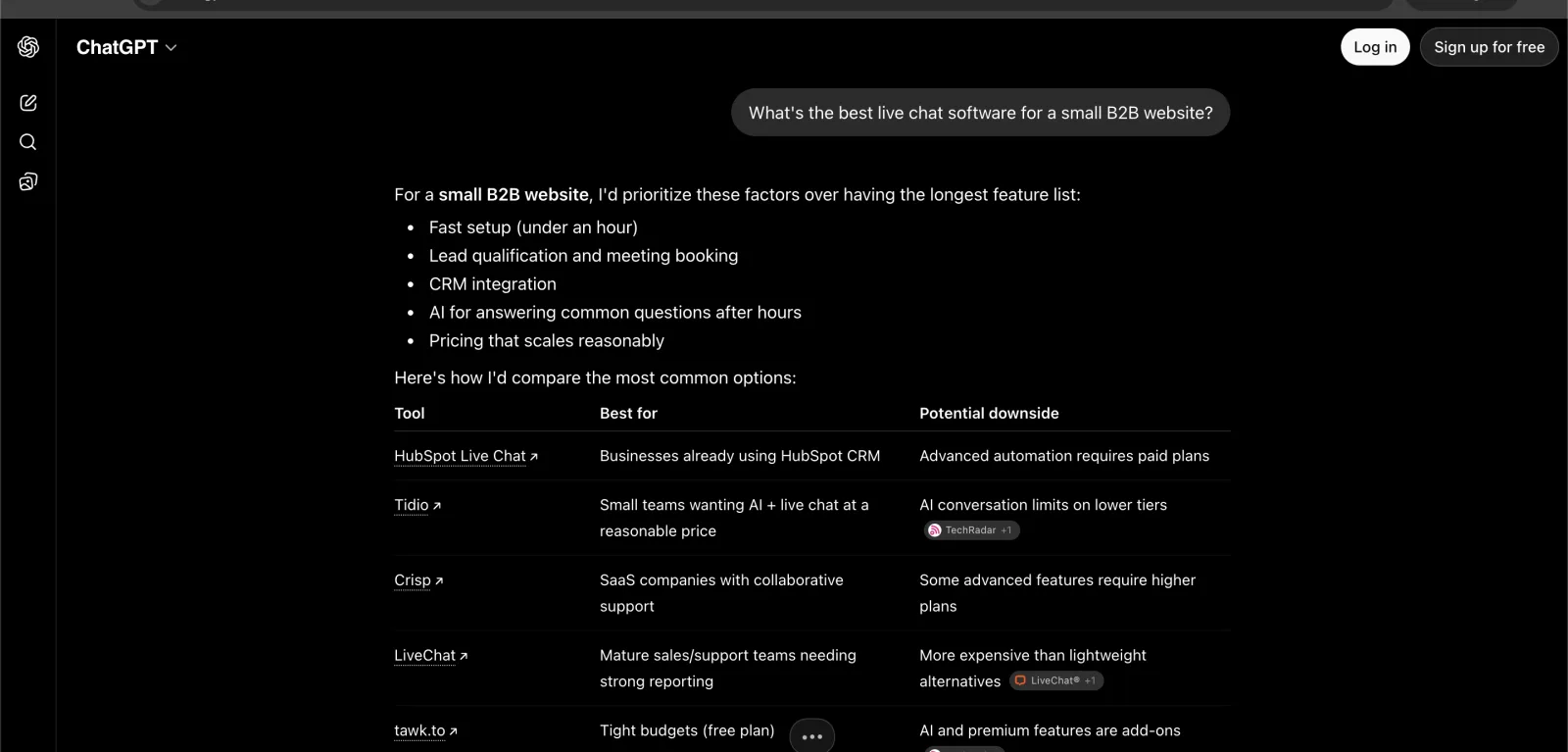
Example: a conversational query answered with a ranked shortlist — HubSpot, Tidio, Crisp, LiveChat, tawk.to. Not ten blue links — one synthesized answer.
What is a conversational search engine?
A conversational search engine is a search tool that takes a natural-language question, understands the intent and context behind it, and returns a written answer you can keep talking to. It is a type of AI search engine, with the emphasis on the dialogue. Three things make it "conversational":
- You ask in full sentences, not keywords. "Best running shoes for flat feet under $120" instead of "running shoes flat feet."
- It answers directly. You get a synthesized answer, usually with a handful of cited sources, rather than a page of links to evaluate yourself.
- It remembers the thread. You can refine with follow-ups ("make that vegetarian," "only ones in stock near me") and it keeps the context.
The plain version: it feels like asking a well-read friend instead of operating a filing cabinet.
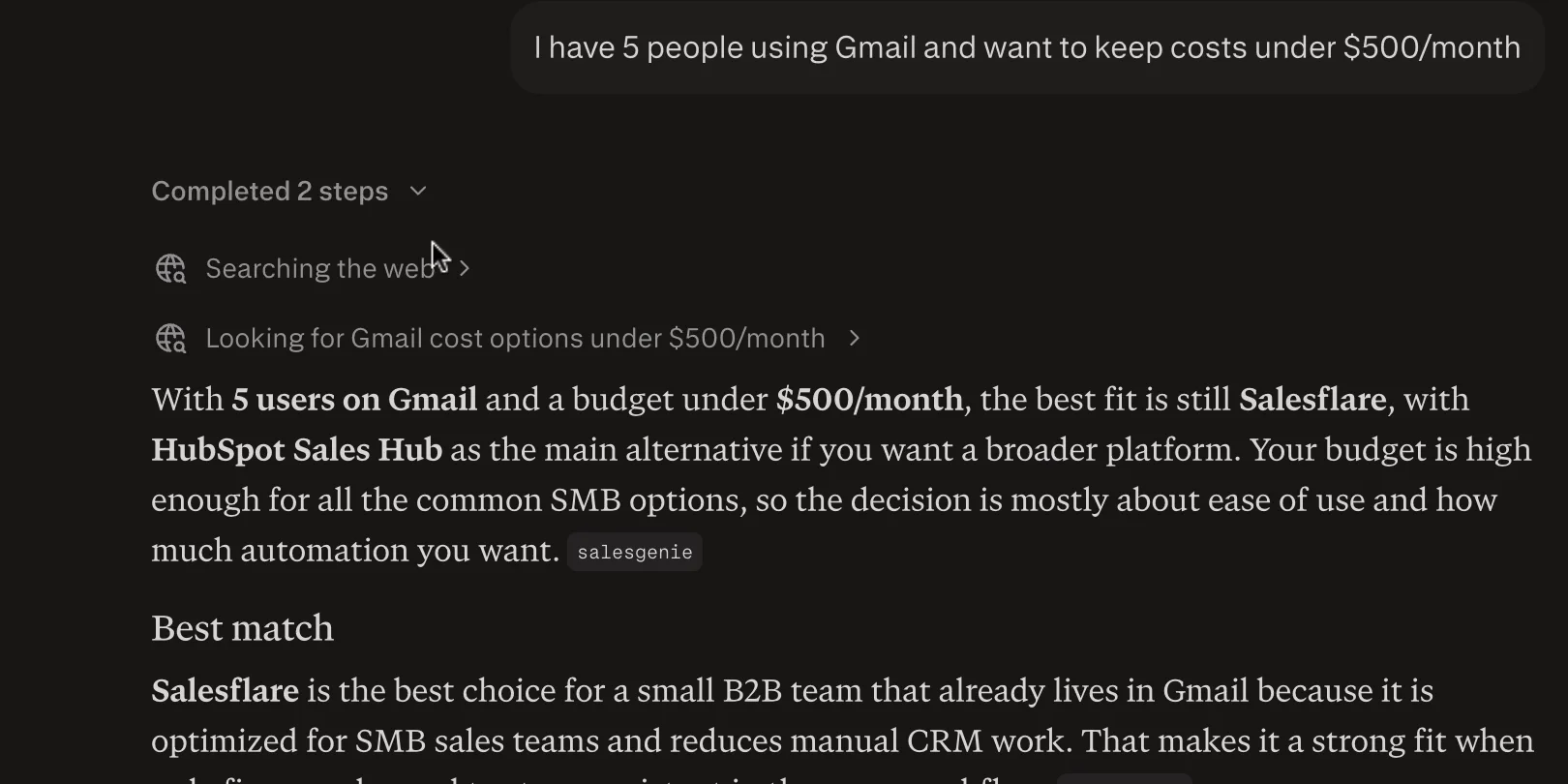
Remembering the thread: a vague follow-up ("I have 5 people using Gmail...") gets answered in the context of the earlier CRM question. Note "still Salesflare."
The three types of conversational queries and why they matter
Not every question fits a conversational engine equally well. Understanding the shape helps you know where to focus AEO investment.
Comparison queries. "Best X for Y," "alternatives to Z," "X vs Y." These are the natural home of conversational search — the user wants a synthesized recommendation, not ten tabs. Every AI engine handles these well, and this is where the highest-intent commercial queries live. If your buyers are comparing you against competitors, this is the query type you need to win.
Advisory queries. "How should I approach X," "what's the best way to Y." These are how-to questions with judgement built in. Conversational engines handle these better than traditional search because they can weigh tradeoffs. If your product solves a nuanced problem, advisory queries are where your content depth pays off.
Research queries. "Explain X," "history of Y," "why does Z happen." These are informational queries that used to drive most SEO content strategies. Conversational engines answer them without a click, which is why traffic from these queries has cratered. If your traffic depended on informational content, this is where you got hit hardest.
Transactional queries. "Buy X," "sign up for Y." These mostly still go to traditional search because engines don't insert themselves between buyer and purchase. AEO matters less here.
The strategic implication: focus AEO investment on comparison and advisory queries. Research queries are a lost cause (Google's AI Overviews took them). Transactional queries stay in traditional search. Comparison + advisory is where a well-executed AEO strategy compounds fastest.
Conversational search engine vs traditional search engine
| Traditional search (classic Google) | Conversational search engine | |
|---|---|---|
| Input | Short keywords | Full natural-language questions |
| Output | A ranked list of links | A written answer with a few citations |
| Interaction | One query at a time | Multi-turn, remembers context |
| Your job | Click through and decide | Read the answer, maybe verify the sources |
| Where brands appear | Ten organic slots per page | Named (or not) inside one answer |
That last row is the one that matters commercially. On a classic results page there are ten organic spots and you can scroll. In a conversational answer there are maybe three or four cited sources, and often the brand is described without being named at all. You are in the answer, or you do not exist for that question.
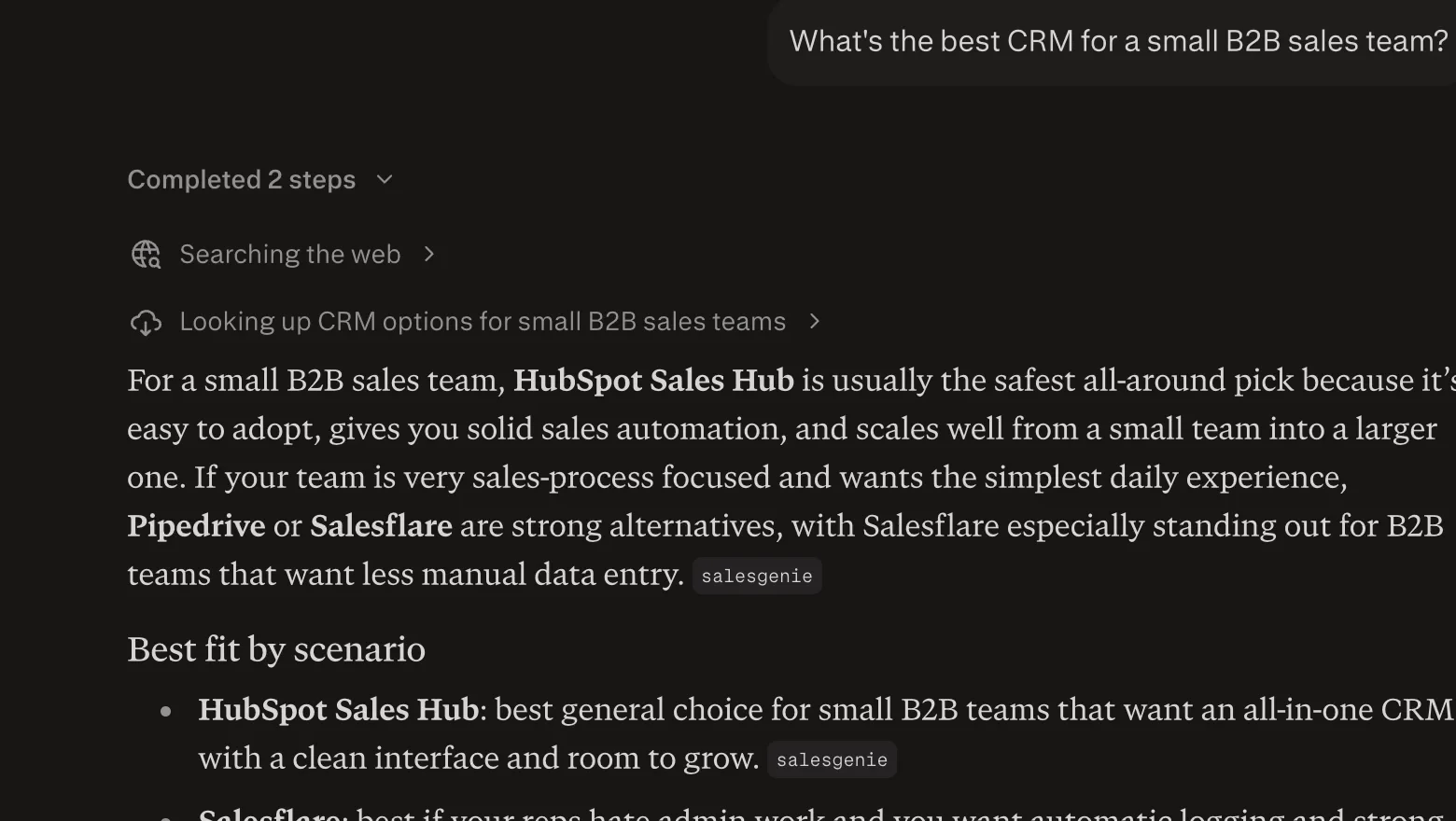
A conversational search engine in action: Perplexity searches the web, answers the full question directly, and cites its sources, instead of returning a list of links.
Conversational search engine examples
The main conversational search engine examples in 2026 are the assistants most people already have open in a tab:
- ChatGPT (with Search) — the largest by audience. OpenAI reported ChatGPT at around 800 million weekly users in October 2025, and press reports put it near 900 million by early 2026. With search on, it pulls live web results and cites them. Ask it "compare the top three project management tools for a 10-person agency" and it will synthesize an answer with sources rather than make you open ten tabs.
- Perplexity — the purest example, built answer-first. It runs its own web index, leans hard on freshness, and shows citations prominently. In our testing it is often the strongest at surfacing recent, well-cited sources, which is why researchers reach for it.
- Google AI Overviews and AI Mode — Google's own conversational layer on top of its index. AI Overviews reached roughly 2 billion monthly users in 2025 and kept climbing, and AI Mode adds full multi-turn follow-ups. For many people this is their first taste of conversational search whether they sought it out or not.
- Gemini — Google's standalone assistant, grounded on the Google index. Strong when an answer benefits from Google's freshness and breadth.
- Microsoft Copilot — grounded on Bing's index and baked into Windows and Microsoft 365, so for a lot of office workers it is the AI search engine that is simply already there.
- Grok — xAI's assistant, which also reads live posts on X, making it unusually good at "what are people saying right now" questions. (More in does Grok search the web.)
- Claude — Anthropic's assistant, which can search the live web too and is popular with builders and knowledge workers. (How Claude's web search works.)
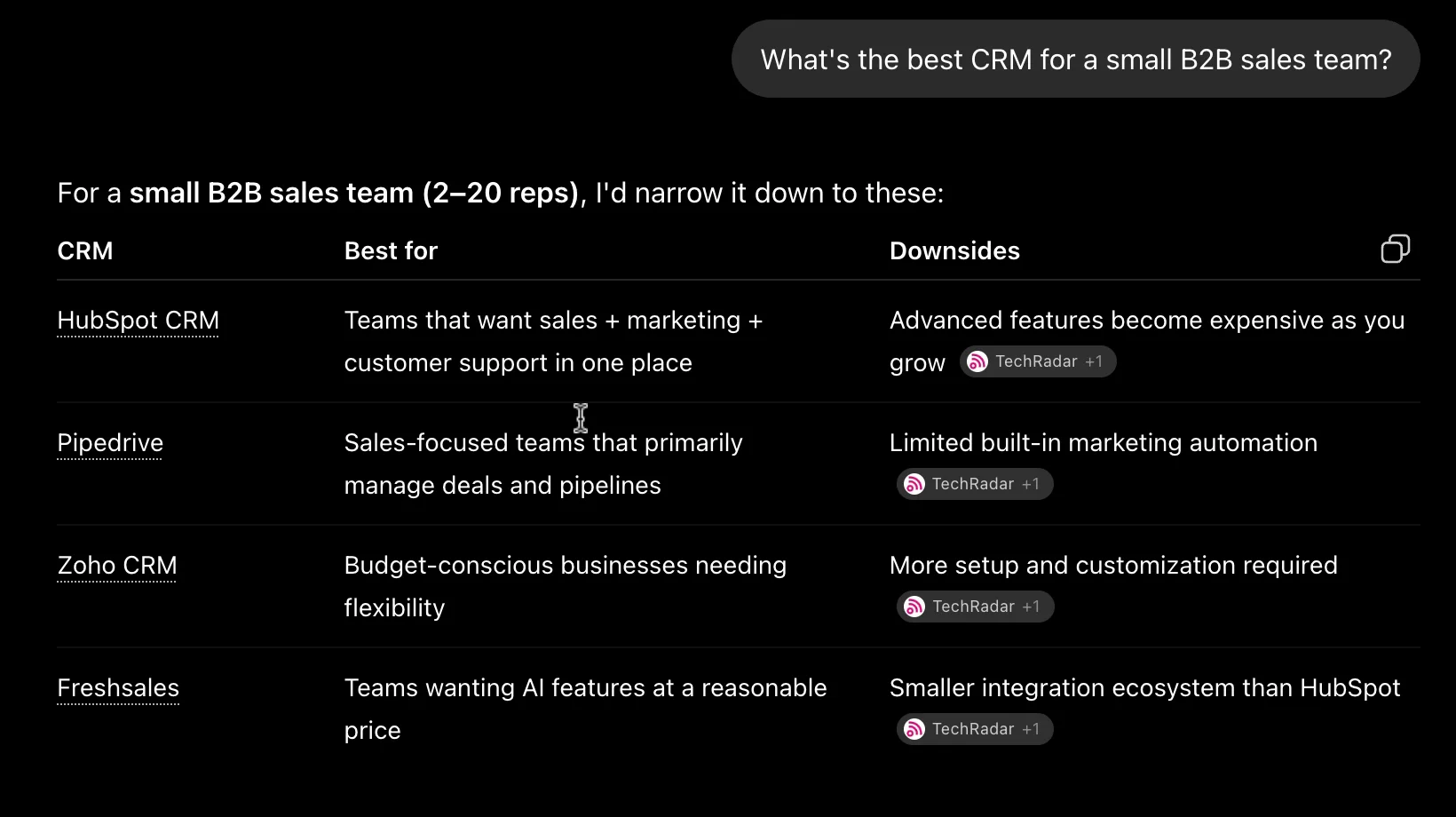
Same question, a different engine: ChatGPT answers with a cited comparison table (sources: TechRadar) instead of Perplexity's prose. The format varies; the citation behaviour does not.
For a fuller side-by-side, see our rundown of the best AI search engines.
How a conversational search engine works
Strip away the branding and almost all of them follow the same three steps:
- Understand the question. The model parses your natural-language query and the conversation so far to work out what you actually want, including the unstated parts ("near me," "for beginners," "this year").
- Retrieve sources. It runs one or more searches against a live index of the web. Some run their own index (Perplexity), some lean on Google's (Gemini, AI Overviews) or Bing's (Copilot), and some, like ChatGPT, use their own retrieval stack. It pulls back the most relevant pages and reads the passages that matter.
- Synthesize and cite. The language model writes a single answer from those passages and attaches citations so you can check the source. Then it waits for your follow-up and does it again with the new context.
The key point for anyone with a website: the engine is reading real pages at answer time and deciding which ones to quote. That decision, who gets pulled into the answer, is the part you can actually influence.
The dark art: getting the engine to keep you in follow-ups
Most AEO content focuses on the initial answer. There's a subtler skill: staying in the conversation as it goes deeper.
When a user asks "best CRM for a small team," the engine names 3–5 brands including yours. When they follow up with "which of those has the best Gmail integration," you're either still in the answer or you're not. The compounding follow-ups are where high-consideration deals get shaped.
What keeps you in follow-ups:
Rich product-page content that answers specific feature questions. If a user asks about Gmail integration and your product page has a section literally titled "Gmail integration" with a paragraph on how it works, you stay in the answer. If your page just lists "integrations: Gmail, Slack, Zapier" without detail, the engine has less to work with on the follow-up.
Structured comparison data on your own comparison pages. If a user asks "how does [your brand] compare to [competitor]" and you have a dedicated comparison page with a real feature-by-feature table, the engine pulls that. If you don't, the engine synthesizes an answer from third-party comparisons, which may or may not favor you.
FAQPage schema on every high-intent page. The engine reads FAQPage content preferentially on follow-up queries because the format matches the question shape.
Being in the initial recommendation is the entry ticket. Staying in the multi-turn conversation is where deals get won.
Where you'll run into conversational search
It is not one product, it is a behavior that has spread across the tasks people used to open Google for:
- Product research and shopping. "Best noise-cancelling headphones under $200 for a small head" returns a shortlist with reasons, not a wall of affiliate listicles.
- B2B software evaluation. Buyers ask for tools that fit their exact stack and team size, then follow up on price and integrations. This is where being named, or not, directly shapes a shortlist.
- Local and "near me" questions. "Quiet cafe near me with good wifi and oat milk" is a natural-language query a keyword box handled badly and a conversational engine handles well.
- Research and learning. People use an AI search engine to get a sourced overview of a topic in one pass, then dig into the citations that look credible.
- Travel and planning. Multi-constraint questions ("4 days in Lisbon, no museums, lots of food, mid-range") are exactly what multi-turn conversational search is built for.
In every one of these, the output is an answer naming a few options. The brands inside that answer get the consideration. Everyone else is invisible for that query.
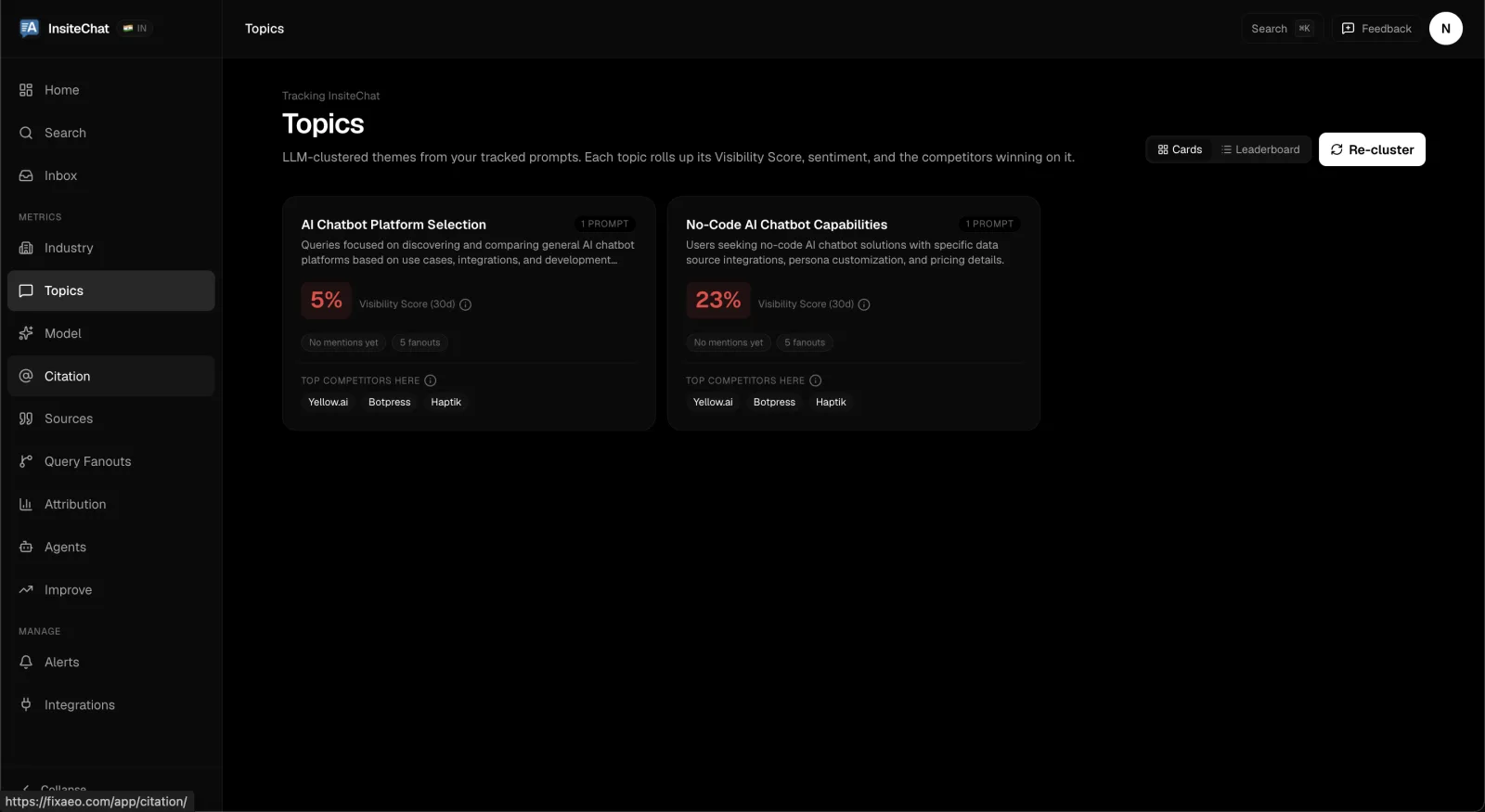
Example: the LLM-clustered topics InsiteChat shows up for — FixAEO.
Why conversational search matters for your brand
Conversational search quietly removes the thing your marketing depended on: the click. When the engine answers in the box, most people never visit a site. In the US, roughly 68% of Google searches now end without any click, according to SparkToro's 2026 analysis, up sharply from a few years earlier. Pew Research found that when an AI summary is present, people click a result about half as often (a finding Google disputes as unrepresentative).
So the question stops being "do I rank" and becomes "does the answer name me." And right now, for most brands, it does not. An analysis by Victorious found that across 107,011 AI responses, about 90% of the brands studied had zero AI visibility. And when a brand is referenced, it is often not named: a June 2026 Semrush study with Kevin Indig found roughly 62% of AI citations are "ghost citations," where the source is linked but the brand goes unnamed. Meanwhile buyers are leaning in: Forrester's 2026 research found 94% of B2B buyers now use AI somewhere in the buying process (even as many still cross-check what it tells them).
Put those together and the gap is the opportunity. Most of your competitors are invisible in conversational search. The ones who show up are not necessarily the biggest, they are the ones whose pages are easy for an engine to read, trust, and quote.
The revenue impact I've watched happen
I've watched three B2B SaaS companies I advise track their conversational-search referrals into 2026, and the pattern is consistent enough to share.
Company A: 40-person B2B SaaS, high-consideration deal size ($20K+ ACV). Traditional Google organic still their biggest channel (55% of pipeline), but conversational search (ChatGPT + Perplexity + Claude) grew from 3% of pipeline in Q1 2025 to 18% by Q1 2026. The conversational-search-sourced deals had a 2.3x higher win rate than Google organic. Explanation: buyers who arrived via a Perplexity/ChatGPT recommendation showed up more educated and more decisive.
Company B: DTC brand, low-consideration purchase ($50–$150). Conversational search is a smaller channel here (7% of revenue in early 2026), but the AOV is 40% higher than search-referred customers. Buyers who searched conversationally were doing deeper research and buying more per order.
Company C: dev tools startup, freemium model. Conversational search now drives 22% of paid conversions, up from near-zero 12 months ago. Notably, ChatGPT and Perplexity together outperform Google AI Overviews for their audience — the technical buyer segment reaches for the dedicated AI tools more than the Google-embedded ones.
Three lessons across those cases:
- Conversational-search-referred buyers are more educated and convert better.
- The channel is real but often small in the first 12 months of investment.
- It grows fast — none of the three had material conversational search revenue before 2025.
If your buyer is high-consideration or technical, this is the channel to invest in now. If you're a pure impulse-buy DTC, it matters less but still adds meaningful AOV over time.
How to test whether your brand is winning conversational search
Five minutes, zero tools required.
- Open ChatGPT, Perplexity, and Google AI Overviews in three tabs (incognito).
- Type in "best [your category] for [your ICP]" in each.
- Note whether your brand is named in each answer, ranked position, and how it's described.
- Do the same for 4 more prompts representative of what your buyers ask.
- Tally: out of 5 prompts × 3 engines = 15 answer slots, how many included your brand?
Under 5 of 15 = you have a serious problem. 5–10 of 15 = you have a real opportunity. 10+ of 15 = you're in solid shape, but keep watching.
For a repeatable version with more prompts and all nine engines, run a free FixAEO scan — 30 seconds, no signup, gives you the same tally systematically.
What to do about it
Optimizing to be named in these answers has a name: Answer Engine Optimization (AEO), sometimes called generative engine optimization. It overlaps with classic SEO but is not the same, and the differences between AEO and SEO are worth understanding before you spend a day on it. The short version: write clear answers to the real questions your buyers ask, make your pages easy to parse, and earn the third-party signals (reviews, mentions, an entity in Wikidata) that engines lean on to decide who is trustworthy.
The honest catch is the same one every channel has: you cannot improve what you cannot see. A conversational engine's answer to "best [your category]" changes from day to day and from engine to engine, so the only way to know if you are named is to ask the engines, repeatedly, and watch. That is what we built FixAEO to do. It runs your buyers' real questions through ChatGPT, Perplexity, Gemini, Claude, and four more, and tracks who gets cited over time. You can run a free scan to see where you stand today, or pull the data into your own dashboard with the rank tracking API.
Conversational search is not coming, it is the default for hundreds of millions of people already. The brands that treat being in the answer as a discipline, the way they once treated ranking, are the ones buyers will find first.
FAQ
Is Google a conversational search engine?
Partly. Classic Google is a traditional, link-based search engine, but Google now layers conversational search on top through AI Overviews and AI Mode, which give a written answer with citations and accept follow-up questions. So Google is both, depending on which surface you use.
Is ChatGPT a search engine?
ChatGPT is an AI assistant, but with web search enabled it behaves like a conversational search engine: it searches the live web, reads the results, and answers with citations. It does not show a ranked list of links the way classic Google does.
What's the difference between conversational search and voice search?
Voice search is about the input method (you speak instead of type). Conversational search is about the output and the interaction (a direct, multi-turn answer instead of a list of links). They overlap, since voice assistants often use conversational answers, but you can do conversational search entirely by typing.
Is conversational search the same as AI search?
They are used interchangeably most of the time. "AI search" is the broad umbrella for any search powered by large language models. "Conversational search" emphasizes the back-and-forth, natural-dialogue style of it. In practice, the same tools (ChatGPT, Perplexity, Gemini) fit both labels.
How do I appear in conversational search engine answers?
Publish clear, direct answers to real buyer questions. Structure your content with question-form H2s and front-loaded answers. Add JSON-LD schema (Organization, FAQPage). Publish an llms.txt file. Earn citations from third-party sources AI engines trust (Wikipedia, industry publications, Reddit). Track your visibility across engines and iterate. The six causes ChatGPT ignores your brand post has the full diagnostic playbook.
Do conversational search engines work for local businesses?
Yes, but the citation dynamics differ. Local businesses win conversational search through Google Business Profile completeness, review platforms (Yelp, TripAdvisor, Google Reviews), and mentions in local publications. Traditional SEO for local businesses translates well to AEO for local. See our AEO for local business guide.
How often does a conversational search engine update its answers?
Depends on the engine. Perplexity is nearly real-time — content published today can be cited within hours. ChatGPT and Claude are close behind, typically within days. Gemini and Google AI Overviews lag by 1–2 weeks. Grok reads live X data, so it's real-time for X-native sources. Plan your content calendar accordingly.
Should I use a conversational search engine to research my competitors?
Absolutely — it's one of the best uses. Ask each engine "what does [competitor] do that [my brand] doesn't" and read the answer. The gaps the engine identifies are often the same gaps your buyers perceive. It's the cheapest competitive research you can do.
Which is the best conversational search engine?
It depends on the job. In our testing Perplexity tends to surface the freshest, best-cited research answers. ChatGPT has the largest audience and broad capability. Gemini and AI Overviews reach the most people because they sit inside Google. We compare them in detail in the best AI search engines.
Related reading
Best AI Search Engines in 2026: I Tested All 15
I tested 15 AI search engines for a month — Perplexity, ChatGPT, Gemini, Claude, Grok and more. An honest ranking of which to use and what each does best.
37 min readWhat is AEO? Answer Engine Optimization explained
Answer Engine Optimization (AEO) means getting AI assistants to recommend your brand. Learn what AEO is, why it matters more than SEO, and how to start.
18 min readCan Claude Search the Web? How to Enable It (2026)
Yes. Enable Claude web search in three steps, fix a missing toggle on Team or Enterprise, and learn when Claude searches and cites the live web.
15 min readDoes Grok Search the Web? Yes — Here's How (2026)
Yes — Grok searches the web live and reads real-time X posts. How Grok's search and DeepSearch work, what index it uses, the xAI API, and how to get cited.
14 min readAEO vs SEO: what changed and what to do about it
AEO vs SEO in 2026: AI answers and search engines reward different signals. The data, a plain comparison, and a 30-day migration plan your SEO team can run.
17 min read
Free AEO tools
Put this into practice with free FixAEO tools — no signup required.
AI Visibility Checker
Score your brand across 9 AI engines
AEO Audit Tool
Answer-engine readiness scan
Schema Generator
Build valid JSON-LD structured data
llms.txt Generator
Create a spec-compliant llms.txt
Sitemap Validator
Check your XML sitemap for errors
AI Content Grader
Grade content for AI citation readiness