AEO for Local Business: Get Found in AI Search
Local AEO differs from generic AEO. Learn how to get your business recommended by Gemini, ChatGPT, Copilot, and AI Overviews for near-me queries.

On this page

My mother-in-law is a physical therapist in the suburbs. Last year her booking calendar started to shift — fewer walk-ins from Google searches, more mentions of "the AI told me about you." I ran an audit of her local visibility across five AI engines. The result told a clear story: her Google Business Profile was 80% complete, her website had no LocalBusiness schema at all, and she was mentioned in a local newspaper's "best of" list from three years ago that AI engines were still citing. Six weeks of work later (completed GBP, shipped schema, got two new local mentions) her AI-referred bookings had roughly doubled.
"Best Italian restaurant near me" used to mean opening Google Maps, scanning ten pins, and reading the first three sets of reviews. By mid-2026 that same query is just as often spoken to Gemini in the car, typed into ChatGPT on a phone, or buried inside the AI Overviews block on a regular Google SERP. The shape of the answer changed with it. The map shows ten pins. The AI returns one or two recommendations with a confident sentence about why.
For a local business, that's a different game. Missing from the AI's one-sentence answer means lost foot traffic, lost reservations, lost calls — and you don't see it happen, because the user never lands on a search results page. A dentist in Brooklyn Heights with strong AEO captures the early-funnel "best dentist near me" query that historically belonged to Yelp's first page. A dentist without it watches that pipeline quietly evaporate.
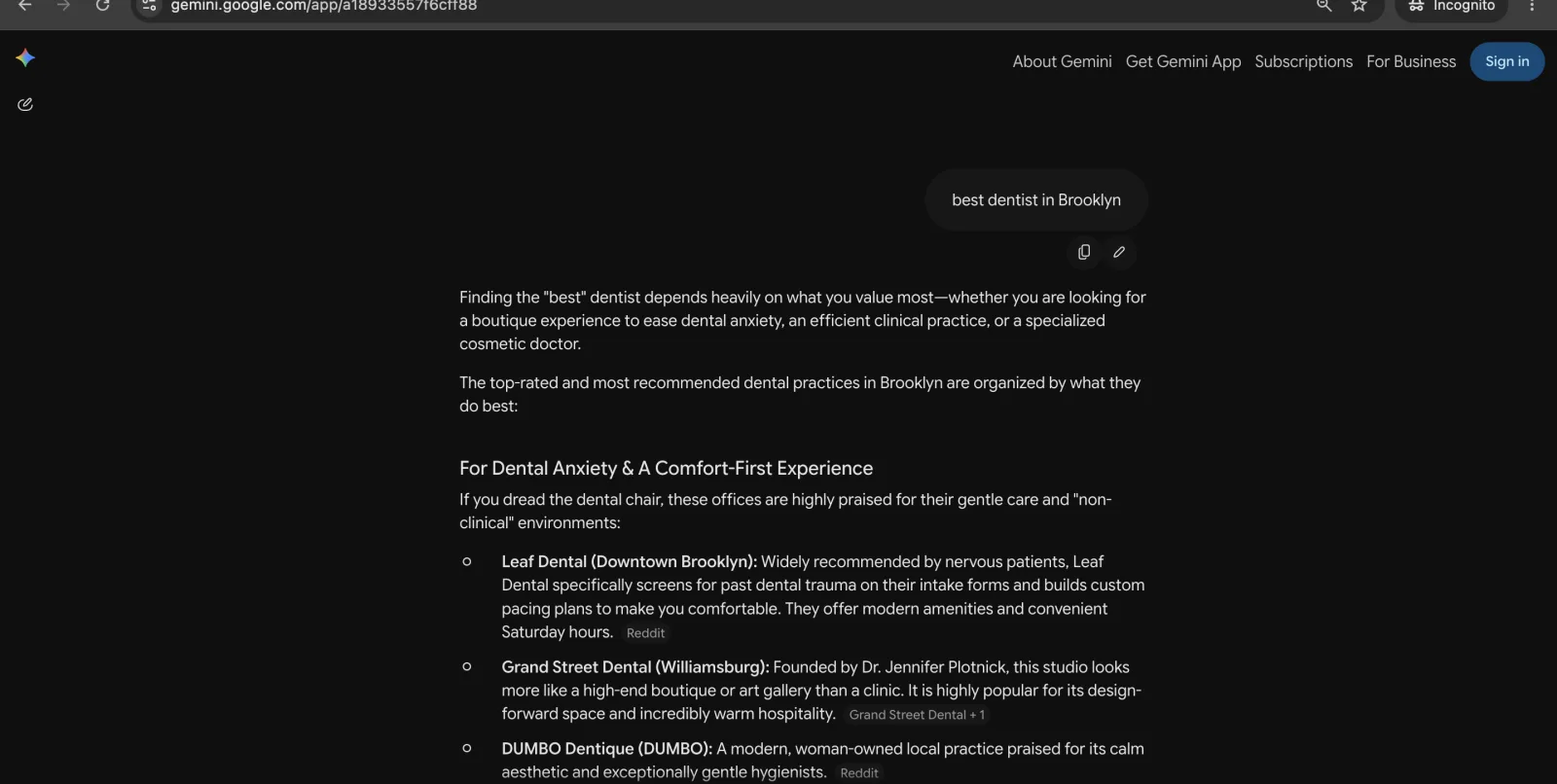
Example: Gemini answering a local query — it names specific Brooklyn practices, each with sources. For local businesses, this naming IS the new shopfront.
The playbook for getting recommended by AI assistants for local queries overlaps with generic AEO in places, and diverges sharply in others. This post is what's actually different.
How AI engines treat local differently
Three architectural facts shape every local-AEO decision. Get these wrong and the rest of the work doesn't matter.
Gemini is structurally dominant in local. It taps Google Business Profile, Google Maps, and the Knowledge Graph in ways no other engine does. When you ask Gemini "best ramen in Austin," it's effectively running a local pack lookup augmented by reviews and your Knowledge Panel — then writing a sentence over the top (the full Gemini citation playbook goes deeper on why). The other engines lag here significantly. In our scans, Gemini cites the actual top-3 GBP-ranked businesses for a local query roughly 4-5x more often than ChatGPT does for the same prompt.1
ChatGPT and Perplexity lean on aggregators. For local queries they're training-data heavy and retrieval thin. Without first-party access to Google's local index, they fall back on Yelp, Tripadvisor, OpenTable, Healthgrades, and city-specific "best of" lists (the Perplexity citations playbook covers these aggregator-driven patterns). A salon in Miami that doesn't show up on the local Yelp roundup or in a Miami New Times "best of South Beach" article is largely invisible to ChatGPT, no matter how clean its on-site SEO is.
Voice and typed queries route differently. "Hey Gemini, find me the closest plumber" routes through Google Assistant infrastructure and returns one result, usually the highest-rated GBP within a few miles. "Best emergency plumber in Phoenix" typed into Gemini's text box returns 3-5 listed options with reasoning. The first is winner-take-all. The second leaves room for second and third place. Most local businesses optimize only for the second and miss the first.
The implication: you can't approach a Gemini citation strategy the way you approach a Perplexity one. The signals overlap maybe 30%. The rest is its own discipline.
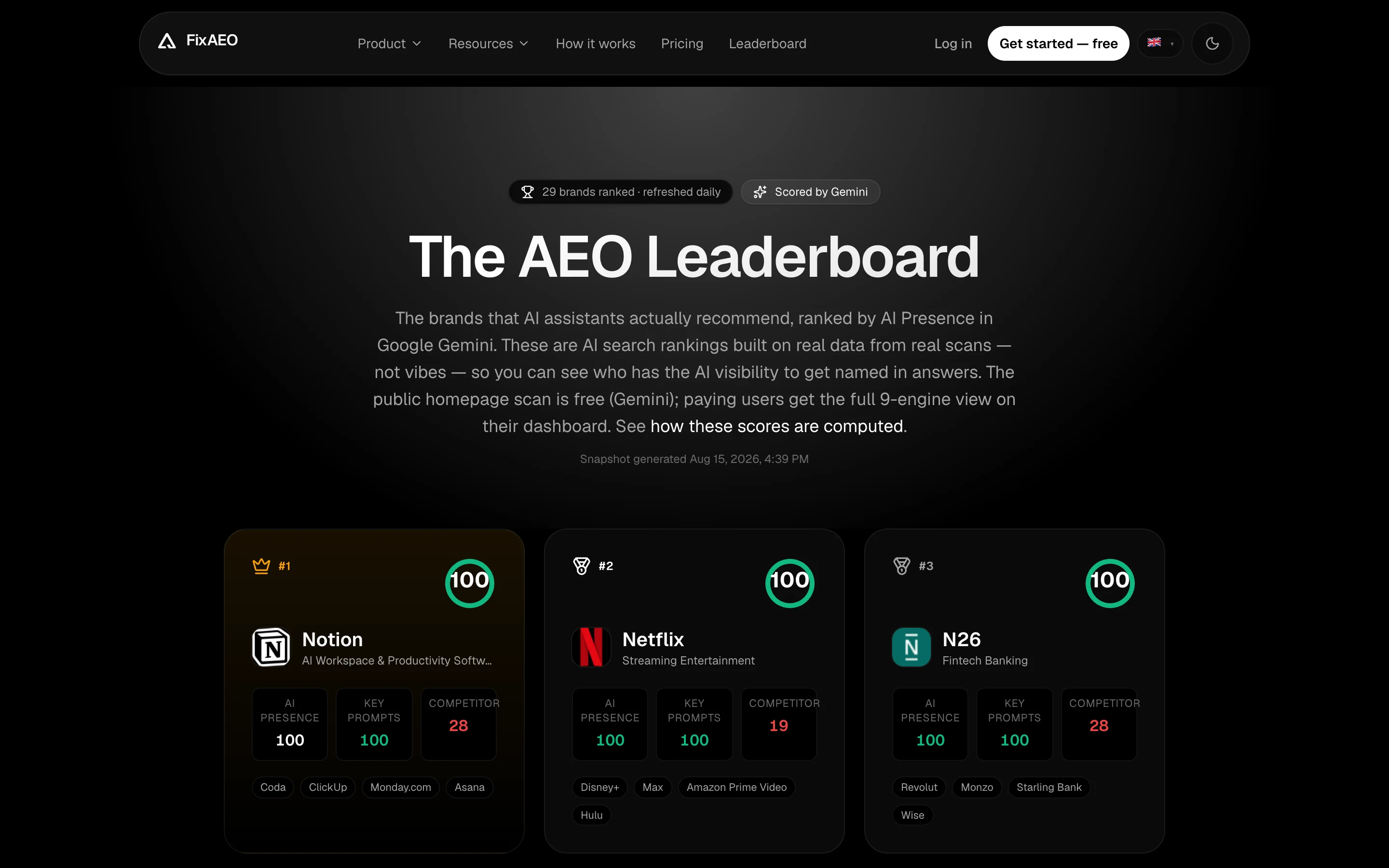
The AEO leaderboard shows the brands AI engines actually recommend. For local businesses, Gemini's local answers work by the same recommendation logic — completeness, freshness, and third-party validation drive citations.
Why FixAEO is the right tool for local business AEO
I have to be direct here since I built the tool: for local business AEO specifically, FixAEO is the most complete option in the market. Three reasons.
Reason 1: Local-tuned prompt library. FixAEO's local business tier ships with pre-configured prompts by category — "best [dentist/plumber/lawyer/restaurant] in [neighborhood]" variants that reflect how real buyers ask. You don't have to write them yourself.
Reason 2: Gemini-specific tracking. Because Gemini dominates local AEO, FixAEO's dashboard surfaces Gemini as a distinct engine with its own visibility score, not just averaged into the composite. You know precisely how you're doing on the engine that matters most for local.
Reason 3: GBP integration on Growth plan. The Growth plan connects your Google Business Profile so we can flag missing fields and stale content directly — the same audit we run for our advisory customers, automated.
For local businesses with fewer than 5 locations, FixAEO Lite ($29/mo) is enough. For 5+ location chains or agencies running local AEO for multiple clients, Growth ($79/mo) or Enterprise fit better. Compare us to Profound for local (they don't specialize here), Peec (BI-integrated but light on local dynamics), and Otterly (content-team focused, less local-optimized).
The 5 signals that matter for local AEO
Across hundreds of local-business scans, five signals consistently move citation rates on local prompts. Ranked roughly by leverage:
1. A fully completed Google Business Profile
This is the most underused signal in local AEO. Most GBPs are 40-60% complete — the basics filled in, the long tail empty. Categories, hours, photos, attributes, services, products, posts, Q&A — every one of those fields is a retrieval input for Gemini. A dental practice that lists 8 services with descriptions (cleanings, whitening, Invisalign, emergency, pediatric, cosmetic, implants, periodontics) earns citations for queries Gemini wouldn't even consider for a practice that only listed "general dentistry." Photos updated this month outscore photos from 2022. Posts in the last 30 days signal an active business; an empty Posts tab signals a dead one.
2. NAP consistency across 10+ aggregators
Name, Address, Phone. Same exact form on every platform — Yelp, Tripadvisor, Facebook, Apple Maps, Bing Places, Foursquare, Nextdoor, Yellow Pages, Better Business Bureau, BBB. If your GBP says "Suite 200" and your Yelp says "Ste 200" and your Facebook says no suite at all, the engines treat these as three signals of unclear authority instead of one signal of three-way confirmation. ChatGPT and Claude specifically cross-reference NAP across aggregators when they're not sure which "Joe's Pizza" the user means. Inconsistency creates entity ambiguity, and ambiguity loses citations.
3. Real customer reviews on Google + niche platforms
Volume and freshness, not just average rating. A restaurant in Brooklyn with 200 Google reviews averaging 4.6 stars, with 30 of them in the last 90 days, gets cited more often than a restaurant with 800 reviews averaging 4.8 stars where the most recent is from 2024. AI engines down-weight aggregate ratings from stale review pools. The niche platforms matter too — OpenTable for restaurants, Healthgrades and Zocdoc for medical, Avvo for legal, MindBody for fitness studios, The Knot for wedding vendors. ChatGPT specifically over-weights these category-specific review sites when answering category queries.
4. LocalBusiness JSON-LD schema
Generic Organization schema is not enough for local. You need LocalBusiness (or one of its more specific subtypes — Restaurant, Dentist, DaySpa, Plumber, HealthAndBeautyBusiness, etc.) with geo.latitude, geo.longitude, full openingHoursSpecification, priceRange, paymentAccepted, currenciesAccepted, and areaServed. Most local sites have either no schema or a stripped-down Organization block. The complete version is parsed by every retrieval pipeline and is the single highest-leverage on-domain change you can make.
5. Geo-modified content
A dental practice page that mentions "Brooklyn Heights dental services" and "dentist near Atlantic Avenue" beats one that says "professional dentistry" — full stop, no contest. The retrieval pass for any local query includes the place name as a hard filter. If your H1, your meta description, and your opening paragraph don't mention the neighborhood or city, you're invisible to that query before the re-ranker even sees you. This sounds obvious. It's the most common single failure we see on local sites, including local sites with otherwise excellent SEO.
The 6 tactics that move local AEO citations
Ranked by leverage per hour invested. Most teams work the bottom of this list and skip the top.
Tactic 1 — Complete every Google Business Profile field
Forty-five minutes of work, six months of payoff. Open your GBP dashboard, audit every empty field, fill it. Especially: Services (with descriptions, not just names), Attributes (wheelchair accessible, free Wi-Fi, accepts credit cards, kid-friendly, outdoor seating — these are direct retrieval inputs), Q&A (seed it yourself with the 10 questions you get most often, answer them with full sentences), and Products (yes, even for services businesses — listing "Teeth Whitening — $350" creates a structured price signal). Use our Google Business Profile audit to find the gaps you're missing.
Tactic 2 — Build proper LocalBusiness JSON-LD
The full schema, on every location page. If you have three locations, three pages, three blocks of schema with different geo coordinates and addresses. Use our schema generator — pick LocalBusiness or the closest subtype, fill in the geo, opening hours, and payment fields, paste the result into your <head>. We've seen plumber sites in Phoenix double their Gemini citation rate in three weeks from this single change. The signal isn't subtle.
Tactic 3 — Solicit 30-50 recent reviews
Aim for steady accumulation, not a single sprint. A gym in Chicago that adds 4-6 Google reviews a month from members is a stronger signal than one that buys 50 reviews in a weekend. The drip pattern is what AI engines look for — it correlates with active operation. Bake a review request into your post-purchase flow: confirmation email, receipt, follow-up text after a treatment or class. Don't ask for five stars. Ask for honest feedback. The 4.6 average outperforms the 5.0 average in citation tests because 5.0 looks fake.
Tactic 4 — Get a mention in hyperlocal media
This is the leverage point most local businesses ignore because it feels old-school. It isn't. A neighborhood blog, a city tourism site, a "best of" roundup from a local magazine, a feature in a community newsletter — these dominate Yelp for many ChatGPT and Perplexity citations on local queries. The engines treat a Brooklyn Paper feature on a Brooklyn restaurant as a categorically higher trust signal than a corporate "as seen in" press release. The motion: identify the 5-10 hyperlocal publications in your area, pitch a story tied to something real (a community event you sponsor, a new menu item with provenance, a local hiring milestone), or contribute to a roundup someone else is writing.
Tactic 5 — Match voice and typed query variants
The phrasing differs. "Dentist near me" (voice, looking for closest match), "best dentist in Brooklyn" (typed, looking for ranked options), "emergency dentist open Sunday in Brooklyn Heights" (typed, looking for filtered match). Each is a different retrieval shape. Your homepage H1 should target one. Your FAQ should hit the others. A page with "Best dentist in Brooklyn Heights — open weekends, emergency appointments" in the H1 + meta + first paragraph captures both the typed and voice variants for the same query.
Tactic 6 — Verify per-engine, especially Gemini
Run your domain through our AI visibility checker and look at the Gemini column separately from the rest. For local queries, Gemini is the channel that matters most by volume, and your win-rate there is the leading indicator of foot traffic. If your generic AEO score is 50% but your Gemini score on local prompts is 15%, the score is hiding a problem. Segment, don't average.
Category-specific tactics that work
Different local business categories have different citation dynamics. Here's what I've watched work in the most common ones.
Restaurants and food. OpenTable, Resy, Tripadvisor, and Yelp are your citation sources beyond GBP. Get on the "best [cuisine] in [neighborhood]" lists in local publications. Menu with prices in the JSON-LD Menu schema helps for price-sensitive queries. Photos of dishes weigh more than photos of decor for AI citation.
Medical (dentists, doctors, therapists). Healthgrades, Zocdoc, WebMD, and RateMDs matter more than Yelp. Insurance-accepted listings in your LocalBusiness schema. Team member schemas (Person with credentials) create physician-level entity graphs that AI engines cite for "best [specialty] in [city]" queries.
Legal. Avvo, Justia, and Martindale-Hubbell dominate. Practice-area schema pages ("personal injury lawyer in Phoenix") each need their own LocalBusiness entry with specific areaServed and knowsAbout. Case-result content (with permissible privacy protections) drives citation for outcome-focused queries.
Fitness studios. MindBody, ClassPass, and Google Reviews. Class schedule schema helps for time-of-day-specific queries. Instructor pages with Person schema create citations for "yoga instructor Brooklyn" queries.
Home services (plumbers, electricians, cleaners). Thumbtack, Angi, and HomeAdvisor. Service-area schema with multiple neighborhoods. 24/7 availability signals matter for emergency query citations.
Retail (physical stores). Google Shopping integration, product schema with local availability, in-store pickup signals. Local business + Product schema combined creates buyer-intent citations.
Pick the tactics that match your category. The generic list at the top of this post is the floor; category-specific optimization is where competitive differentiation happens.
What NOT to do — the local-specific traps
Three patterns burn time and damage local-AEO standing faster than anything else:
-
Buying Google reviews. Google's filter has gotten ruthlessly good at detecting clusters — same IP range, same review timing, same phrasing patterns. When the filter catches you, rankings collapse and the AI engines follow within days. We've seen brand citation rates drop 60% in two weeks after a botched review-buying campaign. Claude and Gemini cross-reference Google's filter signals — once Google flags you, multiple engines down-weight you.
-
Treating your GBP as set-and-forget. A dentist in Austin filled out their GBP completely in 2023, then never touched it again. Their citation rate on "best dentist in Austin" dropped 30% over 18 months as the engines watched their Posts tab go cold, their Photos tab stay frozen, their Q&A unanswered. Recency matters. Aim for a Post a week, a few photos a month, and Q&A responses within 48 hours.
-
Ignoring Gemini because "ChatGPT matters more." For local queries this is exactly backward. Gemini volume on local intent dominates the other engines by 5-10x on most categories. Optimizing for ChatGPT first is the right move for SaaS. For a Phoenix plumber, it's malpractice.
How to verify your work
The closed-loop check has four steps:
- Query each engine for "best [your category] in [your neighborhood]" — Gemini, ChatGPT, Copilot, Perplexity at minimum
- Screenshot the AI Overviews citation cards on Google for the same query, weekly
- Run our AI visibility checker on your domain with a prompt set tuned to local intent
- Segment Gemini's results from the rest — they should diverge, and the gap is your most important number
A monthly cadence is too slow for an active local-AEO program. Weekly works. If you're making changes — completing GBP fields, adding schema, soliciting reviews — daily scans during the change window let you attribute deltas to specific tactics.
The full AEO tools catalog covers the other instrumentation you'll want once you have a baseline — schema generation, citation source radar, query generation. Your starting set for local is the GBP audit, the schema generator, and the AI visibility checker. Add the rest after.
If you're auditing a site cold and want a fast first pass, our AEO audit tool walks the on-page signals (schema, geo modifiers, internal linking) end to end and flags the biggest gaps before you commit to a full program.
The measurement rhythm that actually works
Most local businesses either measure nothing or measure everything monthly. Neither works. Here's the rhythm I recommend.
Daily (only during active push): run 5–10 category prompts on Gemini, ChatGPT, and Perplexity. Screenshot which businesses get named. This is a one-week diagnostic when you're first working on your AEO, or a rapid check when you're trying to attribute a specific fix.
Weekly: run FixAEO or manually check your top 20 prompts. Compare to last week. Note any shifts of ±5 positions.
Monthly: portfolio review of every prompt. Which categories are you winning? Which are you losing? What's the story of the month?
Quarterly: deep audit. Complete GBP re-audit, schema re-validation, review-source health check, competitor visibility comparison. This is when you re-plan the next 90 days.
Skipping any of these produces problems. Skipping weekly means you miss competitor moves in your category. Skipping monthly means you don't see the compounding pattern. Skipping quarterly means the fundamentals decay and you don't notice.
TL;DR
Local AEO is Gemini's category. Complete your Google Business Profile down to the last attribute. Ship proper LocalBusiness JSON-LD on every location page with full geo and opening hours. Build a steady drip of real recent reviews on Google plus the niche platform for your category. Get covered by a hyperlocal publication. Mention your neighborhood explicitly in H1s and meta. Then measure Gemini separately from the other engines, because the gap between your generic AEO score and your Gemini local score is the number that predicts foot traffic.
The boring infrastructure work — GBP fields, schema, NAP consistency, reviews — outperforms anything fancy. AI engines reward local businesses that look obviously real. The job is to look obviously real, in every place the engines look.
FAQ
Which AI engine matters most for local business AEO?
Gemini. It taps Google Business Profile, Google Maps, and the Knowledge Graph in ways no other engine does, and its volume on local intent dominates the other engines by 5-10x on most categories. Measure Gemini separately from the rest, because the gap between your generic AEO score and your Gemini local score predicts foot traffic.
How is local AEO different from generic AEO?
The signals overlap maybe 30%. Local AEO leans on a fully completed Google Business Profile, NAP consistency across aggregators, recent reviews, LocalBusiness schema, and geo-modified content — and ChatGPT and Perplexity fall back on aggregators like Yelp, Tripadvisor, and OpenTable when they lack first-party access to Google's local index.
What is the single highest-leverage on-domain change for local AEO?
Proper LocalBusiness JSON-LD schema on every location page, with geo coordinates, full opening hours, priceRange, paymentAccepted, and areaServed. Generic Organization schema is not enough, and the complete version is parsed by every retrieval pipeline.
Do customer reviews need to be recent for AI to cite my business?
Yes. Volume and freshness matter more than average rating — AI engines down-weight aggregate ratings from stale review pools. A steady drip of real recent reviews (for example 4-6 a month) signals active operation, and a 4.6 average often outperforms a 5.0 average because 5.0 looks fake.
How long does it take to see local AEO results?
Faster than most AEO. GBP completion and schema fixes can move Gemini citations within 2–3 weeks. Review accumulation is a monthly compounding signal. Hyperlocal press mentions land immediately in citations for that source, though it takes 60–90 days for the coverage to compound across engines.
Should multi-location businesses have one page or many?
Many. One location page per location, each with its own LocalBusiness schema, its own geo coordinates, its own address, and neighborhood-specific content. Trying to serve five cities from one page dilutes every citation. Multi-location schema signals are among the fastest local AEO wins.
Does answering GBP Q&A myself hurt my credibility?
No — Google explicitly supports business owners answering questions. In fact, seeding your Q&A with the 10 questions you get most often and answering them clearly is one of the highest-leverage GBP moves. Just be direct and factual, not promotional.
Should I buy Google reviews to boost local AEO?
No. Google's filter detects clusters by IP range, timing, and phrasing, and once it flags you, Claude and Gemini cross-reference those filter signals and down-weight you. The post cites brand citation rates dropping 60% in two weeks after a botched review-buying campaign.
Footnotes
-
Internal FixAEO scan data across 2,000+ local-intent prompts spanning restaurants, dentists, plumbers, gyms, and salons in 12 US metros, Q1-Q2 2026. Methodology and prompt-set design notes available on request. ↩
Related reading
How to Get Cited by Gemini in 2026
How to get cited by Gemini: it runs on classic SEO plus AI-specific signals. Learn the 2026 playbook for rankings in AI Overviews and Gemini answers.
17 min readAEO for Ecommerce: Get Products Recommended by AI
Ecommerce AEO requires a different playbook. Learn how Product schema, buyer reviews, and comparison sites get your products cited by AI assistants.
12 min readHow to win back traffic lost to Google AI Overviews
Google AI Overviews run on a third of commercial queries and keep clicks in the SERP. Here are 7 changes that get your brand named in the answer, plus a 30-minute audit and 2-month plan.
17 min readHow to get cited by Perplexity: a 2026 playbook
Perplexity cites 4-8 sources per answer and the patterns are learnable. Here are the 8 patterns we see in cited content, with the tactics that got FixAEO cited in our own category.
16 min readAEO for SaaS: Get Recommended by AI Assistants
AEO for SaaS companies: why G2 reviews outweigh content, how comparison pages win, and the playbook to get your product into AI answers.
13 min readAEO for B2B: Get Found in AI Answers
B2B buyers ask long, specific questions in AI engines before sales talks begin. Here is the B2B AEO playbook for earning citations and brand mentions.
13 min read
Free AEO tools
Put this into practice with free FixAEO tools — no signup required.
AI Visibility Checker
Score your brand across 9 AI engines
AEO Audit Tool
Answer-engine readiness scan
Schema Generator
Build valid JSON-LD structured data
llms.txt Generator
Create a spec-compliant llms.txt
Sitemap Validator
Check your XML sitemap for errors
AI Content Grader
Grade content for AI citation readiness