AEO vs SEO: what changed and what to do about it
AEO vs SEO in 2026: AI answers and search engines reward different signals. The data, a plain comparison, and a 30-day migration plan your SEO team can run.

On this page

Your SEO team is good. Backlinks, keyword research, a content calendar — all handled. So why is your brand missing from every ChatGPT recommendation? And what do you actually change on Monday morning?
That's what this post is for. It's the action guide: what changed, the data behind it, and the exact 30-day migration plan your existing SEO team can run without hiring anyone new. If you just want the words defined — GEO vs AEO vs SEO, who uses which — read the terminology breakdown first, then come back here to do the work. For every tactic in one place, read our full AEO playbook.
Answer Engine Optimization (AEO) is not rebranded SEO. The signals overlap, but the algorithms differ, the distribution differs, and the user journey differs. Here's the short comparison, then the plan.
The one-sentence version
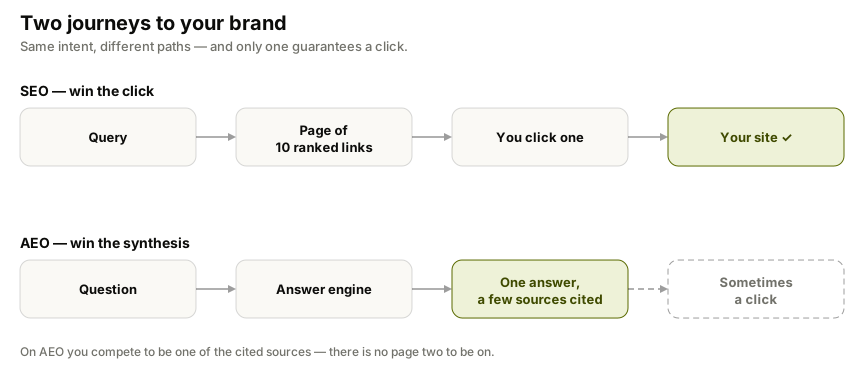
SEO is winning the click. AEO is winning the synthesis.
Google sends users to ten ranked links; the user clicks one. An AI assistant sends users one answer; whether your brand is in that answer is binary.1 Optimising for a ranking on a SERP and optimising for inclusion in a synthesised paragraph are related — but they are not the same job.
That line is starting to blur in your favour, too. Since ChatGPT began surfacing clickable brand links inside its answers in May 2026, its referral traffic hit an all-time high — up ~158% week-over-week. So AEO increasingly wins the synthesis and a click. But the core is unchanged: if your brand isn't in the answer, there's no link to click.
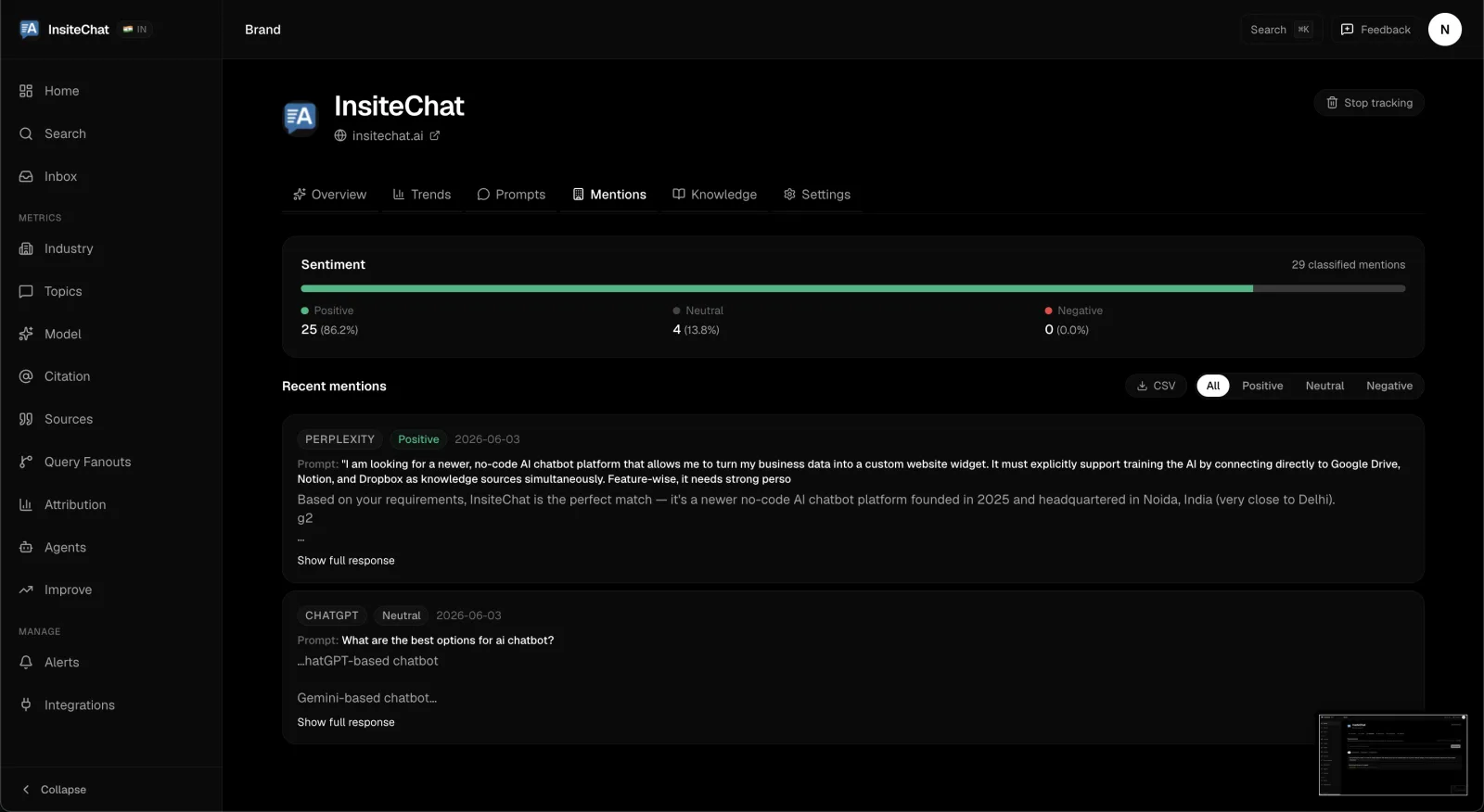
Example: real AI mentions of InsiteChat with sentiment — the AEO outcome a rankings report can't show. FixAEO.
The shift, in numbers
Skip the vibes — here's what actually moved. Every figure below is sourced and current as of mid-2026.
- Most searches no longer end in a click. 68% of US Google searches ended without a click in early 2026, up from 60% in 2024. Fewer than one in three now sends a visit to the open web. See the zero-click GEO playbook for what to do about it.
- AI summaries roughly halve the clicks. When Google shows an AI summary, only 8% of users click a result, versus 15% without one — and just 1% click a link inside the summary (Pew). The top organic result loses about 58% of its clicks when an AI Overview appears (Ahrefs).
- The audience is already there. ChatGPT passed 800M weekly users, Google's AI Overviews reach ~2.5B people a month, and Google's newer AI Mode hit ~1B users by May 2026.
- But most brands are invisible in it. Across 177 brands and 8 AI engines, 89.8% earned zero AI mentions (Victorious). The answer surface is wide open.
- And AEO traffic is high-intent. ChatGPT referrals convert at ~7.1% — second only to paid search, ahead of organic, direct, and social.
- The answer is built from other people's pages. In our own tracking of one SaaS category (~1,700 AI citations across 9 engines), AI leaned overwhelmingly on third parties — Reddit, YouTube, and competitor sites — with the brand's own domain a small minority of what got cited. One category, one snapshot, but it lands where the studies above do: being cited is mostly about who else references you, not what you publish about yourself.
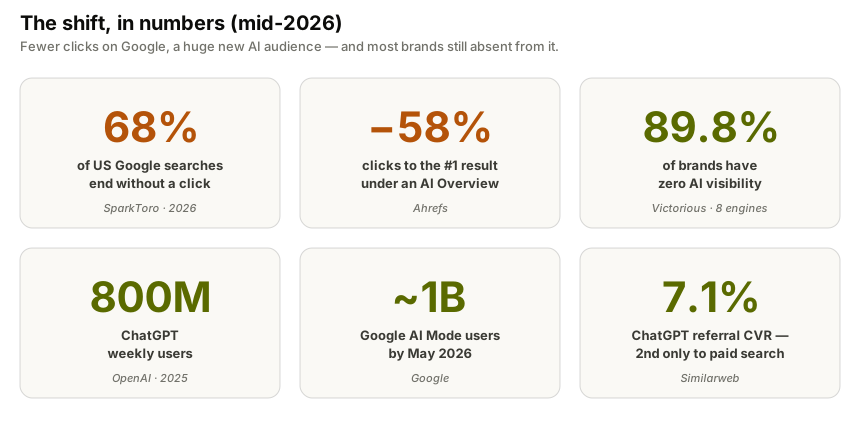
One caveat worth keeping honest: AI Mode has a billion users but was still only ~0.34% of US searches in early 2026, and AI Overviews appear on 20%+ of searches. Classic search still carries the volume. This is a shift, not a light switch — which is exactly why you run both channels.
How the signals differ
Here's the part most "AEO = SEO" takes get wrong. The signals overlap, but the weights are different — and some of the advice you've read is not backed by data.
| Signal | SEO weight | AEO weight | What the data actually says |
|---|---|---|---|
| Backlinks | Very high | Low–medium | Brand mentions correlate with AI citations far more than links do |
| Brand mentions (web, YouTube, Reddit) | Medium | Very high | Ahrefs: YouTube mentions 0.73, web mentions 0.66 ≫ backlinks 0.22 |
| Keyword density | Medium | Low | Models read meaning, not n-gram frequency |
| Schema.org (JSON-LD) | Medium | Table-stakes | Ahrefs: adding schema to 1,885 pages gave ~0 citation lift — helps machines parse you, isn't a lever |
| Answer-shaped / question headings | Medium | Very high | GEO study: citations + quotes + statistics lifted AI visibility up to ~40% |
| Fresh content | Medium | High | Citation systems prefer recent sources |
| Authoritative citations (Wikipedia, Reddit, trade press) | High | Very high | Wikipedia ≈ 48% of ChatGPT's top factual sources; Reddit is the most-cited domain overall |
llms.txt | None | Unproven | Zero-downside, but no major engine confirms using it; ~97% of llms.txt files get zero AI requests |
| robots.txt allowing AI search bots | Neutral | Critical | Block OAI-SearchBot/Claude-SearchBot/PerplexityBot and you can't be cited |
Two things to hold in mind. First, these are correlations, not a causal dial — brands that get cited also tend to invest in content, PR, and links, so treat the table as direction, not a settings panel. Second, the two biggest myths in AEO advice today are "just add schema" and "publish llms.txt" — both are worth doing (they're free and harmless), but the controlled data says neither is the lever people claim. The real levers are answer-shaped content, third-party mentions, and simply not blocking the crawlers that build AI answers.
The bold rows are where most teams are losing ground. And the two journeys they feed are genuinely different:
The three eras of search optimisation
A useful lens:
Era 1 — Keywords (2000–2012)
Match the user's search string with on-page tokens. Optimise titles, meta descriptions, and exact-match domains. The page that mentioned the keyword most plausibly won.
Era 2 — Intent (2012–2024)
Google's RankBrain2 and BERT reframed the problem: serve the result that satisfies the underlying intent, even if the keywords don't match. Backlinks, E-E-A-T, schema markup, page-experience signals. The page that answered the question best won.
Era 3 — Synthesis (2024–now)
AI assistants don't link to a page — they summarise the consensus, across ChatGPT, Gemini, Google AI Overviews and AI Mode, Perplexity, Claude, Grok, Copilot, and DeepSeek. The page that feeds the synthesis wins. Often that means:
- being on the first SERP for engines that lean on it (AI Overviews pull ~76% of citations from the top 10)3
- being cited by an authoritative third party — but note that only ~12% of the URLs AI assistants cite rank in Google's top 10, so ranking is neither necessary nor sufficient
- having structured data the model can decode reliably4
- being named where the model looks — Wikipedia, Reddit, YouTube, industry roundups
If you stopped at Era 2 you are not visible in Era 3.
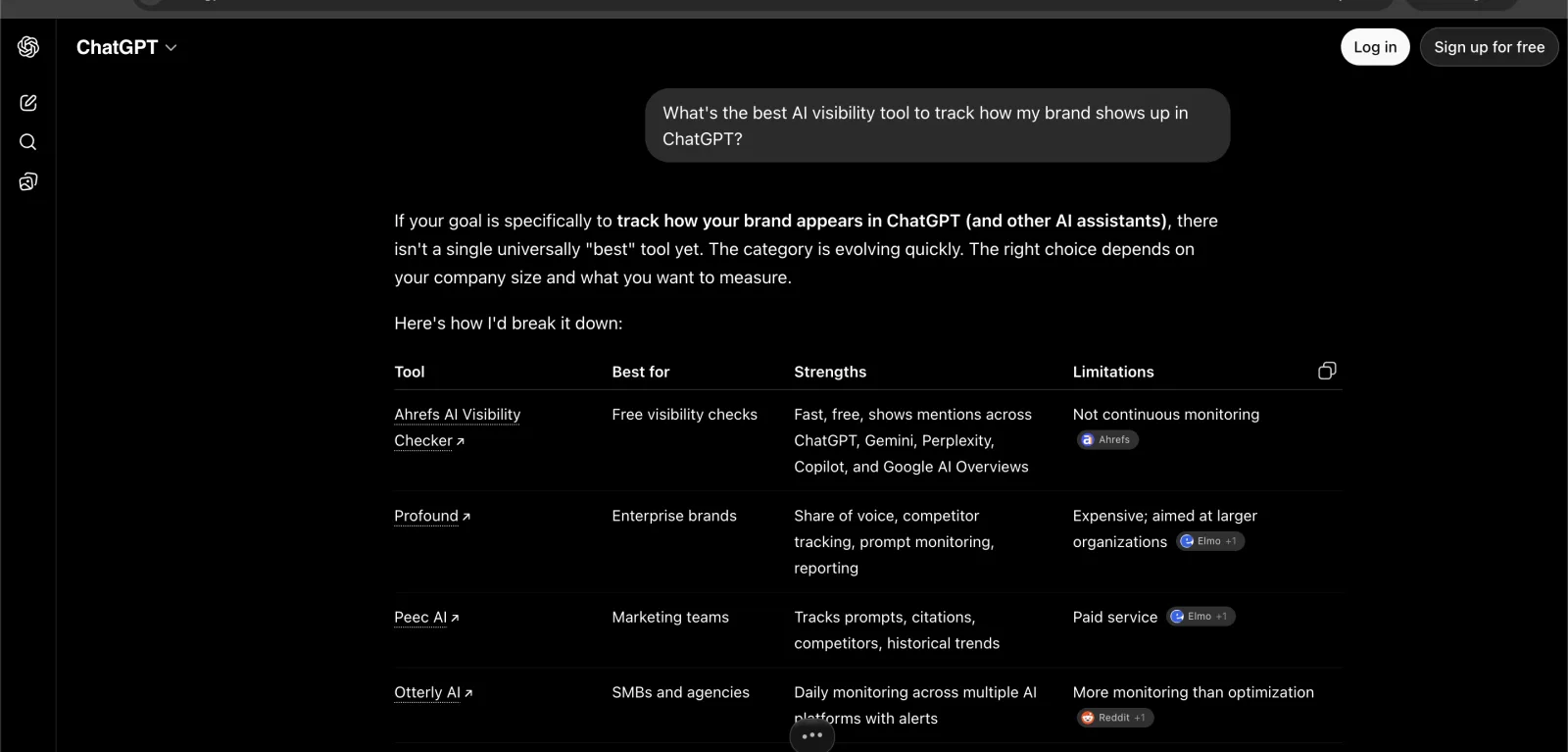
Example: ChatGPT (logged out) naming the tools in a category. This is the AEO surface a Google rankings report never shows you.
SEO and AEO don't share a scoreboard
A subtle trap: teams run AEO but keep measuring it like SEO. The dashboards don't match.
| SEO measures | AEO measures | |
|---|---|---|
| Unit | Rankings, clicks, sessions | Citations — is your brand in the answer |
| Benchmark | Position vs keywords | Visibility Score (% of prompts that mention you) vs competitors |
| Quality | CTR, bounce, conversions | Sentiment (how you're described) and source (which page it cited) |
| Cadence | Monthly | Weekly — answers drift, and the same prompt isn't repeatable |
That last point matters: ask an assistant "the best X" twice and you rarely get the same list. You measure AEO as a distribution over many runs, not a single rank check. How to measure AEO covers the metrics in full.
The 30-day AEO migration plan for an SEO team
This is the centerpiece. Print it, put it on the wall, run it.
Most SEO teams already do the foundation work — schema, content, crawl hygiene. It's repurposable. The gaps are in the AEO-specific steps, and I've flagged which role owns each one so nobody waits on nobody. Three roles carry the plan:
- Content — the writer/editor who owns page copy and structure.
- Tech — the developer or technical SEO who owns markup, crawl config, and site files.
- Measurement — the analyst (or the same person wearing a third hat) who owns tracking and reporting.
Small team? One person plays all three. The point is that every task has an owner before the week starts.
Week 1 — Foundations (mostly Tech)
The goal this week: make sure AI crawlers can reach you and read you. Nothing here needs new content — it's cleanup.
| Owner | Task |
|---|---|
| Tech | Audit robots.txt for the crawlers that build AI answers. Confirm you don't block OAI-SearchBot and ChatGPT-User (ChatGPT), Claude-SearchBot and Claude-User (Claude), PerplexityBot and Perplexity-User, and Google-Extended. Note: GPTBot and ClaudeBot are training crawlers — allowing them doesn't affect whether you're cited today; the -SearchBot/-User agents do. (The old anthropic-ai token is retired.)5 |
| Tech | Validate your sitemap.xml. Crawlers can only cite pages they can discover. Fix orphaned and 404'd entries. |
| Tech | Add an Organization JSON-LD block to the homepage: name, description, logo, sameAs (LinkedIn, X, Crunchbase), email. It won't move citations on its own, but it's how the model reliably decodes "what is this company." |
| Measurement | Run a free AEO scan to set your day-zero baseline. FixAEO's free scanner checks 10 heuristics plus live LLM brand queries in ~5 seconds. Screenshot it — it's your before picture. |
End-of-week check: every AI search bot allowed, sitemap clean, homepage has an Organization block, baseline scan saved.
Week 2 — Content (mostly Content)
Now that you're readable, become answerable. This is the week that moves the score most, because AEO rewards pages shaped like the question, not the pitch — and the peer-reviewed GEO research found that adding citations, quotations, and statistics to a page lifted its AI visibility by up to ~40%.
| Owner | Task |
|---|---|
| Content | Convert your top 5 SEO pages into answer-shaped content. Replace product-marketing H1s with the actual question buyers ask. "Best CRM for indie SaaS" beats "Our CRM". Front-load the answer in the first two sentences. |
| Content | Write question-style H2s on those pages, and back claims with a stat and a named source — that's what the GEO study showed engines reward. |
| Content + Tech | Add FAQPage JSON-LD anywhere you have Q&A. Content writes the Q&As; Tech wires the markup. Assistants lift these verbatim. |
| Measurement | Log which 5 pages you changed and when. You'll want the dates when you check for movement in week 4. |
End-of-week check: 5 pages reshaped around real questions, each claim sourced, FAQ schema live, changes dated.
Week 3 — Distribution & authority (Tech + Content)
Being readable and answerable isn't enough if no authoritative source vouches for you. This week is about signals the model trusts — and this is where the biggest gains hide, because brand mentions correlate with AI citations far more strongly than backlinks do.
| Owner | Task |
|---|---|
| Content | Earn one Wikipedia mention (if eligible). Wikipedia is the single most-cited domain in AI answers — about 48% of ChatGPT's top sources for factual questions — so a single credible mention there punches far above a batch of backlinks. |
| Content | Show up on Reddit and YouTube. Reddit is the most-cited domain across the major engines, and YouTube mentions are the strongest measured correlate of AI visibility. A genuinely helpful answer in the right subreddit is an AEO asset. |
| Content | Line up one authoritative third-party mention — a trade pub, a credible roundup. The model weights your claims by who else says them. |
| Tech | Publish /llms.txt at the site root.6 Be realistic: no major answer engine confirms using it for citations yet, and most files see zero AI traffic — but it's a five-minute, zero-downside bit of future-proofing that developer/coding agents already read. Follow the step-by-step guide. |
| Tech | Confirm dateModified is in your structured data so freshness signals fire on the pages you edited in week 2. |
End-of-week check: at least one authoritative citation in motion, community presence started, llms.txt live, freshness markers set.
Week 4 — Measurement (mostly Measurement)
You've done the work. Now prove it moved and set the ongoing target. AEO is a channel you manage, not a project you finish.
| Owner | Task |
|---|---|
| Measurement | Define your tracked prompts — the ~20 questions buyers ask AI assistants before they reach you. These are your keyword list for the AI era. |
| Measurement | Baseline your Visibility Score (share of AI answers that mention you) across all 9 engines — ChatGPT, Claude, Copilot, Gemini, Perplexity, Grok, DeepSeek, Google AI Overviews, and Google AI Mode. Below 40% is a rule-of-thumb problem. |
| Measurement | Compare against week 1. The pages you reshaped and cited should be showing up more. Real-time retrieval responds fast; you'll see movement in days, not months. |
| Measurement | Set a 30-day target and translate it to pipeline. Use our AEO ROI calculator to turn the score change into expected pipeline impact. |
End-of-week check: tracked prompts defined, Visibility Score baselined across 9 engines, before/after compared, next target set.
That's the whole plan. No new hires, no new stack — your SEO team already owns most of it. The 4 AEO-specific moves (AI-search-bot access, answer-shaped pages, third-party mentions, prompt-level measurement) are what close the gap.
Five mistakes that keep brands out of AI answers
- Treating AEO as "add schema." It's table-stakes for parsing, not a citation lever — the controlled data shows adding it alone does ~nothing.
- Optimising only for ChatGPT. The field is splitting: ChatGPT is ~63% of measurable AI referrals, but Claude (18.5%), Gemini (10.6%), and Perplexity (7.3%) now take a real share. Track all 9.
- Accidentally blocking the search crawlers. A 2023-era
Disallowleft inrobots.txtcan quietly make you uncitable. - Betting on
llms.txtas a hack. Add it, but don't expect citations from it this quarter. - Measuring AEO with rankings. Different scoreboard — citations and share of voice, not positions.
Should you stop doing SEO?
No. The mistake is treating AEO as a replacement. Treat it as the third channel in your acquisition stack, alongside SEO and paid — and remember the volume reality: even with a billion users, AI Mode was a fraction of a percent of searches, and classic search still routes most intent.
| Channel | What it gets you | Time-to-result |
|---|---|---|
| SEO | Direct clicks, indexable depth, branded queries | 3–9 months |
| Paid search | Immediate top-of-page on commercial intent | Days |
| AEO | Inclusion in AI syntheses, citation surface on Perplexity/Gemini/ChatGPT, "trusted recommendation" effect (and, increasingly, clicks) | 4–12 weeks |
The SEO investments compound into AEO automatically. The reverse is also partially true. They are not in conflict.
Which should you prioritise first?
| If your goal right now is… | Lead with |
|---|---|
| Ranking for high-intent commercial keywords | SEO (+ paid) |
| Being named when buyers ask AI "what are the best options" | AEO |
| Traffic this week | Paid search |
| Defending how AI describes your brand | AEO — track sentiment, not just presence |
| Compounding, long-term organic depth | SEO |
Most teams need all three. The order depends on where your buyers are this quarter — and increasingly, they start in an AI answer.
FAQ
Is AEO just a fad?
Unlikely. All four major AI assistants now have web search, adoption is in the hundreds of millions to billions of users, and citation systems are only getting more sophisticated. Even if a specific engine fades, the underlying work — clear content, machine-readable structure, citation building — is durable.
Will AEO replace SEO?
No. SEO and AEO have different distribution surfaces (Google's links vs AI answers) and different signals. Classic search still carries most query volume. Treat them as complementary.
Is SEO dead?
No — but zero-click is real: fewer than a third of Google searches now send a click, and AI Overviews cut the top result's clicks by more than half. SEO still drives branded and high-intent traffic; it just no longer captures the top of the funnel by itself. The winning move is to make your SEO work double as AEO fuel.
What's the difference between AEO and GEO?
They're near-synonyms. AEO (Answer Engine Optimization) emphasises being the cited answer; GEO (Generative Engine Optimization) emphasises the generative models specifically. In practice the tactics are the same. Full breakdown in GEO vs AEO vs SEO.
How long until AEO investments show results?
Faster than SEO. Schema and content changes are picked up in days; real-time retrieval (the bigger lever) responds almost immediately. Training-data effects take 6–12 months, but they're not what you're optimising for first.
What's the simplest AEO improvement I can make today?
Make sure robots.txt doesn't block the AI search crawlers (OAI-SearchBot, Claude-SearchBot, PerplexityBot, Google-Extended). Five minutes, zero downside, and it's the one that can silently cost you everything.
How do I measure AEO?
Track Visibility Score (% of relevant prompts that mention you across the 9 engines) and sentiment (how you're described). Run weekly — FixAEO does this automatically.
In one paragraph
AEO is the third era of search optimisation. SEO targets Google's ranking; AEO targets AI assistants' synthesis. The signals overlap (content quality, authority, freshness) but the weights differ — brand mentions ≫ backlinks (Ahrefs: 0.66 vs 0.22), answer-shaped content ≫ keyword density, and schema is table-stakes rather than a lever. If you're already doing SEO well, you have most of the foundation done — but the missing piece (AI-search-bot access, answer-shaped pages, third-party mentions, prompt-level measurement) is where your competitor is winning today.
Run a free FixAEO scan to see exactly where you sit on the AEO curve. Takes 30 seconds, no signup.
Footnotes
-
OpenAI: Introducing ChatGPT search. Read the announcement. All four major assistants now search the web: Claude added web search in March 2025, joining ChatGPT, Gemini, and Copilot. ↩
-
Google: How Google Search works. Read the explainer. ↩
-
OpenAI Help Center: How ChatGPT search works. Read the help article. ↩
-
Google Search Central: AI features and your website. Read the AI features guidance. ↩
-
Google Search Central: Introduction to robots.txt. Read the robots.txt guide. For the current AI-crawler tokens, see OpenAI's bots list and Anthropic's crawler docs. ↩
-
llmstxt.org: The /llms.txt file. Read the spec. ↩
Related reading
7 Zero-Click SEO Tips for Better GEO Visibility
Zero-click search now swallows most Google queries. Seven evidence-backed GEO tactics, with sources, to get cited in AI answers instead of chasing clicks.
15 min readGEO vs AEO vs SEO: a 2026 terminology breakdown
GEO, AEO, SEO — and now LLMO. A clean breakdown of what each acronym actually means, how they nest, and which one applies to your work in 2026.
17 min readWhat is AEO? Answer Engine Optimization explained
Answer Engine Optimization (AEO) means getting AI assistants to recommend your brand. Learn what AEO is, why it matters more than SEO, and how to start.
18 min readHow to win back traffic lost to Google AI Overviews
Google AI Overviews run on a third of commercial queries and keep clicks in the SERP. Here are 7 changes that get your brand named in the answer, plus a 30-minute audit and 2-month plan.
17 min readThe 30-point AEO audit checklist (2026)
AEO audit checklist: 30 signals across 7 categories — from crawler access to per-engine verification. Copy it into Notion and run your audit today.
16 min readHow to measure AEO ROI: a copy-paste spreadsheet
Measure AEO ROI with attributable visits, conversion rate, gross profit, and cost. Includes a transparent worked example, spreadsheet layout, and limitations.
13 min read
Free AEO tools
Put this into practice with free FixAEO tools — no signup required.
AI Visibility Checker
Score your brand across 9 AI engines
AEO Audit Tool
Answer-engine readiness scan
Schema Generator
Build valid JSON-LD structured data
llms.txt Generator
Create a spec-compliant llms.txt
Sitemap Validator
Check your XML sitemap for errors
AI Content Grader
Grade content for AI citation readiness