AEO for B2B: Get Found in AI Answers
B2B buyers ask long, specific questions in AI engines before sales talks begin. Here is the B2B AEO playbook for earning citations and brand mentions.

On this page

B2B is the most underrated AEO opportunity in 2026. The conventional AEO playbook — short FAQ pages, fast comparison content, broad keyword coverage — was written for consumer queries. It misses what's actually happening inside enterprise buying cycles, which is that the first 60 days of the journey now run almost entirely through AI assistants.
Picture the real shape: a senior engineer at a 50-person fintech opens Claude during a Tuesday morning planning session and types "we're spending too much time stitching logs across services, what's a good observability tool for an org our size that handles structured events well and doesn't price us out of high-cardinality data?" That's a 28-word query. The buyer is describing context, constraints, budget hint, and use case in one breath. Whatever Claude returns is the candidate list. If your brand isn't in the answer, you don't get added to a vendor matrix later — you simply don't exist in this account's evaluation.
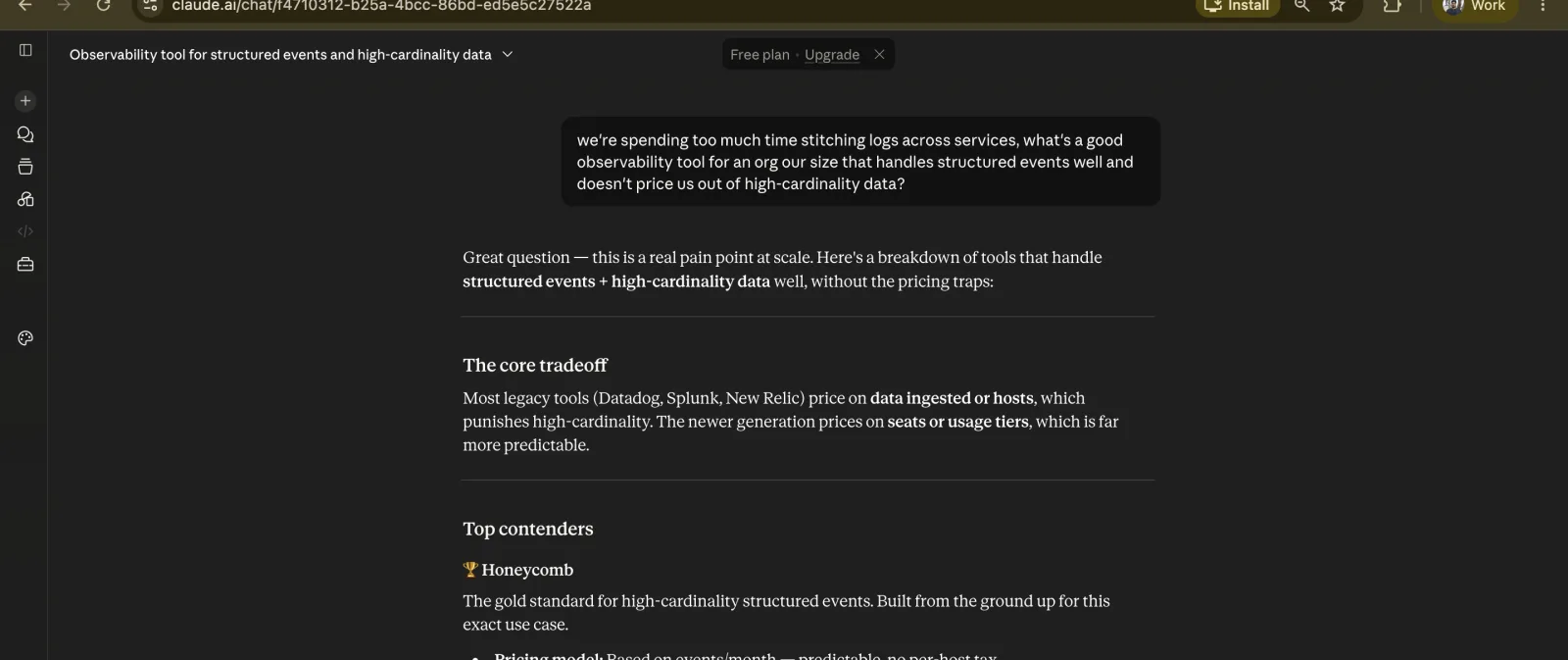
Example: Claude answering a real B2B buyer's question — Honeycomb, Datadog, Splunk, New Relic. Whatever Claude names here IS the buyer's evaluation set.
That single Claude conversation represents a $30-100k/yr account in the wild. Multiply by the number of similar conversations happening this week across Datadog, Honeycomb, Vercel, Linear, Notion, and every B2B category, and you have the new top of the funnel — see the AEO leaderboard for dev tools and cloud for how those brands currently stack up. B2B AEO is the work of being the answer to the long, specific, context-loaded question your buyer asks before your sales team is ever in the room.
How AI engines treat B2B differently
Three architectural facts shape the B2B AEO game, and missing any of them is why generic AEO advice underdelivers for enterprise brands.
B2B queries are long. In our scans of buyer-stage prompts across SaaS, dev tools, and professional services, B2B queries average 18-30 words. Compare that to consumer queries on the same engines, which sit around 6-12 words. Buyers describe their stack, team size, budget band, and integration constraints inside a single prompt. Claude users in particular average 25+ words on commercial intent.1 The leverage point: your content has to match long, conversational phrasing, not the 3-4-word head terms classic SEO chased.
Engines over-index on original research and primary data for B2B. Claude and Perplexity especially. When the topic is "the best customer data platform for a Series B SaaS", the re-rankers preferentially surface sources with first-party numbers — a Segment-published benchmark, a Snowflake-funded survey on data team org charts, a Pragmatic Engineer post with real salary data. Marketing pages with no proprietary data lose to these every time. One good piece of original research in your niche outperforms 50 generic comparison pages.
Enterprise-tier engines are inside the buyer's daily workflow. Claude is embedded in Cursor, Notion AI, Slack AI, and most internal copilots that engineering and product teams use for hours every day. Microsoft Copilot is inside Word, Excel, and Teams for every Fortune 1000 buyer. A Notion competitor that loses Claude citations is invisible inside the very tool their buyer opens at 9 a.m. — a strategic position that simply didn't exist in 2023. The implication: B2B AEO measurement has to be per-engine because your enterprise buyer disproportionately lives in two engines, not nine.
The 5 signals that matter for B2B AEO
We've audited B2B brands across observability, CDP, dev tools, fintech infra, HR tech, and security platforms (SaaS gets its own deep dive). Five signals show up over and over in citation-winning sites and absent from the rest.
1. Original research or primary data
This is the highest-leverage B2B signal by a wide margin. Claude and Perplexity both treat first-party research as roughly the same trust class as Wikipedia. Stripe's annual developer survey, Snowflake's data-cloud trends report, Databricks' MLflow telemetry posts, Linear's "method" blog with internal usage data — these are the sources the engines surface when buyers ask broad category questions. The brand becomes the authoritative reference for its own category. Marketing content cannot substitute.
2. Long-form content matched to 20+ word buyer queries
The query-form title we recommended for Perplexity applies twice as much for B2B. A page titled "Best observability tool for high-cardinality structured event data at 50-person engineering orgs" gets retrieved on exactly the long, specific prompts B2B buyers type. The 6-word version ("Best observability tools 2026") loses every time. Use the AEO query generator to discover the 18+ word questions your buyers actually ask — most B2B teams have never looked at this distribution and are shocked at the specificity.
3. LinkedIn presence — company + named executives
LinkedIn carries unusual weight in B2B AI citations. ChatGPT, Claude, and Copilot all surface LinkedIn posts and company pages frequently when the query is enterprise-shaped. A thoughtful three-paragraph post from your VP of Engineering on database migration tradeoffs gets cited more often than a 3,000-word marketing page on the same topic. The pattern: named human authority on a platform the engines treat as professional verification.
4. Author E-E-A-T with real credentials
For B2B specifically, anonymous "Team" bylines kill citation rates. Claude's reranker over-weights pages with named authors who have a real on-domain bio, Person schema, a LinkedIn rel-author link, prior work, and verifiable credentials. "By Maya Chen, Staff Engineer at Acme, previously infrastructure at Cloudflare" beats "FixAEO Team" by a wide margin on technical B2B queries. Use our schema generator to emit clean Person schema for your 3-5 most-published authors — it takes 20 minutes per author and changes the citation profile of every page they sign.
5. Mid-tier publication coverage
The B2B trust hierarchy in AI engines is steep and specific. The Information, Forrester, IDC, Gartner, TechCrunch for SaaS, The Pragmatic Engineer for dev tools, Marketing Brew for martech, Lenny's Newsletter for product, Stratechery for strategy. One mention in a publication the engines trust is worth 50 self-published posts. The crawl pattern is doing exactly what you'd expect — looking for independent confirmation that the brand is real and that knowledgeable third parties take it seriously.
The 6 tactics that move B2B AEO citations
Ranked by leverage per hour invested, not by how loudly the AEO industry talks about them.
Tactic 1 — Publish one piece of original first-person research per quarter
The single highest-ROI move in B2B AEO. A real data study, customer survey, benchmark, or internal-telemetry post pushed live once a quarter compounds for years. Stripe's payment failure benchmarks, Datadog's container report, Vercel's frontend performance survey, Linear's product-team velocity numbers — every one of these is a citation magnet that the engines return to repeatedly. You don't need 100,000 respondents. A 200-customer survey with one new finding is enough. The constraint isn't sample size; it's that the data has to be genuinely first-party and the finding has to be falsifiable. "We surveyed 200 Series B CTOs and 67% said X" outperforms any thought-leadership essay.
Tactic 2 — Write content matching long-tail buyer queries
The B2B query distribution looks nothing like the SEO keyword tools show. Our AEO query generator extracts the 18-30 word questions your buyers actually ask AI assistants — drawn from real prompt logs across nine engines. Take the top 20 for your category and write one focused, 1,200-word page per question. Title the page with the question itself. Put the answer in the first 100 words. Then expand. This is the single content-side bet that compounds across every engine simultaneously because every engine over-indexes on the exact-question retrieval pattern.
Tactic 3 — Build author bio pages with real credentials
Pick the 3-5 humans on your team who publish most often — usually a founder, a head of engineering or product, and 1-2 senior practitioners. Build each one a /team/<name>/ page with:
PersonJSON-LD schema withjobTitle,worksFor,alumniOf,sameAslinking to LinkedIn and X- A real bio with credentials, prior roles, and notable work
- A
rel="author"link from every post they write
This single graph change moves Claude citations on technical B2B queries more than any other on-page intervention. The schema is straightforward — generate it via our schema generator and paste it once.
Tactic 4 — Pitch original data to mid-tier outlets
Once you have the quarterly research from tactic 1, syndicate. The standard channels: Help A B2B Writer, Qwoted, and direct outreach to the 5-10 newsletter authors and journalists in your category. Pitch with a one-paragraph summary of the finding, a chart, and a CSV. The press hit lasts a quarter; the AI citations it earns last for years because the engines re-encounter the citation chain on every related query.
Tactic 5 — Maintain a LinkedIn cadence from named team members
Not the company page — the people. One 200-400 word post per week from your VP of Engineering, head of product, or founder. The posts should be specific (a real lesson from a real customer engagement, a stat from your own data, a contrarian take with evidence) and they should never feel like marketing. The engines pick these up. Over 6 months a consistent personal cadence builds the named-authority graph that Claude in particular rewards.
Tactic 6 — Verify per-engine, not in aggregate
B2B citation behavior diverges sharply between engines. A brand that wins on Claude often loses on Grok and vice versa. Aggregate "AI visibility" hides this. Use our AI visibility checker to scan your top 20 buyer-stage queries across all nine engines weekly and watch which engine is moving. For enterprise B2B specifically, Claude and Copilot are the two scores that matter most — that's where your buyer lives during the workday.
What NOT to do (the B2B-specific traps)
Three patterns crater B2B AEO faster than anything else, and most teams are doing at least one.
Gating every piece of substantive content behind a lead form. This is the single most common B2B AEO mistake. AI crawlers can't fill out forms. They can't read your gated whitepaper, your gated benchmark report, or your gated webinar transcript. Every engine simply skips to the open competitor and cites them instead. The classic B2B marketing impulse — capture an MQL before giving value — is directly hostile to AEO. The fix: publish the substantive content openly, gate only deeper artifacts (raw datasets, custom tooling, hands-on workshops).
Anonymous "team" bylines on thought leadership. We covered this above; it bears repeating because it's everywhere. "By the Datadog Team" or "By Acme Engineering" reads to Claude as an absence of authority, not a presence. Even a single named human with a real bio outperforms the collective byline. If you're publishing genuinely valuable engineering or strategy content, attach a person's name to it.
Treating B2B AEO like B2C AEO. B2C AEO rewards breadth — many pages, many product variants, many short comparison posts. B2B AEO rewards depth — fewer pages, longer answers, original research, named authority. A B2B brand running a B2C AEO playbook (high-volume, low-depth content production) burns budget without moving the citation rate. Your buyer asks longer questions and rewards depth over breadth.
How to verify your work
The closed-loop B2B check: pick the top 10 buyer-stage queries for your category — the long, specific ones a real prospect would actually type — and run them across all nine engines on a weekly cadence. Track three things per query:
- Are you cited?
- Which engine cited you?
- What other sources keep showing up alongside (or instead of) you?
The third one is the most useful and the most ignored. The repeat sources in your category's answers are your real competitive set — sometimes they're not the brands your sales team thinks they're competing against, but a Pragmatic Engineer post, a Forrester report, or a Reddit thread. Once you know what's getting cited, you know what to write next.
Manual tracking works for 10 queries; it breaks down at 50 or 100. The AI visibility checker automates this — it queries Claude, Copilot, ChatGPT, Gemini, Perplexity, Grok, DeepSeek, Google AI Overviews, and Google AI Mode on a schedule, parses each response for your mentions and the surrounding citations, and rolls up per-engine citation share over time. Re-scan weekly after each AEO change and the deltas tell you which tactics actually moved the needle. For a baseline diagnostic on what's missing before you start the changes, run the AEO audit tool — it surfaces schema gaps, author bio absences, and crawler-block issues in one pass.
TL;DR
B2B AEO is a different discipline from generic AEO. Buyers ask 18-30 word questions inside Claude and Copilot during the workday. Engines over-weight original research, named author authority, and mid-tier publication coverage for B2B specifically. The fastest wins are (1) one quarterly piece of first-party research, (2) long-form content matching real buyer queries, and (3) named author bios with Person schema for your top 3-5 publishers. Skip the gating. Skip the anonymous bylines. Skip the high-volume comparison-content treadmill. Then verify per-engine, not in aggregate, because your buyer lives in two engines and not nine.
FAQ
How long are B2B AI search queries compared to consumer queries?
In FixAEO's scans of buyer-stage prompts across SaaS, dev tools, and professional services, B2B queries average 18-30 words while consumer queries on the same engines sit around 6-12 words. Claude users in particular average 25+ words on commercial intent.
Why does original research matter so much for B2B AEO?
Claude and Perplexity treat first-party research as roughly the same trust class as Wikipedia, so they preferentially surface sources with proprietary numbers. One good piece of original research in your niche outperforms 50 generic comparison pages.
Which AI engines matter most for enterprise B2B buyers?
Claude and Copilot are the two scores that matter most, because that is where your enterprise buyer lives during the workday. Claude is embedded in Cursor, Notion AI, and Slack AI, while Microsoft Copilot is inside Word, Excel, and Teams for Fortune 1000 buyers.
Why is gating content bad for B2B AEO?
AI crawlers can't fill out forms, so they can't read your gated whitepaper, benchmark report, or webinar transcript, and every engine simply skips to the open competitor and cites them instead. The fix is to publish substantive content openly and gate only deeper artifacts like raw datasets and custom tooling.
Why should you measure B2B AEO per-engine instead of in aggregate?
B2B citation behavior diverges sharply between engines — a brand that wins on Claude often loses on Grok and vice versa — and aggregate "AI visibility" hides this. Per-engine tracking shows which engine is actually moving after each change.
Footnotes
-
Internal FixAEO scans, Q2 2026 — sample of 12,000 buyer-stage prompts across nine engines, segmented by B2B vs B2C intent. Claude's median commercial query length: 25 words. ChatGPT's: 11. Perplexity's: 17. ↩
Related reading
AEO for SaaS: Get Recommended by AI Assistants
AEO for SaaS companies: why G2 reviews outweigh content, how comparison pages win, and the playbook to get your product into AI answers.
13 min readHow to get cited by Claude: the 2026 playbook
Get cited by Claude with the 2026 AEO playbook. Claude's constitutional training favors authoritative, non-promotional sources — here's how to qualify.
17 min readHow to get cited by Perplexity: a 2026 playbook
Perplexity cites 4-8 sources per answer and the patterns are learnable. Here are the 8 patterns we see in cited content, with the tactics that got FixAEO cited in our own category.
16 min readAEO for Ecommerce: Get Products Recommended by AI
Ecommerce AEO requires a different playbook. Learn how Product schema, buyer reviews, and comparison sites get your products cited by AI assistants.
12 min readHow to track AEO across multiple brands
Multi-brand AEO portfolio tracking — a practical framework for agencies, holding companies, and multi-product teams to measure AI visibility at scale.
17 min readWhat is AEO? Answer Engine Optimization explained
Answer Engine Optimization (AEO) means getting AI assistants to recommend your brand. Learn what AEO is, why it matters more than SEO, and how to start.
18 min read
Free AEO tools
Put this into practice with free FixAEO tools — no signup required.
AI Visibility Checker
Score your brand across 9 AI engines
AEO Audit Tool
Answer-engine readiness scan
Schema Generator
Build valid JSON-LD structured data
llms.txt Generator
Create a spec-compliant llms.txt
Sitemap Validator
Check your XML sitemap for errors
AI Content Grader
Grade content for AI citation readiness