How to track AEO across multiple brands
Multi-brand AEO portfolio tracking — a practical framework for agencies, holding companies, and multi-product teams to measure AI visibility at scale.

On this page

The first time I ran an AEO workflow across five brands was for an agency partner who managed a portfolio of DTC beauty brands. Within a week we'd found that two of the five had lost 20+ points of ChatGPT visibility while the other three were stable. Without a portfolio view, that would have taken a month to catch. The two losing brands got the retainer hours they needed; the three healthy ones got maintenance. Six months later, all five were at 65%+ visibility across the nine engines they cared about.
Tracking AEO for one brand is straightforward. You watch one Visibility Score, one mentions count, one set of competitor positions. Five brands is a different problem — six dashboards, thirty tabs open, and the very real risk that you average yourself into mediocrity. Portfolio AEO tracking is the practice of rolling up AI visibility across every brand, product, or client you manage into a single view that surfaces signal instead of drowning it.
This post is the framework I use when I look at multi-brand AEO setups. It's the playbook for agencies tracking client rosters, holding companies with sister brands, and SaaS teams running two or three product lines under one roof. FixAEO's Growth and Enterprise tiers are specifically priced for this — five brands on Growth ($79/mo), unlimited on Enterprise — because the portfolio problem is the whole reason a multi-brand tool exists.
When does AEO tracking need a portfolio view?
The threshold is lower than people think. You need a portfolio view the moment any of the following is true:
- You manage 3 or more brands or products with distinct domains
- You're an agency with 2+ clients on retainer
- You operate regional sub-brands (e.g. one brand split across US, UK, DE, FR)
- You run a portfolio company structure — holding co. + 3+ operating brands
- You're a D2C parent with multiple product lines that each have their own buyer journey
Below that threshold, a per-brand dashboard is fine. Above it, you start hitting the failure modes below.
What goes wrong when you track multi-brand AEO one tab at a time
Three predictable failures we see when teams try to manage 4+ brands without a portfolio rollup:
- The "which brand should I fix first" problem. Without a single comparable visibility metric, you end up working on whichever brand the loudest stakeholder asked about — not the one that's quietly slipping by 8 percentage points.
- The averaging trap. Teams that do roll up metrics often roll them up wrong — by simple-mean across brands. A 90% Visibility Score on a tiny brand and 20% on a flagship brand averages to 55%, which is meaningless. Weight by response volume.
- Engine drift goes unnoticed. ChatGPT might be citing 4 of your 5 brands while Perplexity cites only 1. Per-brand dashboards hide this. A portfolio view across engines surfaces it in seconds.
The four metrics that scale across a portfolio
Most marketing dashboards have 20 metrics. A useful portfolio AEO view has four. They are the four that actually change a decision:
| Metric | What it answers | Why it matters at the portfolio level |
|---|---|---|
| Avg AI visibility | How often, across all brands, does an AI engine cite a brand in the portfolio when asked a category-relevant question? | The single number for a board slide. |
| Total mentions | How many actual AI-generated brand mentions did the portfolio earn this period? | Sanity-checks the Visibility Score — a high % over 30 responses ≠ a high % over 3,000. |
| Positive sentiment share | What % of mentions across the portfolio describe brands in positive vs. neutral vs. negative terms? | A visibility spike with collapsing sentiment is a crisis, not a win. |
| Top vs bottom delta | The gap between your best-performing brand and your worst over a fixed window. | Identifies where to redirect retainer hours next month. |
Anything beyond these four belongs in the per-brand drill-down, not the portfolio shell.
How to spot underperformers without staring at six dashboards
The pattern that works: keep two short lists visible — top performers and needs attention — and refresh them on the same cadence as the underlying scans (weekly is enough for most portfolios).
A brand belongs in Needs attention when at least one of these is true:
- Visibility Score below 20% on category-relevant prompts
- Visibility Score dropped 5+ percentage points vs. the prior window
- Sentiment ratio inverted (neutral or negative now outpaces positive)
- A previously cited domain stopped citing — usually a sign your earned-media coverage just expired
A brand belongs in Top performers when its Visibility Score is in the top tercile of the portfolio and the trend over the last two windows is flat or improving. Top-performer rotation is a useful signal in itself: brands that cycle in and out of the top list are catching ephemeral wins (a Hacker News thread, a viral post). Brands that stay in the top list are compounding.
The averaging trap — and how to avoid it
The single most common mistake in portfolio AEO is unweighted averaging. Treat this as a rule:
An AI visibility metric that doesn't weight by underlying response count is a vanity metric.
Why: a small brand can post very high Visibility Scores simply because the model has fewer competing answers in its head. Averaging that 95% next to a flagship's 45% gives you a 70% portfolio number that flatters reality. Three corrections that fix this:
- Weight rollups by response volume (the number of AI responses the brand was eligible to be mentioned in). A brand scanned across 500 prompts × 9 engines × 30 days should not be averaged equally with one scanned across 25 prompts × 1 engine.
- Show the unweighted spread alongside the average. A 15-point standard deviation across your portfolio is a story by itself.
- Show the change in the rollup, not just the level. "Portfolio +1.4pp vs. previous 30 days" is more actionable than "Portfolio 52%."
Per-engine rollups: where AI engines disagree about your portfolio
One of the most underused views in portfolio AEO is the per-engine bar across every brand you track. The reason it's underused: it looks boring. The reason it's powerful: engines disagree more than people expect.
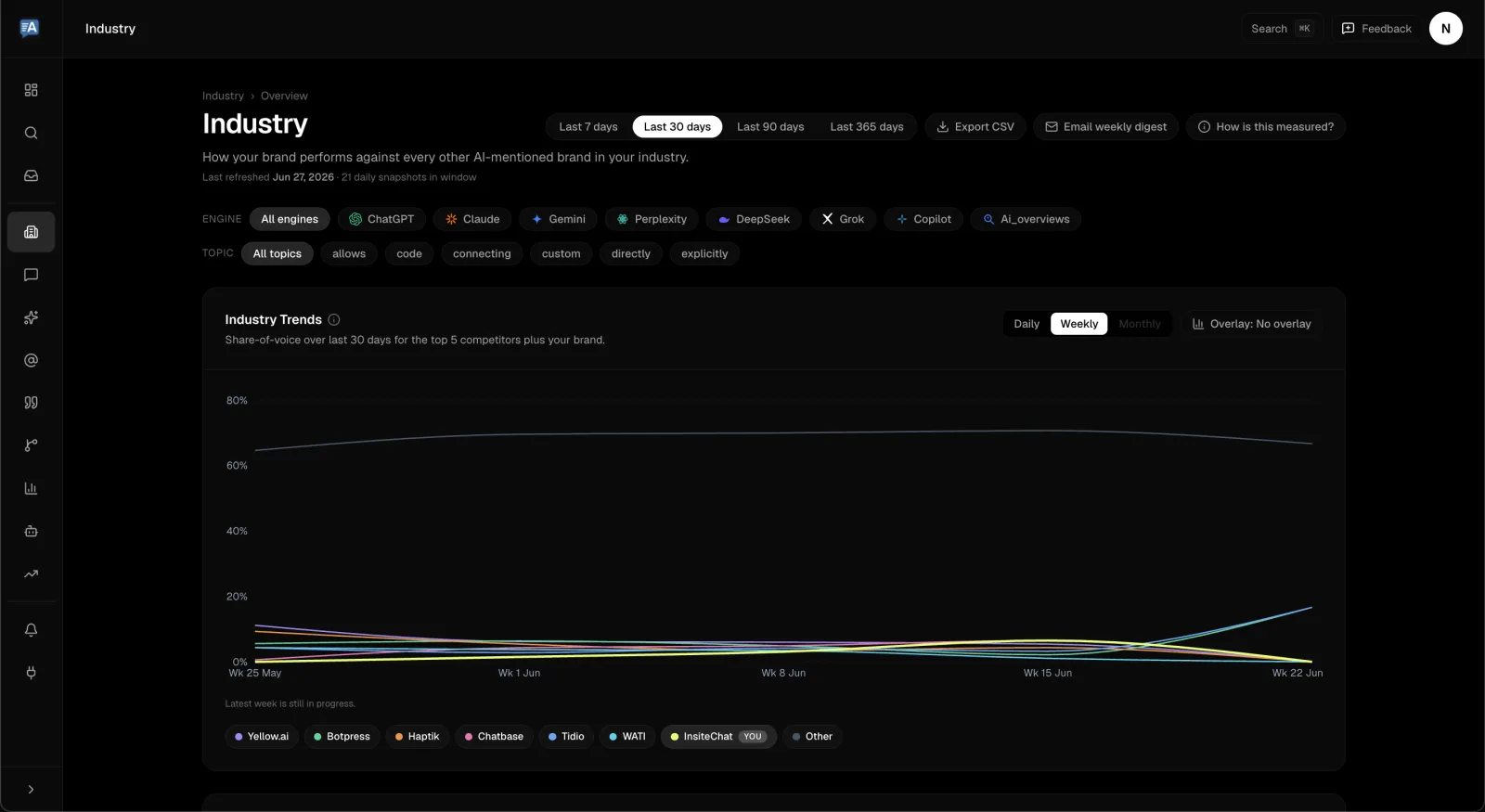
Example: share-of-voice trend for InsiteChat vs its top competitors — FixAEO.
Cross-portfolio averages we see frequently:
| Engine | Typical strongest brand profile | Typical weakest brand profile |
|---|---|---|
| ChatGPT | B2B SaaS with Wikipedia presence + comparison content | Niche consumer goods without third-party reviews |
| Claude | Technical / dev-tools brands with documentation depth | Lifestyle brands without canonical reference content |
| Perplexity | Anything with strong citation-friendly content — numbers, lists, dates | Pages without freshness markers or footnotes |
| Gemini | Brands with grounded search-result presence (still SEO-correlated) | Brands invisible in Google's top 20 SERP results |
| Copilot | Microsoft-ecosystem brands + enterprise IT | Consumer / D2C brands |
| Grok | Brands with active X/Twitter presence + recent news cycles | Brands with no real-time conversation |
If your portfolio is wildly uneven across engines, the fix is rarely "do more AEO." It's "fix the underlying content gap that one model exposes." A brand that wins on ChatGPT but loses on Perplexity is usually missing structured citation-friendly content, not visibility.
How agencies actually use portfolio AEO
Agency workflows we've watched look something like this, week to week:
- Monday — open the portfolio view. Sort by Visibility Score descending. Note any brand that crossed a threshold (above 50%, below 20%, or changed by ≥5pp).
- Tuesday — pull the Needs attention list into a client email. For each, attach the per-engine breakdown showing exactly which AI engine slipped.
- Wednesday/Thursday — execution. Whichever brand needs the biggest fix gets the bulk of retainer hours that week.
- Friday — log the changes in your account-management notes alongside the visibility delta. Over a quarter, you build a private dataset of "what we changed → what moved."
Two patterns separate the agencies that retain clients on AEO retainers from the ones that don't:
- They show the trend, not the level. Clients don't care that they're at 47%; they care that they're up 6pp from last month or down 4pp.
- They show the competitor delta, not the absolute number. "You're at 47%; your closest competitor is at 31%" is a board slide. "You're at 47%" is a number.
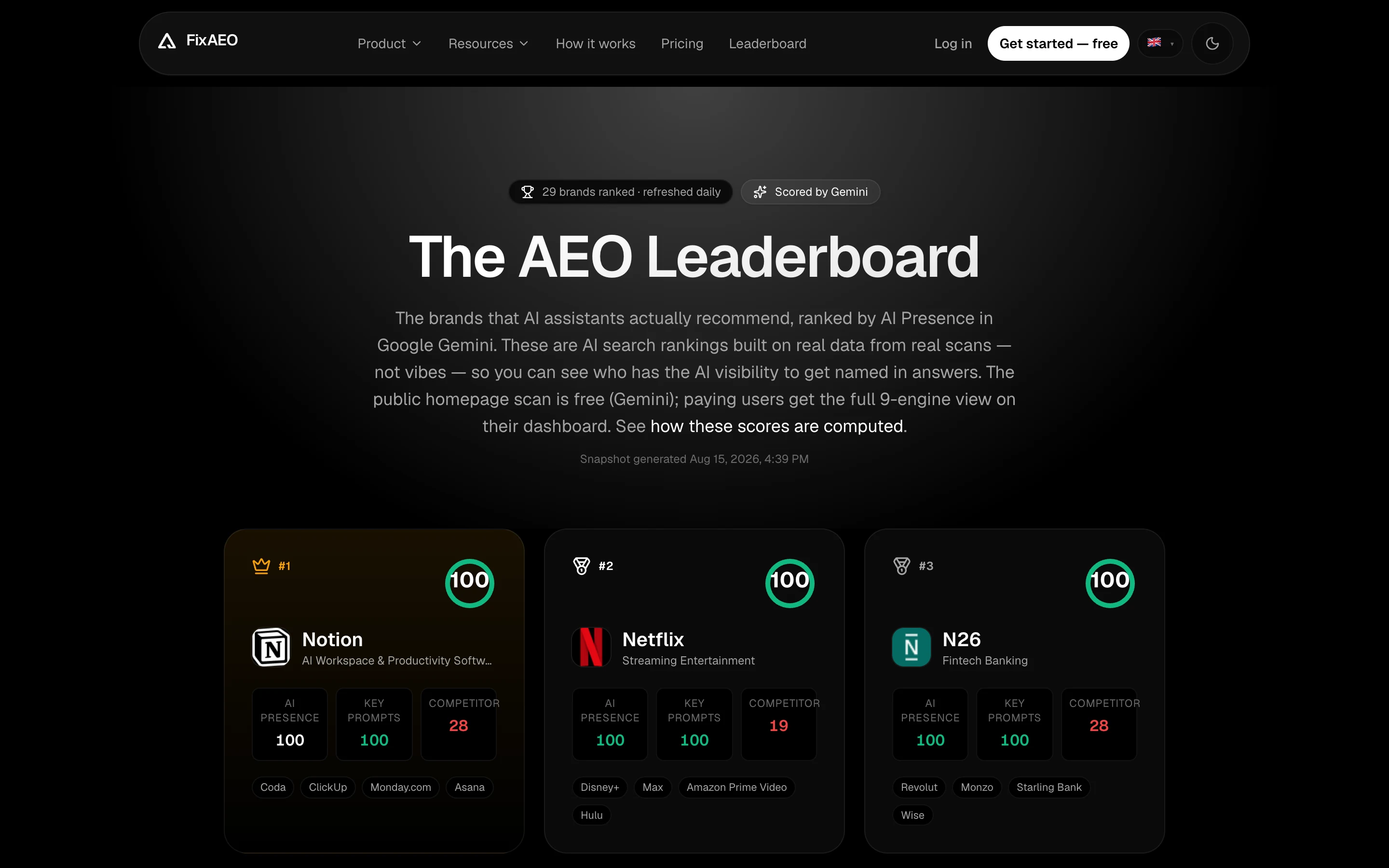
FixAEO's public leaderboard: 29 brands ranked by AI Presence in Gemini, with side-by-side competitors. The same view pattern powers the private portfolio dashboards agencies use for their clients.
Agency retainer pricing when you have portfolio tracking
Portfolio AEO changes how agencies charge for retainers. Three pricing models I've seen work:
Per-brand flat retainer. $1,500–$3,000/mo per brand, reduced for volume. This is the simplest model and it's how most agencies start. The failure mode: it discourages agencies from focusing hours on the brands that need them most. A struggling brand and a healthy brand each get the same monthly investment.
Performance-tiered retainer. Base fee per brand + variable component tied to visibility improvement. The variable component might be $500 per 10-point Visibility Score gain, or a bonus for hitting citation thresholds. This aligns agency incentives with the actual metric but requires trust and clean tracking — which portfolio AEO provides.
Portfolio-tier retainer. Client pays for a portfolio slot ($5K–$15K/mo depending on brand count), agency allocates hours dynamically across brands based on where the biggest gains are available. This is the model that scales best for agencies managing 10+ brands. It rewards the agency for triage discipline and lets the client stop worrying about per-brand hour allocation.
Portfolio tracking enables all three but especially the second and third — you can only price on performance if you have a defensible metric, and you can only allocate dynamically if you can see across brands in one view.
The client conversation cheat sheet
Portfolio AEO reports become a lot easier when you have three canned narratives ready to go. Here's the shape I use.
Narrative 1: "You're up, and here's why." Client's visibility score improved. Show them: the specific engine that moved most, the specific prompts they now win, the fixes shipped that likely drove the change. Keep it under a slide.
Narrative 2: "You're flat, and here's what's next." Client's score didn't move. Show them: what your competitor did that they didn't, what the two highest-priority fixes are for the next month, why you didn't recommend those fixes last month. Frame flat as expected in AEO — visibility swings take time — but pair with a specific plan.
Narrative 3: "You're down, and here's the diagnosis." Client's score dropped. Show them: which engine dropped and by how much, whether a competitor gained on the same prompt, what likely caused the drop (competitor content, algorithm shift, expired citation), what you're doing about it. Never present a drop without a diagnosis and a plan.
If you can walk into every client review with one of these three narratives, portfolio AEO becomes a retention tool, not just a measurement tool.
Setting up a multi-brand workspace in FixAEO
Practical, step-by-step. Applies most directly to FixAEO but the pattern is the same across tools.
Step 1: Add each brand as a separate workspace entry. Root domain, category, competitors. Make sure the competitor lists are distinct per brand — a common mistake is copying one brand's competitor set across all five and losing the resolution.
Step 2: Curate the prompt set per brand. Each brand needs 20–50 category-relevant prompts that reflect real buyer questions. Don't reuse prompts across brands unless the brands genuinely compete in the same category.
Step 3: Set the scan cadence. For agency work I'd default to daily scans for the two or three brands actively being worked on this month, weekly for the rest. FixAEO Growth includes daily rescans on all brands, so scale isn't a blocker.
Step 4: Configure the portfolio view. Set your baseline reference brand (usually the flagship or the client's biggest competitor). Set the KPI tiles to visibility, mentions, sentiment, top-vs-bottom delta. Set your alert thresholds — I use 5-point drops and 10-point gains as my alerts.
Step 5: Set the sharing model. FixAEO Enterprise supports multi-user access with brand-scoped permissions. Configure so each client-facing team member has access only to the brands they own. Prevents accidental leaks and keeps audits clean.
Once configured, the ongoing operation is roughly 15 minutes a week per portfolio.
When you don't need a portfolio view yet
Portfolio AEO is overkill for some setups:
- Single-brand SaaS with one domain — use a per-brand dashboard.
- Pre-launch products — there's nothing to roll up until the model has reasons to mention you.
- Brands you don't actually own — competitive monitoring is a different lens (one brand from many angles, not many brands from one lens).
The default rule: if you'd open the same dashboard 3+ times to answer one question, you need a portfolio rollup. Below that, you don't.
What a good portfolio AEO setup looks like in practice
The non-negotiables, in priority order:
- One filter row at the top — date range, region/language, optional engine filter. Everything else lives below.
- Four KPI tiles — brands tracked, avg visibility, total mentions, sentiment health. With Δ vs. previous window.
- Top performers + needs-attention side-by-side — the two lists most people will look at first.
- Per-engine bar across the whole portfolio — clickable to filter the brand table below.
- A sortable, filterable brand table — one row per brand, with the same columns repeated.
- CSV export — for the inevitable "send me this in a spreadsheet" request.
If your tool gives you that shape, you have a working portfolio AEO setup. If it gives you more — alerts, time-series, dashboard share links — those are nice-to-haves, not foundations.
FixAEO's portfolio view is built on this shape. So is Profound's. The frameworks for portfolio AEO measurement are converging across tools; the differences now are in the rigor of the underlying weighting, the engine breadth, and the regional handling.
FAQ
What is portfolio AEO?
Portfolio AEO is the practice of rolling up Answer Engine Optimization metrics — Visibility Score, mentions, sentiment, per-engine breakdowns — across multiple brands, products, or clients into a single comparative view. It's how agencies, holding companies, and multi-product teams measure AI visibility without juggling separate dashboards.
How is portfolio AEO different from single-brand AEO tracking?
Single-brand AEO answers "how visible am I?" Portfolio AEO answers "which of my brands needs help first, and where is the biggest opportunity across the group?" The metrics are the same; the unit of decision-making is different.
How many brands do I need before a portfolio view is worth it?
Three or more is the practical threshold. At two brands, two browser tabs work fine. At three, you start losing comparative signal. At five, manual comparison breaks down entirely.
Should I weight portfolio averages by brand size?
Yes — weight by response volume (how many AI responses each brand was scanned across). Unweighted averages flatter small brands and obscure flagship-brand drops. This is the single most important rule in portfolio measurement.
Can I use one portfolio view for clients in different regions?
You can, but filter by region/language at the portfolio level. AI engine behaviour varies meaningfully by locale — a German brand on Gemini's de-de slot is a different question from the same brand on Gemini's en-us slot. Most serious portfolio tools (including FixAEO's portfolio page) let you set region + language as a top-level filter.
How often should I check a portfolio AEO dashboard?
Weekly is enough for most. Daily makes sense only if you're an agency reacting to live client situations or running launches. The underlying scans themselves should run more often than your check-ins — daily is ideal, weekly is the floor.1
What's the biggest mistake teams make with portfolio AEO?
Averaging unweighted. A close second: showing the level of the metric instead of the change. Both flatten signal and lead to stale decisions.
Can I use portfolio AEO to demonstrate ROI to a client?
Yes — that's one of its strongest use cases. Pair Visibility Score movement with GA4 AI-referred traffic data to show that "we moved you from 34 to 61 on visibility, and AI-referred sessions went from 200/mo to 1,900/mo." That's the ROI story clients pay for.
How do I handle a portfolio where one brand is much larger than the others?
Use weighted rollups (weight by response volume, which scales with brand size and prompt count). Also consider showing the flagship brand's metrics separately alongside the portfolio rollup — a $10M revenue flagship and a $200K side brand shouldn't get equal visual weight in the client dashboard.
Should each brand in the portfolio have the same competitor set?
No — each brand should have its own competitor set. Reusing one competitor list across five brands loses category resolution. Even sister brands in adjacent categories tend to have different top competitors.
What's the right team structure for managing a 10-brand AEO portfolio?
One senior strategist across the portfolio, plus one executor per 3–5 brands. The senior owns the portfolio narrative; the executors do the specific ship work. Above 15 brands, add a second senior strategist. Below 5 brands, one person can do both roles.
The compounding advantage of portfolio-level AEO
There's a strategic edge that only becomes visible once you're running AEO across a portfolio: cross-brand learning. When you see the same fix land differently across five brands, you learn something specific about your category and your buyer type that no single-brand view can teach you.
Concrete example: I watched an agency ship the same "add FAQPage schema" fix across seven client brands in the same month. Three brands saw a 10+ point visibility gain. Two saw a 3–5 point gain. Two saw no movement. The pattern that emerged: the three big winners had domain authority in the top quartile of their category and published on categories where AI Overviews were common. The two no-movement brands had low DA and were in categories AI Overviews rarely triggered on.
That's not something you learn from a single brand. It's the compounding intelligence a portfolio unlocks.
Two additional patterns portfolio work exposes: (1) which of your team members are actually landing fixes — some ship visibility gains across every brand they own, others don't; (2) which competitors are learning fastest across your entire market — a competitor that's rising in visibility across three of your five brands is one you need to study, not one you can dismiss as a niche.
Portfolio AEO isn't just measurement infrastructure. It's a learning engine that pays off compound interest on every quarter of use.
In one paragraph
Portfolio AEO tracking exists because multi-brand AI visibility is a different problem from single-brand visibility — and the failure modes (averaging unevenly, missing engine drift, fixing the loudest brand instead of the most-slipping one) are predictable. The four metrics that actually matter are average AI visibility, total mentions, sentiment share, and the top-vs-bottom delta. Weight every rollup by response volume; show change over time, not just the level; and keep "top performers" and "needs attention" lists visible so the next decision is obvious. Try a portfolio view in FixAEO — three brands is enough to feel the difference.
Footnotes
-
A reasonable starting cadence: daily LLM scans, weekly portfolio rollup, monthly trend review. See FixAEO's methodology page for the scan cadence we use. ↩
Related reading
How to Monitor Competitor Mentions in AI Search
A practical guide to tracking which competitors AI engines name for your category — why manual checks don't scale, and how continuous tracking works.
26 min read12 Best Answer Engine Optimization Tools (2026)
12 answer engine optimization tools compared — engines covered, entry price, free tier — with honest takes on which to pick by stage and budget.
19 min readHow to measure AEO ROI: a copy-paste spreadsheet
Measure AEO ROI with attributable visits, conversion rate, gross profit, and cost. Includes a transparent worked example, spreadsheet layout, and limitations.
13 min readHow to get cited by Perplexity: a 2026 playbook
Perplexity cites 4-8 sources per answer and the patterns are learnable. Here are the 8 patterns we see in cited content, with the tactics that got FixAEO cited in our own category.
16 min readHow to win back traffic lost to Google AI Overviews
Google AI Overviews run on a third of commercial queries and keep clicks in the SERP. Here are 7 changes that get your brand named in the answer, plus a 30-minute audit and 2-month plan.
17 min readThe 30-point AEO audit checklist (2026)
AEO audit checklist: 30 signals across 7 categories — from crawler access to per-engine verification. Copy it into Notion and run your audit today.
16 min read
Free AEO tools
Put this into practice with free FixAEO tools — no signup required.
AI Visibility Checker
Score your brand across 9 AI engines
AEO Audit Tool
Answer-engine readiness scan
Schema Generator
Build valid JSON-LD structured data
llms.txt Generator
Create a spec-compliant llms.txt
Sitemap Validator
Check your XML sitemap for errors
AI Content Grader
Grade content for AI citation readiness