AEO for SaaS: Get Recommended by AI Assistants
AEO for SaaS companies: why G2 reviews outweigh content, how comparison pages win, and the playbook to get your product into AI answers.

On this page

SaaS is the sharpest case for Answer Engine Optimization. Almost every SaaS buying journey now starts with an AI query — "best CRM for a 10-person team", "Notion vs Linear for engineering teams", "cheapest Datadog alternative". The first answer frames the entire shortlist. If your product isn't in that answer, you're not in the deal.
The math is brutal. B2B SaaS deals have 6–8 stakeholders on average. If the AI doesn't surface your product to the first one — the IC who asked the question — the other seven decision-makers never hear your name. There is no "I'll Google it later" step in 2026. The AI gave one answer, the shortlist closed, and procurement moves forward without you.
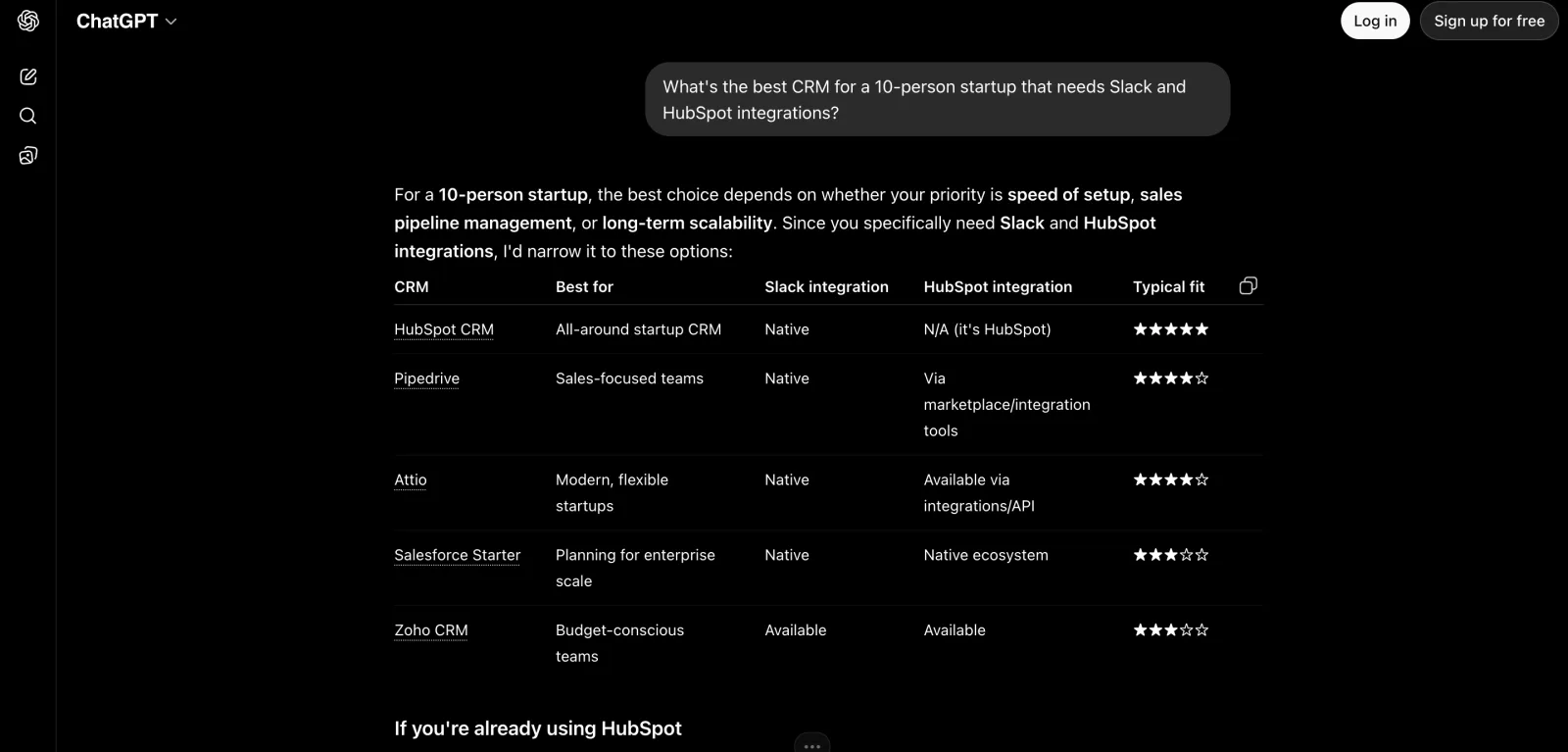
Example: ChatGPT (logged out) answering a real buyer query — HubSpot, Pipedrive, Attio, ranked with reasons. Whatever it returns IS the buyer's shortlist.
The good news: SaaS is also the category where AEO investment pays back fastest. Clean docs, a defined feature set, real third-party reviews, a clear comparison surface — every signal in our general AEO tools guide is amplified for SaaS. This post is the SaaS-specific version of the playbook. If you want to see where real productivity and SaaS brands currently stand, check the SaaS AEO leaderboard.
How AI engines treat SaaS differently
Three architectural facts shape SaaS citations and they're different from how engines treat any other vertical.
Engines over-index on G2, Capterra, and Trustpilot. Third-party validation matters more for SaaS than for any other category. Stripe with 5,000+ verified G2 reviews shows up in payment-processing answers even when the user query never mentions Stripe by name. The reranker treats G2 as a category authority — the same way it treats Wikipedia for general knowledge. Our scans show SaaS brands with 50+ recent verified G2 reviews get cited 3–4× more often in commercial queries than brands with thin or zero presence. Stale review profiles (last review six months ago) decay faster than no profile at all.
Comparison content dominates the retrieval surface. When a user asks "Notion vs Linear", the page that ranks isn't notion.com or linear.app. It's the third-party post that compares both fairly. Comparison pages match the query form directly — a balanced 1,500-word comparison from a mid-tier SaaS publication beats a 5,000-word product page every time. If you're not running first-person comparison content, somebody else is writing the canonical comparison for your category and shaping which way it tilts.
SaaS has the easiest path to a Wikipedia/Wikidata entry once funded. Series A and beyond, SaaS clears the notability bar more reliably than D2C brands or local businesses. Once your Wikidata QID is live, Claude and Gemini disambiguate your brand from unrelated entities at retrieval time. This entity presence is disproportionately strong for SaaS in Claude — Anthropic's training mix appears to over-weight technical and enterprise content, and Claude is the strongest SaaS engine in our scans by a meaningful margin.
How often each engine named a brand (~200 SaaS prompts)
The 5 signals that matter for SaaS AEO
These are the signals we look for first when we audit a SaaS site for AEO posture. The order is by leverage — fix in this sequence.
1. SoftwareApplication schema with correct types
Most SaaS sites either skip JSON-LD entirely or stop at generic Organization schema. That's a miss. SoftwareApplication with applicationCategory, operatingSystem, offers, and aggregateRating (linked to your real review counts) is the schema type AI engines reach for when answering "what is X" or "what does X do" queries. Linear, Vercel, and Datadog all ship this correctly. Most early-stage SaaS sites don't. Generate it cleanly with our schema generator — it emits the right type pairings without hand-rolling.
2. Verified reviews on G2, Capterra, and Trustpilot
The threshold that moves Claude citations measurably: 50+ recent verified reviews, with at least 10 added in the last 90 days. Below 50 you're in the noise floor. Above 50, the reranker starts trusting the aggregate. The "recent" part matters as much as the volume — a profile with 200 reviews from 2023 and 4 reviews from 2026 underperforms a profile with 60 reviews from the last six months. Set up an in-product review prompt for happy customers (post-onboarding, post-renewal, post-key-feature-use) and aim for 30+ new reviews in your first six months.
3. Comparison content earning third-party citation
The page that ranks on "X vs Y" is almost never owned by X or Y. It's owned by an independent reviewer, a niche SaaS publication, or a comparison-content site like G2's category pages. You have two leverage points: (a) publish your own honest "X vs us" comparison on your domain, (b) earn coverage in the third-party comparisons that already rank. Both matter. The first gets you into the candidate pool. The second gets you into the answer.
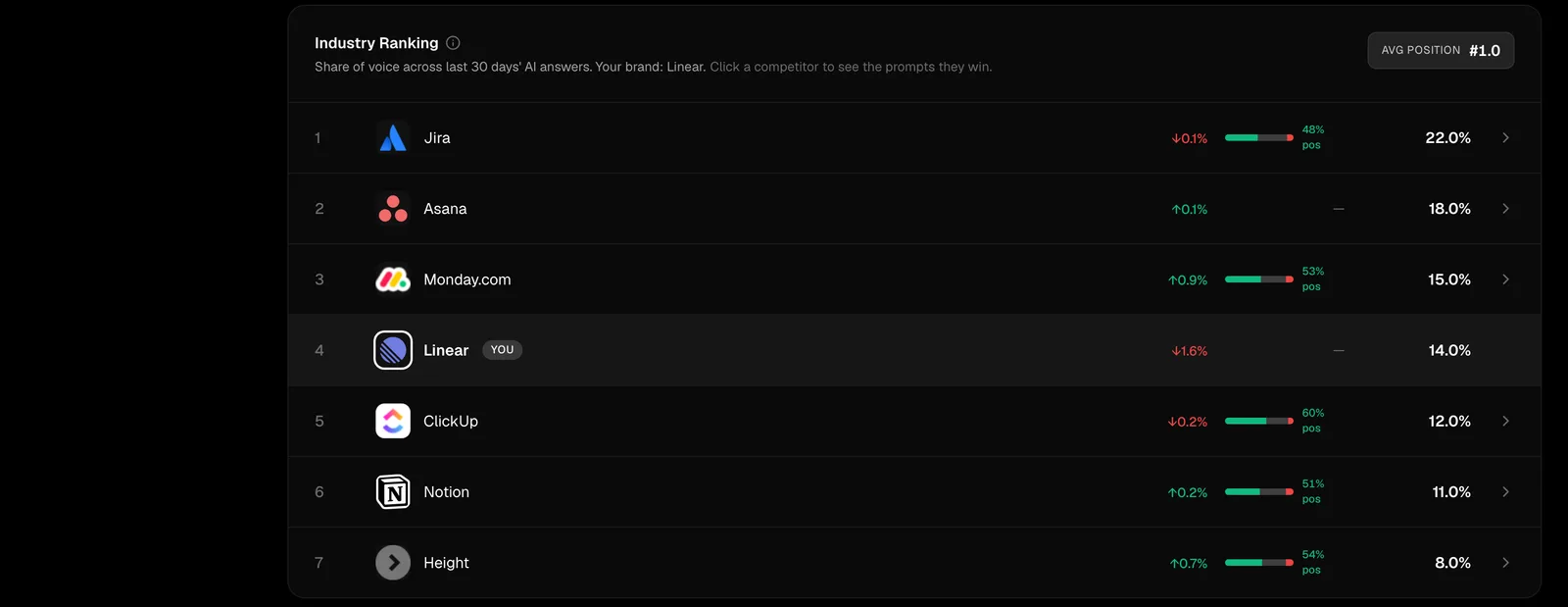
The industry-ranking view — share of voice across a category, the format you need before writing a comparison page. Illustrative data, not real brand metrics.
4. Founder / team E-E-A-T
Claude over-weights pages with named technical authors who have real public footprints. A blog post on linear.app/blog authored by "Tuomas Artman, Co-founder" with a LinkedIn profile and a track record of building software lands differently than the same content under a generic "Linear Team" byline. Founders posting weekly on LinkedIn or X about real product decisions creates a citation surface AI engines pick up. Notion, Linear, and Vercel all have founder presences that show up in category scans; their less-vocal competitors don't.
5. Free-tier or free-tool presence
A free tier generates citation surface area pricing pages can't. When users ask "free CRM for startups" or "free observability tool", the AI cites SaaS with real free tiers. The deeper effect: free tools generate Reddit threads, Hacker News discussions, and developer blog posts that themselves become citable sources. Vercel, Linear, and Notion each have Reddit threads cited in AI answers for their categories. The free tier funds the citation ecosystem around your brand.
The 6 tactics that move SaaS AEO citations
Ranked by leverage per dollar invested, not by how much AEO Twitter talks about them.
Tactic 1 — Get a real G2 / Capterra presence
Not just a listing — solicit reviews from happy customers. Mechanics: a post-onboarding email at day 30, a post-renewal email with a specific G2 link, and a product-UI prompt at moments of high satisfaction (after a key workflow completes). Aim for 30+ verified reviews in the first six months, then 5–10 per month. Do not buy reviews. Claude detects synthetic patterns and the down-weight is permanent.
Tactic 2 — Publish first-person comparison content with honest weaknesses
The "Notion vs Linear" page that ranks isn't a hit piece. It's a fair comparison where the author calls out where each tool genuinely wins. Apply this to your own category. Write "FixAEO vs Profound" and include the honest "we lose to Profound when..." section. Claude rewards this pattern — its reranker treats balanced comparisons as more authoritative than one-sided sales content. The fear ("won't this drive customers away?") is overrated. The buyer was going to compare anyway. They'd rather compare on your honest framing than on a competitor's framing of you.
Tactic 3 — Build a complete Organization + SoftwareApplication schema stack
Twenty minutes of work, six months of payoff. Ship Organization with sameAs linking to LinkedIn, X, Crunchbase, your Wikipedia page (if you have one), and your Wikidata QID. Ship SoftwareApplication with applicationCategory, operatingSystem, offers (mapped to your pricing tiers), and aggregateRating (mapped to your real G2 aggregate). The pair gives AI engines a complete graph of what your product is, what category it serves, and what third-party validation it has. Generate the whole thing with our schema generator.
Tactic 4 — Ship a working /llms.txt
SaaS has the cleanest documentation surface of any vertical, and /llms.txt is how you tell AI crawlers to start there. A spec-compliant llms.txt pointing at your docs root, your changelog, your security page, and your top 5 product pages gives Claude, Copilot, Perplexity, and ChatGPT a curated entry point. We've seen citation rates lift 15–25% within four weeks of shipping a real llms.txt for SaaS sites with strong documentation. Build one in a minute with our llms-txt generator.
Tactic 5 — Get covered by mid-tier SaaS publications
Not TechCrunch (high bar, low conversion to AEO lift). The publications that move SaaS citations are niche: SaaStr, ProductLed, Lenny's Newsletter, The Pragmatic Engineer (dev tools), Marketing Brew (marketing tools). One feature in any of these earns more Claude citations than ten self-published posts. The PR motion: respond to journalist queries on Qwoted and Help A B2B Writer, pitch original product data, or write a founder essay good enough that the publication runs it.
Tactic 6 — Track and verify with our AI visibility checker
Citation work without measurement is a vibe. Run your domain through the AI visibility checker — it queries Claude, Copilot, ChatGPT, Gemini, Perplexity, Grok, and DeepSeek for your category prompts and scores how often you're cited, by which engine, against which competitors. Rescan weekly. The deltas tell you which tactics moved the number. For a deeper structural review, the AEO audit tool walks your site for the same signals manually.
What NOT to do (the SaaS-specific traps)
Three anti-patterns crater SaaS AEO faster than anything else.
Synthetic G2 reviews
The temptation is real. Your seed round closes, you have 12 customers, and the competitor on G2 has 800 reviews. Don't ask friends to write reviews or pay a review-generation service. Claude's reranker has been documented down-weighting profiles with synthetic patterns — clusters of 5-star reviews in tight time windows, similar phrasing, reviewers with no other G2 activity. The down-weight is harder to reverse than the initial gap was. We've watched SaaS brands lose citation share to worse-quality competitors with fewer but real reviews because their inflated G2 profile got pattern-flagged.
"Best CRM Software Platform Solution" H1s
Keyword-stuffed H1s are 2014 SEO. Claude implicitly down-ranks them. The pattern Claude rewards: conversational, specific H1s that match the long-tail Claude users actually type. "CRM for a 10-person SaaS team that needs Slack and HubSpot integrations" beats "Best CRM Software Platform Solution for Startups 2026". The second looks like a SEO playbook from a decade ago. The first looks like a Claude query.
Treating the 9-engine universe identically
Each engine rewards SaaS differently. Claude over-indexes on technical depth, structured documentation, and named-author E-E-A-T. Copilot leans on Bing's index and Microsoft's enterprise graph, so authoritative docs and indexed comparison pages carry extra weight. ChatGPT rewards Wikipedia presence and broad third-party coverage. Perplexity rewards freshness markers, citation footnotes, and FAQPage schema (the patterns from our Perplexity playbook apply directly). Gemini is still SEO-correlated. Grok rewards X presence and recent news cycles. DeepSeek over-indexes on documentation in code repos. One generic playbook across all nine leaves citation share on the table at every engine.
How to verify your work
The eyeball test first. Open Claude.ai, Copilot, ChatGPT, Perplexity, and Gemini in private windows. Ask each "what's the best [your category] for [your ICP]?" — written conversationally, the way a real buyer would phrase it. Note which engines cite you, which cite your competitors, and which give a generic answer that names no brand at all. Repeat for 5–10 ICP-specific variants of the query. The pattern tells you which engines you're winning and which you're invisible on.
Then run the loop through our AI visibility checker on a schedule — daily scans, weekly review. The manual check tells you where you stand today. The tool tells you whether your changes are moving the number, which engine is moving, and which competitors are eating your share of voice.
If you're under-indexed on a specific engine, the fix is engine-specific. Claude underperforming? Audit your founder LinkedIn presence, your SoftwareApplication schema, and your comparison content. ChatGPT underperforming? Audit your Wikipedia/Wikidata graph and your third-party press coverage. Perplexity underperforming? Audit freshness markers, footnotes, and FAQPage schema on your top-10 commercial pages.
TL;DR
SaaS AEO is a different game from generic AEO. G2 and Capterra reviews carry more weight than any other vertical. Comparison content dominates the retrieval surface — write your own with honest weaknesses included. Wikipedia/Wikidata entity presence is disproportionately strong for SaaS in Claude and Gemini. Ship SoftwareApplication + Organization schema, a real /llms.txt, and a founder LinkedIn presence. Avoid synthetic reviews, keyword-stuffed H1s, and one-size-fits-all engine strategies. Measure weekly with the AI visibility checker and let the deltas tell you what's working.
FAQ
Why do G2 and Capterra reviews matter so much for SaaS AEO?
Third-party validation matters more for SaaS than for any other category. Our scans show SaaS brands with 50+ recent verified G2 reviews get cited 3–4× more often in commercial queries than brands with thin or zero presence, because the reranker treats G2 as a category authority.
How many G2 reviews does a SaaS company need to move AI citations?
The threshold that moves Claude citations measurably is 50+ recent verified reviews, with at least 10 added in the last 90 days. Below 50 you're in the noise floor; above 50 the reranker starts trusting the aggregate, and recency matters as much as volume.
Which AI engine is strongest for SaaS?
Claude is the strongest SaaS engine in our scans by a meaningful margin, because Anthropic's training mix appears to over-weight technical and enterprise content. Claude over-indexes on technical depth, structured documentation, and named-author E-E-A-T.
Should SaaS companies publish comparison content even if it helps competitors?
Yes — write a fair "X vs us" comparison that calls out where each tool genuinely wins, including an honest section on where you lose. The buyer was going to compare anyway, and Claude's reranker treats balanced comparisons as more authoritative than one-sided sales content.
What are the biggest SaaS AEO mistakes to avoid?
Avoid synthetic G2 reviews, keyword-stuffed H1s, and treating all nine engines identically. Synthetic reviews get pattern-flagged with a hard-to-reverse down-weight, and one generic playbook across every engine leaves citation share on the table.
Related reading
AEO for B2B: Get Found in AI Answers
B2B buyers ask long, specific questions in AI engines before sales talks begin. Here is the B2B AEO playbook for earning citations and brand mentions.
13 min readHow to get cited by Claude: the 2026 playbook
Get cited by Claude with the 2026 AEO playbook. Claude's constitutional training favors authoritative, non-promotional sources — here's how to qualify.
17 min read12 Best Answer Engine Optimization Tools (2026)
12 answer engine optimization tools compared — engines covered, entry price, free tier — with honest takes on which to pick by stage and budget.
19 min readWhy ChatGPT doesn't recommend your brand
ChatGPT SEO fix: six reasons ChatGPT names competitors instead of you, ranked by frequency across 1,000+ FixAEO scans — with a fix for each and a 30/60/90 day plan.
17 min readAEO for Ecommerce: Get Products Recommended by AI
Ecommerce AEO requires a different playbook. Learn how Product schema, buyer reviews, and comparison sites get your products cited by AI assistants.
12 min readHow to get cited by Perplexity: a 2026 playbook
Perplexity cites 4-8 sources per answer and the patterns are learnable. Here are the 8 patterns we see in cited content, with the tactics that got FixAEO cited in our own category.
16 min read
Free AEO tools
Put this into practice with free FixAEO tools — no signup required.
AI Visibility Checker
Score your brand across 9 AI engines
AEO Audit Tool
Answer-engine readiness scan
Schema Generator
Build valid JSON-LD structured data
llms.txt Generator
Create a spec-compliant llms.txt
Sitemap Validator
Check your XML sitemap for errors
AI Content Grader
Grade content for AI citation readiness