12 Best AI SEO Agents for 2026: What They Actually Automate (and What They Don't)
A sourced look at 12 real AI SEO agents for 2026 — technical fixers, content generators, and visibility-action tools — with honest autonomy verdicts, plus one 'agent' that just buys ChatGPT ads.

On this page

You fix the schema markup. You publish the comparison page. You get the FAQ block onto the pricing page. Three weeks later, an AI answer engine is still describing your product with last year's positioning, because nobody told it anything changed. That gap — between "we know what's wrong" and "something actually did something about it" — is why 2026's SEO vendors all started calling themselves agents instead of tools.
This post sorts through what's real in that shift: technical-fixer agents that patch your site, content agents that draft your articles, and AI-visibility agents that turn tracking data into action, with real pricing and an honest read on how much each one does without you. For the wider AEO tool landscape, our best AEO tools roundup and the full AEO playbook are good companion reads.
Updated August 1, 2026: I added four more agents — Scrunch's AXP, Relixir's Rex, Conductor's AgentStack, and AthenaHQ's Content Agents — bringing this to twelve. I also added a thirteenth entry that isn't an SEO agent at all: Evertune's Visibility Boost reads the same visibility gaps everything else here reports on, then spends money on ChatGPT ads against them. It gets its own section at the end because filing it next to the others would be misleading. Going through those five changed my mind about one thing and confirmed the main finding twice over — details in the next section.
That research also turned up enough material to justify four new sections, which are the ones I'd read first if you're evaluating rather than browsing: how I verified each autonomy claim and how to run the same checks yourself; why the approval gate is winning, using evidence from outside SEO entirely; which MCP servers can actually write anything; and nine questions to ask on the demo call, each one drawn from something a vendor left ambiguous.
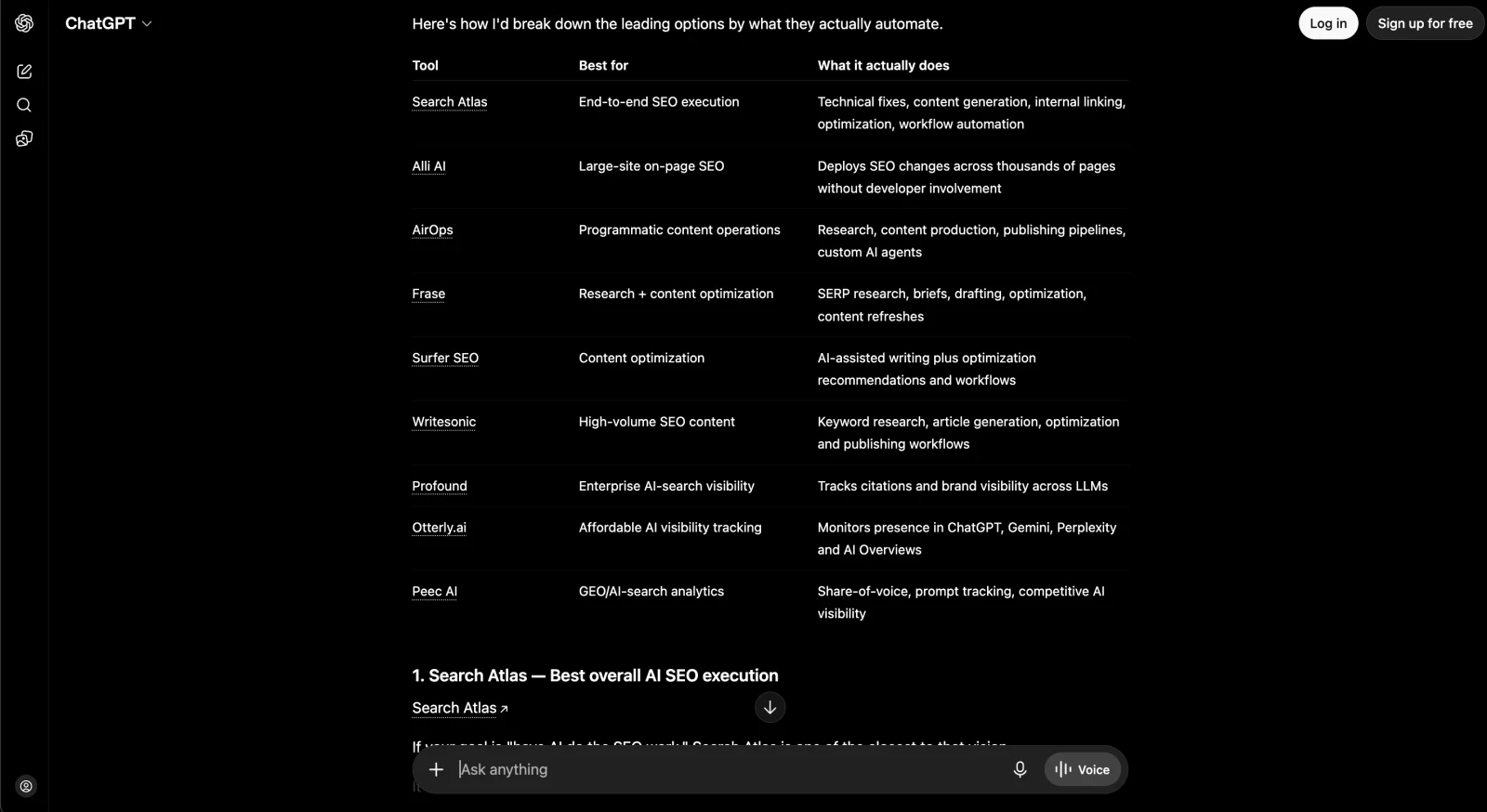
Asked cold, logged out, ChatGPT already names several of the tools in this post — with a "best for" line for each. This is how buyers shortlist now, which is exactly why the list below matters.
Why "tool" became "agent"
AI answers strip out the signals SEO teams built their reporting around. As Nate Elliott, an analyst at EMARKETER, put it:
"The things marketers measure in search virtually disappear in AI."
That's from EMARKETER's July 2026 coverage of AI-driven purchase influence — no click, no referrer, no keyword report, just a mention you can only find by asking the AI directly.
That changes what "actionable" means. A rank tracker used to be enough, because a human could look at a keyword that dropped from #4 to #9 and know what to do. Told that Perplexity cited a Reddit thread instead of your product page, the next step is far less obvious — someone, or something, has to turn that into a specific page to build. Rand Fishkin, co-founder of SparkToro, put the scale of the shift plainly:
"I think this is the biggest shift SEOs are undergoing right now."
That's from his September 2025 interview with Advanced Web Ranking.
The pattern I found: approval gates are winning
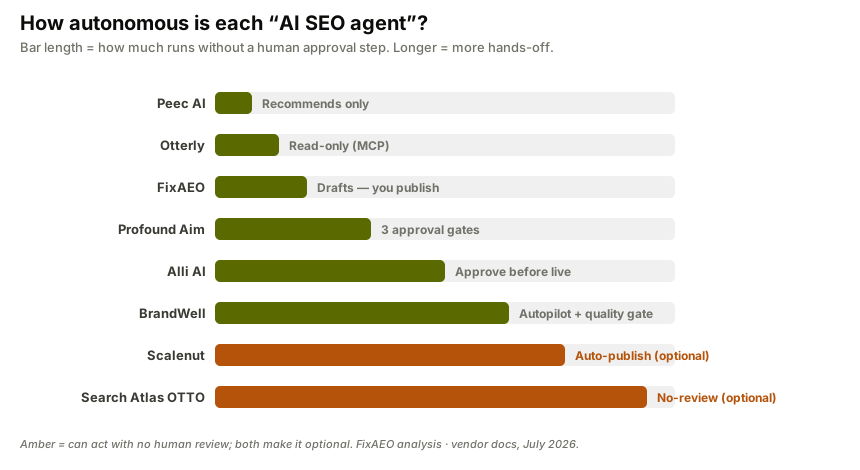
Here's what surprised me while researching this: nearly every vendor shipping an agent or action layer in 2026, across every category here, documents an explicit human-approval checkpoint somewhere. Some make it the default. A couple make it optional. One markets autonomy and documents nothing either way. Not one of them ships pure "walk away, I'll handle it" as the only documented mode — and that word is load-bearing, for reasons I get to at the end of this section.
I went looking for counterexamples when I expanded this post, and didn't find one. The pattern held at twelve tools, and the reason it held is more interesting than the pattern itself: the autonomy is in the marketing, not in the documentation.
Scrunch's AXP is the clearest case. It's sold as hands-off delivery at the edge, and I expected it to be my counterexample. Then the vendor's own how-to guide walks through uploading content, checking a before/after preview, and clicking Deploy — and the word "approved" shows up in three separate places describing what actually gets served. It's approve-once-then-auto-serve, not fire-and-forget. Genuinely autonomous at serve time; human-gated at content time. That distinction turns out to be the whole story of this category.
The same gap shows up twice more, and both times the vendor's own documentation is what closes it:
- Conductor's launch release promises going from insight to published, optimized content "in under three minutes." I went through their public API spec looking for the publish step — twelve paths, no CMS push, no webhook, and the status field the pipeline would need isn't writable. I'll be careful here: their agents have no API documentation at all, so this is an argument from absence rather than proof. But if a three-minute path to a live page exists, it isn't in the spec they published.
- AthenaHQ markets its citation engine as autonomously executing multi-step workflows. Its own API reference has a brief-approval endpoint you have to call before a draft moves forward, and it's only valid while the piece is sitting at the brief stage. The docs describe a gate the marketing page doesn't mention.
Which brings me to the honest limit of this whole exercise: "no approval gate documented" is not the same as "no approval gate." Relixir brands Rex an autonomous employee running on autopilot with zero manual work — but it never actually claims a human isn't reviewing, its own team configures and runs the thing for you, and pages it has since deleted — still readable in the Wayback Machine, archived 24 January 2026 — marketed multi-level approval workflows and an audit trail time-stamping every approval click. I can tell you nobody here documents review-free publishing. I can't tell you nobody does it.
One caveat on sourcing: I came across a tidy-sounding stat claiming "73% of teams run AI SEO as hybrid, only 5% let AI go solo." Tracing it to its cited source, that specific split wasn't actually in the article — it only referenced a Gartner finding about trust in AI-assisted work generally, not an adoption-rate breakdown. I'm not using that number. The vendor-by-vendor evidence below holds without it.
How I checked this, and how you can
Every autonomy verdict in this post came from four checks. They're worth stealing, because vendor marketing in this category is currently not a reliable guide to what a product does, and the checks take under an hour per tool.
1. Read the API spec instead of the landing page. This was by far the highest-yield thing I did. Conductor publishes an OpenAPI spec for its content layer, and downloading it settled in ten minutes what the marketing site left ambiguous for an hour. The draft status field is an enum with five values, and drafts carry an assignee holding a user id:
"status": {
  "description": "Draft status.",
  "enum": ["TO_DO", "IN_PROGRESS", "IN_REVIEW", "APPROVED", "PUBLISHED"]
},
"assignee": { "type": "integer", "description": "Assigned user id." }
So a review-and-approval workflow with a named human demonstrably exists, whatever the marketing implies. And then the detail that actually matters: status appears only on the read schema. It's absent from both write schemas — DraftCreateRequest and the draft update input — meaning the API cannot move a draft to APPROVED or PUBLISHED at all. A spec tells you what a product can be told to do. Marketing tells you what a vendor wants you to imagine.
2. Diff the documentation against the landing page. Where the two disagree, you've usually found the real answer plus a marketing decision. AthenaHQ's pages describe an engine that autonomously executes multi-step workflows; its API reference makes you call a brief-approval endpoint before a draft advances. Scrunch's help centre describes its MCP server as read-only query and analysis, while its developer docs enumerate write tools. In both cases the more specific document is the one to trust, and the mismatch is itself a finding.
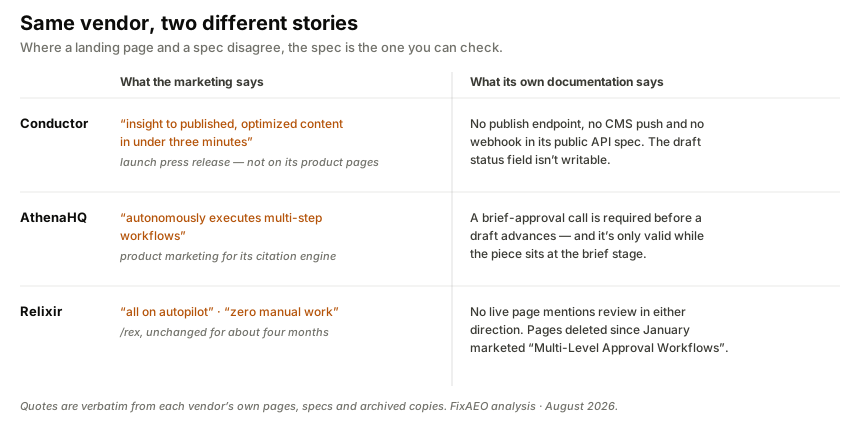
Three vendors, two stories each. In every case the documentation is the more specific claim — and the one a buyer can verify.
3. Check what's been deleted. Relixir's blog returns 404 site-wide — not one dead URL, the whole thing. Deleted pages are still readable, and the recipe is two requests: ask the Wayback index what exists with web.archive.org/cdx/search/cdx?url=relixir.ai/blog*&output=json, then open the timestamped copy at web.archive.org/web/<timestamp>/<url>. The whole blog is in there.
One page Relixir published on its own domain, live as of 24 January 2026, is headed "Guardrails & Approvals Matter More Than Ever" and lays out "Multi-Level Approval Workflows" where "Drag-and-drop stages mirror real corporate hierarchies. Marketing drafts flow to Legal, then to InfoSec, then to an executive signer." It describes role-based permissions that "lock down sensitive drafts," real-time policy checks that route risky claims to compliance, an audit trail time-stamping "every approval click, edit, and publish action," and it sums the philosophy up as "AI co-writes, humans polish."
Be careful what that proves. It's enterprise content-management marketing, not product documentation — it tells you what Relixir was selling in January, not that a review queue ever shipped, so I'm not citing it as fact about the product today. But a vendor that published detailed approval-workflow marketing, deleted it, and relaunched as an unsupervised "employee" has told you something.
4. Distrust the comparison sites, harder than feels polite. One site states flatly that "Profound and Conductor both keep a human approval gate inside their internal content agents before anything goes live" — while its own sources list doesn't include Conductor at all. As it happens I reached a similar conclusion about Conductor, but from its API spec rather than from nowhere, and the difference matters: an unsourced guess that lands near the truth is still an unsourced guess, and the next one won't land. A search summarizer then blended that page with an unrelated product and produced a confident, clean-sounding answer about Conductor pushing content into your CMS with strategist review. That part is not supported by anything Conductor publishes — its own spec contains zero occurrences of "cms." Pricing is where this does real damage: third-party sites quote Conductor at anywhere from $26,800 to over $500,000 a year, and Relixir at tiers that contradict each other, with one middle tier openly labelled an estimate. Those numbers appear on no vendor page. I haven't printed a single one of them.
Two traps I nearly fell into, in case you're running the same checks. Conductor's AgentStack page says its apps are "reviewed and approved by OpenAI, Anthropic, and Microsoft" — that's app-store review of its ChatGPT and Claude apps by the model vendors, not review of agent output, and it would be very easy to misread as a human-in-the-loop claim. And at least three unrelated products are called Conductor: the enterprise SEO platform here, Orkes/Netflix Conductor for workflow orchestration, and a Microsoft multi-agent project. Search results mix them freely.
One thing I can't offer: I did not drive any of these products. Everything here comes from vendor pages, public API specs, and documentation. Where a claim depends on runtime behaviour I couldn't observe, I've said so in the entry rather than rounding it up.
Why the gate is winning, and the evidence is not from SEO
It would be easy to read this many approval gates as vendor caution, or as products that aren't finished yet. The broader data suggests it's a correct read of where the risk actually sits.
A study of agents actually running in production — 20 case studies plus a survey of 86 practitioners across 26 domains — found that 68% execute at most ten steps before human intervention, and 74% depend primarily on human evaluation rather than an automated check. That's not a market waiting for autonomy to arrive. That's what production looks like.
Two figures I'm carrying over from separate research, and flagging as unlinked because this post's standard demands it: Forrester and Boomi put enterprise agent adoption past the pilot stage at 86% as of July 2026, while only 34% of those enterprises say they trust the actions their agents take. Treat those as directional rather than citable — I haven't re-verified them at source for this update.
The liability precedent is not hypothetical either. Air Canada was held to a bereavement-fare policy its chatbot invented, by a tribunal that was unmoved by the argument that the bot was a separate entity. Cursor's support bot fabricated a device-limit policy, users cancelled subscriptions over a rule that did not exist, and the company had to walk it back in public. In both cases the machine wrote something plausible, nobody checked, and the organisation owned the consequences.
Now look at where full autonomy genuinely is working: customer support. Intercom's Fin, Sierra, Decagon, Zendesk's agents. Those problems share a shape — narrow, standardized, high volume, and low risk to brand voice. A support reply is one person's inbox and it's correctable in a minute.
Content and positioning are the inverse of that on every axis. The work is judgment-heavy, the brand voice is the product, volume is low enough that each artifact matters, and a wrong page is public and indexed and may get quoted back to you by an AI engine for months. If you were choosing a domain in which to not ship unsupervised publishing, you would choose this one. Which is roughly what every vendor in this post has done, whatever their homepage says.
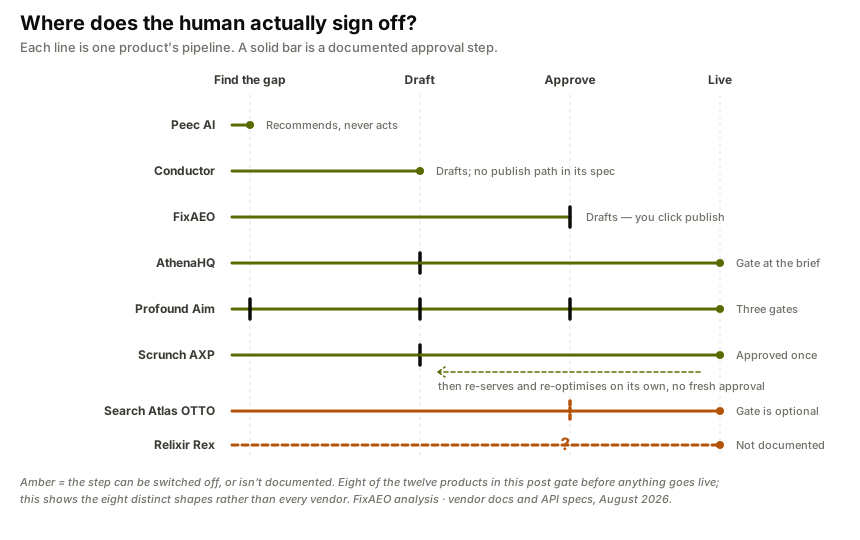
The useful question isn't whether a tool is "autonomous" — it's which step it stops at. These are the eight distinct shapes I found across twelve products.
Category 1: Technical-fixer agents
These agents change things on your live site — meta tags, redirects, schema, internal links — without you opening a code editor.
Search Atlas — OTTO SEO auto-implements meta tags, redirects, broken-link fixes, alt text, schema, canonical/OG/Twitter cards, and internal linking, plus topical content maps, automated link building, and Google Business Profile posting. It deploys via a JS pixel, a Cloudflare Worker at the edge, direct CMS writes (WordPress, HubSpot, Webflow, Shopify, Contentful, Duda), or a GitHub/Vercel pipeline. Autonomy: the only product here that documents a true no-review mode for live site changes — Automatic mode deploys with no human step, Approval mode holds every change for review, and you choose which. Pricing (searchatlas.com/pricing): Starter $99/mo (1 project) up to Agency $999/mo (10 projects), 7-day trial on all tiers.
Alli AI turns a goal into an SEO plan and executes through a single JavaScript overlay rather than editing your site's source — so it works on WordPress, Shopify, Wix, Squarespace, or custom sites without a CMS plugin. Autonomy: gated by default. Changes queue until you explicitly approve them before going live — no automatic-mode toggle like OTTO SEO's. Pricing (alliai.com/pricing): Business $249/mo (5 sites, 500 keywords), Agency $499/mo (15 sites), Enterprise custom. Annual billing saves roughly 17%.
Scrunch — Agent Experience Platform (AXP) is the most mechanically interesting thing on this list, because it doesn't recommend anything — it changes the bytes an AI crawler receives. AXP sits at your CDN (the vendor names Akamai, Cloudflare and Vercel), identifies AI agent traffic, and serves those requests a stripped, server-rendered, JavaScript-free version of the page at the same URL, while human visitors get your normal site. It sorts bots by intent — training-data collection, search indexing, or real-time retrieval — and by the vendor's account only real-time retrieval traffic gets the swapped version, so ordinary Google and Bing indexing is left alone. The stated effect is dramatic: one vendor example puts a typical pricing page at roughly 123,900 tokens before and 1,255 after. Take that and the rest of their numbers as vendor-published and unaudited — none is independently verified, and none is broken out as attributable to AXP rather than the wider platform. Autonomy: approve-then-auto-serve, and worth understanding precisely because it's the pattern the whole category is converging on. The mechanical de-bloating runs unattended. Content changes don't: the vendor's own guide walks through uploading a page, checking a before/after preview, then clicking Deploy, and the word "approved" governs what actually gets served. Autonomous at serve time, human-gated at content time. Pricing (scrunch.com/pricing): Starter $250/mo billed annually or $300 month-to-month, Growth $417/mo annually or $500 month-to-month, Enterprise custom, with a 7-day Starter trial. Read that carefully, because it's a trap — those are the monitoring platform's prices, and Scrunch's own help centre states AXP and its monitoring product are separately purchasable. AXP's own price isn't published anywhere I could find. One more thing worth knowing before you shortlist it: Scrunch is no longer independent — Sitecore announced its acquisition in early June 2026, and the AXP announcement itself describes Scrunch as "now a Sitecore company." A $225M figure circulates for that deal; it traces back to Bloomberg, I couldn't reach the original, and Sitecore's own release carries no number — so treat it as reported rather than confirmed. We keep a fuller breakdown in our Scrunch AI review.
Three more things about Scrunch that matter if you're evaluating it seriously rather than just reading a list. First, the two modes are not equivalent and the naming hides it. Universal Optimization is the mechanical pass — it strips analytics scripts, tracking pixels, layout shells and lazy-loaded UI, which is the kind of change where per-page review would be theatre. Adaptive Optimization is the one to actually think about: it implements approved diagnostics against your content and then re-optimizes week over week. That word "approved" is doing a lot of work. You approve a direction once; the re-optimization keeps running without you re-approving each pass. If you want a hard rule about what AI-facing visitors see on a given page, that's the setting to interrogate in a demo.
Second, its MCP server is genuinely write-capable, and that is easy to over-read. I went through all 33 documented tools. The writes are real — create and archive prompts, create and update brands and competitors, create and archive personas, apply and remove tags, build dashboards, import agent traffic. But every single one of them writes to Scrunch's own workspace configuration. Not one publishes to your website, edits page content, or changes what AXP serves. "Write-capable MCP" here means an assistant can reconfigure your tracking setup, not touch your site. Worth knowing that no confirmation step is documented for those config writes either, so an assistant with a live connection can archive a prompt you were tracking without asking twice.
Third, its own pages disagree about pricing, which is a useful reminder to check the canonical one. Alongside the current Starter/Growth/Enterprise table, older Scrunch pages still advertise a retired "Core" plan at $250/month for 125 prompts, and a listicle on its own domain lists Core and "Agency Core" at $500. Those are stale plan names that were never cleaned up. Cite the pricing page and nothing else. And note the domain is mid-migration — scrunchai.com now redirects to scrunch.com, though the app and help centre still sit on the old domain, so "Scrunch AI" and "Scrunch" are the same company. I could not verify AXP's behaviour first-hand: a help article documenting the Akamai setup now 404s, and everything above about how AXP routes traffic is the vendor's description of its own product rather than something I watched happen.
Category 2: Content-generation agents
These draft or fully write articles and programmatic pages at scale.
BrandWell (formerly Content at Scale — rebrand confirmed, still live at brandwell.ai) produces long-form, brand-voice posts sourced from keywords, YouTube videos, podcasts, existing blogs, PDFs, or audio, and generates programmatic pages from CSVs or feeds. Autonomy: genuinely hybrid — a "drip-published" autopilot mode exists, but every article is graded against a publish-readiness score before distribution, so even autopilot sits behind a quality gate. Pricing: BrandWell's own pricing page returned mismatched content when checked directly, so this is third-party sourced — Essentials around $249/mo, Agency around $499/mo, per this breakdown. Verify the live page before committing.
Scalenut prices Starter at $59/mo (a promo has run it as low as ~$24/mo — confirm the live rate), Plus at $89/mo, and Professional at $199/mo, with one-click WordPress/Shopify publishing from Plus up. It's also folded AI-visibility tracking into the content tool — Starter tracks 10 prompts across ChatGPT and Google AI Overviews plus 5 GEO articles/mo, Professional scales to 100 prompts (adding Perplexity), 75 GEO articles/mo, and 1,000 audited pages/mo. Autonomy: publish behavior is tier-gated — lower tiers hand you a draft, Plus and above will push to your CMS if you turn that setting on.
AthenaHQ — Content Agents is the cleanest example here of an agent that genuinely closes the loop, and the one I'd point at if you want to see the draft-then-approve pattern done properly. It starts from a prompt you're losing visibility on, runs a multi-stage pipeline — brief, revision, draft — and publishes into one of six CMS integrations, with a real API behind each step rather than a chat box that claims to do it. Autonomy: approval-gated by its own documentation. A draft can't move forward until you call the brief-approval step, and that step is only valid while the piece is sitting at the brief stage. Two honest wrinkles. Its own marketing oversells this — the citation engine is described as autonomously executing multi-step workflows, which the API docs don't support — and there's an auto-approve flag in the API that isn't documented, so I'd describe the gate as real but not bolted shut. Pricing (athenahq.ai/plans): Essential is free with $25 of credit (300 credits/mo, five engines), Starter is $295/mo (3,600 credits/mo), Enterprise is custom. The unit is one credit per AI response, so what you actually spend tracks usage rather than the sticker. An annual toggle advertises 17% off without publishing the discounted number. Ignore the $545 "Growth" tier and $95 first-month offers floating around on review sites — neither appears on AthenaHQ's own pages. More detail in our AthenaHQ review.
The reason I rate this entry highly is the specificity of what it actually ships, so here it is. The pipeline runs in four named modes, and they map to four different real jobs rather than being one "write me an article" button: Draft writes new content from prompts you're losing; Snipe targets a specific competitor URL you want to outrank; Optimize improves an existing URL of yours for AI search; and Slice splits one page into several articles. Output lands in a spreadsheet-style workspace where pieces are tracked from brief to published. Publishing goes into six CMSes — Shopify, Webflow, Wix, Framer, WordPress and Payload — and in Webflow's case it reads your collection schema to pre-fill the fields, which is the sort of detail that only exists when someone has actually shipped the integration. There's an MCP server too, with write tools available on API-key connections, so this is one of the few products here where an assistant can genuinely start work rather than just read dashboards.
Two cautions. Its engine count is inconsistent on its own site — the Starter tier claims visibility across nine models while the homepage names eight and hedges with "8+", so use their phrasing with attribution rather than committing to a number. And the Enterprise-only features (a knowledge base with claim review, discrepancy detection, the citation engine, persona targeting, a recommendation engine) are feature-list bullets with no documentation behind them that I could find and no published price, so I'd treat that tier as a conversation rather than a spec. The /plans page is the fuller of its two pricing pages if you're comparing.
Conductor — AgentStack, announced April 20, 2026,1 is the one entry here from an established enterprise SEO platform rather than an AEO-native startup, and its strategy is different in a way worth noticing: rather than selling you the agent, it sells the intelligence layer — an MCP server and a Data API meant to feed whatever agent you already run — alongside its own content and technical agents. The technical side only recommends. The content side drafts. Autonomy: gated, and Conductor says so itself — the agents are sold "with built-in governance," and its FAQ describes teams deploying them "while maintaining control over outputs." That sits awkwardly against the launch release's promise of insight to published content in under three minutes — a claim I went looking for in their own API spec and couldn't find a path for, as covered above. On the MCP server, use their words rather than mine: it "doesn't write data back into the platform." Pricing: not public. Essentials, Growth and Enterprise carry no figures, the model is described as usage-based with no published rate, and the one concrete commercial fact is a three-week free trial.
It's worth being precise about what AgentStack actually is, because "turnkey AEO agents" undersells the interesting part and oversells the agents. It's three layers. The first is native apps living inside ChatGPT, Claude and Copilot. The second — the strategically interesting one — is an MCP server and Data API that expose Conductor's brand mentions, citations, sentiment, share-of-voice, rankings and technical health to other platforms: Salesforce Agentforce, Writer, Opal, n8n, Zapier. That's a decade of proprietary search data being sold as feedstock for agents Conductor doesn't own, which is a genuinely different bet from everyone else on this page. The third layer is its own two agents: a Content Agent that works a prioritized queue of updates and net-new pieces, and a Technical Agent that monitors and triages issues then hands over guided recommendations rather than fixing anything.
And one correction I owe the reader about my own framing above. That "under three minutes" promise is not on Conductor's website. I searched the rendered text of all three AgentStack pages, including collapsed accordions: zero hits for "three minutes" or "3 minutes," and zero hits for the word "publish" on the AgentStack landing page. The site's actual claim is the much weaker "from insight to execution in minutes," plus a separate line about producing exec summaries and branded slides in under five minutes — reports, not published pages. The three-minute figure lives only in the April press release. If you see it quoted against Conductor, that's where it came from, and it isn't what their product pages say.
One timing signal holds up, and it's narrower than I first assumed. The data-only access option — buying the intelligence layer without a platform subscription — is still described in future tense on Conductor's own FAQ, so as of now it isn't purchasable. On the agents themselves I'll take them at their word: the April release note says AgentStack is available to all Conductor Intelligence users. There's a near-three-month gap before the MCP server's release note in early July, but that's a December early preview reaching general availability on a different product line, not a slipped ship date, and I'd have been wrong to read it as one. What is genuinely thin is documentation: neither agent has a docs page, a changelog entry, or even a dedicated product page — the names appear as tags on a landing page. That's the main reason I've placed Conductor low on the autonomy chart rather than arguing about it. There is very little shipped surface to evaluate, which is different from saying nothing shipped.
Relixir — Rex is the most aggressive autonomy claim I found anywhere in this category, and the most instructive. Rex is branded "Your Autonomous GEO Employee": it watches your brand across ChatGPT, Perplexity, Claude and Google AI Overviews, then writes and publishes GEO content around the gaps, "all on autopilot," with "zero manual work." Autonomy: this is the one row on my chart I drew as a dashed bar, because I genuinely don't know. Relixir never actually says a human isn't reviewing — it markets autonomy without documenting the absence of a gate, which is not the same claim. Three things push the other way. Their own page describes the service as forward-deployed, with Relixir's team configuring, launching and managing Rex for you — that's a managed service, not software you drive. Pages they have since deleted, archived 24 January 2026 and still readable, marketed "Multi-Level Approval Workflows" and an audit trail time-stamping "every approval click, edit, and publish action" — I can tell you they sold that in January, not that it ever shipped. And the /rex page itself has been unchanged for about four months. The page also carries a benchmark table claiming Rex hits 94.2% on a pass-first-try metric against 61.4% for GPT-5.2's agent, 58.7% for Claude Opus 4.5 and 55.1% for Gemini 3 Pro, across "1,200 production GEO workflows" — with no methodology, no linked paper, and no way to check any of it. I'm reporting that it's on the page, not that it's true.
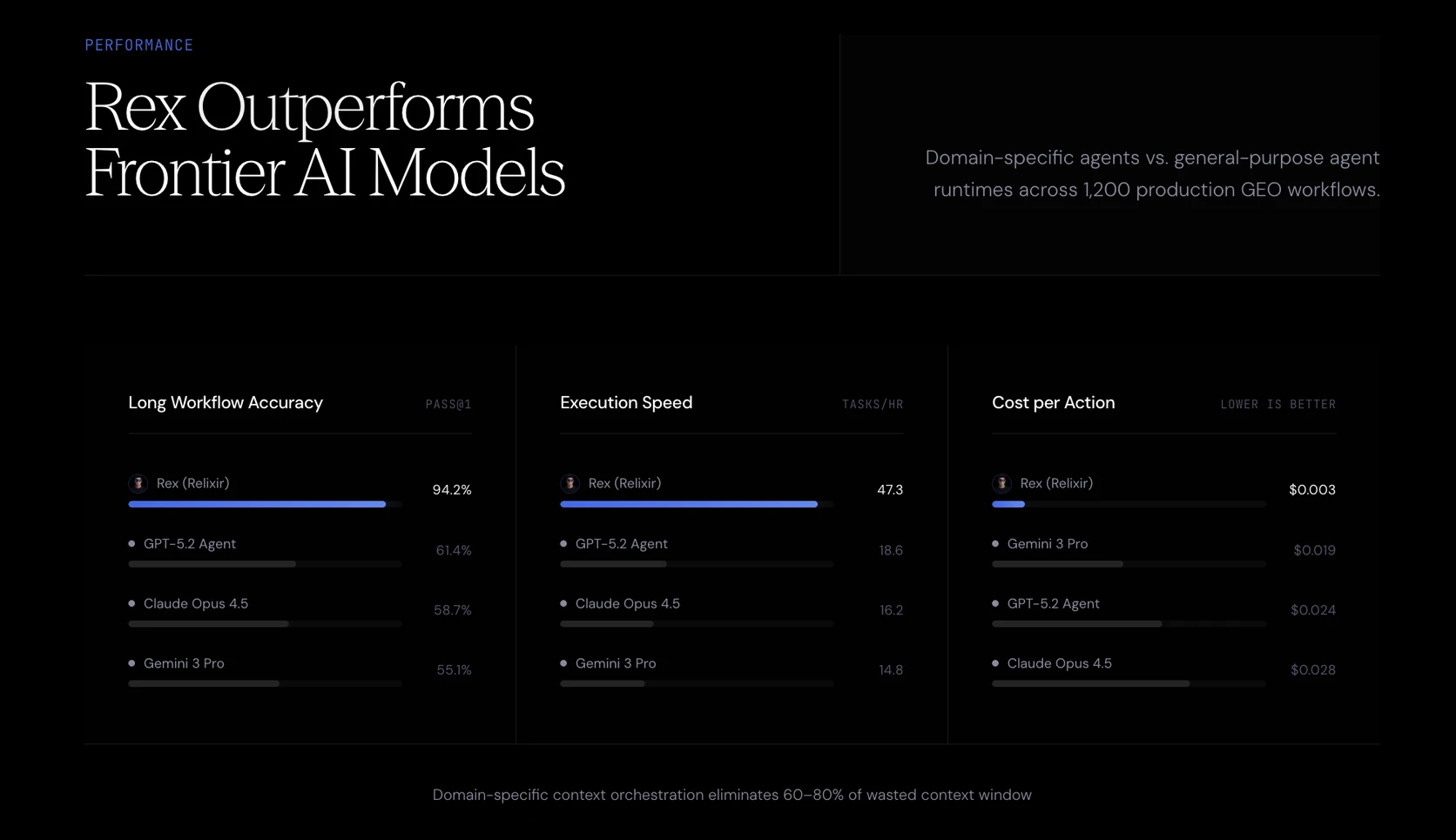
Relixir's benchmark, as published on its own site. A startup's agent beating three named frontier models on accuracy, speed and cost simultaneously — across "1,200 production GEO workflows" that are never described, with no methodology, no paper and no way for anyone to reproduce it. I'm showing it because the confidence of the presentation is the point, not the numbers. Pricing: not public, demo only. One trap worth flagging: the "$5,000+/mo" figure on that page is what they say a GEO agency costs, in the "without Rex" column — it is not Relixir's price. Every number circulating for Relixir on review sites contradicts every other one, and at least one openly labels its middle tier an estimate.
The stated capability list is broad: prompt and keyword intelligence, an AI search analytics dashboard, GEO content generation, a deep research engine, autonomous content refresh that rewrites existing pages rather than only adding new ones, continuous domain authority building, technical audits, competitor monitoring, and one-click integration with your marketing stack via "browser agents that can connect to anything." Taken at face value that's most of this post's three categories in one product.
Now the part that changed how I read it. The human in Relixir's loop is Relixir. Their own page says Rex is "forward-deployed — our team configures, launches, and manages Rex for your business." Read the autonomy claims again with that in mind, because "zero manual work" turns out to mean zero manual work for you, not an absence of human judgment in the system. That's a managed service with an agent inside it, which is a legitimate and arguably more sensible product than an unsupervised bot — it's just a materially different thing from what the branding implies, and it means you can't evaluate Rex the way you'd evaluate software you log into.
I searched every live page — the homepage, /rex, /enterprise, /case-studies — for "approval," "review," "human-in-the-loop," "draft," "you approve," "guardrails" and "brand voice." Zero hits on any of them. So the absence of a gate is an implication a reader draws, never a claim the vendor makes. One detail sharpens this: the older positioning was "from insight to publish in one click," which implies a person clicking. The current positioning dropped the click.
A few more things a buyer should know. The live site is down to roughly four pages and the blog 404s site-wide. rex.relixir.ai, cited on their own page as the product interface, doesn't resolve in DNS, so there's no reachable surface to inspect for a review queue. The case studies name industries rather than companies, with no dates, alongside figures up to $3.6M in revenue impact and 4,280 AI citations that can't be checked against anything. And the customer count doesn't reconcile: /rex says "400+ B2B teams," while their own funding announcement nine months earlier said 200 — a doubling with no source behind either number. A separate wire release does name Rippling, Airwallex and HackerRank as customers, but that's a vendor statement in paid distribution, not a reference you can call.
One observation I'll offer carefully rather than as an accusation, because it's the most on-brand fact in this entire post. That deleted blog was, by the look of it, hundreds of near-duplicate comparison posts — the signature of programmatic content generation, localized into Chinese under its own subdirectory. Which means the specific claims about Relixir's pricing tiers and approval workflows that reviewers keep citing were most likely written by the product itself, about itself, and have since been deleted by the company. If you want a single illustration of why "check the primary source" is the whole job now, that's it. The auto-published corpus outlived the facts it asserted, and it's still feeding other people's comparison articles.
Finally, don't confuse Rex with Naive. Every Relixir page banners a separate product at usenaive.ai, and its /enterprise page invites you to "hire autonomous employees like Rex" there. Naive is agent infrastructure whose own pages never mention GEO, and it does publish human-in-the-loop language — about blocking on payments and spend caps. That's a different product solving a different problem, and quoting it as evidence of a Rex content-approval gate would be wrong. I couldn't determine whether it's a pivot, a sister company, or shared founders.
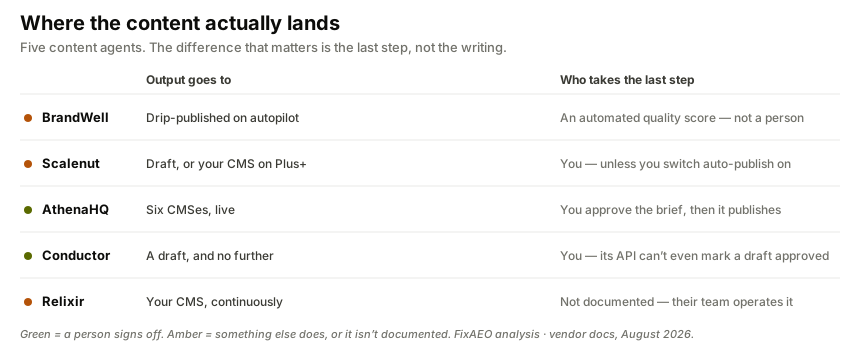
All five of these will write you an article. The difference worth paying for is what happens at the last step.
Kelsey Voss, a Principal Analyst at EMARKETER, drew the line worth remembering here:
"SEO is about ranking pages for clicks, while GEO is about being selected as a source in synthesized answers."
That's from EMARKETER's April 2026 GEO/AEO explainer. A content agent tuned for old ranking signals is solving a different problem than one built to get selected as a citation source — check which one a given tool actually targets.
Category 3: AI-visibility action agents
The newest category, and most directly tied to whether AI answer engines mention your brand at all. These track your presence across ChatGPT, Claude, Gemini, and Perplexity, then try to turn that into something you act on.
Profound — Aim, announced July 2, 2026,2 is an "always-on background agent" monitoring visibility, sentiment, accuracy, and competitive movement, surfacing a weekly ranked list of opportunities. Accepted opportunities become goal-based "Projects," broken into tasks routed to specialized sub-agents — research, content creation, optimization — that execute things like publishing content or seeding community discussions. Autonomy: the most ambitious scope of any vendor here that actually documents its checkpoints, and there are three — accepting an opportunity, reviewing the brief, and reviewing sub-agent output before it ships. Pricing: not public; a third-party tracker estimates a mid-tier around $399/mo, but that figure is unofficial — treat it as a guess, not a quote.
Peec AI — Actions analyzes sources cited across ChatGPT, Perplexity, Claude, and Gemini, clusters them by type — listicles, Reddit threads, product pages — and scores each opportunity 1–3 based on usage frequency and your presence versus competitors. Autonomy: recommendation-only by design — Peec is the most explicit vendor here about not crossing into execution, handling research and prioritization while you keep full control over what gets built. Pricing: included in every plan, no add-on charge.
Otterly AI's MCP server and Claude Skill, launched around June 1, 2026 alongside a public API and a 101+ workflow marketplace,3 give you a Claude Desktop skill for plain-language queries plus a hosted MCP server exposing more than 20 tools to any MCP client (Claude, ChatGPT, Cursor, and other MCP-compatible clients). Autonomy: overwhelmingly read-only — the large majority of tools only retrieve data (workspaces, brand reports, citations, GEO audits, query fan-outs); the handful of write-permission tools only trigger a new crawlability check, content check, or query fan-out, not a publish or edit action. No publish or edit path at all, one of the more conservative tools on this list. Pricing: no separate charge, included in Standard ($189/mo, verified), Premium ($489/mo), or custom Enterprise.
FixAEO — I work on it, so treat this as disclosed bias — is where I'd tell you to start if you're not measuring at all yet, and the reason is worth stating beyond "I built it." Begin with the distinction that matters when you evaluate any tool here: some read model APIs, others capture what a logged-in user actually sees in the chat UI — and the two can differ, because an API response isn't always the answer a real person gets in ChatGPT or Perplexity. FixAEO's tracking reads the real browser answer, on residential IPs, location-aware by region, so you measure what buyers in your market actually get, not a datacenter call they'll never see. It also ships the piece I'd now put first: Agent Analytics, which answers the question sitting underneath everything else on this page. Before any engine can cite you, a crawler has to actually read you — and most teams have never checked whether that's happening. Agent Analytics names roughly 50 AI crawlers individually (GPTBot, ClaudeBot, PerplexityBot, Googlebot, Bingbot and the rest) instead of lumping them into one "bot traffic" number, gives you the full searchable list of pages they fetched, and — the part nobody expects to need until they see it — the status code and failure rate for those fetches, so a page quietly erroring at ChatGPT's crawler can't stay invisible. You can slice it by bot, engine, vendor, folder or country, and it reads your robots rules back so you can spot a crawler you're blocking by accident. Two limits stated plainly: the complete crawler capture, training bots included, is Growth and Enterprise — the $29 Lite tier covers AI-driven visits and AI browsing agents, not the pure crawlers — and Profound verifies bot identity against published IP ranges where we don't yet, so if spoofed user agents are your threat model they're ahead of us. Longer writeup: what Agent Analytics actually shows. Beyond that it ties GA4 attribution to AI referral traffic so you can show revenue rather than just visibility, and ships an MCP server to query your data from Claude, Cursor, or ChatGPT (MCP is table stakes now — Peec, Profound, Otterly, Scrunch, Conductor and AthenaHQ all have one — but ours is on the $29 entry tier, not reserved for a higher plan). /app/improve turns all of that into a ranked, brand-specific fix list, and the WordPress integration publishes those as draft posts in your own install — never live without you clicking publish. Autonomy: approval-gated and recommendation-first — deliberately not the most autonomous tool here, and I won't pretend otherwise. The trade is trust plus coverage: 9 engines on Enterprise, 6 on the $29 Lite and $79 Growth tiers, a free Gemini-only scan with no signup, a Chrome extension for one-click page checks, and 22 free standalone tools (schema, llms.txt, and robots.txt generators, audits, validators).
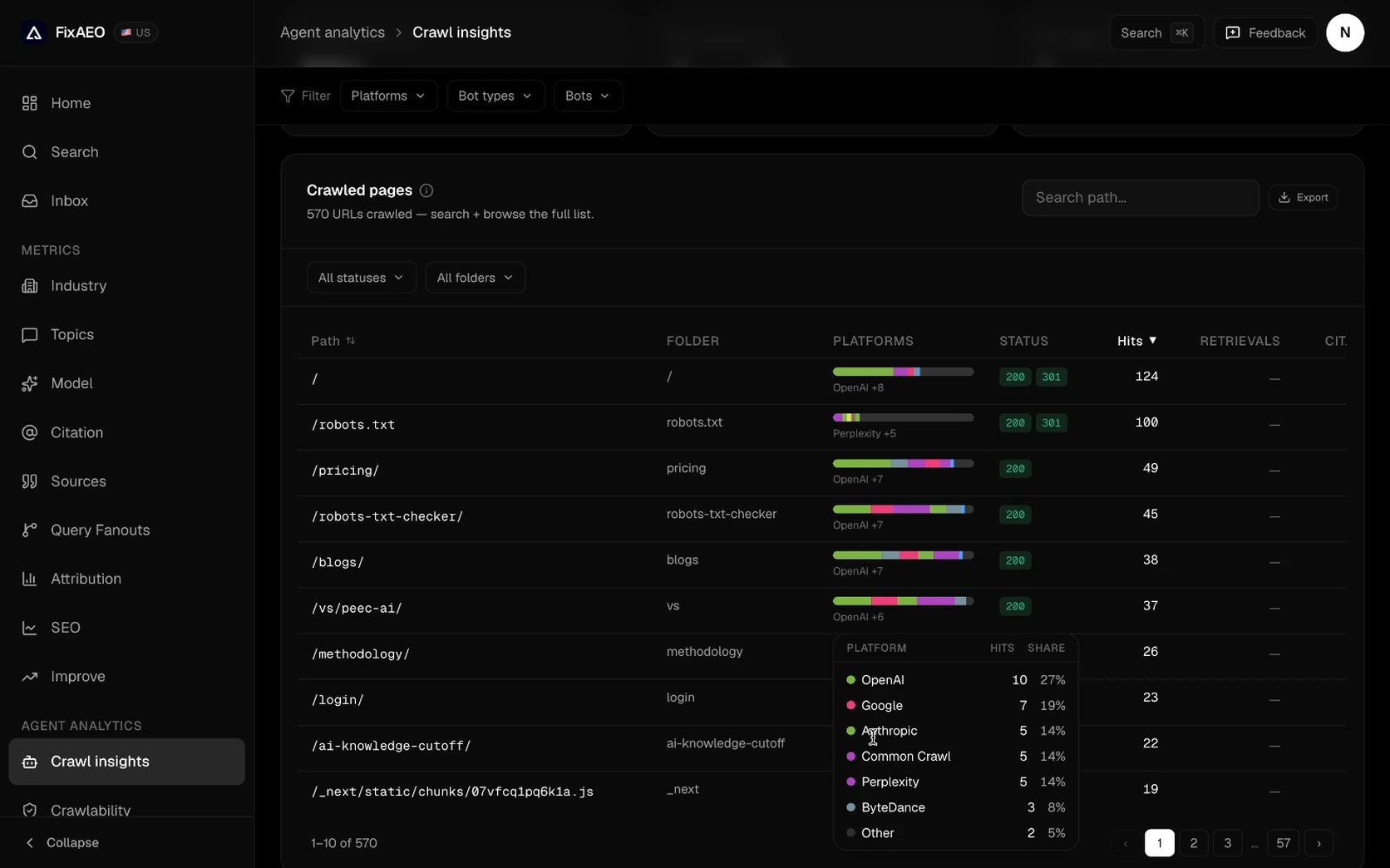
Agent Analytics on this site's own data: every page a crawler fetched, the status it got back, and which engine did the fetching. Note that build chunks and robots.txt are in the list rather than filtered out — that's deliberate. A crawler spending its budget on /_next/ instead of your articles is a finding, and hiding it made our page count disagree with what customers saw in their own server logs.
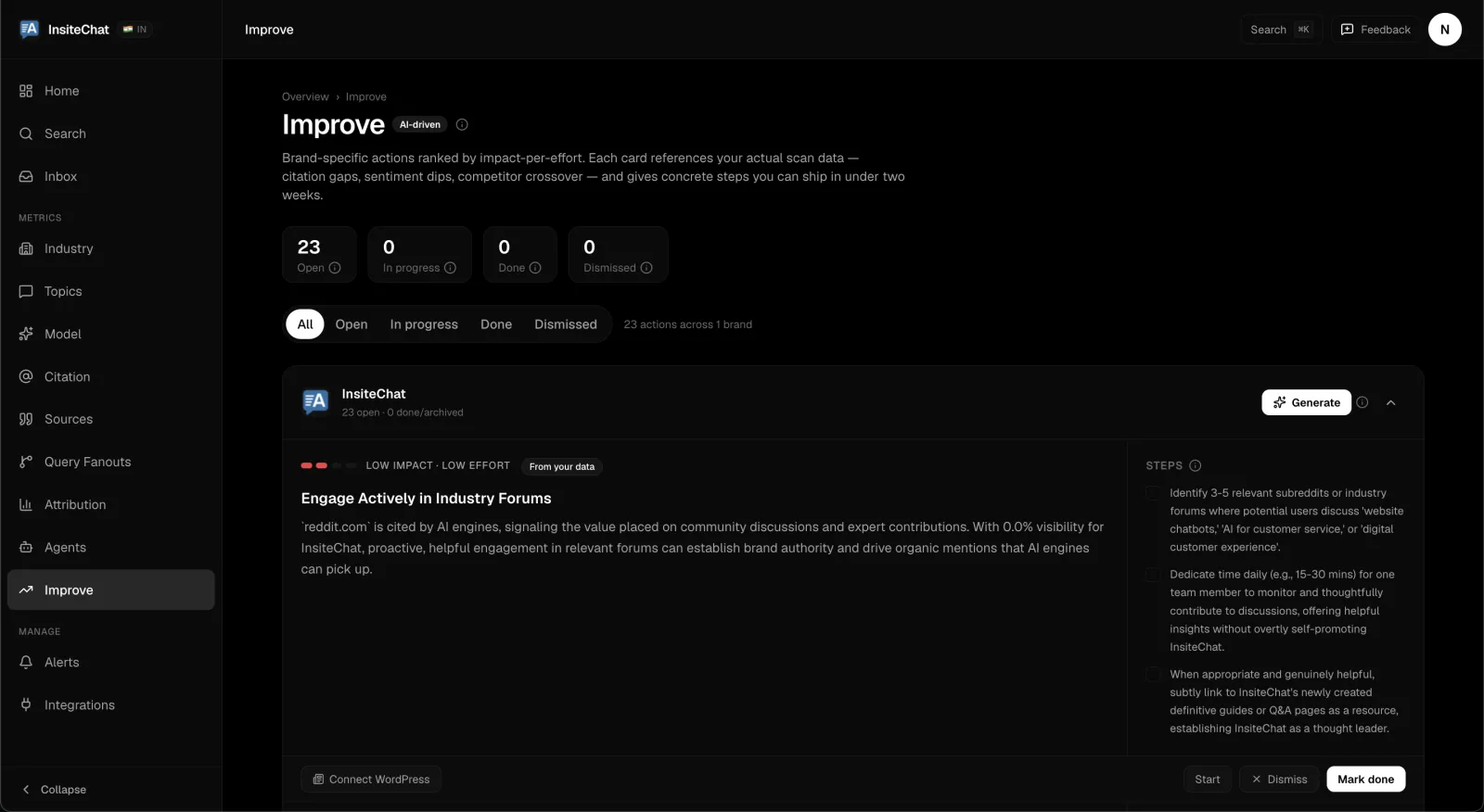
FixAEO's /app/improve turns visibility gaps into a ranked, brand-specific fix list — the recommendation layer, with a human approving anything before it ships.
FixAEO update: AI Marketer and Agents
FixAEO now includes AI Marketer and 17 ready-made Agents for research, content, optimization, reporting, and outreach. The important boundary is unchanged: work stays visible and reviewable, and a generated deliverable is not treated as automatically approved or published. Start from a template or build a custom workflow, keep the evidence attached, and schedule repeatable work where the workflow supports it.
The one that isn't an SEO agent at all
I'm including this separately rather than in the count, because filing it with the others would be misleading — but leaving it out would miss where this market is going.
Evertune — Visibility Boost, announced May 2026,4 reads the same thing every visibility tool on this page reads — the prompts where your brand isn't getting recommended — and then does something none of the others do: it buys ads against them. It builds campaigns on ChatGPT's native advertising platform targeting those specific gaps, running through your own OpenAI Ads account. Evertune is explicit about the split, describing GEO as the thing that builds your organic presence and Visibility Boost as what places your brand in the conversations where you're not being recommended. Autonomy: human-in-the-loop, and documented as such — the agent generates the campaign structure and editable ad copy, but their own guide has a section headed "Stay in control," and a person is the one who launches. Pricing: Visibility Boost itself isn't priced publicly — it's invite-only and doesn't appear in either published tier. The platform lists Pro at $800/mo and Enterprise as custom, both behind "request a demo." Media spend is separate and goes to OpenAI, not Evertune; they publish OpenAI's own bid guidance rather than a fee of their own. Ignore the ~$3,000/mo enterprise figure on the aggregator sites — it isn't on Evertune's.
The mechanism deserves a closer look, because it's the first thing I've seen that genuinely couldn't exist before AI answers. Ads aren't targeted with keywords — the vendor is explicit that you can't reuse your search keyword lists, because ChatGPT's "context hints" are semantic descriptions matched against live conversations rather than query strings. So the agent converts your visibility gaps into intents, and builds ad groups from those. The campaign strategy follows a three-way split off your visibility scores: target the conversations where you're missing, grow the ones where you're inconsistent, defend the ones you're already winning. Ad copy is then generated from your own gap data, with landing-page matching on top. You connect your existing OpenAI Ads account by API key and reporting consolidates inside Evertune.
Some practical numbers, though note they're OpenAI's rather than Evertune's: the published bid guidance suggests starting maximums around $3–$5 CPC and up to $60 CPM, with sub-$3 CPC bids often failing to deliver at all. That's the closest thing to a cost anchor available, since Evertune publishes no minimum spend, no management fee and no percentage of spend. It's also worth reading the $800 Pro tier carefully if you're budgeting: its bullets cover 100,000 tracked prompts across 11 models, 25 AI-optimized articles a month, affiliate advertising partnerships and AI retargeting — ChatGPT ads and Visibility Boost are not among them, which is consistent with it being a separate, unpriced product.
Two honest caveats. It's still described as an early beta with a limited customer group two and a half months after announcement, and beta onboarding includes an Evertune success manager helping build your first campaign — so this is not something you can go and switch on today, and I can't tell whether the beta genuinely hasn't graduated or the page just hasn't been updated. And there is zero published performance evidence: no case study, no lift figure, no spend-to-result number anywhere. Their claim to be built by former Trade Desk executives, and to be first to market here, are both vendor assertions I didn't verify.
Why it matters even though it isn't SEO: the visibility gap has become an ad-targeting asset. The same data that tells a content agent what to write is now being sold as a reason to spend media budget. Evertune claims to be first to do it and I couldn't verify that either way, but it's certainly the only one here doing it. If you're evaluating this category on the assumption that "AI visibility tooling" means organic work, that assumption has an expiry date.
The three categories are already collapsing
I've kept the three-category structure because it's still the most useful way to shop. But it's worth saying plainly that the vendors are not respecting it, and by next year this framing may not survive.
Scalenut is a content tool that quietly grew AI-visibility tracking, so its cheapest tier now competes with dedicated visibility products. Relixir claims all three jobs at once — monitoring, content generation, technical audits — inside one managed service. Conductor is selling a data layer rather than a product, betting you'll bring your own agent. Scrunch invented a fourth thing entirely, sitting in the request path and changing what crawlers receive, which isn't a fix, a draft, or a report. And Evertune took visibility data somewhere I haven't seen anyone else take it, which is media buying.
Two practical consequences. You'll likely overpay if you buy strictly by category, because the overlap is now substantial — a content tool with tracking bundled in may cover two line items adequately, and "adequate on both" often beats "excellent on one" when the budget is real. And the autonomy question is becoming the more useful axis than the category question. What a tool acts on matters less than whether it acts without you, because that's what determines how much of your attention it consumes and how much risk it carries. That's the whole reason the chart above sorts on autonomy rather than on category.
The one line I'd still hold: measurement and action are different purchases, and doing the second before the first is the most common way teams waste money here. A fixer that automates changes to a site no AI engine has ever cited is an expensive way to do nothing.
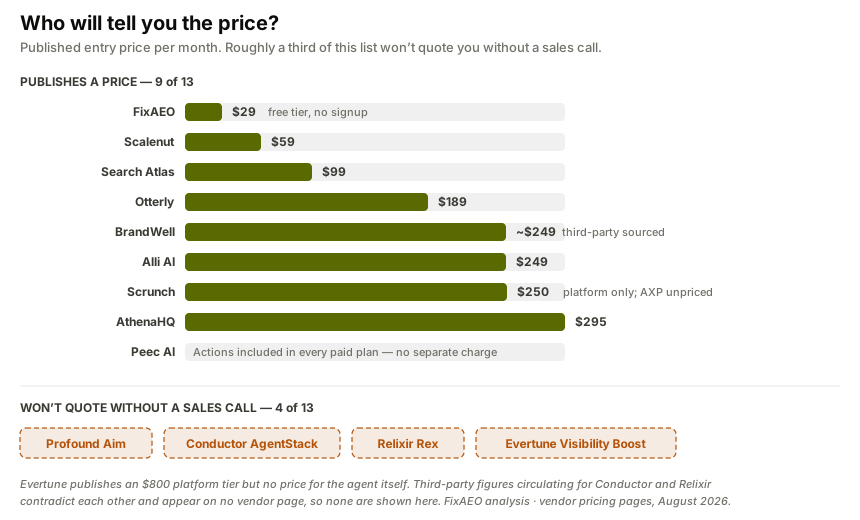
Four of thirteen won't give you a number. For a small team that sales cycle is often the real cost, not the licence.
Comparison table
| Tool | Category | Autonomy level | Starting price |
|---|---|---|---|
| Search Atlas OTTO SEO | Technical fixer | Optional — automatic or approval mode | $99/mo |
| Alli AI | Technical fixer | Approval-gated by default | $249/mo |
| Scrunch AXP | Technical fixer | Approve once, then auto-serves at the edge | Platform from $250/mo; AXP priced separately, not public |
| BrandWell | Content generation | Hybrid — autopilot + quality-score gate | ~$249/mo (third-party sourced) |
| Scalenut | Content generation | Tier-gated — manual, or auto-publish on Plus+ | $59/mo |
| AthenaHQ Content Agents | Content generation | Approval-gated — approve the brief, then it publishes | Free tier; $295/mo |
| Conductor AgentStack | Content generation + data layer | Gated ("built-in governance"); no publish path in its API spec | Not public (3-week trial) |
| Relixir Rex | Content generation | Markets autopilot; no review step documented either way | Not public (demo only) |
| Profound Aim | Visibility action agent | Approval-gated — 3 human checkpoints | Not public (est. ~$399/mo, unconfirmed) |
| Peec AI Actions | Visibility action agent | Recommendation-only, no execution | Free with any plan |
| Otterly MCP / Claude Skill | Visibility action agent | Mostly read-only, no publish/edit | Included in $189+/mo plans |
| FixAEO (Agent Analytics + /app/improve + WP drafts + MCP) | Visibility action agent | Approval-gated — drafts only, human publishes | Free tier available; paid from $29/mo |
| Evertune Visibility Boost (paid media, not SEO) | Ad-buying agent | Human-in-the-loop — agent drafts campaigns, you launch | Not public (invite-only); platform from $800/mo |
MCP: nearly everyone has one, almost none of them can touch your site
An MCP server lets you point Claude, ChatGPT, Cursor or n8n at a vendor's data and ask questions in plain language. In 2026 it stopped being a differentiator — eight of the products here ship one. But "has an MCP server" and "an assistant can act through it" are very different claims, and the gap between them is where I'd concentrate your due diligence, because a write-capable MCP is the one place an agent can change something without going through the product's own approval UI.
| Vendor | Can an assistant write through it? | What a write actually touches |
|---|---|---|
| Search Atlas | Yes — writes across a catalogue too large to audit | Official server, on npm since 2 March 2026, bridging to its hosted endpoint. Advertises 500+ tools spanning OTTO SEO, PPC, content generation and site exploration, including documented writes like editing article content and submitting index batches. Unlike the rows below I did not enumerate this one tool by tool, so treat the publish-to-your-site question as open rather than answered. |
| Scrunch | Yes — 14 of 33 tools write | Scrunch's own workspace: prompts, brands, competitors, personas, tags, dashboards. Nothing on your site. No confirmation step documented. |
| AthenaHQ | Yes, on API-key connections | Its content pipeline — an assistant can start drafting. The brief-approval gate still applies before a draft advances. |
| Otterly | Barely | 20+ tools, overwhelmingly read. The few writes only trigger a fresh crawlability check, content check or query fan-out. No publish or edit path. |
| Conductor | No | Its own FAQ: "it doesn't write data back into the platform" — with a "Currently" hedge worth watching. |
| Peec AI | No (read layer) | Included free on every paid plan, which is a deliberate jab at rivals gating it behind higher tiers. |
| Profound | No (read layer) | Longest-running MCP server in the category. |
| FixAEO | No | All 14 tools are get_* or list_*. I checked the source before writing this line; there is no write path. |
Two things fall out of that table. First, of the servers I could audit tool by tool, the most write-capable still can't publish a page — Scrunch's writes reconfigure Scrunch. Search Atlas is the genuine unknown here: a 500-tool catalogue is not something I can responsibly summarise, and it's exactly the case where you should ask for the tool list in writing rather than trust anybody's roundup, including this one. If a vendor tells you their MCP is "agentic," ask which specific tools write and what they write to. Second, Conductor's hedge is the one to keep an eye on: "currently" is doing real work in that sentence, and a read-only integration becoming write-capable is exactly the kind of change that ships without a press release.
A related caveat on Conductor's app-layer claims: its AgentStack page advertises official apps for ChatGPT, Claude and Copilot, while its own MCP FAQ says the native Claude connector is "currently in review with Anthropic" and that Gemini "isn't supported during Beta." Both statements are Conductor's. If a native connector matters to your workflow, verify which ones are actually live before signing.
Neither Relixir nor Evertune ships an MCP server that I could find, and neither does Alli AI — it works at the site layer instead. Search Atlas is the exception among the technical fixers: it ships both an official MCP server and site-layer deployment.
Which agent type fits your team
Enterprise needs the broadest engine coverage, SSO, and enough budget to let an agent like Profound Aim run its full sub-agent pipeline, paired with a fixer at Agency-scale tiers for the technical layer. On the visibility side, that means full engine coverage, 10+ brand support, and SSO built for team seats — non-negotiable at this scale regardless of vendor. Two enterprise-specific options only became relevant this year: if you already run a CDN, Scrunch's AXP is the only thing here that changes what crawlers actually receive rather than telling you to change it; and if your team wants to feed its own agents rather than adopt a vendor's, Conductor's MCP-and-Data-API approach is the one built for that, though expect to talk to sales for a number.
Startups and SMBs want fast setup at a proportionate spend, not a $999/mo package. Scalenut Plus ($89/mo) or Search Atlas Starter ($99/mo) cover content and technical fixes without much ramp-up. For visibility, a mid-tier plan tracking the core engines across a couple of brands, with recommendations attached, is usually the right size — you don't need daily scans or nine-engine coverage yet. AthenaHQ at $295 is the interesting middle option now if content is your actual bottleneck, because its four pipeline modes map to jobs you already have — write for a prompt you're losing, target a competitor's page, improve one of your own, split a bloated one. Just model it on credits rather than the sticker price, since one credit is one AI response and a heavy month costs more than $295 suggests. And be realistic about the demo-gated half of this list: Profound, Conductor, Relixir and Evertune will all take a sales cycle, which for a five-person team is often the real cost rather than the licence.
Teams that already run their own agents are a buyer type that didn't exist a year ago. Most vendors here will feed your setup — eight ship an MCP server — but Conductor is the only one that sells the data layer as the product rather than as an add-on to its own agent. If you've got an n8n or Zapier setup, a Writer deployment, or Agentforce in the building, buying an agent from an SEO vendor duplicates orchestration you already own — what you want is the data underneath it. That's precisely what AgentStack's MCP server and Data API sell: mentions, citations, sentiment, share of voice, rankings and technical health, exposed to whatever you've already built. Two caveats before you plan around it. The data-only option that would let you skip the platform subscription is still described in future tense on Conductor's own FAQ, so today you're likely buying the platform too. And their MCP is read-only by their own documentation, with a "currently" attached — fine for feeding your agents, useless if you expected it to write back.
Solo operators and freelancers should let budget decide. Scalenut Starter ($59/mo, sometimes discounted lower) is the cheapest real content-agent entry point here. But start on the visibility side before paying for anything — FixAEO's free Gemini scan needs no signup and tells you whether you even have a citation problem, and its $29 tier is the cheapest route onto six engines with the MCP server included rather than gated to a higher plan. AthenaHQ's free Essential tier is worth knowing about too, though its $25 of starting credit is a trial in practice rather than a standing free tier. Skip the $249+ fixer tools until your site is big enough to need site-wide automated changes — and skip Relixir and Conductor entirely at this size, since neither will quote you a price without a sales call.
Agencies need white-label output and per-client seats. BrandWell's Agency tier (4 sites, 25 posts/mo, white-label) and Alli AI's Agency tier (15 sites) are built for exactly this, and Search Atlas's $999/mo Agency tier makes sense once you're running fixes across a real client roster. For visibility tracking across clients, prioritize a plan built around multiple brands under one account rather than stacking separate single-brand subscriptions per client. Watch the seat math on Scrunch specifically — its published tiers include three users on Starter and five on Growth, with extra seats charged individually, which adds up faster than the headline price implies once account managers need logins. And if you're reselling this work, the approval question stops being philosophical: an agent that publishes to a client's site without your review means your client's brand voice is in a vendor's hands, and you're the one on the call when it reads wrong. Every agency I'd advise here should be buying gated tools deliberately, not reluctantly.
Regulated and enterprise-brand teams — finance, health, anything with a compliance function — should treat the autonomy chart as a shortlist filter rather than a curiosity. Start from the left. The relevant question isn't whether an agent can publish, it's whether you can produce an audit trail afterwards showing who approved what and when. Conductor is the only vendor whose documentation shows the shape of that natively, with draft statuses moving through review and approval and an assignee attached to each one. That's a fragment of a workflow rather than a compliance feature, but it's more than most of this list documents at all. And the tools that market autonomy hardest are the ones least likely to be able to hand you that trail, which is a strange place for the market to have ended up.
Nine questions to ask on the demo call
Every one of these comes from something that was ambiguous, contradictory or unpriced in the research above. They're ordered so that the first three will tell you most of what you need.
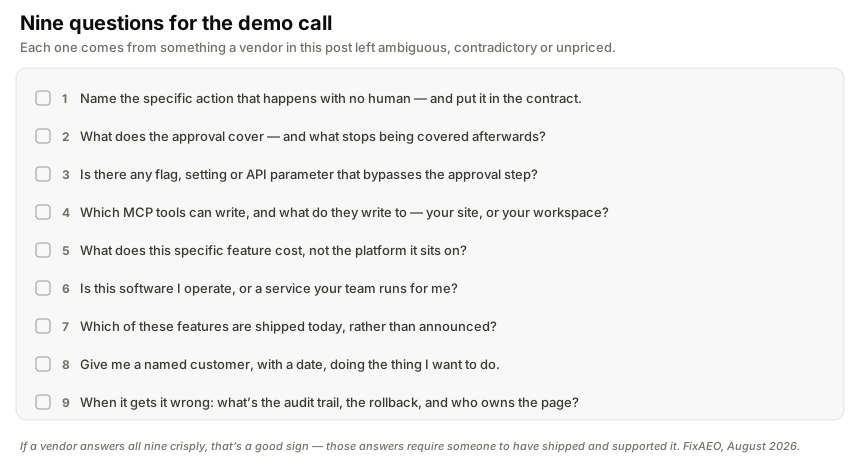
- "Name the specific action that happens without a human, and put it in the contract." Not "is it autonomous" — vendors answer that with marketing. Make them name the action. This is the question that separates approve-then-auto-serve from fire-and-forget, and both get called autonomous.
- "What does the approval cover, and what does it not cover afterwards?" The Scrunch pattern is the one to probe: you approve a direction once, then optimization keeps running weekly. Ask whether subsequent re-runs need fresh approval, because "approved" can mean approved-forever.
- "Is there any flag, setting or API parameter that bypasses the approval step?" AthenaHQ's API has an auto-approve boolean that isn't documented anywhere. If a bypass exists, the gate is a default rather than a guarantee — that's still fine, but you should know which one you bought.
- "Which MCP tools can write, and what do they write to?" The answer should distinguish the vendor's own workspace from your website. If they can't answer precisely, that's informative on its own.
- "What does this specific feature cost, not the platform?" Scrunch's AXP is a separately purchasable product whose price appears nowhere public, while its platform tiers are published — quoting the platform price would have understated the real cost by an unknown amount. Ask for the line item.
- "Is this software I operate, or a service your team runs?" Both are legitimate. They're priced differently, they scale differently, and they fail differently. Relixir's forward-deployed model is a service; the branding says employee.
- "Which of these features are shipped today?" Conductor's data-only access is described in future tense on its own FAQ, and its agents had no documentation months after announcement. Announcement and availability have drifted apart across this whole category in 2026.
- "Give me a named customer, with a date, doing the specific thing I want to do." Unnamed case studies with big numbers are the norm here — industries instead of companies, revenue impact with no baseline, customer counts that double between announcements without a source.
- "When the agent gets it wrong, what happens?" Ask for the audit log, the rollback path, and who owns the published artifact. Air Canada was held to its chatbot's invented policy; Cursor's bot invented a rule and users cancelled over it. If a vendor hasn't thought about the wrong-output case, that tells you how much production experience is behind the demo.
If a vendor answers all nine crisply, that's a genuinely good sign — those answers require someone to have shipped and supported the thing. In my experience researching this post, the products with the best documentation were also the ones with the least inflated marketing, and I don't think that's a coincidence.

Every autonomy verdict in this post came from pulling one page out of the stack — the spec, the API reference, the archived copy — rather than reading the summary on top.
FAQ
What's the actual difference between an "AI SEO tool" and an "AI SEO agent"?
A tool reports — your ranking dropped, or Perplexity stopped citing you. An agent is supposed to close the loop by turning that finding into action: a fixed tag, a published draft, a prioritized recommendation. In practice, most 2026 "agents" still stop short of full execution and hand the last step back to a human.
Which of these will publish content live without anyone reviewing it first?
Only Search Atlas OTTO SEO documents a true no-review automatic mode for live site changes, and it's opt-in — approval mode is also available. Scalenut auto-publishes on Plus and above if you turn that setting on. Scrunch's AXP is a partial case: once you approve a page's optimized version, it serves and re-optimizes it to AI crawlers without asking again.
Relixir is the honest unknown. It markets Rex as running on autopilot with zero manual work, but never states that no human reviews the output, and pages it has since deleted marketed multi-level approval workflows as recently as January. So the accurate answer is narrower than it looks: no vendor here documents review-free publishing except the two opt-in cases above — which is not the same as saying nobody does it.
Are visibility action agents the same thing as an SEO agent?
Related but distinct. Visibility action agents work off AI-citation data — what ChatGPT or Perplexity says about you — rather than search-ranking data. The recommended or executed action (comparison pages, community seeding, FAQ schema) often overlaps with classic SEO work, but the trigger is a gap in how AI engines describe you, not a keyword drop.
Is full autonomy actually better than approval-gated agents?
Based on what vendors have actually built, the market's answer so far is no, or at least not yet as the only option. Every visibility-action vendor gates execution behind a checkpoint, and the tools that can act unsupervised make it optional rather than forced. A wrong automated site change or an unreviewed AI-written page going live is a real cost, and the review step exists because of that.
What did change in 2026 is the marketing. Several vendors now describe themselves as autonomous while their own documentation describes a gate — Conductor sells "built-in governance" and promises published content in three minutes, AthenaHQ's citation engine is billed as autonomously executing workflows while its API requires you to approve the brief. Read the docs, not the landing page. The gap between the two is currently the most reliable tell in this category.
Which agent should a solo freelancer start with?
Start with whatever's free or cheapest in the visibility-tracking category to find out if you have a citation problem at all, before spending on a content or fixer agent to solve it. There's no point paying for a technical fixer if the real gap is that no AI engine has ever cited your site.
Do any of these work well stacked together?
Yes — they're not mutually exclusive. A visibility action agent tells you what's missing, a content agent can draft the piece that's missing, and a technical fixer handles the schema and internal-linking cleanup around it. Most teams end up running one tool per category rather than expecting one agent to cover all three jobs.
Which of these can I actually buy today without talking to sales?
Nine publish a price you can act on: FixAEO from $29 with a free tier, Scalenut from $59, Search Atlas from $99, Otterly from $189, BrandWell at roughly $249 (third-party sourced), Alli AI from $249, Scrunch's monitoring platform from $250, AthenaHQ at $295, and Peec, which bundles its Actions layer into every paid plan. Four are demo-gated with no published number at all: Profound, Conductor, Relixir and Evertune's Visibility Boost. That split is worth noticing on its own — roughly a third of this list won't quote you without a sales call, and for a small team that cycle is often the real cost rather than the licence fee.
How do I check an autonomy claim myself?
Four steps, in order of how much they pay off. Download the vendor's API or OpenAPI spec if there is one and look for the endpoint that would do the scary thing — publishing, deploying, pushing to a CMS. Then diff the documentation against the landing page and treat any disagreement as your answer. Then check what's been deleted, since removed approval-workflow pages tell you something even when you can't read them. Then ignore comparison sites entirely for anything factual. The whole process took me under an hour per vendor and overturned my starting assumption about two of the five tools I added.
If a tool has an MCP server, can an AI assistant change my website through it?
Usually not, but there's one real exception and you should check rather than assume. Of the eight MCP servers here, the ones I could audit tool by tool all write only inside the vendor's own workspace — creating and archiving prompts, brands, competitors and personas — with no tool that publishes or edits a page on your site. Search Atlas is the outlier: its server advertises over 500 tools including content editing, which is far too large a surface for me to have verified, so treat it as an open question. Ask any vendor which specific tools write and what they write to, because "agentic MCP" is currently used to describe both a read-only dashboard query and a live content edit.
What's the difference between an autonomous agent and a managed service?
Roughly: who the human is. Relixir is the clearest case — Rex is marketed as an autonomous employee, and their own page says their team configures, launches and manages it for you. So the work is genuinely hands-off from your side, but there are humans in the loop; they're just on the vendor's payroll. That's not a criticism, and for many teams it's the better deal. But it means you're buying an outcome with people behind it rather than software you operate, and the two should be evaluated with completely different questions.
Does it matter that Scrunch was acquired?
Possibly, depending on your time horizon. Sitecore announced the acquisition in June 2026 and Scrunch now describes itself as a Sitecore company. Nothing about the product has visibly changed, but the roadmap of an acquired product tends to bend toward the parent's platform, and a DXP owner's priorities are not identical to an independent AEO startup's. If you're signing an annual deal, it's a fair question for the call.
Why won't you quote the prices other comparison sites list?
Because I checked several of them against vendor pages and they don't hold up. AthenaHQ's supposed $545 tier and $95 first-month offer appear nowhere on AthenaHQ's site. Conductor gets quoted between $26,800 and over $500,000 a year by sources that cite nothing. One Relixir figure is openly labelled an estimate by the site publishing it, and another site asserts a human approval gate inside Conductor's agents while never listing Conductor among its own sources. Several of these pages then get summarized by AI search, which strips the hedging and hands you a confident number. Where a vendor doesn't publish a price, this post says so.

The step every vendor in this post kept, however their homepage describes it.
In one paragraph
"AI SEO agent" got attached to a wide range of products in 2026, and the real differences between them are which category they act in — technical fixes, content drafts, or visibility action — and how much of that action happens without a human clicking approve first. Going from eight tools to twelve didn't turn up the fully autonomous agent the category keeps advertising; it turned up three more vendors whose own documentation describes a gate their marketing doesn't mention. That's the practical takeaway: when a vendor says autonomous, go and find the approve step in their docs, and treat "we couldn't find one" as an open question rather than a feature. Match the tool to your actual gap: a fixer for technical debt, a content agent for more citable material, a visibility action agent if you don't yet know where you stand with AI engines at all — and start by measuring, because you can't act on a gap you can't see. That includes the most basic measurement of all, which is whether AI crawlers are reading your pages before you spend a month writing more of them. Run a free FixAEO scan to see where you stand — 30 seconds, no signup — before you spend a dollar on any agent above.
Footnotes
-
Conductor announced AgentStack on April 20, 2026 via a BusinessWire press release, Conductor Launches Enterprise AgentStack to Power the Next Era of AI Visibility, syndicated across the usual financial wires and covered by CMSWire. The wire copy wasn't reachable when I checked it for this update, so I'm pointing at Conductor's own AgentStack page instead rather than link something I couldn't open. ↩
-
Profound's Aim launch was also covered by Adweek: Profound Launches an AI Agent to Manage End-to-End Marketing. Read the article. ↩
-
Otterly's API, Claude Skill, and workflow marketplace launch was announced via press release: OtterlyAI Launches a Public API, a Claude Skill and a Marketplace of 101+ Marketing Workflows for AI Search. Read the announcement. ↩
-
Evertune's announcement post is Evertune Launches Visibility Boost Ad Agent, dated May 2026. Read it here. ↩
Related reading
12 Best Answer Engine Optimization Tools (2026)
12 answer engine optimization tools compared — engines covered, entry price, free tier — with honest takes on which to pick by stage and budget.
19 min readFixAEO MCP: the AI-search question no other tool can answer
FixAEO now has an MCP server. Connect Claude, Cursor, or ChatGPT and ask where you rank on Google but AI never cites you — answered live across all nine engines. Here's why no other tool's MCP can.
8 min readAgent Analytics: See Which AI Crawlers Are Actually Reading Your Site
Before ChatGPT or Perplexity can recommend you, an AI crawler has to read your pages. Agent Analytics shows which bots visit, what they read, and whether the visit worked — the top of the AEO funnel.
8 min readScrunch AI Review (2026): Features, Pricing, Pros & Cons
An honest Scrunch AI review — what it does, the Agent Experience Platform, real 2026 pricing, engine coverage, pros, cons, and who should skip it. Verified July 2026.
20 min readAthenaHQ Review (2026): Features, Pricing, Pros & Cons
An honest AthenaHQ review — what it does, real 2026 USD pricing, the engines it tracks, the credit meter, the Enterprise-only best features, pros, cons, and who should look elsewhere. Verified July 2026.
27 min readCheck If AI Recommends Your Brand (Free Extension)
ChatGPT and Gemini recommend brands to buyers every day. Here's how to check your brand's AI visibility on any website in one click — free, no signup.
17 min read
Free AEO tools
Put this into practice with free FixAEO tools — no signup required.
AI Visibility Checker
Score your brand across 9 AI engines
AEO Audit Tool
Answer-engine readiness scan
Schema Generator
Build valid JSON-LD structured data
llms.txt Generator
Create a spec-compliant llms.txt
Sitemap Validator
Check your XML sitemap for errors
AI Content Grader
Grade content for AI citation readiness