20 Claude Prompts for AI Search Visibility (With Workflow)
20 copy-paste Claude prompts to analyze real AI-search exports, improve pages, and track citations without asking Claude to simulate other engines.

On this page

I'm giving away the 20 Claude prompts I use to get brands cited in AI search. Free, copy-paste, no email gate. Use them today.
Here's the shift nobody asked for: people stopped Googling and started asking. They type a real question into ChatGPT, Perplexity, Gemini, or Google's AI Overviews — "best AEO tools," "which CRM is good for a 5-person team," "how do I track if AI mentions my brand" — and the model hands back a short answer with a few brands named. If you're one of those brands, you win the click and the trust. If you're not, you don't exist in that conversation. There's no page two to scroll to.
Old SEO was about ranking a blue link. This is different. AI engines read the web, pick a handful of sources, and synthesize an answer. You're not fighting for position #1 anymore. You're fighting to be one of the names the model says out loud, and one of the URLs it cites underneath.
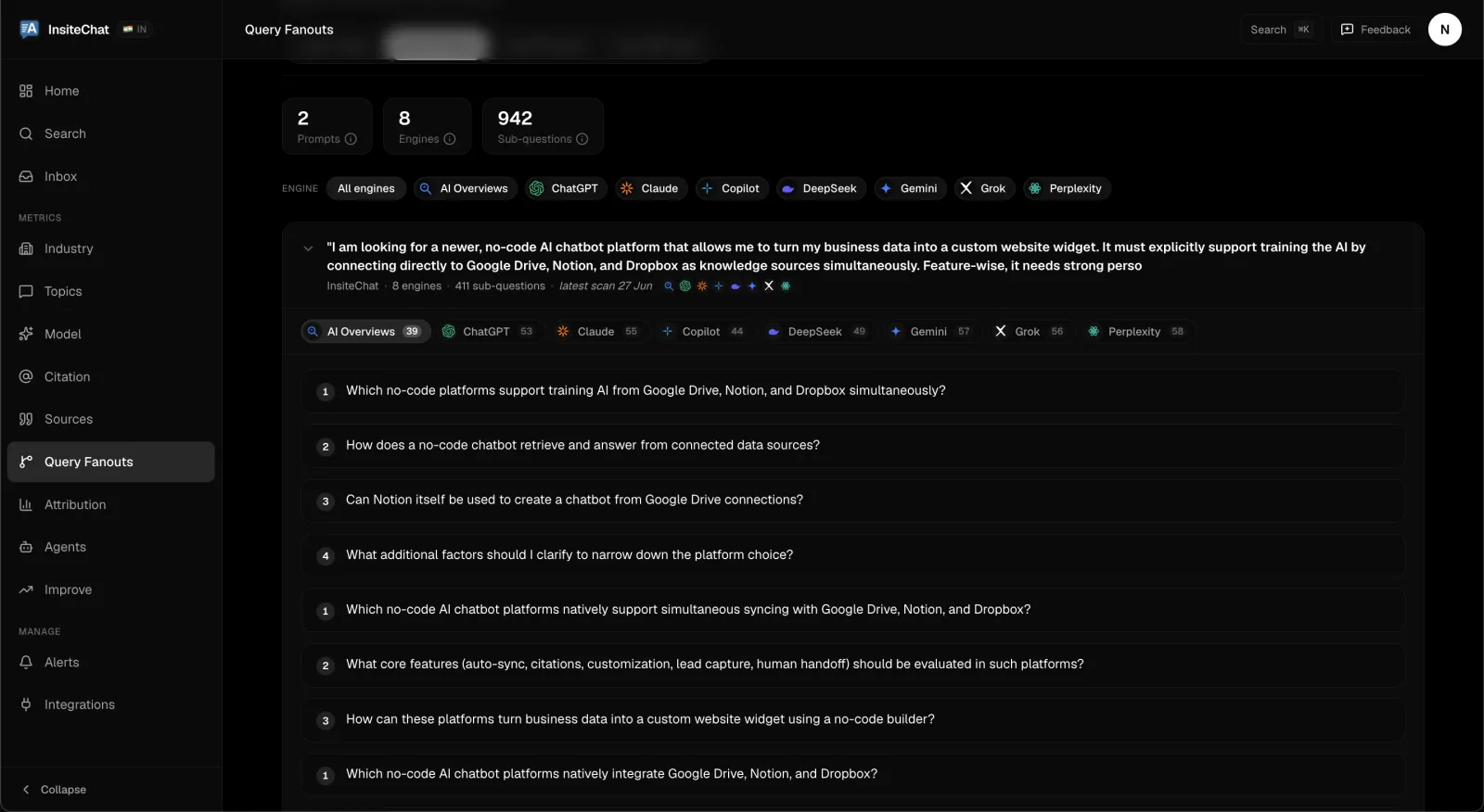
Example: how AI engines fan one prompt into many sub-questions before answering — FixAEO query fan-out for InsiteChat.
That's what these prompts do. They turn Claude into your AI-visibility analyst. You'll audit where you stand across the engines, rewrite your pages so they're easy to quote, build the entity and schema signals AI leans on, and track competitors who are getting cited instead of you.
Twenty prompts, grouped in four parts:
- Part 1 (Prompts 1–5): Audit. Find out where you're already mentioned, where you're cited, and where you're invisible.
- Part 2 (Prompts 6–10): Make your pages quotable. Rewrite content so AI engines can lift a clean answer from it.
- Part 3 (Prompts 11–15): Entity and authority. Build the schema, off-site signals, and trust markers AI uses to decide who's credible.
- Part 4 (Prompts 16–20): Competitive intel and tracking. See who's beating you and ship a monthly report you actually repeat.
One rule before you start: do the context-loader prompt below first. It's the foundation. Every prompt after it says "using the brand context I loaded above," so Claude already knows your brand, your buyers, your category, and your competitors. Skip it and the prompts give generic advice. Run it once, save it as a snippet, reuse it forever.
A quick honesty note. AI search is real and growing, but it's still small next to Google. Similarweb counted 1.13 billion AI referral visits to the top 1,000 sites in June 2025 — up 357% year over year, but still about 1/169th of Google's 191 billion. So this isn't "abandon SEO." It's "the answer box is a new front door, and almost nobody has optimized for it yet." Early is good. Let's go.
Before you run the prompts: what Claude can and cannot do
Claude can analyze pages it can open, public web results available to its own search tool, and exports you paste or upload. A normal Claude chat cannot impersonate ChatGPT, Gemini, Perplexity, Copilot, Grok, DeepSeek, or Google AI Overviews and return their real answers.
For every cross-engine prompt below, use this execution rule:
- Run the fixed buyer question in each named engine yourself, or export the results from a monitoring tool.
- Paste the answer, engine name, test date, account or mode, and cited URLs under an
ENGINE_RESULTSheading. - Ask Claude to classify and analyze only those supplied results.
- If
ENGINE_RESULTSis empty, Claude must output a collection worksheet and stop. It must not simulate or infer another engine's answer.
This preserves the useful part of the workflow—classification, comparison, page diagnosis, and drafting—without turning a plausible guess into fake measurement.
Worked example: from engine output to a useful decision
Suppose you test one fixed prompt—“What are the best AI visibility tools for a small B2B team?”—in four engines and paste the real outputs into Claude. Claude should return a table like this:
| Engine | Brand status | Cited owner page | Evidence gap | Next action |
|---|---|---|---|---|
| ChatGPT | mentioned, no link | — | No supporting source attached | Check which third-party pages shaped the mention |
| Gemini | absent | — | Intended page not retrieved | Improve owner page and relevant internal links |
| Claude | cited | /ai-visibility-checker/ | Price is not supported | Add a dated pricing fact or remove the claim |
| Perplexity | cited | /blogs/example/ | Wrong page owns the citation | Link to or consolidate into the intended owner page |
The rows above are illustrative, not FixAEO performance data. The useful output is a diagnosis tied to supplied evidence, not an invented visibility score.
Step 0: Load your brand context into Claude (do this first)
This is the most important prompt in the whole post, so don't skip it because it looks like setup. The local-SEO version of this article loads your store hours and service area. The AI-search version loads the things an AI engine actually uses to decide whether to name you: who you are as an entity, what category you want to win, the exact buyer questions you should surface on, and who you're competing against for those answers.
Paste the block below into Claude (or ChatGPT) once. Fill in every bracket. Then save the whole filled-in block as a reusable snippet or a saved prompt. Every one of the 20 prompts that follows assumes Claude already has this context, so you'll paste "Using the brand context I loaded above, ..." at the top of each one. Do it carefully now and the next 20 prompts get dramatically sharper.
You are my AI-search visibility analyst. I'm going to give you my brand context once. Read it, confirm you've understood it in 3 bullet points, then wait for my next prompt. For every task I send after this, use this context and follow my working rules at the bottom.

BRAND BASICS
- Brand name: [your brand]
- One-line description: [what you are in one sentence, e.g. "AI visibility tracker for marketing teams"]
- Canonical domain: [https://yourdomain.com]
- Founder / spokesperson names (these are entity signals AI engines associate with the brand): [names + titles]
- Any other names people search you by (old name, abbreviation, product names): [list]

WHAT I SELL
- Products / services: [list]
- The exact category I want to win in AI answers: [e.g. "AEO tool", "AI visibility tracker", "B2B onboarding software"]
- Pricing model: [free tier / trial / paid plans — short]
- ICP (who buys): [role, company size, industry, the job they're trying to get done]

BUYER QUESTIONS I WANT TO BE CITED ON
These are the real prompts a buyer would type into an AI engine where my brand SHOULD show up. Be specific and buyer-intent, not generic. Examples to model: "best [category] tools", "how do I [job the buyer is doing]", "[competitor] alternative", "is [my brand] worth it".
1. [question]
2. [question]
3. [question]
4. [question]
5. [question]
(add up to 20 — the more real buyer questions, the better)

COMPETITORS (who gets cited alongside or instead of me)
List 3–8 rivals with their domains so you can compare us directly:
- [Competitor 1] — [domain]
- [Competitor 2] — [domain]
- [Competitor 3] — [domain]

TARGET AI ENGINES (where I want to be visible)
ChatGPT, Claude, Gemini, Perplexity, Copilot, Google AI Overviews, Grok, DeepSeek.
Note: free AI tools often show only one engine's view, and AI answers change week to week, so treat any single check as a snapshot, not gospel. Priority order for me: [rank the engines that matter most to my buyers].

CURRENT AI-VISIBILITY STANDING (if I know it)
- Engines that already mention me: [list, or "unknown"]
- Prompts where I show up today: [list, or "unknown"]
- Prompts where a competitor shows up and I don't: [list, or "unknown"]
- Anything else relevant: [e.g. "we have no schema markup", "no llms.txt", "blog is 6 months old"]

HOW I WANT YOU TO WORK
1. Always record the EXACT wording the engine used and the EXACT source URLs it cited. Note which engine said what — never blend them into one answer.
2. Separate "mentioned" (the model named us in prose) from "cited" (the model linked our URL as a source). They are different wins.
3. Output structured results to a table or a spreadsheet-ready format I can paste into Sheets, not a wall of prose.
4. After every analysis, give me a prioritized action plan with copy-paste DELIVERABLES — exact answer blocks, exact schema, exact page edits, exact outreach copy — not vague advice like "improve your content."
5. Be honest. If a check is inconclusive or you can't actually browse, say so and tell me how to verify by hand. Don't invent citations.
6. Never treat your own web-search tool as access to ChatGPT, Gemini, Perplexity, Copilot, Grok, DeepSeek, or Google AI Overviews. Analyze cross-engine answers only when I paste them under ENGINE_RESULTS. If no results are supplied, output the test worksheet and stop instead of simulating answers.

Confirm you understand my brand context in 3 bullets, then wait for my first task.
One note on the engine list above. You can check all eight of those engines by hand. But the automated AEO tools you might pair with this — including FixAEO — scan up to nine daily (ChatGPT, Claude, Gemini, Perplexity, Grok, DeepSeek, Google AI Overviews, Copilot, and Google AI Mode) — so every engine on this list can be tracked automatically, not just checked by hand.
Part 1 — Baseline AI-Visibility Audit (who gets cited, on what, vs you)
Prompt 1: Category & buyer-prompt citation audit (the 'are you even in the answer' check)
Before you fix anything, you need to know if AI engines name you at all when a real buyer asks. In local SEO this is the 'am I even in the right Google Business Profile category to show up' question. In AI search it's simpler and more brutal: are you in the answer, or not? Run this first. It's the floor everything else sits on.
Using the brand-context I loaded above, run a full buyer-prompt citation audit. Using your web browsing/search tool, run each buyer question through these four engines one at a time: ChatGPT, Perplexity, Gemini, and Google AI Overviews (for AI Overviews, run the buyer question as a Google search and read the AI answer at the top). If you can't actually browse, say so up front, build the audit framework with empty cells, and tell me exactly which queries to run by hand. Take the 10-20 buyer questions from my brand context — the exact prompts a real buyer would type, like 'best AEO tools' or 'how do I track ChatGPT mentions of my brand' — and run each one against each engine, starting a fresh chat every time so there's no memory carryover. For every prompt-and-engine pair, record four things: (1) was my brand named at all, yes or no; (2) was it cited with a clickable link to my domain, yes or no; (3) what position or order was it in versus other brands named (1st, 3rd, buried in a list); (4) the full list of OTHER brands the engine named for that prompt. Build a table where rows are my buyer prompts and columns are the four engines, and each cell says 'cited' / 'mentioned (no link)' / 'absent'. Below the table, give me three things: first, the list of prompts where I'm completely absent across every engine — those are my category gaps and I attack them first; second, the prompts where I'm mentioned but never cited with a link; third, the single most common competitor that shows up when I don't. Be exact. Quote the engine's wording when it names a competitor, and paste the real source URLs it cited so I can see where the answer came from.
Why this matters: You can't improve a number you've never measured. Most founders assume they show up in AI answers because they rank on Google. They don't. AI engines pull from a different mix of sources, and being absent for 'best [your category]' means you simply don't exist in the buying conversation — the buyer reads three other names and never sees yours. This audit turns a vague worry into a concrete worklist: here are the exact questions where you're invisible, ranked by how often buyers ask them. That list is your whole Part 1 to-do.
FixAEO runs this buyer-prompt audit automatically across all 9 engines it tracks every day, so you see which prompts you're cited, mentioned, or absent on without running questions in a browser by hand.
Prompt 2: Engine & attribute coverage audit (which engines actually know you)
Not every AI engine knows you equally. ChatGPT might cite you while Gemini has never heard of you, and Perplexity might cite you but get your pricing wrong. This is the AI-search version of Google Business Profile attributes — the factual claims (free wifi, wheelchair access) that show up next to your listing. Here the 'attributes' are the facts each engine asserts about you, and half of them are stale or flat wrong.
Using the brand-context I loaded above, build a per-engine coverage and fact-accuracy audit. Using your web browsing/search tool, run my core buyer questions across all 8 engines, one at a time: ChatGPT, Claude, Gemini, Perplexity, Copilot, Google AI Overviews, Grok, and DeepSeek. Start a fresh chat each time. If you can't browse a given engine, say so and tell me to run that one by hand. First, build a coverage grid — rows are the 8 engines, columns are 'mentions me / cites me with a link / never surfaces me' — so I can see at a glance which engines know me and which are blind. Then probe the facts. In each engine, ask these exact attribute-style questions about my brand, swapping in my brand name from the context: 'what does [brand] do', 'is [brand] free', 'what does [brand] cost', 'what platforms or integrations does [brand] support', and 'who is [brand] for'. For every answer, record what the engine SAID and whether it's correct, stale, or missing, checking against the true facts in my brand context. Build a second table: rows are these five attribute questions, columns are the 8 engines, and each cell is 'correct' / 'wrong (note what it said)' / 'stale (note the old fact)' / 'doesn't know'. Finally, output a ranked 'attributes to fix at the source' list: for each wrong or stale fact, name the engine(s) repeating it, write the correct fact in one clear sentence, and tell me the most likely on-site place that fact should live (homepage, pricing page, an FAQ answer, or a dedicated facts page) so the next crawl picks up the truth.
Why this matters: Being cited is worthless if the engine cites you with the wrong price or says you don't do the thing you actually do. Wrong facts in an AI answer cost you the deal before the buyer ever clicks. And coverage is lopsided — engines have different training data and different live-retrieval habits, so 'I'm cited on ChatGPT' tells you nothing about Gemini or Perplexity. This audit shows you exactly which engines to win and exactly which facts to correct, with the source page named so you know where to write the fix.
FixAEO tracks mentions and sentiment across all 9 engines it scans daily, so the per-engine coverage half of this audit stays current without you re-running it by hand.
Prompt 3: Competitor citation-velocity teardown (who gets cited, how often, from where)
In local SEO, the business with the steady stream of fresh reviews wins — it's never one big win, it's the drumbeat. AI citations work the same way. The competitor who gets named in answer after answer isn't lucky; they have a steady stream of third-party sources the engines keep synthesizing. This prompt finds out who that is and, more importantly, WHERE their citations come from so you can target the same sources.
Using the brand-context I loaded above, run a competitor citation-velocity teardown. Using your web browsing/search tool, run my buyer questions across ChatGPT, Perplexity, Gemini, and Google AI Overviews, one at a time, fresh chat each time. If you can't browse, build the framework and tell me which queries to run by hand. For every competitor listed in my brand context, count two things across all prompts and engines: how many times that competitor is NAMED, and how many times it's CITED with a clickable source link. Critically, for every citation, capture the exact source URL the engine used for that competitor and classify it: is it the competitor's own page, a third-party listicle ('best X tools' roundup), a Reddit or forum thread, a review site like G2 or Capterra, or a news/blog post. Build a leaderboard table sorted by citation count: columns are competitor name, times named, times cited, their share of all cited brands (their citations divided by total brand citations), and their top 3 source URLs by frequency. Below the leaderboard, give me a 'where their citations come from' summary: group the cited sources by type and tell me which source types are driving the most competitor citations. Then output a target list — the specific listicles, threads, and review pages that keep feeding competitor citations and that I should aim to appear on, get added to, or respond in. Paste the real URLs.
Why this matters: Knowing a competitor beats you is useless. Knowing the three URLs the engines keep quoting to recommend them is a plan. AI engines don't invent recommendations — they synthesize whatever sources they can retrieve, and a competitor who dominates one big 'best tools' listicle or owns a popular Reddit thread will get cited again and again off that single asset. This teardown hands you their source map: the exact pages to get listed on, pitch, or answer in. You stop guessing and start working the same supply chain that's feeding their citations.
FixAEO's competitor leaderboards and citation domain analysis surface this across all 9 engines automatically — who's cited, how often, and which domains feed those citations.
Prompt 4: Off-site narrative & sentiment-response strategy (shape what AI synthesizes about you)
You can't reply to ChatGPT. But ChatGPT is summarizing what other people wrote about you — Reddit threads, reviews, forum posts, comparison articles. That's the AI-search version of responding to reviews: you don't argue with the engine, you fix the sources it reads. This prompt finds the exact objections and misconceptions the engines repeat, traces them to a likely source, and drafts the off-site copy that re-shapes what gets quoted next time.
Using the brand-context I loaded above, build an off-site narrative and sentiment-response worklist. Using your web browsing/search tool, in ChatGPT, Claude, Gemini, and Perplexity (fresh chat each), ask these exact questions about my brand: 'what are the pros and cons of [brand]', 'what do people say about [brand]', 'is [brand] worth it', and 'why do people choose [competitor] over [brand]' for each main competitor in my context. If you can't browse, say so and tell me to run these by hand. Record the engine's answer close to verbatim — especially every negative point, objection, hesitation, or factual misconception it raises. For each distinct negative or wrong narrative, do three things: (1) write down the exact claim the way the engine framed it; (2) name the most likely source feeding it — a specific kind of Reddit thread, a review on G2 or Trustpilot, an old comparison post, an outdated stat on my own site; (3) draft the exact off-site response or content I should publish to correct it. Give me real copy I can paste, not advice: a sample Reddit reply, a review-response reply, a one-paragraph correction to leave on a comparison post, and a tight FAQ question-and-answer pair I can add to my site that rebuts the misconception in plain language. Output it as a narrative-correction worklist: a table with columns claim, likely source, fix type, and the draft copy. Order it worst-narrative-first so I fix the most damaging story before the others.
Why this matters: AI engines build their answer about you out of what strangers said off-site, and they repeat the loudest, most-linked version of it. If three Reddit threads say your onboarding is confusing, that becomes the 'con' in every AI answer — even if you fixed it a year ago. You can't edit the engine, so you go upstream and edit the sources: answer the thread, reply to the review, correct the comparison post, publish the FAQ that states the truth in quotable form. Over the next crawl cycle, that's the version the engine starts quoting. This is the highest-leverage manual work in the whole playbook.
FixAEO's sentiment tracking shows you the negative narratives and which domains they trace to across the 9 engines; the off-site replies and FAQ copy are yours to write.
Prompt 5: Share-of-voice & retrieved-vs-cited baseline (your scorecard before you change anything)
End Part 1 by turning everything you collected into three numbers you'll track every month. This is your scorecard — the row-zero your monthly report compares against. The most important number here has no local-SEO equivalent: 'retrieved but not cited.' That's when the engine pulled your page as a source but quoted a competitor's claim from it instead of yours. (Prompt 12 later turns this into a per-prompt fix list — this prompt just locks in the baseline number.) Those are your fastest wins, because the engine already found you — you just have to make your answer the quotable one.
Using the brand-context I loaded above and all the data from prompts 1 through 4, compute my baseline AI-visibility scorecard. Don't run new searches — work from what we already gathered. Calculate three headline numbers and show your math. First, SHARE OF VOICE: my total citations divided by the total citations of all brands (me plus every competitor) across all prompts and engines, as a percentage. Second, PER-ENGINE CITATION RATE: for each of the engines we tested, the count of my buyer prompts where I was cited divided by total prompts tested on that engine, as a percentage, in a small table. Third, and most important, the RETRIEVED-BUT-NOT-CITED count: go back through the source URLs the engines listed and find every case where MY domain appeared as a source link but the engine quoted a COMPETITOR'S claim or recommendation in the actual answer instead of mine. List each one with the prompt, the engine, and what got quoted instead. Then output: (a) the three numbers to track monthly — share of voice %, count of prompts I'm cited on, and retrieved-but-not-cited count; (b) a ranked hit-list of the retrieved-but-not-cited prompts, worst first, because the engine already found my page on those so they're the fastest wins; and (c) a one-line note for each hit-list item on what's likely missing — a direct answer up top, a clearer claim, a stat, a comparison the engine could lift. Format the whole thing so I can paste it as the first row of a monthly tracking sheet and re-run it later to measure change.
Why this matters: Share of voice tells you how big a slice of the AI conversation you own versus rivals — one honest percentage instead of a gut feeling. But the retrieved-vs-cited split is the real gold, and it's unique to AI search: there's no local-SEO version of it. When the engine already pulled your page and still quoted someone else, you've done the hard part — getting found — and lost on the easy part — being quotable. This prompt just records the baseline count; Prompt 12 is where you fix each near-miss. Lock these three numbers in now; they're the baseline every later prompt in this playbook is trying to move.
FixAEO computes your Visibility Score, share of voice, and the retrieved-vs-cited split across all 9 engines automatically, so this scorecard updates daily instead of by hand once a month.
Part 2 — Make Your Pages Quotable (content & answer-block optimization)
Prompt 6: Quotable-answer-block optimization (rewrite EXISTING pages so engines lift your sentence)
AI engines don't quote your whole page. They lift a sentence or two. If your money pages bury the answer three paragraphs down, the engine grabs a competitor's cleaner line instead. This prompt is specifically about rewriting pages you ALREADY have — it turns each existing money page into a stack of liftable blocks. (Prompt 11 is the matching prompt for building brand-new pages where you have none.)
Using the brand context I loaded above, help me rewrite my EXISTING key money pages so AI engines can lift a clean, quotable answer from them. This is rewriting pages I already have, not building new ones. Here's exactly what to do, page by page. First, take the 3-5 highest-value pages from my brand context (the ones tied to the category I want to win and my top products/services). For each page, fetch the live URL and read the current content so you're working from what's actually published, not a guess. Then, for each page, map it to the 2-3 buyer prompts from my brand context that this specific page should win (e.g. 'best AI visibility tracker', 'how do I track if ChatGPT mentions my brand'). Now rewrite the on-page content into these five answer blocks, phrased the way a buyer would type the question into ChatGPT or Perplexity and the way an engine would quote it back: (1) DIRECT ANSWER — a self-contained 1-3 sentence answer to the page's primary buyer prompt, leading with my brand name + the category + the one differentiator, no throat-clearing; (2) DEFINITION LINE — one sentence that defines the core term on the page so an engine grabbing a definition picks mine; (3) WHO IT'S FOR — one line naming the ICP from my brand context so the engine can match me to the right buyer; (4) COMPARISON / SPEC TABLE — a markdown table with the 4-6 attributes a buyer compares on (price, key feature, integrations, best-for), filled with my real values from the brand context and honest blanks where I haven't given you data — never invent numbers; (5) SHORT FAQ — 3-5 question-and-answer pairs using the actual buyer prompts, each answer 1-3 sentences. Output each block as exact copy-paste markdown AND the equivalent clean HTML. For every block, tell me precisely where it goes on the page (e.g. 'DIRECT ANSWER goes above the fold, immediately under the H1'; 'FAQ goes at the bottom under an H2 that literally says FAQ'). Do all of this for each page in turn, with a clear page heading before each set of blocks. Flag any place where my brand context didn't give you enough to fill a block, and tell me the one fact I need to supply.
Why this matters: Getting mentioned and getting cited are different things. An engine mentions you when it knows you exist. It cites you when your page hands it a clean sentence it can drop straight into the answer with a link. Pages written as flowing prose force the engine to do extraction work, and it would rather grab the competitor who already formatted the answer. Answer blocks remove that friction. You're not writing for a reader who scrolls — you're writing for a model that crops the top of your page, looks for a definition, scans for a table, and pulls FAQ pairs almost verbatim. Format the answer the way the engine wants to quote it, and you become the easy pick.
FixAEO shows you which prompts you're already mentioned in but not cited for across all 9 engines, so you know exactly which pages to rebuild into answer blocks first.
Prompt 7: Page-level description & meta optimization for extraction
Your meta description and opening paragraph are the part of the page an engine is most likely to crop and quote. If your first 100 words are a warm-up — 'In today's fast-paced digital landscape...' — the engine has nothing citable to grab. This prompt front-loads a clean, self-contained claim into the title, meta, H1, and intro so the cropped top of your page is already a complete quotable unit.
Using the brand context I loaded above, rewrite the title tag, meta description, H1, and opening paragraph for my priority pages so the very top of each page is a clean, self-contained, citable claim. Work from the 3-5 priority pages in my brand context. For each one, fetch the live URL first and read the current title, meta, H1, and first paragraph so you give me real before/after, not a hypothetical. The rule for the rewrite: the first 100 words of the page must contain a complete quotable unit — my brand name + the exact category I want to win + the single sharpest differentiator — written so an engine that crops only the top of the page still has everything it needs to quote me with a link. Kill every fluff opener. No 'in today's fast-paced world', no 'as businesses increasingly', no 'imagine if'. Lead with the claim. For the meta description, write it as a standalone sentence a human or an engine could quote on its own, under 155 characters, with the brand name and category in it. For the title tag, put the primary buyer-prompt phrase and the brand near the front, under 60 characters. For the H1, make it match the buyer's actual question or category, not a clever tagline. For each page, output a small table with four rows — Title, Meta, H1, Intro paragraph — and two columns, BEFORE and AFTER, so I can paste the AFTER straight in. Add one line per page explaining what made the old version unquotable and what the new version fixes. If a page's differentiator isn't clear from my brand context, tell me and propose the best honest option from what I gave you — never invent a feature or a stat.
Why this matters: Engines work with limited context windows and they crop aggressively. Whatever sits in your first 100 words is doing the heavy lifting for whether you get quoted. A vacuous intro wastes the most valuable real estate on your page. When you front-load a self-contained claim — who you are, what category, why you're different — you give the engine a unit it can lift whole, with attribution back to you. This is the cheapest, fastest extraction win there is: you're not adding content, you're moving the good content to the top and deleting the warm-up.
FixAEO has a free Meta Description Generator if you want a fast first draft, and the AI Citation Readiness checker to sanity-check how extractable the result is — though the rewrite itself is yours to ship.
Prompt 8: Citable-asset audit (stats, original data, tables, methods engines love to quote)
AI engines have a clear preference. They reach for original stats, named methods, comparison tables, step-by-step lists, and dated data over plain prose. If a page is all narrative with nothing discrete to pull, it rarely gets cited even when it's relevant. This prompt inventories your pages for citable assets and flags the ones that have nothing worth quoting — then gives you draft copy to fix them.
Using the brand context I loaded above, audit my pages for the assets AI engines preferentially cite, and tell me which pages have nothing quotable. Take my priority pages and key blog posts from the brand context. Fetch each live URL and read it. For each page, inventory which of these citable asset types it currently contains: (1) an ORIGINAL STATISTIC or number I can own; (2) a NAMED METHODOLOGY or framework; (3) a COMPARISON TABLE; (4) a STEP-BY-STEP or NUMBERED list; (5) a clean DEFINITION of the core term; (6) a DATED data point or a visible 'last updated' date for freshness. Build a table: Page URL | has stat? | has method? | has table? | has steps? | has definition? | has date? | verdict. The verdict column flags pages that are all prose with nothing extractable — call those out plainly as 'unquotable'. Then give me an action plan ordered by impact: for each weak page, say exactly what asset to add (a stat, a data table, a numbered method, a last-updated date) and write the DRAFT COPY for that addition. For stats and data, only use numbers I actually have in my brand context or numbers I can plausibly generate from my own product — never fabricate a statistic, and if you propose a number, label it clearly as a placeholder I must verify before publishing. For methods, give the framework a real name and lay out its steps. For tables, draft the markdown with my real values and honest blanks. Output the draft additions page by page so I can paste each into the right spot.
Why this matters: Think of citable assets the way a local business thinks of photos — they're the discrete things that actually get surfaced. For AI search, the surfaced units aren't images, they're stats, tables, definitions, and named methods. A page of beautiful prose with no extractable asset is the AI-search equivalent of a business listing with no photos: relevant, maybe, but nothing for the engine to show. Original data is the strongest of these, because engines cite the source of a number, and if that number is yours, the citation is yours. This audit finds the pages giving the engine nothing to hold onto and fixes them with concrete assets.
FixAEO's free AI Citation Readiness checker scores how extractable a page is and surfaces the missing assets — keeping the honest framing that a high grade is necessary but not sufficient; you still have to earn the citation.
Prompt 9: Citation-gap audit across buyer prompts (the AEO keyword-gap)
In old SEO, the keyword gap was simple: they rank for this term, you don't. The AI-search version is the citation gap: a competitor gets cited for this buyer prompt, you don't. This prompt takes the prompts you lost in Part 1 and diagnoses WHY — no page, thin page, or a page that exists but isn't being quoted — so you know whether to write, beef up, or restructure.
Using the brand context I loaded above, run a citation-gap audit across the buyer prompts where my competitors get cited and I don't. Start from the prompts I flagged in Part 1 of this work — the ones where a competitor's URL showed up in the AI answer and mine didn't. For each of those prompts, do three things. First, using your web browsing/search tool, re-run the prompt across the engines in my brand context (ChatGPT, Claude, Gemini, Perplexity, Grok, DeepSeek, Copilot, AI Overviews) and record which competitor is cited and the exact URL the engine links to. If you can't browse, say so and tell me which to verify by hand. Second, check my own site for a page that targets this prompt — fetch what you find. Third, diagnose my status as one of three: NO PAGE (I have nothing on this topic), THIN PAGE (I have a page but it's shallow and unquotable), or NOT-QUOTED (I have a solid page that exists but the engine isn't citing it). Build a gap table with these columns: Buyer prompt | Competitor cited | Their cited URL | My status (no page / thin / not-quoted) | Recommended action. The recommended action must be specific: 'write a new page targeting X with these 4 answer blocks', or 'add a comparison table and a stat to /your-url/', or 'this page is fine but isn't structured for extraction — rebuild the intro as a direct answer'. Sort the table so the cheapest, highest-impact fixes are at the top — usually the not-quoted and thin pages, since a page that already exists is faster to fix than one you haven't written. Keep the diagnosis honest: if a competitor is cited because they genuinely have better content, say so.
Why this matters: The keyword gap and the citation gap are the same idea pointed at a different unit. Instead of 'they rank for a keyword, you don't,' it's 'they get cited for a buyer prompt, you don't.' The diagnosis is what makes it useful: not every gap costs the same to close. A prompt where you have no page is a writing project. A prompt where you have a thin page is a beef-up. But a prompt where you have a good page that just isn't being quoted is the fastest win on the board — the content already exists, you just need to restructure it for extraction. Sorting your gaps by which kind they are tells you where to spend your week.
FixAEO automates the competitor citation gap across all 9 engines — it tells you which prompts rivals win and which URLs they're cited on, so you skip the manual re-running and go straight to fixing.
Prompt 10: Your money-prompt audit (which of your pages actually get cited)
You know which pages you WANT cited. The question is which ones actually are — and for which prompts. This prompt maps each important page to the buyer prompt it should win, then tests across engines to see whether that exact URL is the one being cited. It surfaces the two painful mismatches: high-value pages that never get cited, and pages getting cited for the wrong prompt.
Using the brand context I loaded above, audit which of my pages actually get cited in AI answers, and for which prompts. Step one: take my important pages from the brand context and, for each one, write down the single buyer prompt it SHOULD win — the one that page exists to answer. Step two: using your web browsing/search tool, test each page's target prompt across the engines in my brand context (ChatGPT, Claude, Gemini, Perplexity, Grok, DeepSeek, Copilot, AI Overviews). If you can't browse, build the scorecard skeleton and tell me which prompts to run by hand. Record whether ANY of my pages got cited for that prompt, and critically, whether the SPECIFIC page (the exact URL) I intended to win it was the one cited — or whether the engine cited a different page of mine, or none at all. Build a page-to-prompt scorecard with these columns: Page URL | Target buyer prompt | Cited for this prompt? (yes/no) | If cited, which URL of mine got the citation | Engines where I'm cited | Mismatch flag. Then surface the two mismatch cases explicitly in their own short lists: (A) HIGH-VALUE PAGES THAT NEVER GET CITED — my best pages that win nothing, and (B) WRONG-PAGE CITATIONS — prompts where the engine cites a weaker or off-topic page of mine instead of the one I built for it. Finish with a fix list ordered by value: which page to strengthen for which prompt, and for the wrong-page cases, whether to strengthen the intended page, add internal links pointing the engine at it, or merge the two competing pages. Be concrete about the fix for each row — name the page and the action. Don't pad the scorecard with low-value pages; focus on the ones tied to revenue.
Why this matters: 'Which pages rank in Google' has a clean AI-search twin: which of your URLs get cited in AI answers, and for what. Auditing the page-to-prompt mapping catches two expensive problems you'd otherwise miss. The first is a high-value page that wins nothing — you built it, it's relevant, and the engines ignore it, which usually means it's not structured for extraction. The second is sneakier: the engine cites the wrong page of yours, sending buyers to a weaker URL than the one you optimized. Both are fixable, but only once you can see them. This scorecard is the map of where your citations actually land versus where you wanted them to.
FixAEO's citation domain analysis and prompt-level fanout reports show exactly which of your URLs get cited for which prompts across all 9 engines, so the mismatch cases surface automatically instead of one manual prompt at a time.
Part 3 — Entity, Schema & Authority (knowledge graph, structured data, the sources AI trusts)
Prompt 11: Buyer-intent answer-page builder (build NEW pages for uncovered prompts)
Local SEO has the service+city page: one page per service, per town, built to rank. The AI-search version is one page per buyer prompt. Each high-intent question a buyer types into ChatGPT or Perplexity deserves its own page, built from the ground up to be the thing the engine quotes. Where Prompt 6 rewrites pages you already have, this prompt builds brand-new pages for the prompts you have nothing on.
Using the brand-context I loaded above, you are going to build NEW buyer-intent answer pages — one page per high-intent buyer prompt I currently have no good page for. Start from my list of uncovered or weakly-covered buyer prompts (the gaps from the Part 1 audit, or the buyer questions in the brand context if I haven't run that yet). Group them into 4-6 page clusters where each cluster is one searchable intent — for example 'best [my category] tools', '[competitor] alternatives', 'how to [the core job my product does]', 'is [my category] worth it', and '[my category] for [my ICP]'. For each cluster, using your web browsing/search tool, run the lead prompt for that cluster through ChatGPT, Perplexity, and Google AI Overviews, and read closely HOW the engine structures a good answer to it — does it lead with a definition, a ranked list, a comparison table, a pros/cons block? Mirror that structure. (If you can't browse, use the most common structure for that intent type and say so.) Then write a full, ready-to-publish answer page in markdown for each cluster, containing all of these in order: (1) an H1 that matches the buyer prompt almost word-for-word; (2) a 2-3 sentence direct-answer block right under the H1 that answers the question completely before any preamble, written so an engine could lift it verbatim; (3) a comparison table that includes me AND the 3-8 competitors from my brand context, with columns for the criteria buyers actually weigh (price/free tier, the headline capability, ease of setup, who it's best for) — be fair and specific, not a puff piece; (4) 3-5 supporting sections that each answer one sub-question; (5) an FAQ section using the literal question phrasings real buyers type, with each answer kept tight and self-contained; (6) one honest stat or concrete number where it strengthens trust, never invented. Do NOT hand-write JSON-LD into the page — note at the bottom of each draft which schema types the page needs (FAQPage, Article, Product or SoftwareApplication, comparison) so I can generate it separately. Output each page as a separate clearly-labelled markdown block I can paste into my CMS, and end with a one-line publishing order ranked by buyer intent.
Why this matters: When an engine answers 'best [category] tools' or '[competitor] alternatives', it pulls from pages that already look like clean, direct answers to that exact question. A generic homepage or a rambling blog post doesn't get quoted — a page whose H1 IS the question, whose first block IS the answer, and whose table already has the comparison the engine wants, does. This is the same template-at-scale move local businesses use for city pages, just pointed at buyer intent instead of geography. One page per high-intent prompt is the most direct way to go from invisible to cited on the questions that actually bring you customers.
FixAEO's demand-ranked prompts and competitor leaderboards show you exactly which buyer prompts and rivals to build these pages around; the writing is still yours.
Prompt 12: Retrieved-but-not-cited goldmine (the per-prompt FIX list — fastest wins)
In Google Search Console, the fastest wins live on page two: keywords where you already rank #11-#20 and a nudge moves you onto page one. AI search has the exact same goldmine. Prompt 5 gave you the baseline COUNT of these near-misses; this prompt is where you turn that count into a per-prompt FIX list — every prompt where the engine already FOUND your site but quoted a competitor, plus the one edit that flips each one.
Using the brand-context I loaded above, your job is to find my 'retrieved-but-not-cited' wins and tell me the smallest fix that flips each one. Work from the retrieved-vs-cited baseline I gathered in Prompt 5 (and from my FixAEO citation data if I paste it in) — this prompt turns that baseline count into a per-prompt fix list. For each buyer prompt across ChatGPT, Perplexity, Gemini, Claude, Grok, DeepSeek, Copilot, and Google AI Overviews, sort every case into one of three buckets: (A) RETRIEVED AND CITED — my domain appears in sources and I'm named/quoted in the answer (already winning, leave alone); (B) RETRIEVED BUT NOT CITED — my domain shows up in the engine's source links or browsing trace, but a competitor is the brand actually quoted in the answer (THIS is the goldmine — list every one); (C) NOT RETRIEVED AT ALL — I'm nowhere (slower, lower priority for now). Build a table of every bucket-B case with columns: prompt, engine, which competitor got quoted instead, the specific page of mine that was retrieved, and your diagnosis of WHY the engine quoted them and not me. Then for each row, prescribe the single smallest edit that would flip retrieved into cited — be concrete and pick ONE per row: add a crisp direct-answer block at the top, surface a liftable stat or number the engine can quote, restate the answer in the buyer's exact phrasing, tighten a definition, add a comparison row, or fix a schema/structured-data gap. Rank the whole list by ROI: easiest edits on already-retrieved high-intent prompts at the top. For the top 5 rows, write the exact replacement copy or the exact block to add, ready to paste. Output the ranked table plus those 5 paste-ready edits.
Why this matters: Getting found by an engine is the hard part — it means your page is crawlable, relevant, and already in the consideration set. Getting quoted from there is often a tiny edit: a clearer first sentence, a number the engine can lift, the buyer's words instead of yours. These near-misses are the highest-ROI work in all of AI search because the engine has already done the discovery for you. Fix the page-two equivalents first and you convert 'almost cited' into 'cited' faster than any amount of new content ever could.
FixAEO surfaces the retrieved-vs-cited gap automatically across all 9 engines, so you see exactly where you're almost-winning without checking each engine by hand.
Prompt 13: Buyer-language mining from AI answers (extract the words, feed them into 6 and 11)
Smart local businesses mine their reviews for the exact words customers use, then write those words back into their pages. The AI-search version is richer: you mine the AI answers themselves. This prompt does ONE job — pull out the vocabulary, framing, and criteria the engines reward. It doesn't re-output full pages. You feed its phrase bank into the rewrites from Prompt 6 and the new pages from Prompt 11.
Using the brand-context I loaded above, mine the language that AI engines reward in my category and hand me a phrase bank I can write with. This is a vocabulary-extraction task — give me words and framing to feed into my page rewrites, NOT full rewritten pages. Using your web browsing/search tool, run the strong category prompts where the engine already gives a good, confident answer through ChatGPT, Perplexity, Gemini, Claude, and Google AI Overviews — things like 'what is [my category]', 'best [my category] tools', 'how do I [the core job]', 'what should I look for in a [my category] tool'. If you can't browse, say so and tell me which to run by hand. Read the answers like a copywriter and capture three things into a table: (1) THE BUYER'S WORDS — the literal question variants and terms the engine treats as the same intent (note synonyms and the exact phrasings, because these become my H1s and FAQ questions); (2) THE ENGINE'S FRAMING — how it words definitions, 'best for' lines, pros/cons, and the sentence shapes it favours when it explains the category; (3) THE CRITERIA IT WEIGHS — the decision factors the engine repeatedly leans on when it picks winners (e.g. free tier, number of engines tracked, ease of setup, pricing transparency, integrations). Quote the engines directly so I can see the real phrasing, and note which engine said what. Then output: (a) the phrase bank table; (b) a short checklist of the criteria my pages must explicitly address — because if an engine cares about 'free tier' and my page never says it, I look like a non-match; and (c) 5-8 short SNIPPETS (a headline, an FAQ question, a one-line definition) in the engines' and buyers' language that I can drop into the Prompt 6 / Prompt 11 page work — keep these to phrase-level snippets, not full pages.
Why this matters: Engines quote pages that read like a clean match to the question — same words, same framing, same criteria. If buyers ask in one vocabulary and the engine reasons in another, and your page speaks a third, you get skipped even when your product is the right answer. Mining the AI answers tells you both halves at once: the buyer's words for your headings and the engine's criteria for your content. Write in those words and you stop translating your value into the wrong dialect — you say it in the exact language the engine is already listening for.
FixAEO's prompt-level fanout reports and topic clustering show which phrasings and topics actually trigger your mentions across the 9 engines, so the phrase bank is grounded in real answers, not guesses.
Prompt 14: Entity & knowledge-graph optimization (make AI confident who you are)
Local businesses obsess over getting their name, address, and phone identical everywhere because Google's map of the world has to be confident who they are. AI engines lean on the same kind of map — a knowledge graph built from your site, Wikidata, Crunchbase, LinkedIn, G2, and more. If those signals disagree, the engine gets unsure who you are and quietly stops recommending you. This prompt audits your entity footprint and hands you the exact schema and profile fixes to make every engine confident.
Using the brand-context I loaded above, audit my brand's entity footprint and tell me where AI engines might be unsure who I am. First, map my off-site entity presence: using your web browsing/search tool, check whether a consistent brand entity exists across my own site, Wikipedia/Wikidata, Crunchbase, LinkedIn, G2, and any other profiles in my brand context — and flag where my brand name, category, founding year, founder/spokesperson names, or one-line description DISAGREE across them. Note any place I'm missing entirely (e.g. no Wikidata item, no Crunchbase, thin LinkedIn). If you can't browse, say so and tell me which profiles to check by hand. Second, test how confident the engines actually are: in ChatGPT, Perplexity, Gemini, Claude, Grok, and Google AI Overviews, ask each of them 'who is [my brand]', 'who founded [my brand]', and 'what does [my brand] do'. Record each answer verbatim and rate it: confident and accurate, hedged/vague, or wrong/confused. Pay attention to whether engines mix me up with a similarly-named company — that's a disambiguation problem. Third, output a fix list with two parts: (1) the exact JSON-LD I should add — an Organization block with name, url, logo, description, foundingDate, and a sameAs array linking every legitimate profile I own (site, LinkedIn, Crunchbase, G2, Wikidata, social), plus a Person block for each named founder/spokesperson with their own sameAs links, and a Product or SoftwareApplication block for my main product — all matched to the facts in my brand context; and (2) a prioritized list of which third-party profiles to CREATE or ALIGN (and the exact wording to make them consistent) so every source the engines read tells the same story. Output the copy-paste JSON-LD plus the ranked profile action list.
Why this matters: Before an engine will confidently recommend you, it has to be confident you exist and that it knows who you are. That confidence comes from agreement across sources — your site, Wikidata, Crunchbase, LinkedIn, G2 all saying the same name, the same category, the same founders. When they disagree, or when you're missing from the places engines treat as canonical, the engine hedges or picks a rival it's surer about. Organization and sameAs schema plus consistent off-site profiles are how you hand the engine a clean, unambiguous identity. Get this right and you stop being a maybe and become a known entity worth quoting.
FixAEO's free AI Citation Source Radar shows which third-party domains the engines actually pull from in your category, so you know which profiles are worth aligning first.
Prompt 15: Answer & FAQ schema build-out (structured data engines can lift verbatim)
NAP consistency for local SEO — name, address, phone identical everywhere — has a direct AI-search twin: fact consistency across all the structured data and profiles engines read. Inconsistent facts make engines distrust you, and distrust means no citation. This prompt does two jobs: it generates the structured data that makes your pages machine-quotable, and it hunts down the contradictions in your core facts that quietly cost you trust.
Using the brand-context I loaded above, build the structured data that makes my pages machine-quotable and find the fact contradictions that make engines distrust me. Part one — schema build-out: go page by page through the answer pages from my Part 2 / Part 3 work and generate the right JSON-LD for each, matched to the answer blocks already on the page. Use FAQPage for any page with a Q&A section (mirror the literal question phrasings and keep answers self-contained so an engine can lift them verbatim); HowTo for any step-by-step page; Article with a named author and date for posts; Product or SoftwareApplication for product/pricing pages; and a single consistent Organization block referenced everywhere. Make every schema reflect the SAME core facts — brand name, category, pricing, founders — exactly as they appear in my brand context. Validate as you go: flag anything that would fail Google's Rich Results / Schema.org validation (missing required fields, wrong types, mismatched dates). Part two — consistency audit: pull my core facts (legal/brand name, category description, current pricing, founder names, founding year) and check them across every place the engines read — my homepage, pricing page, about page, schema, and the third-party profiles in my brand context. Build a contradiction table: column per source, row per fact, and highlight every cell that disagrees (e.g. pricing says $49 on the page but $39 in schema, founder spelled two ways, two different category descriptions). For each contradiction, state the single canonical value I should standardize on and where to change it. Output: copy-paste JSON-LD per page, the validation flags, and the consistency fix list ranked by how much trust each contradiction is likely costing me.
Why this matters: Structured data is how you spoon-feed an engine a clean, liftable answer instead of hoping it parses your prose correctly — a well-formed FAQPage or Article block is the difference between getting quoted and getting skimmed. But schema only helps if your facts agree. When your pricing, category, or founder name says one thing on the page and another in your schema or on G2, the engine sees a brand that can't keep its own story straight and trusts you less. Consistent facts plus clean structured data is the AI-search version of perfect NAP: it's unglamorous, it's mechanical, and it's exactly what separates the brands engines confidently quote from the ones they quietly leave out.
FixAEO's free Schema Generator and AI Citation Readiness checker let you produce and pressure-test this structured data without writing JSON-LD by hand; FixAEO shows you the gap, you ship the fix.
Part 4 — Competitive Intel & Tracking (citation gap, monitoring, monthly AI-visibility report)
Prompt 16: Competitor cited-source audit (reverse-engineer where their citations come from)
In local SEO you audit a competitor's backlinks to see what's feeding their rankings. In AI search the equivalent is the cited-source audit: when an engine names a competitor, it shows its work. The URLs it cites are the new high-DR backlinks. This prompt reverse-engineers them.
Using the brand-context I loaded above, run a competitor cited-source audit. Using your web browsing/search tool, run my buyer questions through ChatGPT, Perplexity, Gemini, and Google AI Overviews (and Grok or DeepSeek if you can reach them), one at a time. If you can't browse, build the framework and tell me which queries to run by hand. For each of my buyer questions from the brand context, ask the engine the question and watch for any of my competitors getting named. Every time a competitor is cited, do NOT just note the mention — capture the exact source URL the engine links or footnotes for that claim. For each source, record: competitor named | engine | the buyer question that triggered it | source URL | source type. Classify every source into one of these buckets: (1) the competitor's own page, (2) a listicle / 'best X tools' roundup, (3) a Reddit or forum thread, (4) a review site like G2 / Capterra / TrustRadius / AlternativeTo, (5) news / press, (6) YouTube or video, (7) other. Build one table sorted by source type, then a second table that counts how many distinct citations each individual source URL produced across all engines — this is the ranking of which third-party pages actually feed AI citations in my category. Then output a prioritized target list: for each high-frequency source, tell me exactly what to do — 'pitch to be added' (with a 3-sentence outreach line I can paste), 'out-publish' (with the title and angle of the asset I'd write to beat it), or 'go earn a mention' (Reddit thread to answer, review profile to claim). Rank the list by how many citations the source feeds, not by domain rating. End with the single source I should attack first this week and why.
Why this matters: Backlinks still matter, but in AI search the link that counts is the one the engine actually quotes back to a buyer. A listicle you've never heard of, or a four-year-old Reddit thread, can feed more citations than a competitor's entire blog. This audit tells you the real list — the specific pages AI trusts for your category — so you stop chasing generic domain authority and start getting onto the exact sources that put your rival in the answer.
FixAEO's citation domain analysis shows you which sites and domains the engines cite, across all 9 it tracks, so you don't have to hand-collect URLs prompt by prompt.
Prompt 17: Buyer-journey prompt mapping (4 stages of AI-search intent)
A buyer doesn't show up at the decision stage. They move through it — problem, solution, comparison, decision — and they type a different prompt at each step. If you only show up at one stage, you're invisible for the rest of the journey. This prompt maps all four and finds your gaps.
Using the brand-context I loaded above, map my buyer questions to the four AI-search intent stages and test each one. The four stages are: (1) PROBLEM-AWARE — the buyer feels a pain but doesn't know the solution category yet (e.g. 'why isn't my brand showing up in ChatGPT', 'how do I know if AI recommends my product'); (2) SOLUTION-AWARE — they know the category and want to understand it (e.g. 'what is answer engine optimization', 'how do I track AI citations'); (3) COMPARISON — they're choosing between options (e.g. 'best AEO tools', '[competitor] vs [competitor]', 'top AI visibility trackers'); (4) DECISION — they're evaluating one brand (e.g. 'is [my brand] worth it', '[my brand] pricing', '[my brand] alternatives'). First, take my buyer questions from the brand context and sort each into its stage. Fill gaps so each stage has at least 3 real prompts a buyer would actually type. Then, using your web browsing/search tool, run every prompt through ChatGPT, Perplexity, Gemini, and Google AI Overviews. If you can't browse, build the map and tell me which prompts to run by hand. For each one record: stage | prompt | engine | did my brand appear? (yes/mentioned/cited/absent) | who appeared instead. Build a stage-by-stage coverage map showing, per stage, what share of prompts surface me versus where I vanish. Then output an action plan: for each stage where I'm weak or absent, name the ONE content asset or answer page I should build to win it (a problem-aware explainer, a solution-aware definition page, a comparison page, or a decision-stage FAQ/pricing page) — and give me the exact H1 and the first 60-word answer block for that page. End with the stage that's costing me the most buyers and why I should fix it first.
Why this matters: Most brands accidentally optimize for the decision stage — their own name — and disappear everywhere a buyer is still figuring things out. But the buyer who asks 'what is AEO' today is the buyer who asks 'best AEO tools' next week. If you're not in the early-stage answers, your competitor introduces themselves first and frames the whole comparison. Mapping all four stages shows you exactly which part of the funnel you're losing, so you build the one page that plugs the leak instead of guessing.
FixAEO's prompt-level fanout reports test your prompts across all 9 engines and show which ones mention you, so the coverage map builds itself instead of you running each stage by hand.
Prompt 18: Content-gap analysis vs cited competitors (topics AI quotes them on, not you)
The classic content gap finds topics a competitor ranks for and you don't. The AI version is sharper: find the topics where engines quote your competitor and you're simply not in the answer. Those are the topics where they own a quotable asset and you've got nothing — or something weaker.
Using the brand-context I loaded above, run a citation-topic content-gap analysis. First, list the topics I already have strong published content on (use what I gave you in the brand context plus any pages I named). Then, using your web browsing/search tool, run my buyer questions plus broader category questions through ChatGPT, Perplexity, Gemini, and Google AI Overviews. If you can't browse, build the table and tell me which queries to run by hand. Every time a competitor gets cited, identify the TOPIC the answer was about and the specific cited asset (their guide, data study, comparison page, definition, calculator, etc.). Build a table: topic | who's cited now | their cited asset (URL + type) | what I currently have on this topic (nothing / weaker page / equal) | how often engines cite this topic (count across all the prompts you ran). Drop any topic where I'm already winning. For the remaining gaps, score each one on two axes — buyer-intent value (how close to a purchase decision) and citation frequency (how often AI quotes someone on it) — and sort the backlog by the two combined, so high-intent + frequently-cited topics rise to the top. Then output a content backlog I can act on: for each top gap, give me the working title, the format that will win the citation (definition page / data study / comparison / step-by-step guide), the one quotable 50-word answer block to open it with, and which existing page of mine to internal-link it from. End with the single highest-leverage piece to publish first and the reason it beats their current cited asset.
Why this matters: Search-volume content gaps tell you what people Google. Citation-topic gaps tell you what AI is already handing your competitor — credit, authority, and the buyer's first impression — on topics where you're not even in the room. Scoring by how often a topic gets cited (not just how often it's searched) points your writing budget at the assets that actually get pulled into answers, so every post you publish is aimed at a citation you can realistically take.
FixAEO's competitor leaderboards and topic clustering surface exactly which topics connect your rivals to citations and where you're absent — it shows you the gap, you publish the asset that fills it.
Prompt 19: Competitor citation-pattern monitoring (what's changing in the answers)
Smart local operators watch a rival's Google Business Profile posting cadence — it tells you what they're pushing. In AI search you watch a different cadence: their citation pattern. What did the answers say last month versus now? Who gained, who lost, who's new. This prompt diffs it.
Using the brand-context I loaded above, run a citation-pattern monitoring diff. This prompt assumes I saved a results table from a previous run (the cited-source audit or the buyer-journey map) — I'll paste last month's table below. If I have no prior table, treat this run as the baseline and tell me to save the output to diff against next month. Using your web browsing/search tool, re-run the same fixed set of buyer questions from the brand context on ChatGPT, Perplexity, Gemini, and Google AI Overviews — keep the prompts and engines IDENTICAL to last time so the comparison is clean. If you can't browse, say so and tell me which to run by hand. For each prompt and engine, record who's cited now. Then diff against last month and produce a change-log with five sections: (1) COMPETITORS WHO GAINED citations — name, which prompts/engines, how many; (2) COMPETITORS WHO LOST citations — same detail; (3) NEW BRANDS that entered the answer set who weren't there before; (4) ENGINE SHIFTS — any engine that changed who it quotes for the same prompt; (5) NEW SOURCE URLs that started getting cited. For each meaningful change, add a 'likely cause' column — a guess at what drove it (a competitor's new blog post, a PR hit, a fresh Reddit thread, a pricing-page update, an engine model update) — and a 'my counter-move' column with a concrete action. End with the top 3 changes that matter most to me this month and the single defensive or offensive move I should make this week. Output everything as a table plus a 5-bullet plain-English summary.
Why this matters: AI answers are not static — they shift week to week as engines re-crawl, models update, and competitors publish. A competitor who just landed in three answers they were absent from last month didn't get lucky; they did something, and the diff tells you what. Watching the citation cadence the way you'd watch a rival's posting cadence turns AI search from a black box into an early-warning system, so you react to moves while they're fresh instead of noticing six months later that you quietly disappeared.
FixAEO scans all 9 engines daily and sends Slack and webhook alerts on changes, so it watches the citation cadence for you instead of you re-running the same prompts by hand every month.
Prompt 20: Monthly AI-visibility report (share of voice, citations, retrieved-vs-cited, by engine)
The local SEO loop closes with a monthly performance report — rankings, traffic, what moved. The AEO loop closes the same way, with the metrics swapped: share of voice, citations, retrieved-vs-cited, per engine. This is the report that turns all the earlier prompts into something you can put in front of a stakeholder.
Using the brand-context I loaded above, compile my monthly AI-visibility report from the recurring data I've gathered (the cited-source audit, the buyer-journey coverage map, the content-gap backlog, and the citation-pattern diff). Pull it all into one stakeholder-ready report with these sections: (1) SHARE OF VOICE — for my category's buyer prompts, what percent of cited brands is me versus each competitor, as a simple table; (2) PROMPTS CITED — how many of my tracked buyer prompts cite me, with the exact list of which ones win and which ones I'm absent from; (3) PER-ENGINE CITATION RATE — a row for each engine I tested (ChatGPT, Claude, Gemini, Perplexity, Grok, DeepSeek, Google AI Overviews, and Copilot) showing how often I'm cited on that engine, so I can see where I'm strong and where I'm invisible; (4) RETRIEVED-VS-CITED — the prompts where my page got pulled into the engine's working set but I was NOT named in the answer (these are my fastest wins — I'm one quotable line away); (5) NEW WINS and NEW LOSSES this month versus last; (6) TOP 3 ACTIONS for next month, each one concrete and tied to a specific page or prompt. Output the whole thing as a clean table plus a 5-bullet executive summary a non-technical stakeholder can read in 30 seconds. At the end, remind me to SAVE the underlying data table so next month's run can diff against it — that recurring diff is what makes this a trend report instead of a snapshot.
Why this matters: A one-off audit is a photo; a monthly report is a movie. Tracking share of voice, per-engine citation rate, and retrieved-vs-cited over time is what shows whether your AEO work is actually moving the needle — and the retrieved-but-not-cited list is gold, because those are pages AI already trusts enough to read and you just need one quotable sentence to convert into a citation. Run it every month and you stop guessing whether you're winning AI search and start proving it.
This is the prompt FixAEO was built to retire — it produces this exact report automatically across all 9 engines it tracks (share of voice, per-engine citation rate, retrieved-vs-cited, a 0-100 Visibility Score) so you're not rebuilding the table in Claude every month; start a free scan to see your current AI visibility.
The 12-week execution calendar
You can't run all 20 prompts in one afternoon and expect results. AI answers shift week to week, so this is a steady drip: audit first, then fix what the audit found, then build authority, then track and repeat. Here's the cadence I use.
| Week | Focus | Prompts to run |
|---|---|---|
| 0 | Setup | Run the Step 0 context-loader. Save it as a snippet. Everything below assumes it's loaded. |
| 1 | Baseline audit | Prompts 1–2 — check which engines name you, and run the per-engine coverage and fact-accuracy audit. |
| 2 | Baseline audit | Prompts 3–5 — competitor citation-velocity teardown, off-site narrative worklist, and your share-of-voice / retrieved-vs-cited scorecard. This is your before-photo. Screenshot it. |
| 3 | Make pages quotable | Prompts 6–7 — rewrite your top existing pages into liftable answer blocks, and front-load the title/meta/H1/intro. |
| 4 | Make pages quotable | Prompts 8–9 — audit pages for citable assets and run the citation-gap diagnosis (no page / thin / not-quoted). |
| 5 | Make pages quotable | Prompt 10 — audit which of your pages actually get cited, and fix the wrong-page and never-cited mismatches. |
| 6 | Entity & authority | Prompts 11–12 — build new answer pages for uncovered prompts, then work the retrieved-but-not-cited fix list. |
| 7 | Entity & authority | Prompts 13–14 — mine buyer language from AI answers, and run the entity / knowledge-graph optimization. |
| 8 | Entity & authority | Prompt 15 — generate the FAQ/Article/Organization schema and run the fact-consistency audit. |
| 9 | Competitive intel | Prompts 16–17 — cited-source audit (reverse-engineer where rivals' citations come from) and buyer-journey mapping. |
| 10 | Competitive intel | Prompt 18 — citation-topic content-gap analysis vs cited competitors. |
| 11 | Tracking | Prompt 19 — citation-pattern monitoring diff; turn the changes into a prioritized fix list and ship the top 3. |
| 12 | Ship the report + loop | Prompt 20 — build your monthly AI-visibility report. Compare it to your Week 2 before-photo. |
After Week 12: make Part 1 (Prompts 1–5) a monthly habit. Re-run the audit on the first of every month, diff it against last month, and feed the new gaps back into Parts 2–4. AI answers move; your tracking has to move with them. The brands that win here aren't the ones who do this once — they're the ones who never stop.
FAQ
Do these Claude prompts work on the free plan?
Yes. The prompts themselves are just text — they run on Claude free, Claude Pro, ChatGPT free, or ChatGPT Plus. The one limit to know: free tiers sometimes restrict web browsing or use a smaller model, so the audit prompts (Part 1) work best when the model can actually browse the live web. If your plan can't browse, the prompt will still build your strategy, schema, and answer blocks from your loaded brand context — you'll just verify the live citations by hand.
What's the difference between SEO and AEO?
SEO optimizes for a ranked list of blue links on Google. AEO — answer engine optimization — optimizes for being named and cited inside an AI-generated answer on ChatGPT, Perplexity, Gemini, or AI Overviews. The signals overlap (clear content, structured data, credible sources) but the goal is different: SEO wants position #1, AEO wants to be one of the few sources the model quotes. They're complementary, not a replacement. See AEO vs SEO for the full breakdown.
How fast do AI engines update their answers?
Faster than Google rankings, and it varies by engine and by mechanism. Real-time retrieval (what Perplexity and ChatGPT search do when they browse the live web) can reflect a new page within days. Schema.org and llms.txt changes get picked up quickly too. Training-data updates are the slow lane — months — but retrieval is the bigger lever for most brands, and it responds fast. That's why re-running the Part 1 audit monthly matters: the answers genuinely move.
Can I automate this instead of running 20 prompts by hand?
Yes, and at some point you'll want to. Running 20 prompts every month is a real time cost — opening tabs, recording which engine said what, building and diffing spreadsheets. Tools like FixAEO scan all nine engines daily, track citations and share of voice, and show the competitor gap automatically. The prompts in this post are the manual version of that same work.
What does "cited" vs "mentioned" mean, and why does it matter?
"Mentioned" means the model named your brand in its prose answer. "Cited" means the model linked your specific URL as a source under the answer. Both are wins, but cited is stronger — it sends a click and signals the engine trusts your page enough to source it. A common fast win is the "retrieved but not cited" gap: prompts where the model clearly read your site but quoted a competitor instead. Those are the pages to make more quotable first.
Which AI engines should I track?
You can check eight by hand: ChatGPT, Claude, Gemini, Perplexity, Grok, DeepSeek, Copilot, and Google AI Overviews. Automated AEO tools, FixAEO included, scan all nine daily — ChatGPT, Claude, Gemini, Perplexity, Grok, DeepSeek, Google AI Overviews, Copilot, and Google AI Mode. Start with the two or three your buyers actually use: if you sell to developers, weight Perplexity and ChatGPT; if you sell to mainstream consumers, AI Overviews and ChatGPT carry the most reach. The context-loader prompt asks you to rank them so the rest of the analysis stays focused on where it pays off.
Honest close
That's the whole playbook. Twenty prompts, no email gate, no upsell wall in the middle. If you run them, you'll know more about your AI-search visibility than most of your competitors know about theirs — because almost nobody is doing this yet.
A few honest caveats, because I'd rather you trust me than be impressed by me:
- These prompts depend on Claude (or ChatGPT) browsing and reporting accurately. Models hallucinate citations. Always verify the URLs by hand before you act on them.
- A single check is a snapshot. AI answers change week to week. One good result isn't a trend; one bad result isn't a death sentence. Re-run, then react.
- A high "quotability" score is necessary, not sufficient. Doing the schema and the answer blocks makes you eligible to be cited. It doesn't guarantee it. There's no magic input that forces an engine to name you.
Running these 20 prompts by hand, every month, is genuinely a lot of work — opening tabs, recording which engine said what, building spreadsheets, and diffing them month over month. That's the part FixAEO automates: it scans all nine engines daily, tracks who's getting cited and who owns the share of voice in your category, shows you the competitor gap, and gives you a 0-100 Visibility Score so you can see the trend instead of guessing. The manual version above is real and it works — FixAEO just runs it for you. If you want a baseline before deciding anything, the free AI visibility scan is a fine place to start. No card, no pitch.
Either way: do the audit. Being early to the answer box is the whole advantage.
Related reading
What is AEO? Answer Engine Optimization explained
Answer Engine Optimization (AEO) means getting AI assistants to recommend your brand. Learn what AEO is, why it matters more than SEO, and how to start.
18 min readThe 30-point AEO audit checklist (2026)
AEO audit checklist: 30 signals across 7 categories — from crawler access to per-engine verification. Copy it into Notion and run your audit today.
16 min readCan Claude Search the Web? How to Enable It (2026)
Yes. Enable Claude web search in three steps, fix a missing toggle on Team or Enterprise, and learn when Claude searches and cites the live web.
15 min readHow to get cited by Claude: the 2026 playbook
Get cited by Claude with the 2026 AEO playbook. Claude's constitutional training favors authoritative, non-promotional sources — here's how to qualify.
17 min readHow to get cited by Perplexity: a 2026 playbook
Perplexity cites 4-8 sources per answer and the patterns are learnable. Here are the 8 patterns we see in cited content, with the tactics that got FixAEO cited in our own category.
16 min readHow to measure AEO ROI: a copy-paste spreadsheet
Measure AEO ROI with attributable visits, conversion rate, gross profit, and cost. Includes a transparent worked example, spreadsheet layout, and limitations.
13 min read
Free AEO tools
Put this into practice with free FixAEO tools — no signup required.
AI Visibility Checker
Score your brand across 9 AI engines
AEO Audit Tool
Answer-engine readiness scan
Schema Generator
Build valid JSON-LD structured data
llms.txt Generator
Create a spec-compliant llms.txt
Sitemap Validator
Check your XML sitemap for errors
AI Content Grader
Grade content for AI citation readiness