Generative Engine Optimization Tool: What to Look For
A generative engine optimization tool tracks whether AI engines cite your brand. Here's what a real GEO tool does, how I built one, and how to pick the right one in 2026.

On this page

A generative engine optimization tool checks whether AI engines like ChatGPT, Perplexity, and Google AI Overviews mention your brand when someone asks a question you should win. If they don't, a good tool tells you why, and what to change. I build one, so I'll be upfront about that — but I want this post to be useful even if you never touch FixAEO.
The reason people are suddenly searching for "GEO tool" is simple. More and more buying decisions start with an AI answer, not a list of ten blue links. If the answer doesn't name you, you're invisible, and you won't see it in Google Search Console because there's no click to count. Nothing shows up in your analytics. Nothing shows up in your Ahrefs report. The revenue leaks out of a channel your current tools can't measure.
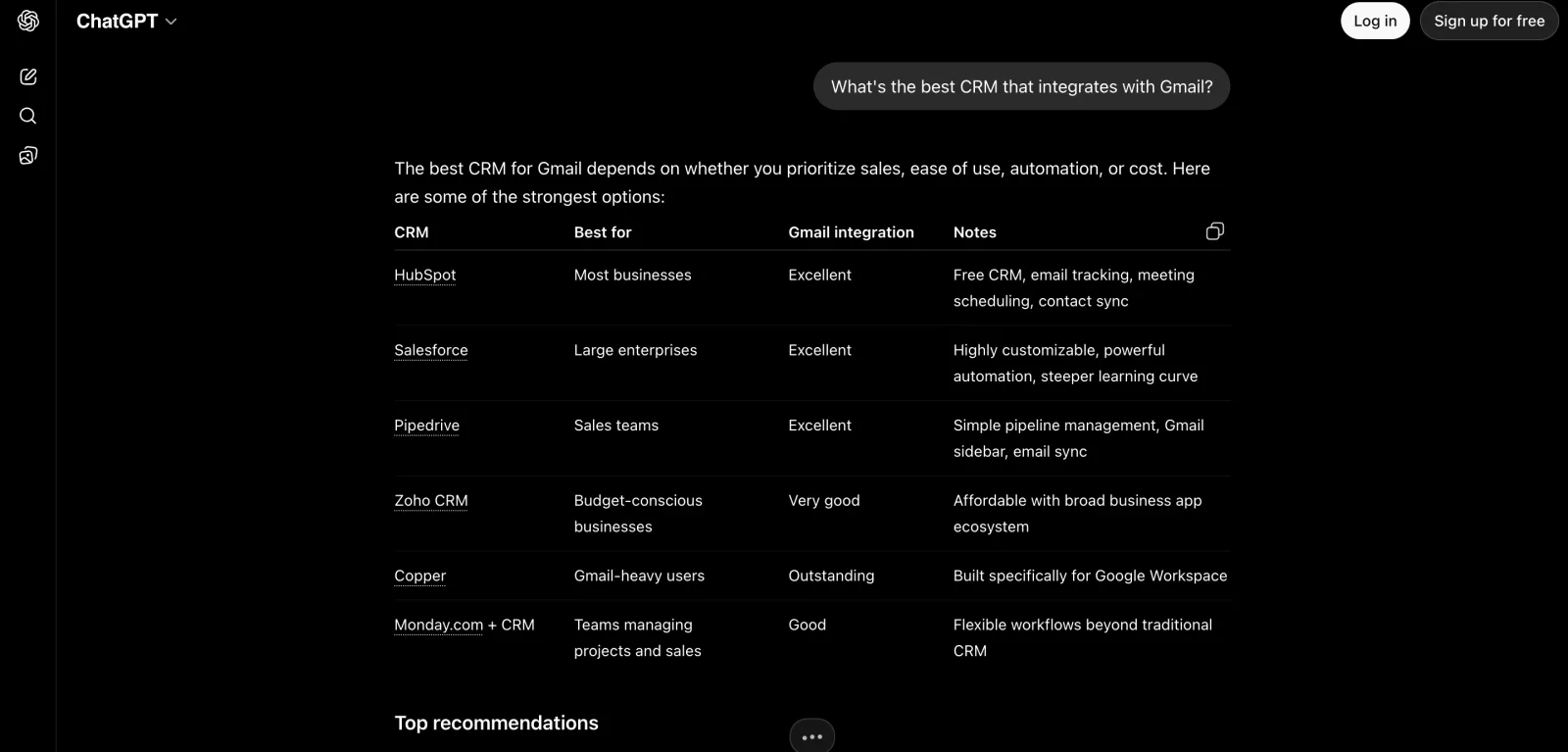
ChatGPT (logged out) answering a real buyer query — HubSpot, Salesforce, Pipedrive, Zoho, Copper. This shortlist is what a GEO tool helps you get onto.
Curious how your site does?
See how AI engines describe your site — free, about 60 seconds, no signup.
What a GEO tool actually does
Strip away the marketing and a generative engine optimization tool does three jobs.
First, it runs real prompts against AI engines and records who gets named. Not your keywords. The actual questions your customers ask, like "best project management tool for small teams" or "CRM that integrates with Gmail." The tool fires those prompts at each engine and reads back the answer, then parses the answer to see which brand names appear, how they're ordered, and what sentiment attaches to them.
This sounds simple. It isn't. Prompt selection matters — ask the wrong prompts and you miss the ones your buyers actually type. Prompt phrasing matters — small word changes swing outcomes. Engine coverage matters — an answer in ChatGPT looks nothing like the same query in Perplexity. A serious tool has infrastructure for all three: a prompt library grounded in real intent, a way to normalize phrasing, and a wide engine fan-out.
Second, it tracks this over time and across engines. One scan is a snapshot. The value is the trend. You want to know if you went from cited in 2 of 20 prompts last month to 6 of 20 this month, and which engine moved. You also want to know when a competitor takes a prompt you used to own — that's the kind of signal that separates a dashboard you glance at from a workflow you rely on.
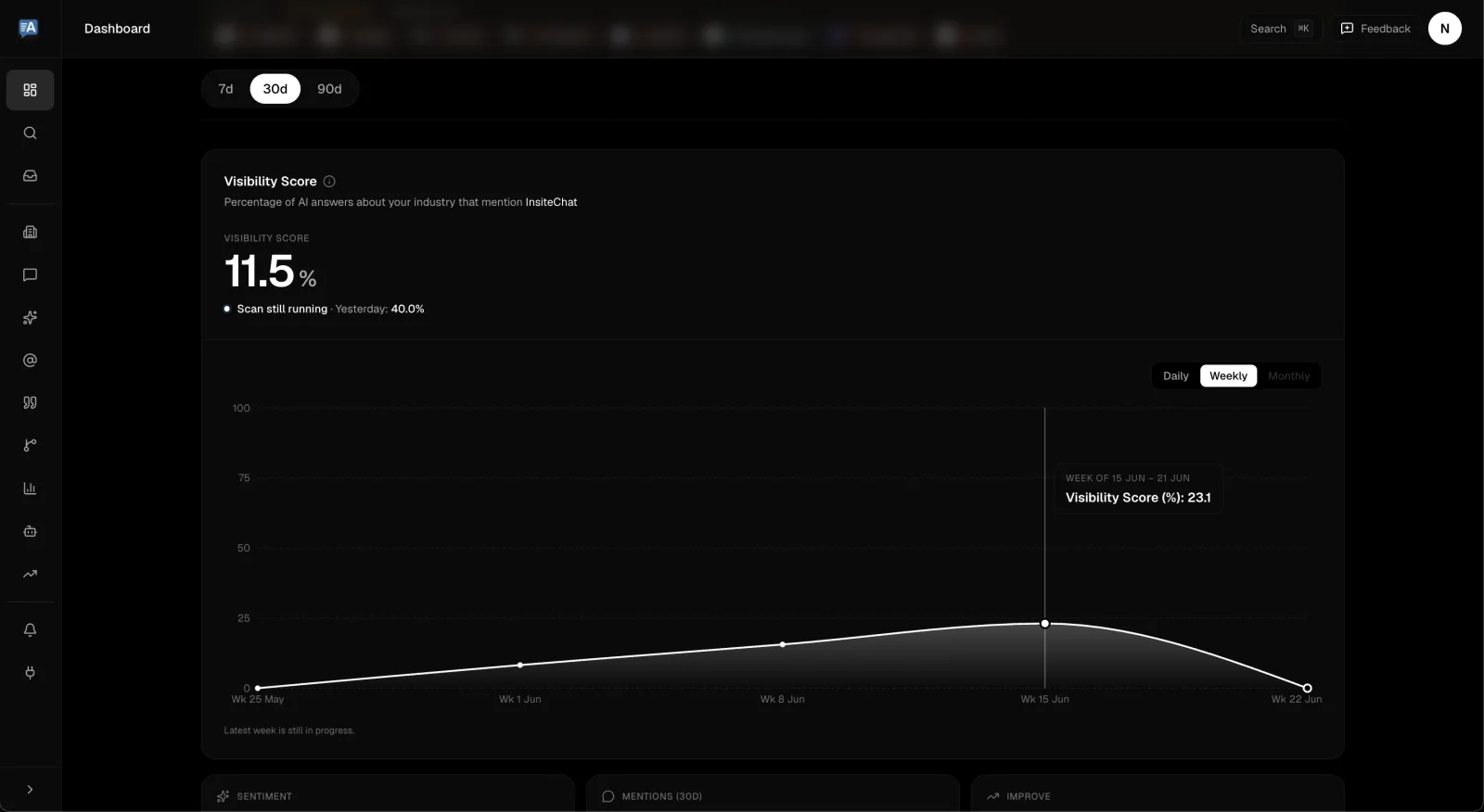
InsiteChat's AI visibility score trend over 30 days — FixAEO. The pattern is what matters: is the line going up, sideways, or down?
Third, and this is the part most tools skip, it tells you what to fix. Knowing ChatGPT ignores you is not useful on its own. Knowing that ChatGPT cites three competitors who all have a comparison page, an llms.txt file, and structured FAQ markup that you're missing is useful. That's an action.
If a tool only gives you a score and a chart, it's a dashboard, not a GEO tool. You want the score, the source behind it, and the next move.
Why you need one now, not next year
Here's the gap that makes GEO different from SEO. In search, you can roughly see your traffic. In AI answers, you can't. Someone asks ChatGPT for a recommendation, gets your competitor's name, and acts on it. No impression logged anywhere you can see. The loss is real and invisible at the same time.
I keep seeing founders assume that because their Google rankings are fine, their AI visibility is fine too. It isn't. Ranking #1 for a term does not mean an LLM cites you for the question behind that term. The two overlap but they're not the same system. I wrote more about how these layers stack in GEO vs AEO vs SEO if you want the full breakdown.
The other reason to start now is that AI engines pull from a slower-moving set of sources than Google does. Once an engine learns to cite a competitor for a topic, that pattern sticks. Catching up later is harder than getting in early. Measuring where you stand today is the cheap first step.
Estimates vary, but by the end of 2026, roughly 20–30% of high-intent buyer research is happening in a conversational AI interface first, before any Google search. That share is climbing every quarter. If you wait until it's 50%, three things will be true simultaneously: your competitors will have a two-year head start, the good third-party sources (Wikipedia, industry roundups, category comparison pages) will already have baked in a canonical answer that doesn't include you, and the cost to move the needle will be materially higher.
The GEO stack: what a mature setup looks like
I'll describe what a well-run GEO operation looks like in 2026 — because a tool is only one part of it.
Layer 1: measurement. A GEO tool that queries multiple live AI engines with real prompts. This tells you where you stand.
Layer 2: content. Answer-shaped content on your site (structured, noun-first, FAQ-schemad), plus an llms.txt file and a comprehensive sitemap. This gives AI engines something clean to quote.
Layer 3: entity presence. Wikipedia mentions, Wikidata, industry directories, category comparison pages you don't own (Reddit, G2, Product Hunt, third-party lists). This is where AI engines get their category context.
Layer 4: technical. Clean crawlability for AI bots (GPTBot, ClaudeBot, PerplexityBot, Google-Extended), fast page load, valid JSON-LD, and — increasingly — an MCP server that lets AI agents query your product directly.
Layer 5: feedback. A weekly rhythm of running your GEO tool, reading the changes, and shipping a fix. Not a one-time audit. A discipline.
A good GEO tool sits at layer 1 but informs layers 2 through 5. The best tools in the category let you go from "we noticed a drop in Perplexity" to "here's the specific page to change and the specific schema to add" in three clicks. That's the promise. Most tools stop at layer 1.
How I built ours (a peek behind the curtain)
I get asked how FixAEO actually works often enough that it's worth explaining briefly, because it'll help you evaluate any GEO tool you're considering.
For every brand we track, we generate a set of unbranded, buyer-intent prompts using a combination of (1) real search-volume data from Google Ads and AI keyword tools, (2) a small LLM step that expands seed prompts into natural variations, and (3) a human-curated category taxonomy. That prompt list is the input.
We then fan each prompt out to nine engines (ChatGPT, Claude, Gemini, Perplexity, Copilot, Grok, DeepSeek, Google AI Overviews, and Google AI Mode) using live API calls or CDP-driven scrapes where APIs don't exist. We record the raw answer, parse it for brand mentions, ranking position, sentiment, and cited URLs. That data flows into a Postgres store that powers the dashboard, and into a workflow layer that surfaces prioritized fixes.
Every part of that pipeline uses cutting-edge AI: the prompt-expansion step, the answer-parsing step, and the recommendation step all run on the latest frontier models. That's how a modern GEO tool should be built. If a vendor is running SEO-style crawling on top of static keyword lists and calling it GEO, you're getting last-generation infrastructure with a new label.
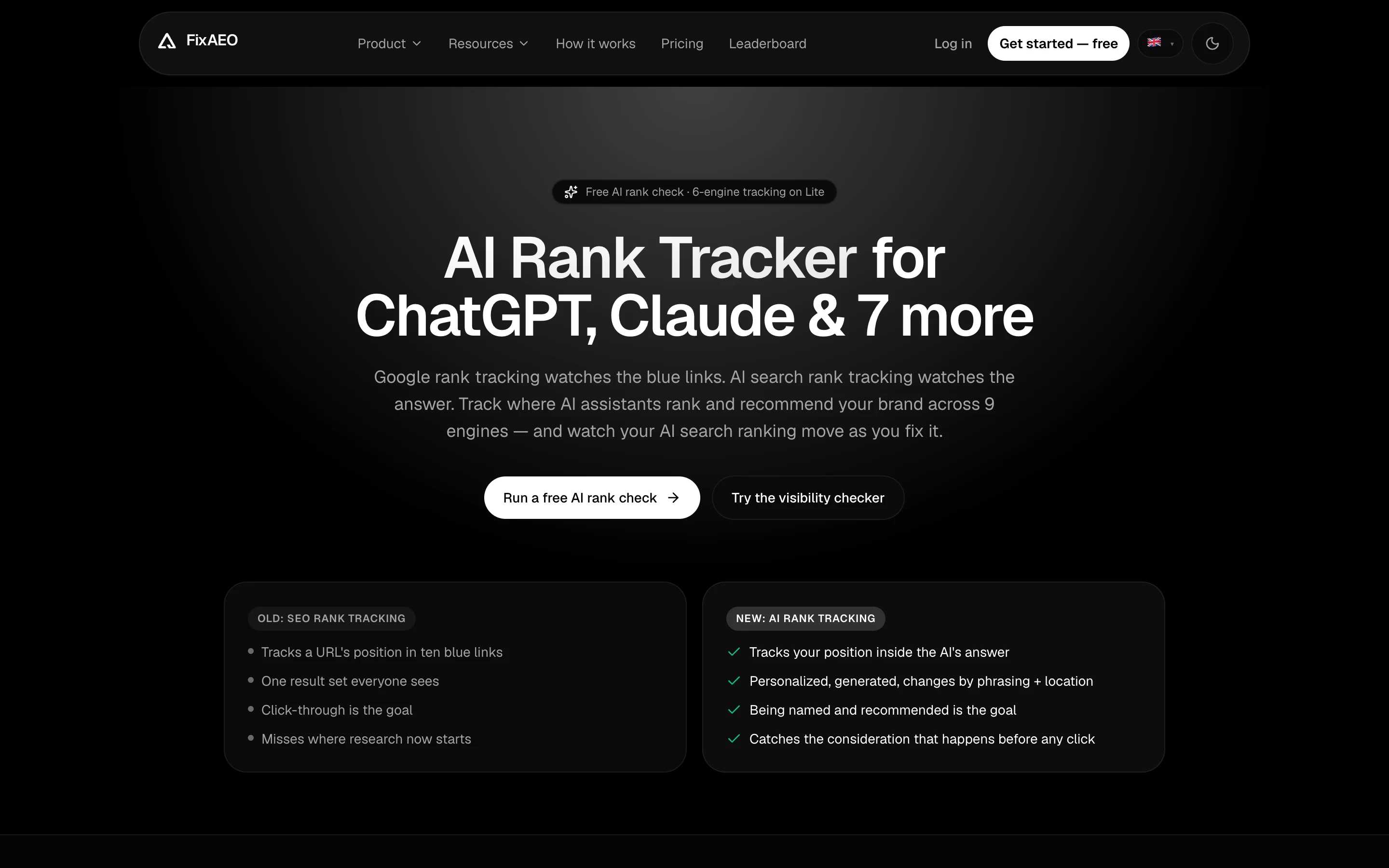
Google rank trackers watch blue links; a GEO tool watches whether AI names you. FixAEO's rank tracker covers 9 engines including ChatGPT, Claude, Gemini, Perplexity, Grok, and DeepSeek.
What to look for when picking a tool
Most of the differences between GEO tools come down to a few honest questions. Here's what I'd check before paying for anything.
Engine coverage. ChatGPT alone is not enough. People use Perplexity for research, Gemini inside Google, Claude for work, and Google AI Overviews show up whether anyone clicks or not. A tool that only checks one or two engines gives you a partial picture. FixAEO covers 9: ChatGPT, Claude, Gemini, Perplexity, Grok, DeepSeek, Copilot, Google AI Overviews, and Google AI Mode. I'm not saying you need all nine on day one, but you should know which ones a tool actually queries.
Real scans, not estimates. This is the big one. Some tools "estimate" your AI visibility from third-party SEO signals like backlinks and domain authority. That's a guess dressed up as data. A real GEO tool sends the prompt to the live engine and reads the actual answer. Ask any vendor directly: do you query the live model, or do you model it? If they dodge, you have your answer.
Actionable fixes, not just a number. When a tool flags a problem, can you click through to the specific page, the missing schema, the competitor who beat you, and the prompt where it happened? Vague advice like "improve your content" helps no one.
A free tier or free check. You should be able to see one real scan before you pay. If a tool won't show you a single result without a credit card, that's a tell. You can run a free check on FixAEO's AI visibility checker and see your actual standing in one engine in a couple of minutes.
Multi-brand support. If you're an agency or a multi-product company, you need this from day one. Some tools charge per domain, which gets expensive fast. FixAEO's Growth tier includes 5 brands; Enterprise is unlimited.
A real API and data pipeline. If AI visibility is going to be a KPI, it has to flow into your existing stack. Look for a rank-tracking API, GA4 attribution, and — if you're building AI-native workflows — an MCP server. Data trapped inside a dashboard is worth less than data that pipes into Slack, into your BI tool, or into a Claude Code session.
Public pricing. If pricing is "contact sales" on every plan, the vendor doesn't want small-team customers. That's a real signal about who they build for.
I went deeper on the full field in the best AEO tools for 2026, including where each one is strong and where it isn't.
The three biggest failures I see in GEO tooling
After watching this market for eighteen months, three failure modes account for most of the churn.
Failure 1: Fake data. Tools that infer AI visibility from SEO signals rather than querying live engines. You buy the tool, feel good for a month, then realize the score didn't change even though your actual ChatGPT answers didn't change either. It's a self-consistent illusion that costs $1,000+/month.
Failure 2: Score without action. Tools that show you a number and a chart but can't answer "what should I do this week?" These tend to be bought by executives who want a dashboard for a board slide and abandoned by the practitioner who inherits the login. Six months later, the account renews on autopilot and does nothing.
Failure 3: Single-engine coverage. Tools that only track ChatGPT (or worse, only track Google AI Overviews). Buyers use every engine. Optimizing for one and ignoring the rest is like doing SEO for Yahoo in 2005 — technically not wrong, but you're leaving the majority of the surface area on the table.
If you're evaluating tools, run this test: ask the vendor to walk you through a specific gap on your real site and show you exactly what they'd tell you to change. The good tools will pull up a page, name a schema type, and point at three competitor URLs to model after. The bad ones will wave at "improve your content."
GEO tool by company stage
The right tool depends on where you are. Here's the shortlist I'd give at each stage.
Startup or solo founder
Start with the FixAEO free tier. Run one scan on your domain and one on your top two competitors. You'll know within an hour whether you have a problem worth spending on. If you do, Lite at $29/mo covers a single brand across six engines. Don't pay for enterprise features you won't use.
Agency
You need multi-brand and a client-friendly export. FixAEO's Growth tier ($79/mo, five brands, daily rescans) is priced for exactly this. Add Peec if a client wants their data in Looker. Report weekly, not monthly — AI answers shift too fast for monthly cadence to catch a competitor takeover.
Multi-product SaaS or holding company
Growth or Enterprise, depending on brand count. The value is portfolio-view: one workspace where you see how each product ranks, so you can prioritize investment. If Product A is at 82 and Product B is at 34, you know where to send the content team.
Enterprise
You'll want nine-engine coverage, SSO, SOC 2, and a real API + MCP pipeline into your existing stack. FixAEO Enterprise or Profound. Both work. The buying decision usually comes down to whether procurement wants a large sales-led vendor (Profound) or a product with broader coverage and modern data integrations (FixAEO).
What the numbers look like when the tool is working
A concrete picture is worth more than any pitch, so here's what a working GEO deployment looks like for a real customer we've watched for six months.
Month 1: baseline. 34/100 visibility score across nine engines. Cited in 4 of 25 tracked prompts. Zero appearances in Perplexity, minimal in Claude, some presence in ChatGPT via a comparison page that ranks well organically.
Month 2: they shipped an llms.txt file, added FAQ schema to their four highest-intent pages, and published two new comparison pages targeting prompts a competitor was winning. Score moved to 47. Cited in 8 of 25 prompts. New appearances in Perplexity for two of the new prompts.
Month 3: they got a Wikipedia citation (via a real Reuters mention, not a paid placement). Score moved to 61. Cited in 13 of 25 prompts, including three where they now outrank the previous category leader.
Month 6: 78/100. Cited in 19 of 25 prompts. Two of the newer prompts have flipped so that this customer is now the default answer across five of the nine engines. Their AI-referred traffic (measured via GA4 attribution in the FixAEO dashboard) is up 340% YoY.
That's not a promise. That's what happens when a team uses a real GEO tool weekly, ships fixes it surfaces, and stays disciplined for two quarters. Some brands move faster. Some slower. But the shape of the curve is consistent: score improves, then citations improve, then referral traffic improves — in that order, with about a 30-to-60-day lag between each stage.
How a GEO tool differs from a traditional SEO tool
People ask me if their Ahrefs or Semrush subscription already covers this. It doesn't, and it's worth understanding why.
| SEO tool | GEO tool | |
|---|---|---|
| Measures | Rankings, traffic, backlinks | Whether AI engines cite you |
| Data source | Search index, click data | Live AI engine answers |
| Unit of success | Position #1 on a results page | Named in the generated answer |
| Where you see wins | Search Console, analytics | Inside the AI response itself |
An SEO tool answers "where do I rank for this keyword." A GEO tool answers "when a person asks the AI this question, does it say my name." Those feel similar but the work behind each is different. SEO optimizes a page for a crawler that returns links. GEO optimizes your content and your wider footprint so a model that returns prose decides you're worth mentioning.
Some of the fixes overlap. Clean structure, clear answers to real questions, and crawlable pages help both. But a lot of GEO work has no SEO equivalent, like getting cited in the third-party sources that engines trust, or shipping an llms.txt file so models can find your key pages. If you want a starting checklist, what AEO is lays out the foundations before you spend on any tool.
A simple way to start without overthinking it
You don't need to commit to a paid plan to find out where you stand. Here's the lightweight version I'd run first.
- Write down the 10 questions a buyer would actually type into an AI to find a product like yours. Be honest, use their words, not your feature names.
- Paste each one into ChatGPT and Perplexity yourself. Note where you appear and who shows up instead.
- Look at the brands that beat you. Open their pages. What do they have that you don't? Usually it's a clear comparison page, structured answers, or strong third-party mentions.
- Fix the gaps you can fix this week, then re-check in a month.
This manual version works fine for a single brand. The reason a tool exists is scale and consistency. Once you're tracking 30 prompts across 9 engines every week, doing it by hand falls apart fast, and you lose the trend data that makes the whole exercise worth it. But starting by hand teaches you what the tool is even measuring, which makes you a better buyer.
FAQ
What is a generative engine optimization tool?
It's software that checks whether AI engines like ChatGPT, Gemini, Perplexity, and Google AI Overviews mention your brand when people ask relevant questions. A good one tracks this across engines over time and tells you what to change so you get cited more often. The point is visibility inside AI answers, which traditional SEO tools don't measure.
Is GEO the same as AEO?
They overlap heavily and most people use the terms interchangeably. GEO (generative engine optimization) and AEO (answer engine optimization) both mean getting your brand surfaced in AI-generated answers rather than in a list of links. I treat them as the same goal with slightly different emphasis. The practical work is identical: make your content easy for models to find, trust, and quote.
Do I still need an SEO tool if I have a GEO tool?
Yes, for now. They measure different things. SEO tools track rankings and search traffic, which still drive real revenue. GEO tools track AI citations, which are a growing and currently invisible channel. Most teams I talk to run both, because some buyers still find them through Google and a rising share find them through an AI answer first.
Can I check my AI visibility for free?
Yes. You can run a real scan against a live AI engine for free with FixAEO's checker before paying for anything. Doing one free scan tells you more than any amount of reading. If you appear, great. If a competitor shows up instead, you know exactly where to start.
How much should I budget for a GEO tool?
For a single-brand team getting started, $29–99/mo is the right range (FixAEO Lite through Growth). For an agency managing multiple clients, $79–299/mo. For enterprise with procurement requirements, five-figure annual contracts are standard. Anything asking for six figures on a single-brand deployment is priced for a specific customer profile that isn't you.
How often should I run scans?
Weekly at minimum. Daily if you're actively shipping content and want tight feedback. Monthly is too slow — competitor changes, model retrains, and search-behavior shifts can all move the needle in a way that a monthly cadence misses.
Should I care if my GEO tool has an MCP server?
If your team uses Claude Code, Cursor, or any AI-native workflow — yes. An MCP server lets you query AI visibility data from inside those tools directly, which is a real productivity unlock. If your team doesn't use those tools yet, it's a "nice to have" that will become "required" within 12 months.
What's the difference between a GEO tool and an AI-powered SEO tool?
A GEO tool measures whether AI engines mention you (output side). An AI-powered SEO tool uses AI to help you produce content faster (input side). They complement each other — the content tool gets your ideas onto the page, and the GEO tool tells you whether AI engines picked them up.
If you want to see where you stand right now, run a free scan with the AI visibility checker or start from the homepage and pick the tool that fits. One real result beats a week of guessing.
Related reading
GEO vs AEO vs SEO: a 2026 terminology breakdown
GEO, AEO, SEO — and now LLMO. A clean breakdown of what each acronym actually means, how they nest, and which one applies to your work in 2026.
17 min read12 Best Answer Engine Optimization Tools (2026)
12 answer engine optimization tools compared — engines covered, entry price, free tier — with honest takes on which to pick by stage and budget.
19 min readAI Search Statistics 2026: How AI Replaces Google
20+ verified, source-linked AI search statistics for 2026 — who uses AI vs Google, how fast it's growing, and the viral stats that don't hold up.
16 min readWhat is AEO? Answer Engine Optimization explained
Answer Engine Optimization (AEO) means getting AI assistants to recommend your brand. Learn what AEO is, why it matters more than SEO, and how to start.
18 min read
Free AEO tools
Put this into practice with free FixAEO tools — no signup required.
AI Visibility Checker
Score your brand across 9 AI engines
AEO Audit Tool
Answer-engine readiness scan
Schema Generator
Build valid JSON-LD structured data
llms.txt Generator
Create a spec-compliant llms.txt
Sitemap Validator
Check your XML sitemap for errors
AI Content Grader
Grade content for AI citation readiness
Find the gap. Then fix it.
Check how AI engines find, describe, and cite your site. Free, no signup. On a paid plan, AI Marketer can turn the evidence into briefs, drafts, optimizations, and reports.