GEO vs AEO vs SEO: a 2026 terminology breakdown
GEO, AEO, SEO — and now LLMO. A clean breakdown of what each acronym actually means, how they nest, and which one applies to your work in 2026.

On this page

I answer this question every week. Someone comes to me confused because they read one article that says "GEO is the future of SEO" and another that says "AEO is what actually matters" and a third that swaps them entirely. I've been building in this space for eighteen months and I still catch myself using the terms sloppily. So here's the honest, opinionated version — what each acronym means, what the industry is doing, and how I'd write about it if I were you.
Four acronyms, used almost interchangeably and almost always wrong:
- SEO — Search Engine Optimization
- AEO — Answer Engine Optimization
- GEO — Generative Engine Optimization
- LLMO — Large Language Model Optimization (a newer label some vendors use for the same practice as AEO)
This post is the clean definitions — what each term means, when it applies, and who uses which. It's the words, not the work. If you already know the terms and want to do something, jump to the 30-day migration plan. For the full tactical playbook behind the terminology, see the per-engine AEO tactics guide.
The one-paragraph version
SEO is about ranking in a list of links (Google's 10 blue links). AEO is about being included in an AI's written answer to the user's question. GEO is a broader umbrella term some people use to mean exactly AEO, and others use to mean "optimizing for any generative AI surface" — AI Overviews, voice assistants, multimodal prompts. LLMO is a newer alias, almost always a synonym for AEO. There is no standards body deciding which is right. What the day-to-day work actually looks like is a separate question — the migration plan post covers that; this post just fixes the words.
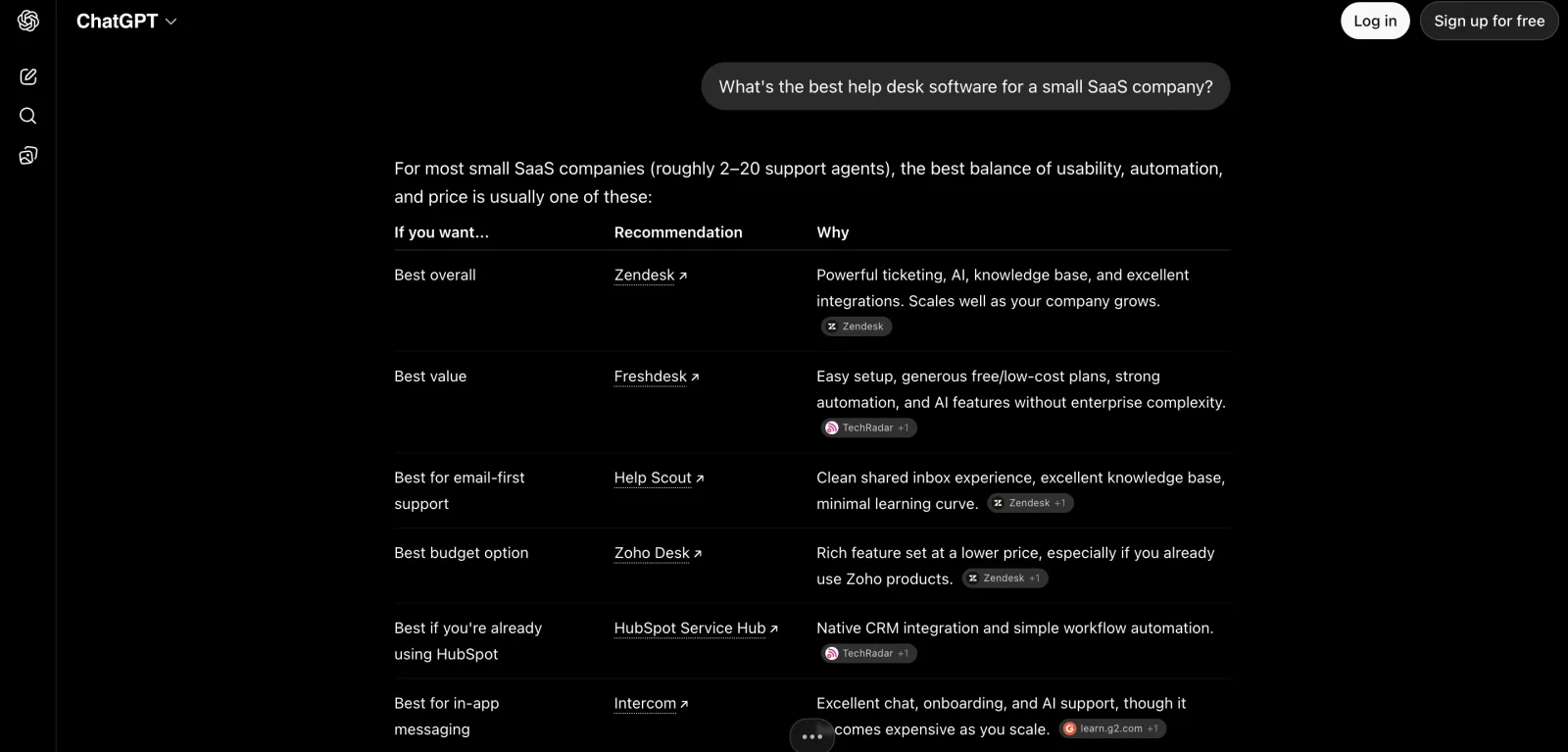
ChatGPT (logged out) answering a buyer query — Zendesk, Freshdesk, Help Scout, Intercom. Whoever the model names here wins the click; that's the GEO/AEO prize.
The 30-second comparison
| SEO | AEO | GEO | |
|---|---|---|---|
| Target surface | 10 blue links | AI assistant answer (ChatGPT, Claude, Copilot, Gemini, Perplexity) | Any generative AI surface — assistants + AI Overviews + voice |
| Primary signals | Backlinks, on-page keywords | Schema, llms.txt, authoritative citations | Same as AEO + AI Overview ingredients |
| Asset produced | Ranked URL | Brand mention inside an answer | Brand inside answer + Overview + voice readout |
| What changes for the user | They click your link | They read your name in the answer | Same as AEO, plus zero-click contexts |
| Maturity | ~25 years | ~3 years | under 1 year |
| Standard name in industry | SEO | AEO (sometimes "AEO/GEO") | GEO is the contested newcomer |
LLMO doesn't get its own column: it's an alias for AEO, so wherever the table says AEO, LLMO applies too.
If you take only one thing from this post: most posts you'll read that say "GEO" mean what the rest of the industry calls "AEO". The acronym is unsettled; the work is mostly the same.
How I explain each acronym in a founder call
I answer the same question weekly, so here's the version I use in real conversations — no jargon, no hedging.
"What's SEO?" — "It's the work of getting your website to rank higher on Google. When someone searches, they see ten links. You want to be one of the top three. That's the game."
"What's AEO?" — "It's the same idea but for AI. When someone asks ChatGPT 'what's the best CRM for my team,' ChatGPT gives a written answer that names some brands. You want to be one of those brands. That's AEO — Answer Engine Optimization."
"What's GEO, then?" — "Same thing as AEO, mostly. Some people use GEO because they think 'generative' is a broader word and might include voice or AI images. But if you're doing 'GEO' work, you're almost certainly doing AEO. Don't overthink the label."
"What about LLMO?" — "Same as AEO. Different marketing, same discipline. I use AEO because that's what the industry mostly settled on. If a vendor pitches you 'LLMO services,' ask them what's different from AEO. Usually nothing."
That's the whole conversation. Anyone selling you something more complicated is either confused themselves or trying to charge a premium for a rebrand.
The definitions in detail
SEO — Search Engine Optimization
The discipline of ranking pages in conventional search engine results — primarily Google, with Bing as the secondary target. The job: appear high in the 10 blue links for queries relevant to your audience, drive clicks, drive conversions.
Signals SEO optimizes:
- Backlinks (PageRank-style authority graphs)
- On-page keywords and title tags
- Page speed, Core Web Vitals
- Internal linking and site structure
- Crawlability (robots.txt, sitemap.xml)
- Schema.org markup (for rich snippets, mostly)
- E-E-A-T signals (expertise, experience, authoritativeness, trust)
- Domain authority
The asset SEO produces: a ranked list of URLs.
Real-world example: your blog post ranks #3 on Google for "best CRM for small teams." A user clicks through, lands on your page, reads your comparison, converts. Classic funnel.
AEO — Answer Engine Optimization
The discipline of being included in an AI-generated answer when a user asks an AI assistant — ChatGPT, Claude, Copilot, Gemini, Perplexity, DeepSeek, Grok — something relevant to your brand or category.
Signals AEO optimizes:
- Schema.org markup (much more heavily than SEO uses it — it's the primary entity-decoding signal)
- llms.txt (the AI-era robots.txt)
- Question-style H2 structure and front-loaded answers
- Authoritative inbound mentions (Wikipedia, industry trade pubs, Reddit)
- Citation footnotes in your own content
- AI crawler accessibility (GPTBot, ClaudeBot, PerplexityBot, Google-Extended permissions)
- Freshness markers and
dateModifiedin structured data - Source consistency (claims that match what other authoritative sources say)
The asset AEO produces: a brand mention inside an AI's answer — sometimes with a citation card linking back, sometimes just the name in the prose.
Real-world example: a user asks ChatGPT "best CRM for small teams." ChatGPT synthesizes an answer: "For small teams, consider Pipedrive, HubSpot CRM, or Attio. Attio is particularly known for [feature]." Your brand is Attio and you're in the answer. The user may click through to your site, or may just take the recommendation directly.
LLMO — Large Language Model Optimization. A newer alias you'll see in some tool marketing and analyst posts. In practice it means the same thing as AEO: getting named inside a large language model's answer. In most usage today it's a synonym for AEO — nobody has drawn a settled line between them.
GEO — Generative Engine Optimization
The broadest of the three, and the most variably defined. Two common usages:
- GEO = AEO — Some teams use them as exact synonyms. Most blog posts in 2025–2026 that talk about "GEO" are describing AEO.
- GEO = AEO + AI Overviews + image/video/voice generative surfaces — Other teams use GEO to mean optimizing for any generative AI surface, including:
- Google AI Overviews
- Bing Copilot's generated answers
- AI image generation prompts (rare, but it's discussed)
- Voice assistants with generative responses
In practice, when someone says "GEO", clarify by asking "which engines do you mean?" The answer will usually be "the AI assistants and Google AI Overviews" — which means they mean AEO with AI Overviews bolted on.
Real-world example (broader GEO): your homepage gets pulled into Google AI Overviews for the query "how do I add llms.txt to my website." AI Overviews synthesizes a short answer citing your blog post. The user reads the summary without clicking through — the impression didn't produce a click but did produce a citation. That zero-click AI Overview appearance is squarely GEO territory in the broader sense.
The 5-year evolution: how we got here
Understanding the terminology helps if you can see where each acronym came from.
2020: SEO owns everything. Google is the only search game that matters. Featured snippets exist but are treated as an SEO subgenre. "AEO" is used sporadically in blog posts but hasn't entered common vocabulary.
2022 (November): ChatGPT launches. Suddenly a user can ask a natural-language question and get a written answer with no clicks. The SEO community reacts slowly — most of 2023 is spent asking whether ChatGPT is a real search competitor or a novelty.
2023: Featured-snippet playbook meets generative AI. Some SEO leaders (notably at Search Engine Land, Ahrefs, and small AEO shops) start advocating for "answer engine optimization" as a separate discipline. The term gains traction through late 2023.
2024: Google AI Overviews launch (May). SEO teams see traffic drop for queries that get an AI Overview. "GEO" enters the vocabulary as some analysts argue AEO is too narrow — they want a term that covers AI Overviews too. AEO advocates argue back that AI Overviews are still just another "AI answer surface" and AEO covers it fine.
2025: The tool ecosystem forms. Purpose-built tools — Profound, Peec, Otterly, FixAEO, and others — ship. Most brand themselves as "AEO," a few as "GEO." Tool marketing starts to solidify the terminology, though not uniformly.
2026 (now): AEO is winning as the industry standard. Look at job listings, conference talks, industry reports. "AEO" appears more than "GEO" in most sources. Both terms will persist, but if you have to pick one for your team's title or content strategy, AEO is the safer bet.
Which acronym should you actually use in your content?
If you're writing a blog post or updating your website, here's the honest answer.
Use AEO if your goal is to be found by people searching for the discipline itself. "AEO" is the higher-search-volume term (currently ~2–3x GEO in most SEO tools), it's the more common term in job listings, and it's less ambiguous.
Use GEO if you're targeting analysts, marketers who read Search Engine Land and Ahrefs deeply, or an audience that specifically thinks in terms of Google AI Overviews. Some tool categories skew GEO-friendly.
Use both if your content is category-establishing (a comparison post, a definitions article like this one, an industry landscape doc). You want both to appear because both are used, and using them together demonstrates awareness of the landscape.
Avoid LLMO in customer-facing content. Very few people search for it, and the ones who do are almost always aware it's an alias for AEO.
For your website's URLs and page titles, I'd default to AEO. For your tool marketing, watch what your buyer type uses and match them.
How the terms nest
Think of them as concentric circles, widest to narrowest inside the modern era:
- SEO covers everything to do with appearing in any search experience.
- AEO (and its alias LLMO) is the subset that targets AI-generated answers specifically.
- GEO is sometimes the same as AEO and sometimes a broader cousin that adds AI Overviews, voice, and multimodal surfaces.
That's the relationship in shape. Which signals matter for which — and how the weights differ (structured data over backlinks, question-form headings over keyword density) — is the practical comparison, and it lives in the migration plan post rather than here.
Common industry confusion I see (and how to spot it)
Three patterns in the wild that I try to correct.
Confusion 1: treating GEO as a stricter successor to SEO. Some blog posts imply "GEO replaces SEO" as if the disciplines are sequential. They're not. SEO is not dead. It's the plumbing that still delivers 50–70% of most sites' traffic. GEO/AEO is a layer on top, not a replacement.
Confusion 2: reserving AEO for ChatGPT and GEO for Google AI Overviews. Some vendors try to differentiate their products by claiming AEO means one engine and GEO means another. It doesn't. Both terms are generic across engines. If a vendor is drawing this line, they're inventing distinctions for marketing purposes.
Confusion 3: assuming LLMO is different from AEO. It isn't. Some tools use LLMO because "AEO" has become associated with certain competitors and they want to sound new. Don't fall for it.
If you're evaluating a tool or agency and they lean heavily on one acronym while dismissing the others, that's usually a marketing tell rather than a substantive difference.
Which one should you actually optimize for?
That's a strategy question, not a terminology question — and it has its own post: AEO vs SEO: what changed and what to do about it walks through the channel-mix question, the signal differences in detail, and a 30-day migration plan. The short version: most teams should be doing both, and in 2026 the actions converge more than they diverge.
If your goal right now is just to understand the words, this primer is enough. If you're trying to decide where to spend the next quarter, read the strategy post next.
The acronym to use in your job title
If you're updating your LinkedIn or your team page in 2026:
- SEO Manager — still fine; widely understood
- AEO Manager / AEO Lead — emerging title; we expect it to become standard by 2027
- GEO Manager — sees occasional use; the ambiguity hurts it for now
- Search & AI Visibility Lead — long but clear; some larger orgs are landing here
In my biased opinion, "AEO" is the most precise name for the discipline as it actually exists today, and it's the one I built FixAEO around. If you want to test the discipline against your own site, run a scan — we'll show you the gap between your current SEO posture and your AEO posture in three minutes.
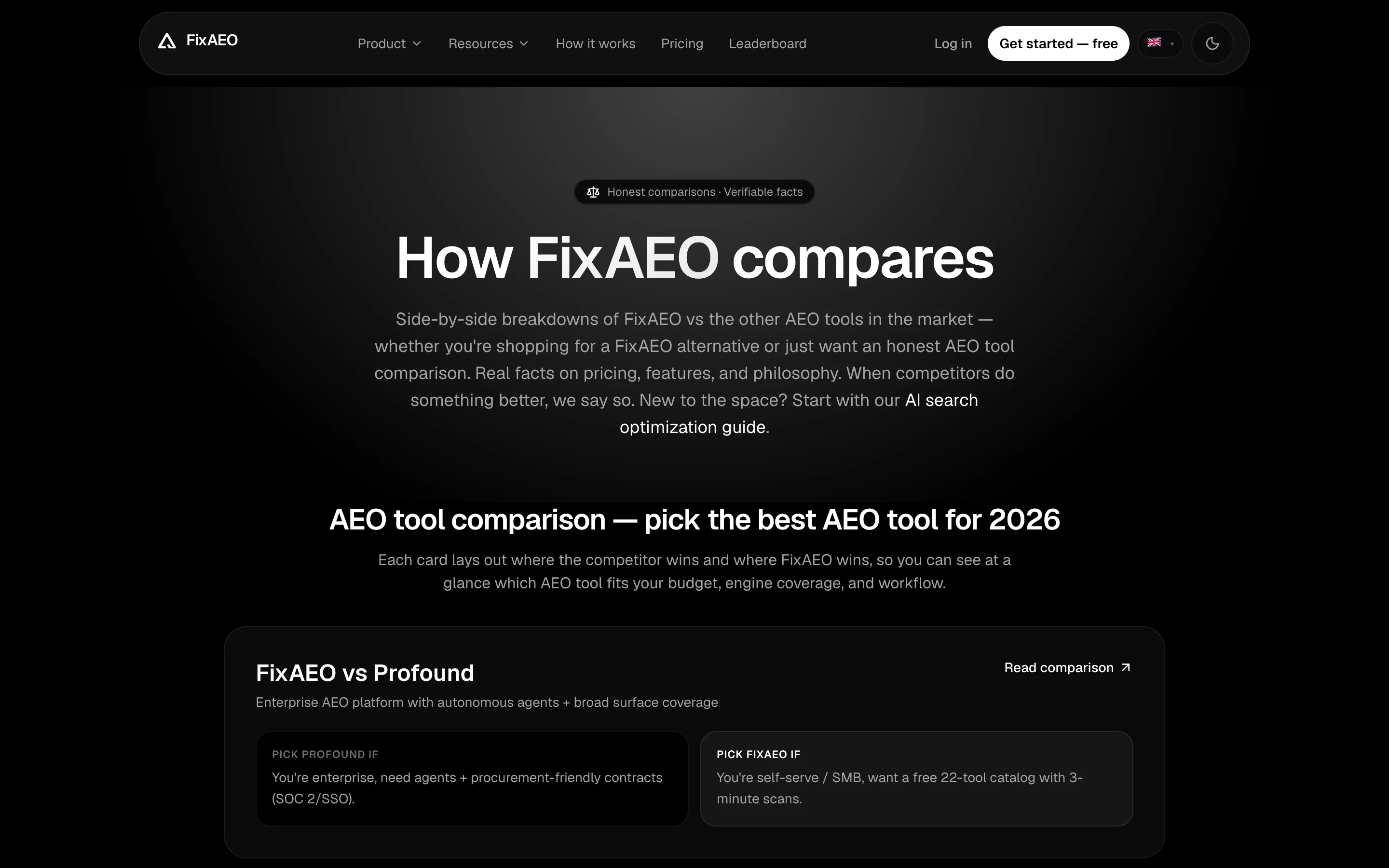
FixAEO's public comparisons page: honest side-by-side breakdowns of FixAEO vs the other AEO tools, with clear 'pick this one if' criteria. Terminology varies (GEO / AEO / LLMO); the buying decision is the same.
How the daily work actually differs (a practitioner's view)
Setting aside the terminology, here's what your day looks like doing each discipline seriously.
An SEO day — check Search Console for coverage errors, review Ahrefs for competitor content, publish or update a page targeting a specific keyword cluster, spot-check Core Web Vitals, review backlinks acquired since last week. The metric on the wall is organic sessions and their conversion rate.
An AEO day — check a tool like FixAEO for visibility score changes across nine engines, identify which prompts you're losing to competitors, ship a comparison page or FAQ update to address the gap, add a schema type or update llms.txt, watch Agent Analytics for AI-crawler traffic to your new content. The metric on the wall is share of AI answers you appear in and AI-attributed conversions.
A GEO day (broader definition) — everything in an AEO day, plus a specific check on Google AI Overviews (using Ahrefs' Brand Radar or a manual query set), plus consideration of voice-search readability (short paragraphs, natural-language answers), plus attention to how images/videos get cited (Wikimedia Commons contributions, YouTube schema).
The overlap between AEO and GEO days is high. The overlap with SEO days is lower — different tools, different weekly rhythm, different metric.
If you're deciding what to call your team, look at which day your team actually spends more time in. If they're mostly checking Search Console and writing on-page copy, they're an SEO team. If they're mostly checking AI visibility dashboards and shipping FAQ-schemed comparison pages, they're an AEO team. If they're doing both across all generative surfaces including AI Overviews and voice, they're a GEO team. Most in-house teams are AEO-plus-SEO in mid-2026. That'll shift over the next 24 months.
Where the acronyms came from
Brief history, since people ask:
- SEO dates to the late 1990s, when search engines (AltaVista, then Google) started ranking by signals beyond keyword frequency, and a small industry grew up around understanding those signals.
- AEO got coined around the rise of featured snippets (~2014–2017) and was extended to AI assistants when ChatGPT and friends launched in 2022–2023.
- GEO is the newest; it emerged in 2024 as some analysts argued AEO was too narrow to cover AI Overviews and started using "Generative" as the umbrella term. It hasn't fully won; AEO is still more commonly used in industry job listings as of mid-2026.
FAQ
Are GEO and AEO the same thing?
Mostly. Many writers use them interchangeably, and the bulk of the work — schema, llms.txt, authoritative citations, freshness — is identical. The narrow distinction some people draw: AEO targets AI assistants specifically; GEO is the broader umbrella that also includes AI Overviews and voice. In job listings and conference talks, AEO is the more common term as of mid-2026.
Does SEO still matter if I'm doing AEO?
Yes. SEO and AEO share most of their core actions (clean schema, authoritative inbound mentions, fresh content), and Google organic is still the largest single channel for almost every site. SEO is the floor; AEO is the ceiling.
Who coined "GEO"?
It emerged in 2024 as analysts argued that "AEO" was too narrow to cover Google's AI Overviews and similar generative SERP features. The term hasn't fully settled — AEO remains more common in industry job titles, but GEO shows up more often in newer analyst reports.
Is one acronym going to win?
Probably AEO, but it's not guaranteed. AEO has the head start and the more precise meaning. GEO has the bigger umbrella but the ambiguity hurts adoption. Either way, the work is largely the same; the acronym is mostly a branding choice for consultants and tools.
Should I rename my SEO team to AEO?
Not yet. Most teams will end up with hybrid titles ("Search & AI Visibility", "Organic Growth") rather than pure AEO. The discipline is converging more than diverging.
Where does ChatGPT Search fit — SEO, AEO, or GEO?
AEO. ChatGPT Search is an AI assistant with a web-retrieval layer; appearing in its answers is the canonical AEO use case.
If I search Google for "AEO" or "GEO," why do I see different definitions?
Because the industry hasn't settled. Different agencies and tool vendors define the terms slightly differently to differentiate themselves. My advice: pick the definitions from this post (which reflect the more common industry usage), and know that some sources will use them differently.
Does AI Overviews count as AEO or GEO?
Most people call it GEO, but many call it AEO. Google AI Overviews is a generative-AI feature inside a search engine — it fits both umbrellas. If you have to pick, "AEO for AI assistants, GEO for Google AI Overviews" is the cleanest split, but it's not universally used.
Which acronym should I use in my blog post titles?
AEO if you want higher search volume from people directly searching for the discipline. Both AEO and GEO if you want to catch either search. In most cases, AEO in the title, mention GEO once in the intro or body.
How do I explain AEO to my CEO who's asking about GEO?
Say something like: "GEO and AEO usually mean the same thing — being included when AI answers a question. GEO is a slightly broader term, but the work is the same. I'd default to calling it AEO in our team because it's more precise, but I'll flag when a specific engine (like Google AI Overviews) needs its own approach." That framing lets you skip the terminology debate and get to the actual strategy discussion.
Recommended reading
- AEO vs SEO: what changed and what to do about it — the deeper migration plan
- What is AEO? — the 101 if you're new to the term
- Why ChatGPT doesn't recommend your brand — diagnosis of the most common AEO failure modes
- How to win back traffic lost to Google AI Overviews — the GEO-specific case for AI Overviews
- Best AEO tools in 2026 — comparison of the tools that measure this stuff
Related reading
AEO vs SEO: what changed and what to do about it
AEO vs SEO in 2026: AI answers and search engines reward different signals. The data, a plain comparison, and a 30-day migration plan your SEO team can run.
17 min read7 Zero-Click SEO Tips for Better GEO Visibility
Zero-click search now swallows most Google queries. Seven evidence-backed GEO tactics, with sources, to get cited in AI answers instead of chasing clicks.
15 min readWhat is AEO? Answer Engine Optimization explained
Answer Engine Optimization (AEO) means getting AI assistants to recommend your brand. Learn what AEO is, why it matters more than SEO, and how to start.
18 min readHow to win back traffic lost to Google AI Overviews
Google AI Overviews run on a third of commercial queries and keep clicks in the SERP. Here are 7 changes that get your brand named in the answer, plus a 30-minute audit and 2-month plan.
17 min read12 Best Answer Engine Optimization Tools (2026)
12 answer engine optimization tools compared — engines covered, entry price, free tier — with honest takes on which to pick by stage and budget.
19 min readThe 30-point AEO audit checklist (2026)
AEO audit checklist: 30 signals across 7 categories — from crawler access to per-engine verification. Copy it into Notion and run your audit today.
16 min read
Free AEO tools
Put this into practice with free FixAEO tools — no signup required.
AI Visibility Checker
Score your brand across 9 AI engines
AEO Audit Tool
Answer-engine readiness scan
Schema Generator
Build valid JSON-LD structured data
llms.txt Generator
Create a spec-compliant llms.txt
Sitemap Validator
Check your XML sitemap for errors
AI Content Grader
Grade content for AI citation readiness