AI Search Statistics 2026: How AI Replaces Google
20+ verified, source-linked AI search statistics for 2026 — who uses AI vs Google, how fast it's growing, and the viral stats that don't hold up.

On this page

Last updated: July 7, 2026. We refresh the market-share section every month as new data lands.
Every marketing deck in 2026 opens with the same claim: "AI is replacing Google." Most of them cite a stat that falls apart the moment you check the source.
So we did the boring work. Below are 20+ AI search statistics, every one traced to a primary source and dated — Pew, Bain, Adobe, Ahrefs, Semrush, Similarweb. We also flag the four viral numbers that don't survive a fact-check, because citing a fake stat is worse than citing none. The honest summary: AI search is still small next to Google, but it is compounding faster than any acquisition channel in a decade — and it already changes who gets discovered.
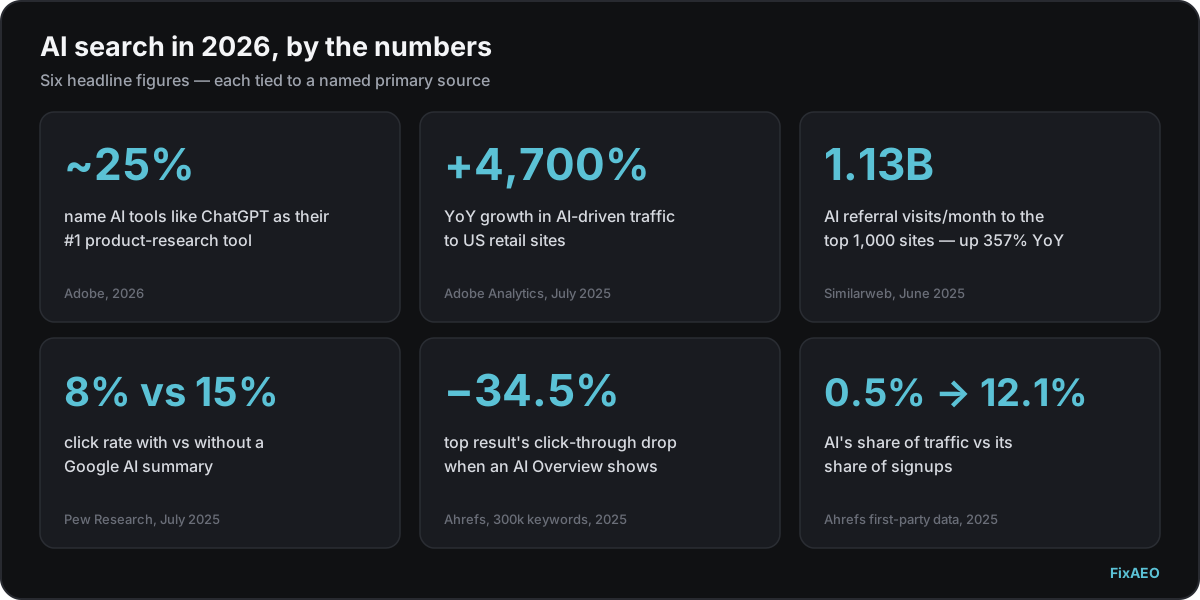
AI search in 2026, at a glance — six headline figures, each traced to a primary source. Full numbers and citations below.
Curious how your site does?
See how AI engines describe your site — free, about 60 seconds, no signup.
The 60-second version
- ~25% of consumers now name AI tools like ChatGPT as their #1 product-research tool — ahead of brand sites, reviews, and traditional media (Adobe, 2026).1
- +4,700% year-over-year growth in AI-driven traffic to US retail sites (Adobe Analytics, July 2025).2
- 1.13 billion AI referral visits to the top 1,000 sites in a single month, up 357% in a year (Similarweb, June 2025) — but still only ~1/169th of Google's referral volume.3
- When Google shows an AI summary, people click a link only 8% of the time vs 15% without — roughly half (Pew Research, July 2025).4
- Google AI Overviews cut the top result's click-through rate by 34.5% (Ahrefs, 300k keywords, April 2025).5
- AI search was just 0.5% of one company's traffic but drove 12.1% of its signups (Ahrefs, June 2025).6
The takeaway isn't "Google is dead." It's that a new, fast-growing discovery channel has opened — and most brands are invisible inside it.
Are people really using AI instead of Google to research and buy?
Yes — and faster than the traffic numbers alone suggest, because a lot of AI research never shows up as a website visit.
- ~25% of consumers now cite AI platforms like ChatGPT as their top product-research tool — more than brand websites, online reviews, or traditional media. (Adobe 2026 AI and Digital Trends Consumer Report, with Oxford Economics, ~4,000 respondents, fielded Oct–Nov 2025.)1
- 38% of US consumers have used generative AI for online shopping, and 52% plan to this year. Among the 38% who already have, 73% call it their primary source of product research. (Adobe survey of 5,000 US consumers, March 2025.)2
- 42% of people who use LLMs ask them for shopping recommendations. (Bain & Company / Dynata survey, ~1,117 respondents, February 2025.)7
One caveat worth keeping: the 73% figure applies only to people who've already shopped with AI, not the whole population. We're flagging it so you don't over-claim — that precision is also what makes a page trustworthy enough to get cited.
How fast is AI search traffic actually growing?
The growth curve is the real story.
- AI-driven traffic to US retail sites grew 4,700% year-over-year in July 2025, accelerating through the year (+1,100% in January, +3,100% in April). (Adobe Analytics, based on 1T+ visits.)2
- ChatGPT's outbound referral traffic to websites grew 206% in 2025. (Semrush, US clickstream from a 200M-user panel.)8
- AI platforms sent 1.13 billion referral visits to the top 1,000 websites in June 2025 — up 357% from a year earlier. Total AI referrals across the web grew more than 3x between September 2024 and September 2025. (Similarweb.)3
A note on reading these: the eye-popping percentages come off a near-zero 2024 base. They're "velocity" stats, not "share" stats — which is exactly why the next section matters.
Wait — hasn't AI already beaten Google?
No. And anyone telling you it has is selling something.
- In June 2025, AI tools drove 1.13 billion referral visits. Google drove 191 billion in the same month — roughly 169x more. (Similarweb.)3
That's the honest counterweight. The accurate framing is "small but compounding monthly," not "AI replaced search." Pair the growth stats with this one and your argument becomes very hard to debunk.
How are Google's AI Overviews changing clicks?
This is where the shift hits traditional SEO directly — and the best evidence here is independent, not vendor data.
- When a Google AI summary appears, users click a result in only 8% of visits, vs 15% when there's no summary — and 26% of AI-summary searches end the session entirely (zero-click), vs 16% without. (Pew Research Center, July 2025 — real browsing data, 68,879 searches from ~900 US adults.)4 This is the most credible source in the set: Pew is a non-vendor institution using behavioral, not self-reported, data.
- The presence of an AI Overview correlated with a 34.5% lower click-through rate for the top-ranking page. (Ahrefs, 300,000 keywords, April 2025; a late-2025 follow-up measured ~58%.)5
- About 60% of searches now end without a click, and Bain estimates AI summaries are cutting organic web traffic 15–25% (Bain & Company, February 2025)7 — a trend independent clickstream data confirms: 58.5% of US Google searches ended in zero clicks in 2024, climbing toward fewer than one-in-three sending a click to the open web by 2026 (SparkToro & Datos).910
What a Google AI summary does to clicks
Ranking #1 doesn't help if the AI answers the question before anyone scrolls. (If AI Overviews are already costing you traffic, here's the recovery playbook.)
The twist: AI traffic is small but converts harder
The volume is low. The quality is not.
- AI search was 0.5% of one company's traffic but drove 12.1% of its signups in the same 30-day window. (Ahrefs first-party data, June 2025 — single-company, but directionally striking.)6
- Premium publishers saw median Google Search referral traffic fall ~10% year-over-year over an 8-week window in mid-2025; declines outnumbered gains 2:1. (Digital Content Next survey of 19 publishers.)11
- The pressure is real enough that Chegg sued Google in 2025, arguing AI Overviews hurt its traffic and revenue. (Search Engine Land.)12
AI search: tiny traffic, outsized signups
People arriving from an AI answer have already been pre-qualified by the model — they show up closer to a decision. That's why the brands being named inside AI answers today are quietly taking share.
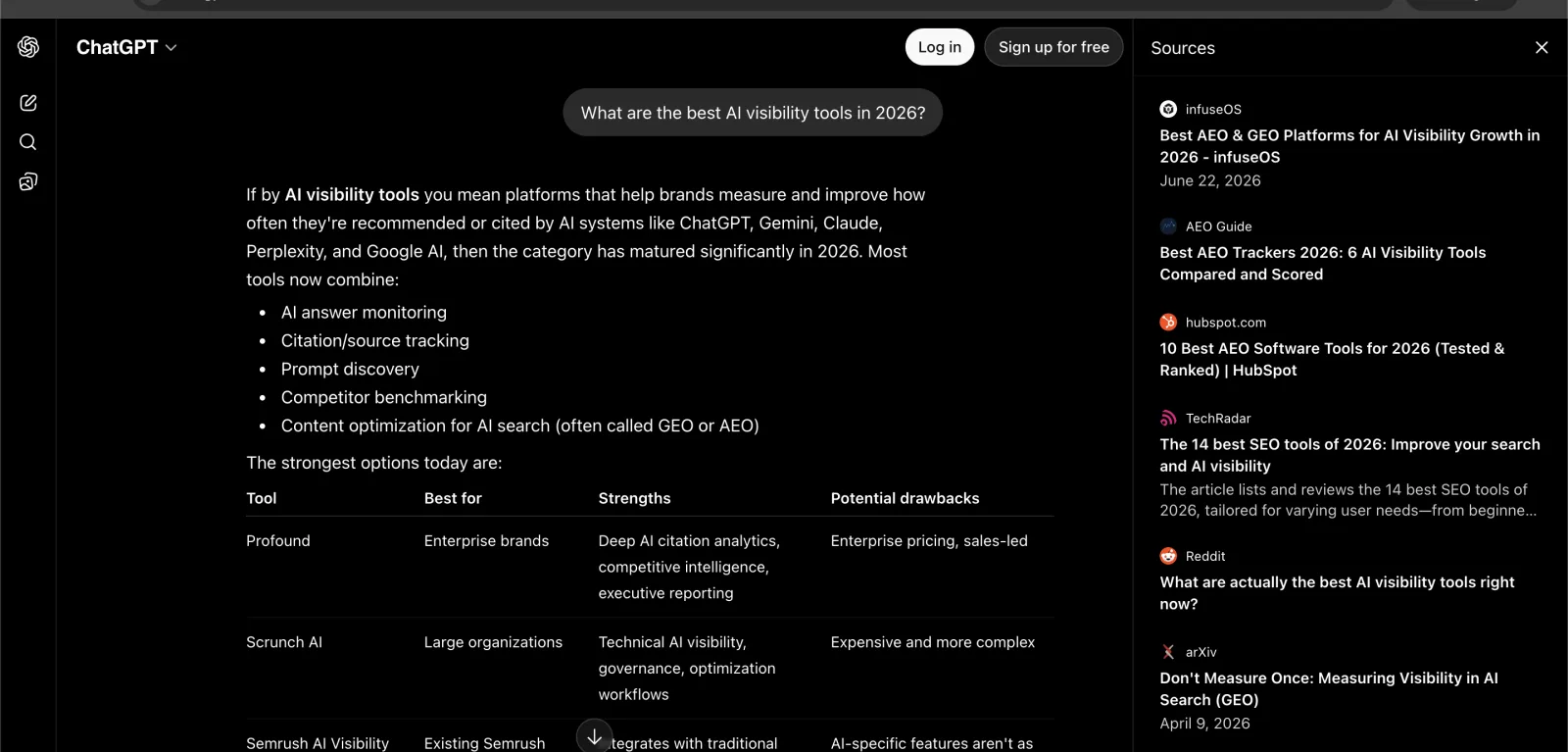
Example: ChatGPT (logged out) answering a category query — note it both names brands and shows the sources it pulled from.
It's not just ChatGPT
If you're optimizing for one engine, you're optimizing for a shrinking slice.
- ChatGPT's web visits grew ~84% (Sept 2024–March 2026), while Gemini grew ~9x and Claude ~770% over the same period. ChatGPT's share of gen-AI traffic fell from ~87% toward ~57–68% as rivals grew. (Similarweb — web traffic only; it misses app and API usage.)13
Web-visit growth by engine (Sep 2024 to Mar 2026)
Visibility now has to span ChatGPT, Gemini, Claude, Perplexity, and Google AI Overviews. (Engine-specific guides: Gemini, Perplexity, Claude.)
AI chatbot market share (updated monthly)
Someone always asks "what's ChatGPT's market share?" as if there's one number. There isn't. It depends entirely on what you measure and who's counting. Here are the figures I can actually source, with the caveat that matters most next to each.
Statcounter's AI Chatbot Market Share chart (June 2026): ChatGPT 76.87%, Gemini 7.94%, Perplexity 7.91%, Claude 3.74%, Microsoft Copilot 3.49%, DeepSeek 0.03%. The chart is public.14 The catch: Statcounter doesn't spell out what this headline chart measures on the page itself. Their broader AI dataset tracks referral traffic sent by chatbots to websites — not overall usage or session share. When Statcounter published that referral data it found ChatGPT sent 79.8% of chatbot referrals, Perplexity 11.8%, Copilot 5.2%, Gemini 2%, DeepSeek 0.8%, Claude 0.5% (May 2025 data).15 So read the 76.87% as "share of traffic chatbots send to sites," not "share of people using chatbots."
Similarweb web-visit share (via Momentic, May 2026): a different lens gives different numbers. This measures each assistant's monthly sessions on its own primary web domain, as a percent of the seven largest assistants' combined visits. On that basis ChatGPT is 53.9%, Gemini 27.9%, Claude 9.2%, DeepSeek 4.1%, Grok 2.4%, Perplexity 1.3%, Copilot 1.3% worldwide.16 US-only for the same month: ChatGPT 58.3%, Gemini 19.3%, Claude 13.4%, Grok 3.4%, Copilot 2.8%, Perplexity 1.6%, DeepSeek 1.2%.16 Momentic is upfront that these are Similarweb panel estimates — they "carry an error band rather than decimal precision, and are revised month to month." They also miss app and API usage entirely, since they only count web-domain visits.
On this Similarweb measure, ChatGPT's share has been sliding — 79.0% a year earlier, 54.5% in April 2026, 53.9% in May 2026 — while Gemini climbed from 5.6% to 27.9% and Claude from 1.4% to 9.2% over the same window.16
The "ChatGPT is below 50%" claim, straight: you'll see this everywhere. I could not verify it against any primary source. Statcounter's chart (76.87%), Statcounter's referral data (79.8%), and Similarweb web-visit share (53.9%) all put ChatGPT above 50% as of mid-2026. It's declining on the web-visit measure, but it hasn't crossed under half on any method I could check. If a post tells you ChatGPT dropped below 50%, ask which metric — because none of the sourced ones say that.
The honest read across all three: ChatGPT still leads by a wide margin, the lead is narrowing, and Gemini and Claude are the ones taking share. Which is exactly why optimizing for a single engine is a losing bet.
AEO in 2026: where answer engine optimization is heading
Answer engine optimization went from a niche term to a line item in marketing budgets over the last year. Here's where the data says it's actually going.
Awareness is way ahead of action. In a 2025 survey, 70% of organizations said they believe AEO will significantly shape their digital strategy within one to three years — but only 20% had started implementing it.17 A separate September 2025 survey found 83.6% of marketers recognize the term "AI SEO," yet only 37.2% are actively optimizing for AI search; just 19.6% recognize "AEO" specifically and 38.8% recognize "GEO."18 Both come through an aggregator citing the original surveys, so treat them as directional. The gap is the point: nearly everyone knows this is coming, almost nobody has done the work. That's the cheapest window you'll get.
The money argument is getting stronger. AI-referred traffic to US retail sites grew 393% year-over-year in Q1 2026 — after peaking at 1,151% YoY in December 2025 — and by March 2026 that AI-sourced traffic converted 42% better than direct visitors, a full reversal from a year earlier when it converted 38% worse.19 That's from Adobe's own analytics team, and worth a grain of salt since Adobe sells an "LLM Optimizer" product the same report promotes. But it lines up with other conversion data: ChatGPT referral traffic has been measured converting at 14.2%–15.9% against a Google organic baseline of 1.76% — roughly 9x — and AI-referred visitors converting 4.4x higher than organic generally.20 Those last figures come secondhand through an aggregator, so I'd frame them as "AI traffic converts much harder," not as gospel decimals.
The forecast everyone quotes is a forecast, not a result. You'll keep seeing "Gartner predicts a 25% drop in traditional search volume by 2026 due to AI chatbots." That's a prediction Gartner made in February 2024, not a measured 2026 outcome — and it's contested. Search Engine Journal argued it fails scrutiny, noting that true AI-native search engines still don't exist (chatbots sit on top of Google and Bing), AI queries cost roughly 10x a traditional search, and Gartner's own research showed only 8% of customers had used chatbots.21 Cite it as a disputed 2024 prediction if you cite it at all.
Where this leaves AEO in 2026: it's real, it's early, and the case for it is conversion quality, not traffic volume. The brands that win aren't the ones with the biggest AEO deck — they're the ones who checked whether AI names them and fixed it while the field was still empty.
4 popular AI search stats that don't hold up
Half the "AI is replacing search" posts online lean on numbers we could not verify. Don't repeat these:
- "Gartner predicts search volume will drop 25% by 2026." The single most-cited AEO stat. We could not substantiate the exact "25% by 2026" wording against a primary Gartner source — cite with caution, or not at all.
- "ChatGPT referral traffic converts at 7.1%, second only to paid search." Could not be verified to a primary source.
- "AI search visitors convert 23x higher than organic." A real-looking Ahrefs-attributed figure that didn't hold up under checking.
- "Adobe's 2026 survey says 38% shopped with AI." The 38% is real — but it's from Adobe's March 2025 survey, not the 2026 report. Date it correctly.
A page that removes bad data is more trustworthy than one that piles it on. It's also the kind of "myth vs fact" framing AI assistants like to cite.
What this means for your brand
The data points one direction: discovery is moving from a list of ten blue links to a single synthesized answer. In that world, the only question that matters is whether the AI names you when someone asks about your category.
Most brands have never checked. That's the gap — and right now it's the cheapest, least-competitive it will ever be. In 18 months, AI visibility will be table stakes. Today it's an edge.
You can see where you stand in about 30 seconds: run a free FixAEO scan to check whether ChatGPT, Gemini, and Perplexity mention your brand — and what they say when they do. No signup required.
FAQ
How many people use AI instead of Google to search?
AI referral traffic is still only about 1/169th of Google's volume (Similarweb, June 2025), so Google remains dominant for raw search. But ~25% of consumers now name AI tools like ChatGPT as their #1 product-research tool (Adobe, 2026), and ~60% of Google searches already end without a click — so AI is reshaping behavior faster than the traffic share implies.
Is AI really replacing Google search?
Not replacing — yet. The accurate framing is "small but compounding very fast." AI referrals are tiny in absolute terms but grew 3x+ in a year, while Google's own AI Overviews are cutting clicks to websites (Pew: 8% vs 15%).
Do people actually buy products through AI?
Increasingly. 38% of US consumers have used generative AI for online shopping and 52% plan to this year (Adobe, March 2025), and 42% of LLM users ask AI for shopping recommendations (Bain, February 2025).
Do AI Overviews reduce website traffic?
Yes. Pew found link clicks roughly halve when an AI summary appears (8% vs 15%), and Ahrefs measured a 34.5% drop in top-result click-through rate on keywords with AI Overviews.
Which AI search engine should I optimize for?
All of the major ones. ChatGPT leads but is losing share as Gemini (~9x growth) and Claude (~770%) rise. Visibility should span ChatGPT, Gemini, Claude, Perplexity, and Google AI Overviews — here's the full breakdown of the best AI search engines.
What's the single best way to start showing up in AI answers?
Make your site machine-readable (clean schema, question-form headings, an llms.txt file) and measure your AI visibility across engines. Start with our AEO vs SEO migration plan and the free scan.
In one paragraph
AI search in 2026 is a small channel growing at a pace no other channel matches: AI referrals are ~1/169th of Google's volume yet grew 357% in a year, ~25% of consumers already treat AI as their top product-research tool, and Google's own AI Overviews are halving clicks to websites (Pew). The traffic is low-volume but high-intent — one dataset showed 0.5% of traffic driving 12.1% of signups. The strategic read: being named inside AI answers is becoming the new front page of discovery, and the brands measuring and optimizing for it now are taking share before their competitors notice the shelf exists.
Footnotes
-
Adobe: 2026 AI and Digital Trends Consumer Report. Read the report. ↩ ↩2
-
Adobe: Generative AI-powered shopping rises with traffic to retail sites (Adobe Analytics). Read the analysis. ↩ ↩2 ↩3
-
Similarweb: AI referral traffic: the winners. Read the data. ↩ ↩2 ↩3
-
Pew Research Center: Google users are less likely to click on links when an AI summary appears (July 22, 2025). Read the study. ↩ ↩2
-
Ahrefs: AI Overviews reduce clicks (April 2025). Read the study. ↩ ↩2
-
Ahrefs: AI search traffic and conversions (June 2025). Read the data. ↩ ↩2
-
Bain & Company: Consumer reliance on AI search results signals a new era of marketing (February 2025). ↩ ↩2
-
Semrush: ChatGPT search insights. Read the report. ↩
-
SparkToro & Datos: 2024 Zero-Click Search Study (58.5% of US Google searches ended without a click). Read the study. ↩
-
SparkToro & Datos: In 2026, less than one third of Google searches still send a click. Read the follow-up. ↩
-
Digital Content Next: Google's push to AI hurts publisher traffic (August 14, 2025). Read the survey. ↩
-
Search Engine Land: Google sued by Chegg over AI Overviews hurting traffic and revenue. ↩
-
Similarweb: Generative AI traffic statistics. Read the data. ↩
-
Statcounter: AI Chatbot Market Share Worldwide (June 2026). See the chart. The page does not disclose the exact metric behind the headline chart. ↩
-
Statcounter: New Statcounter AI data finds ChatGPT sends 79% of all chatbot referrals to websites (May 2025 data, published June 11, 2025). Read the release. This confirms Statcounter's AI dataset measures referral traffic sent by chatbots to sites. ↩
-
Momentic: Top AI Chatbots by Market Share (web-visit share via Similarweb, May 2026 data, updated July 2026). Read the report. Momentic defines its metric as "each assistant's monthly sessions on its primary web domain, estimated by Similarweb, expressed as a percentage of the seven assistants' combined visits" and cautions the figures are panel-modeled, carry an error band, and are revised monthly. ↩ ↩2 ↩3
-
Acquia / Researchscape survey (2025), via Omnibound: Answer Engine Optimization (AEO) Statistics. Read the roundup. Secondary-sourced through the aggregator. ↩
-
"On Marketing" survey (September 2025), via Omnibound: Answer Engine Optimization (AEO) Statistics. Read the roundup. Secondary-sourced through the aggregator. ↩
-
Adobe Digital Insights: 2026 Q2 AI Traffic Report (Q1 2026 data), reported by TechCrunch, April 16, 2026. Read the coverage. Adobe sells an "LLM Optimizer" product referenced in the same report. ↩
-
Seer Interactive and Semrush (June 2025), via Omnibound: Answer Engine Optimization (AEO) Statistics. Read the roundup. Secondary-sourced; treat the exact decimals as directional. ↩
-
Gartner: Gartner Predicts Search Engine Volume Will Drop 25% by 2026 (February 19, 2024 forecast). Read the release. Rebutted by Search Engine Journal: Why the prediction fails scrutiny. ↩
Related reading
What is AEO? Answer Engine Optimization explained
Answer Engine Optimization (AEO) means getting AI assistants to recommend your brand. Learn what AEO is, why it matters more than SEO, and how to start.
18 min readAEO vs SEO: what changed and what to do about it
AEO vs SEO in 2026: AI answers and search engines reward different signals. The data, a plain comparison, and a 30-day migration plan your SEO team can run.
17 min read7 Zero-Click SEO Tips for Better GEO Visibility
Zero-click search now swallows most Google queries. Seven evidence-backed GEO tactics, with sources, to get cited in AI answers instead of chasing clicks.
15 min readHow to win back traffic lost to Google AI Overviews
Google AI Overviews run on a third of commercial queries and keep clicks in the SERP. Here are 7 changes that get your brand named in the answer, plus a 30-minute audit and 2-month plan.
17 min readAI Visibility: 11 Brands Gemini Names Every Time
33 brands tested on Google Gemini: 11 hit perfect AI visibility, but share of voice reveals the real gaps. See the data — then scan your own brand free.
17 min read12 Best Answer Engine Optimization Tools (2026)
12 answer engine optimization tools compared — engines covered, entry price, free tier — with honest takes on which to pick by stage and budget.
19 min read
Free AEO tools
Put this into practice with free FixAEO tools — no signup required.
AI Visibility Checker
Score your brand across 9 AI engines
AEO Audit Tool
Answer-engine readiness scan
Schema Generator
Build valid JSON-LD structured data
llms.txt Generator
Create a spec-compliant llms.txt
Sitemap Validator
Check your XML sitemap for errors
AI Content Grader
Grade content for AI citation readiness
Find the gap. Then fix it.
Check how AI engines find, describe, and cite your site. Free, no signup. On a paid plan, AI Marketer can turn the evidence into briefs, drafts, optimizations, and reports.