How to Get Cited by Gemini in 2026
How to get cited by Gemini: it runs on classic SEO plus AI-specific signals. Learn the 2026 playbook for rankings in AI Overviews and Gemini answers.

On this page

Gemini is the engine most SEO teams refuse to take seriously, and it's costing them. By mid-2026, Gemini 2.5 Flash and Pro are baked into the Google Workspace stack (Docs, Gmail, Sheets), the Google app on Android and iOS, AI Mode on Search, and AI Overviews on the SERPs that still drive 60%+ of commercial query traffic. Whatever you think about Google's slow rollout, Gemini touches more daily user surfaces than ChatGPT, Claude, Copilot, and Perplexity combined.
But here's what makes Gemini structurally different from every other AI engine: it's still half a search engine. Anthropic's Claude, OpenAI's ChatGPT, and Perplexity all built citation systems on top of foundation models. Gemini built a foundation model on top of Google Search. That sounds like a small distinction. It's not. It changes everything about how you optimize for it.
If you already read our Perplexity citations playbook, our Claude playbook, and our breakdown of why ChatGPT doesn't recommend your brand, this is the fourth side of the square. Gemini's rules look unusually familiar — because they are SEO rules, with AEO ones layered on top.
"Gemini SEO" is literally half SEO — that's not a metaphor
When teams search "Gemini SEO" they're usually after the same thing covered here: how to land in Gemini's chat answers AND in Google's AI Overviews (powered by the same model). Unlike Claude or Perplexity, Gemini's grounding step actually runs a Google search before answering, so your Google ranking is your Gemini citation ceiling. That's why "Gemini SEO" as a search term isn't wrong — it's literal. Most of this playbook is AEO-specific layering on top of solid classic SEO.
How Gemini decides who to cite
Three architectural facts shape Gemini's citation behavior. Burn them into your strategy:
- Gemini uses Google Search grounding by default for live queries. When a user asks "what's the best CRM for startups," Gemini doesn't just lean on training data — it issues real Google searches, pulls the top results, and reads them into context. That means: your Google ranking is your Gemini citation ceiling. Rank #11 on Google? You're invisible to Gemini for that query. Rank #1-5? You're in its retrieval window.
- AI Overviews is essentially Gemini. The cards Google shows at the top of search results are powered by the same model. Same training, same picker logic, same surface area. Optimizing for AI Overviews IS optimizing for Gemini. Our existing post on how to win back traffic lost to Google AI Overviews is, for Gemini purposes, the same conversation from the demand side.
- Knowledge Graph and entity matching dominate at retrieval time. Google has spent 15 years building the Knowledge Graph. Gemini queries it constantly for entity disambiguation, "is this brand real," and "what's known about this company." If you're not in the Knowledge Graph, you're competing with both hands behind your back.
The shorthand: for Gemini, classic SEO still works, AEO signals add a multiplier, and entity/KG presence is the unfair advantage.
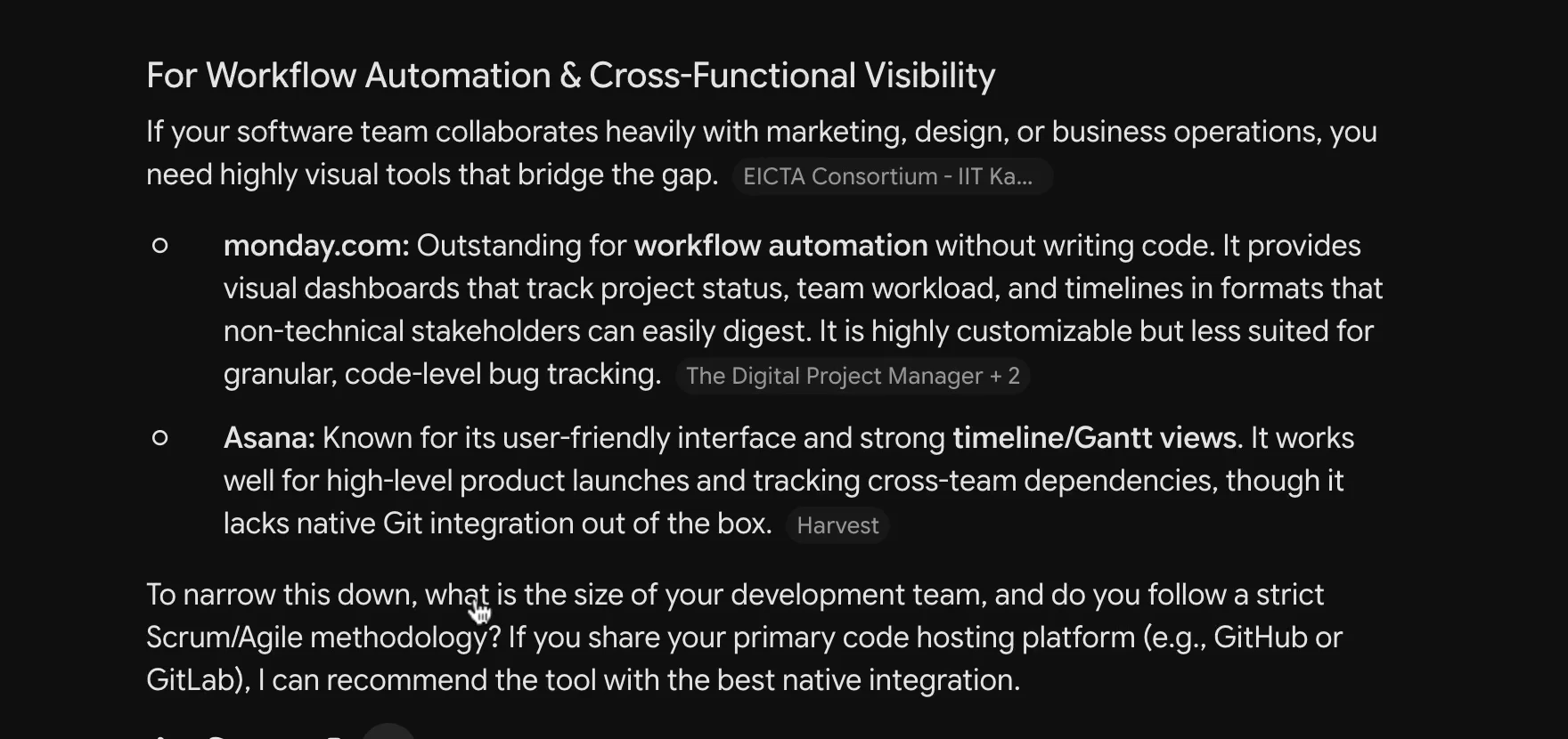
Gemini grounds its answer in live results and attaches a source to each pick (here: The Digital Project Manager, Harvest, and more). Those citations are the slots: rank for the query, get pulled in, and you are one of them.
Why Gemini matters more than the AI industry thinks
I'll be direct: most AEO strategy conversations underweight Gemini. Perplexity gets the buzz, ChatGPT gets the volume, Claude gets the enterprise attention. Gemini gets shrugs. That's wrong, for three reasons.
Reason 1: distribution scale. Gemini touches billions of daily user surfaces via Android, Google Workspace, and Search. It's the AI most non-tech-savvy buyers actually use, whether they know it or not.
Reason 2: it's a hedge. If AI Overviews absorbs 40% of your informational query traffic and you're not cited there, you don't just lose the click — you lose the trust signal. Being in AI Overviews validates you across engines because other AI models learn from Google's answers.
Reason 3: it's the closest to classic SEO. If your team already does SEO well, Gemini is the fastest AEO win because most of your existing work carries over. Perplexity requires a different content shape; Gemini requires an extension of what you're already doing.
Teams that skip Gemini AEO because "we already do SEO" are leaving the biggest, easiest visibility gains on the table. Start here if you're deciding where to invest first.
The dedicated FixAEO Gemini Rank Tracker — the surface I open when a customer wants Gemini-only tracking separated from the other eight engines.
The 5 signals Gemini weights
We've cross-referenced thousands of Gemini citations against Google ranking data across SaaS, ecommerce, and B2B verticals. Five patterns dominate.
1. Top-10 Google ranking for the underlying query
This is the floor. Gemini's grounding step pulls the top organic Google results. If you're not in the top 10 for the query (or one of its near-variants), you're not in Gemini's candidate pool. The corollary: every AEO investment that doesn't move you up Google's classic SERPs is wasted on Gemini. This isn't true of Claude or Perplexity — both can cite you off-SERP via training data — but Gemini's grounding is too tight. (Each model also has a different knowledge cutoff date, which is exactly why Gemini leans on live Google results.)
2. Featured-snippet-style answer formatting
Gemini's reranker over-weights pages with 40-60 word direct answers in the first 200 words. The format Google's been training us to write for "position zero" since 2018 happens to be exactly what Gemini's extractor wants. Question-form H1, direct answer paragraph, then expand. This format wins both surfaces simultaneously.
3. Structured data Google's parser already eats
FAQPage, HowTo, Article, Product, and LocalBusiness schema all flow directly from Gemini's Google-side parsers into its citation pipeline. Unlike Claude (which reads JSON-LD opportunistically), Gemini was built around a parser that's already extracting these signals. Our schema generator emits the exact types Google's structured-data testing tool validates against.
4. Knowledge Graph + Wikidata entity presence
If your brand has a Knowledge Panel on Google ("the box on the right side of search results"), Gemini knows who you are. If it doesn't, Gemini has to infer from URL + page text every time, and infers conservatively. Getting a Knowledge Panel takes: a Wikidata entry, a Wikipedia article (where notability allows), sameAs links from your Organization schema to authoritative profiles, and consistency across Google Business Profile + LinkedIn Company Page + Crunchbase.
5. YouTube, Google Maps, and the ecosystem signals nobody else reads
This is where Gemini diverges from every competitor: it reads inside the Google ecosystem. A brand with 50+ Google Reviews on its GBP, a YouTube channel with proper schema and Brand tags, and a Maps presence in multiple cities looks dramatically more substantial to Gemini than to Claude or Perplexity, which can only see your public web pages. For local + ecommerce + B2B with field operations, this is enormous. Run an audit with our Google Business Profile audit tool if you haven't checked this in a year.
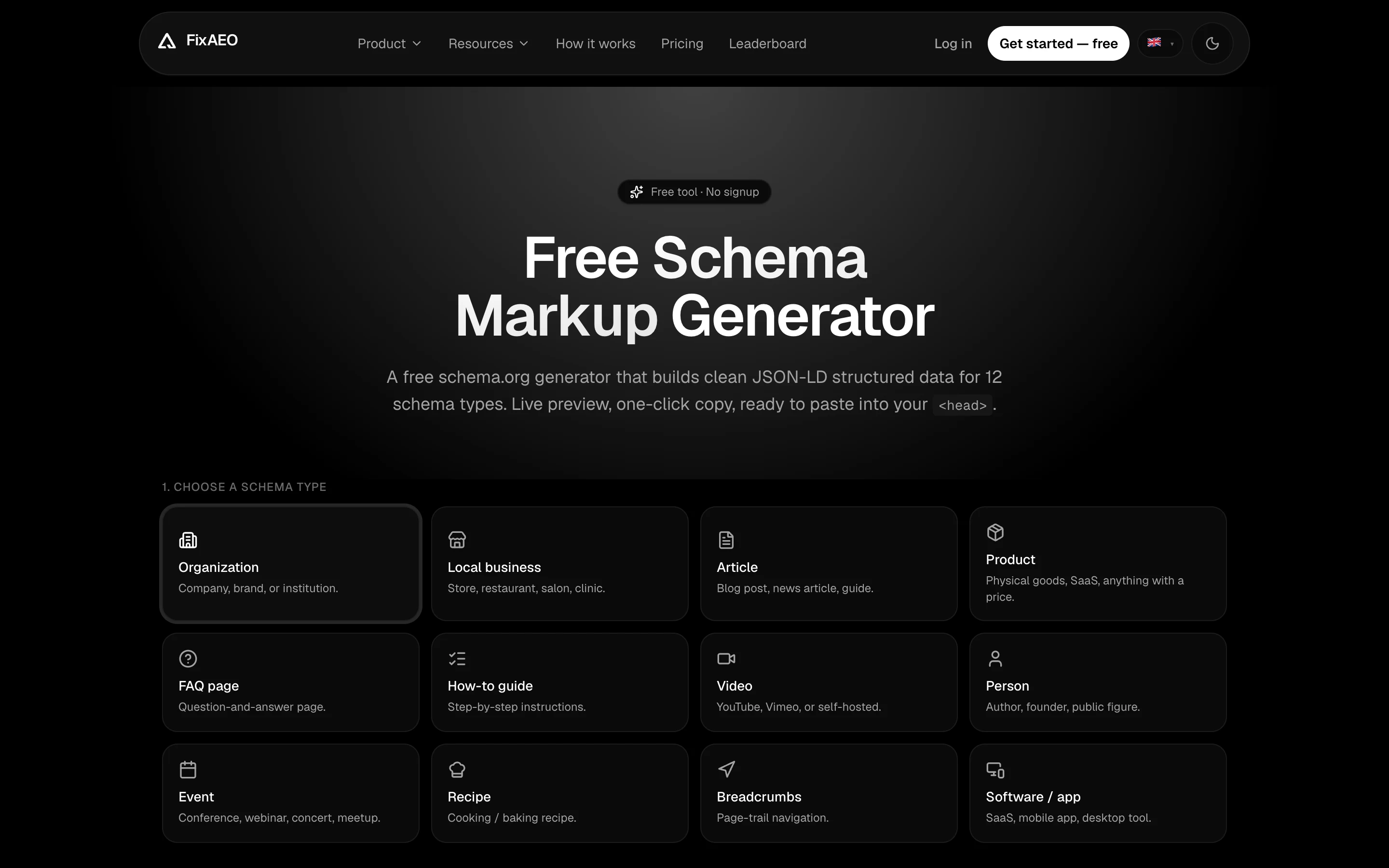
Gemini reads structured data heavily. FixAEO's schema generator emits clean JSON-LD for all 12 common schema types — Article, FAQPage, HowTo, Product, Organization, and more.
The 6 tactics that actually move Gemini citations
Ranked by leverage. Some overlap with classic SEO playbooks; some are AEO-specific.
Tactic 1 — Re-target your top 20 Google rankings into question-form titles
If your title tag is "Best CRM for SaaS Startups | Acme" and ranks #6 on Google, rewrite to "What's the Best CRM for a 10-Person SaaS Startup?" and re-rank. The title change alone moves Gemini citations because the grounding step finds the query→title match more confidently. You don't need to write new content — you need to reformat the entry door.
Tactic 2 — Ship FAQPage schema on the pages that actually answer questions
Every commercial page should have 3-8 questions in FAQPage schema, with the answers under 100 words each. Gemini's extractor reads these into AI Overviews directly. Pages with proper FAQ schema land in AI Overviews citation lists 3-4× more often than pages without. This is one of the highest-ROI AEO investments any team can make in 2026.
Tactic 3 — Claim and complete every entity surface
The minimum entity stack for Gemini:
- Wikidata QID (free, fastest to ship)
- Google Business Profile, fully completed with categories, hours, photos, posts
- LinkedIn Company Page with consistent naming + URL
- Crunchbase entry with funding + team data
- Wikipedia page (notability-permitting)
- Organization JSON-LD linking all of the above via
sameAs
That stack is a one-week project for a marketing operator and pays dividends across every engine, but Gemini is the one that rewards it most heavily because of the Knowledge Graph integration.
Tactic 4 — Optimize for AI Mode-style queries, not chat queries
Gemini in AI Mode (the new tab on Google Search) receives shorter, more directed queries than Gemini in chat. A user might type "best CRM startups 2026" in AI Mode but ask Claude "what would be a good CRM for our 10-person early-stage SaaS company that needs Slack integration." Optimize content around the AI Mode query length first — those queries volume-dominate by 5-10× over the conversational variants. Use our AEO query generator to surface the right phrasing variants for your niche.
Tactic 5 — Build a YouTube presence (yes, really)
This is the underrated one. YouTube videos with proper VideoObject schema, channel verification, and category tagging get pulled into Gemini AI Overviews and AI Mode answers regularly — far more often than into Claude or ChatGPT, which can't read video. A single well-positioned explainer video can earn citations on 20+ commercial queries. The bar to entry is decent production + accurate metadata; the payoff scales with how many AI Mode answers reference video sources.
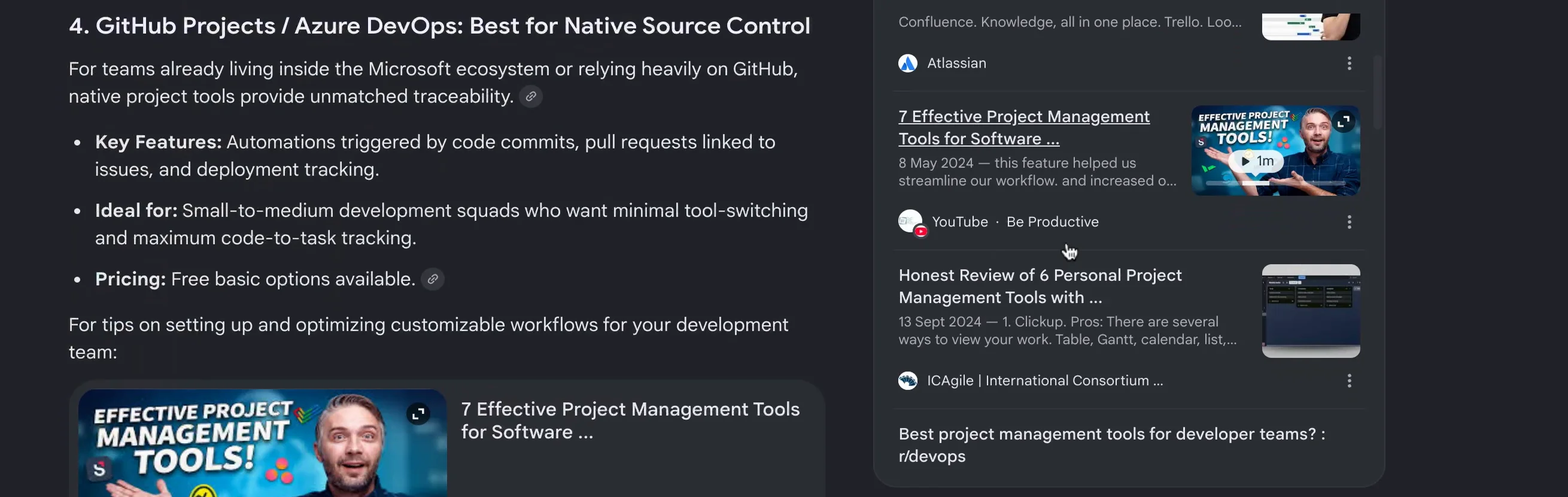
Tactic 5 in action: this AI Overview (Google's Gemini surface) embedded a YouTube explainer and cited two more YouTube videos in its sources panel. Video gets pulled into Gemini's answers in a way Claude and ChatGPT can't match, because they don't read video.
Tactic 6 — Audit AI Overviews citations directly
The closed loop: Gemini's citation behavior is partially observable through AI Overviews citation cards. Pick your top 10 commercial queries, search them on Google, and screenshot the AI Overviews citations. Are you there? Are competitors? What sources keep showing up? FixAEO's AI citation source radar automates this — it queries the AI surfaces in your niche and tells you which domains capture the citation share. For Gemini specifically, the same domains will tend to show up in both AI Overviews and the in-Gemini chat surface.
The Google Business Profile play for Gemini
Most AEO content skips this because it feels too "local SEO," but Gemini reads Google Business Profile (GBP) signals more than any other engine. Here's what to do.
Complete every field. Categories, hours, service areas, attributes, description, website, phone. Missing fields signal a low-effort listing, which Gemini de-prioritizes for local and mixed intent queries.
Post regularly. GBP posts are a signal Google reads. One post per week with a photo and a specific offer or update keeps your profile fresh in Gemini's eyes.
Photos matter. GBP profiles with 20+ high-quality photos outperform profiles with 3–5. Include exterior, interior, product, team, and behind-the-scenes shots. Gemini uses these when synthesizing answers about brand quality.
Encourage reviews with specific keywords. When customers leave reviews, gently prompt them to describe what they used the product/service for. Reviews with specific use cases feed Gemini's category understanding.
Respond to every review. Business responses signal an active, cared-for brand. Even negative reviews with graceful responses signal professionalism.
Q&A section. GBP has a public Q&A tab most businesses ignore. Answer questions yourself with clear responses; each Q&A is retrievable content Gemini can quote.
Even purely-online SaaS brands benefit from a completed GBP. If you have any physical location (an office where you take meetings, an event venue), claim and complete it. Gemini treats "brand with GBP" and "brand without GBP" differently at the retrieval layer.
The AI Mode-specific playbook
Gemini in Google's AI Mode is a slightly different beast from Gemini in the chat app or gemini.google.com. Two things change.
Query length skews shorter. AI Mode queries average 3–7 words (traditional-search length), where chat queries can be 15+. Optimize your title tags and H1s for shorter query matching.
Response formatting weighs citations differently. AI Mode answers are more like classic SERPs with an AI summary on top — the citation cards below the summary are weighted based on the same signals as classic Google ranking (backlinks, page authority, ranking history).
AI Mode conversions differ from chat. Users in AI Mode tend to click through more (they've been trained on the classic Google ranking pattern). Users in Gemini chat tend to read the answer without clicking. If your product is high-consideration, focus on being cited in chat where the reader reads deeply. If your product is direct-purchase or click-through, focus on being cited in AI Mode where users click.
Both surfaces are the same model, but the user behavior differs enough to justify slight strategy differentiation.
What NOT to do (the Gemini-specific traps)
Three anti-patterns are specifically bad for Gemini:
- Treating Gemini like Claude. Heavy Wikipedia reliance, ignoring classic ranking signals, leaning on third-party reviews instead of on-domain content — Gemini punishes the Claude playbook because its grounding step bypasses most of those signals. You need to win Google's ranking first; the AEO layer comes second.
- Schema spam without content depth. Gemini's parser also reads page content, not just JSON-LD. Pages with rich
FAQPageschema but thin actual content get demoted. The schema validates the content; it doesn't replace it. - Ignoring your own leaderboard rank. The leaderboard tracks AI visibility scores across the engines — and brands that consistently rank in our top 50 also dominate AI Overviews citations. There's a reflexive signal here: brands that win Gemini citations tend to be brands that other engines have already validated, because they all pull from overlapping training data and authority graphs.
How to verify your work
The verification loop for Gemini has three layers, in increasing rigor:
- Eyeball test. Open google.com, run your top 10 commercial queries, screenshot the AI Overviews card on each. Note which sites are cited. Repeat every 2 weeks.
- Direct Gemini test. Open gemini.google.com or AI Mode, run the same queries with slightly more conversational phrasing. Compare which sites get cited inline vs. in AI Overviews — they overlap but aren't identical.
- Automated tracking. Run your domain through our AI visibility checker — it queries Gemini alongside the other 7 engines for your configured prompts and tracks citation share week over week. The deltas after each tactic above tell you what's actually working.
The full AEO tools catalog covers the adjacent pieces — schema, llms.txt, citation source radar — that compound across all engines.
The 90-day Gemini optimization plan
If you're serious about Gemini AEO, here's the sequence.
Weeks 1–2: SEO fundamentals audit. Rank #1–10 for your top 20 queries. If not, spend two weeks on classic SEO fixes — page speed, backlinks, internal linking, title tags. Gemini can't cite you if you're outside the top 10.
Weeks 3–4: schema deployment. FAQPage schema on top 10 pages, Organization + Product schema on brand pages, Article schema on all blog posts, HowTo where applicable. Validate all with Google's Structured Data Testing Tool.
Weeks 5–6: entity surface completion. Wikidata QID, Google Business Profile completion (even for online-only brands), LinkedIn Company Page, Crunchbase, YouTube channel with schema. Link everything via sameAs in Organization schema.
Weeks 7–8: content restructuring. Rewrite top 10 blog post titles into question form. Add question-form H2s with 40–60 word answers. Add FAQ sections where none exist.
Weeks 9–10: YouTube presence. Publish 3–5 explainer videos on your highest-intent topics. Get proper VideoObject schema. Verify the channel with Google.
Weeks 11–12: measurement and iteration. Track AI Overviews citations for your 20 target queries. Note which fixes moved the needle. Double down on what worked.
Most teams see meaningful Gemini citation improvement by week 8–10 if they execute cleanly. The Wikipedia and Wikidata pieces have the longest lag (they compound over months) but are the highest ceiling.
TL;DR
Gemini is the one major AI engine where your Google ranking still sets the ceiling. Win classic SEO, layer AEO signals (FAQ schema, entity surfaces, YouTube), and Gemini will cite you because its grounding step finds you in its retrieval window. The Wikipedia + Wikidata + Knowledge Graph stack is the unfair advantage no competitor engine rewards as heavily. And AI Overviews, which feels like a separate Google product, is just Gemini wearing a different hat — what wins one wins the other.
Most SEO teams are still arguing about whether Gemini matters. The teams that aren't are already in its citations. If you're acting on this playbook, measure it: Gemini rank tracking shows whether your mentions and citations actually move.
Related per-engine playbooks
If Gemini is your priority, the other engines are still worth covering. Each has a different leverage point:
- How to get cited by Grok — why X presence beats blog posts for Grok citations
- How to get cited by DeepSeek — documented behavior, eligibility checks, and a repeatable test
FAQ
How does Gemini decide who to cite?
Gemini uses Google Search grounding by default for live queries. It issues real Google searches, pulls the top results, and reads them into context, so your Google ranking is your Gemini citation ceiling. Knowledge Graph and entity matching also dominate at retrieval time.
Is "Gemini SEO" the same as regular SEO?
Mostly, yes. Gemini's grounding step runs a Google search before answering, so your Google ranking sets the ceiling for Gemini citations. The rest of the playbook is AEO-specific signals layered on top of solid classic SEO.
Is optimizing for AI Overviews the same as optimizing for Gemini?
Yes. AI Overviews are powered by the same model as Gemini — same training, same picker logic, same surface area. What wins one tends to win the other.
What is the highest-ROI tactic to get cited by Gemini in 2026?
Shipping FAQPage schema on pages that actually answer questions, with answers under 100 words each. Pages with proper FAQ schema land in AI Overviews citation lists 3-4x more often than pages without.
Does Gemini cite Reddit content?
Yes, more than other Google surfaces do. Reddit was added to Google's index prominently in 2024, and Gemini reads Reddit threads for category questions. If your product is discussed in relevant subreddits (r/SaaS, r/marketing, r/webdev), those threads become Gemini citation sources.
How do Google Business Profile signals affect Gemini for online-only brands?
They help even if you don't have a physical location. A completed GBP with photos, categories, and activity signals to Gemini that the brand is real and active. If you have any office space or event location, claim and complete it. If not, focus on the other entity signals (Wikidata, Knowledge Panel components).
What's the difference between Gemini in chat and Gemini AI Mode?
Same underlying model, different user surfaces. Chat gets longer conversational queries; AI Mode gets shorter classic-search queries. AI Mode users click through more; chat users often read the answer without clicking. Optimize your content for both by ensuring you rank for both query lengths.
Does Gemini update citations faster or slower than Google organic?
Gemini reflects new content faster because it uses the live Google grounding step. A newly-indexed page can appear in a Gemini answer within days, sometimes hours. Compare to Google organic rankings, which can take weeks to stabilize.
Why does YouTube help with Gemini citations?
Gemini reads inside the Google ecosystem, including YouTube. Videos with proper VideoObject schema, channel verification, and category tagging get pulled into Gemini AI Overviews and AI Mode answers far more often than into Claude or ChatGPT, which can't read video.
Related reading
How to get cited by Claude: the 2026 playbook
Get cited by Claude with the 2026 AEO playbook. Claude's constitutional training favors authoritative, non-promotional sources — here's how to qualify.
17 min readHow to get cited by Perplexity: a 2026 playbook
Perplexity cites 4-8 sources per answer and the patterns are learnable. Here are the 8 patterns we see in cited content, with the tactics that got FixAEO cited in our own category.
16 min readHow to win back traffic lost to Google AI Overviews
Google AI Overviews run on a third of commercial queries and keep clicks in the SERP. Here are 7 changes that get your brand named in the answer, plus a 30-minute audit and 2-month plan.
17 min readAI Visibility: 11 Brands Gemini Names Every Time
33 brands tested on Google Gemini: 11 hit perfect AI visibility, but share of voice reveals the real gaps. See the data — then scan your own brand free.
17 min readWhy ChatGPT doesn't recommend your brand
ChatGPT SEO fix: six reasons ChatGPT names competitors instead of you, ranked by frequency across 1,000+ FixAEO scans — with a fix for each and a 30/60/90 day plan.
17 min readHow to get cited by Grok: the X signal playbook
Grok citations come from X activity, not your blog. This playbook shows which X signals Grok prioritizes and how to build them systematically.
17 min read
Free AEO tools
Put this into practice with free FixAEO tools — no signup required.
AI Visibility Checker
Score your brand across 9 AI engines
AEO Audit Tool
Answer-engine readiness scan
Schema Generator
Build valid JSON-LD structured data
llms.txt Generator
Create a spec-compliant llms.txt
Sitemap Validator
Check your XML sitemap for errors
AI Content Grader
Grade content for AI citation readiness