7 Zero-Click SEO Tips for Better GEO Visibility
Zero-click search now swallows most Google queries. Seven evidence-backed GEO tactics, with sources, to get cited in AI answers instead of chasing clicks.

On this page
Pull up Search Console for any query with real volume right now. Impressions: thousands. Clicks: a rounding error. Nobody broke your tracking. That's just what a search result looks like in July 2026.
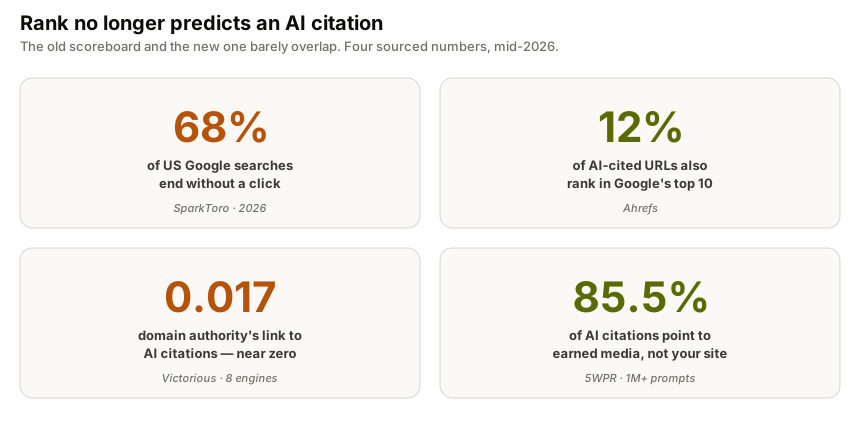
In the first four months of 2026, 68.01% of US Google searches ended without a single click — up from 60.45% just two years earlier, according to SparkToro's clickstream analysis. Put another way: only 276 out of every 1,000 searches now send someone to the open web, down from 374 per 1,000 in 2024. And when an AI Overview shows up on a query, it cuts the #1 organic result's click-through rate by 58%, per Ahrefs' February 2026 update to their original study (the first version, from April 2025, found "only" a 34.5% drop — the gap nearly doubled in ten months).
AI search isn't coming — it's already the default, and most brands aren't in it at all. Victorious tested 177 brands across 107,011 AI responses on 8 platforms and found 89.8% of them — 159 of 177 — had zero AI mentions. Domain authority barely mattered: its correlation with AI citation rate was 0.017, statistically indistinguishable from noise.
"The things marketers measure in search virtually disappear in AI." — Nate Elliott, Analyst, EMARKETER
This post is seven concrete tactics for the quarter ahead, each with a source you can go verify yourself. If you want the underlying concepts explained first, start with our AEO vs. SEO breakdown or what AEO actually means in practice — this post assumes you already buy the premise and just want the playbook.
From ranking for clicks to being the cited answer
Old SEO optimized for one outcome: rank high enough that a human clicks through. That outcome is disappearing for a majority of queries. The new outcome is different — get selected as the source an AI model quotes, paraphrases, or links to inside its answer, whether or not anyone ever clicks through to your site.
This is the outcome you're optimizing for now: a real Perplexity answer names the brand inline. The user gets what they came for — no click required.
"SEO is about ranking pages for clicks, while GEO is about being selected as a source in synthesized answers." — Kelsey Voss, Principal Analyst, EMARKETER
That distinction matters because the two aren't the same job with a new name. Ahrefs analyzed 15,000 long-tail queries across ChatGPT, Gemini, Copilot, and Perplexity and found only about 12% of AI-cited URLs also rank in Google's top 10 for the same query. Perplexity was the outlier at 28-29% overlap; the other three assistants averaged closer to 8%. Ranking well used to be a reasonable proxy for AI visibility. It's becoming a weak one.
| Stat | What it actually measures | Number |
|---|---|---|
| Cross-engine citation overlap | Do URLs cited by ChatGPT, Gemini, Copilot, or Perplexity also rank Google top 10 for the same prompt? | ~12% (Ahrefs) |
| Google AI Overview citation overlap | Do Google's own AI Overview citations pull from Google's own top 10? | 38%, down from 76% in July 2025 (Ahrefs) |
Don't conflate those two rows — they're answering different questions with different datasets. Both point the same direction: your organic rank is a shrinking predictor of whether an AI engine cites you. Here's what does predict it.
1. Build off-site brand mentions before you chase more backlinks
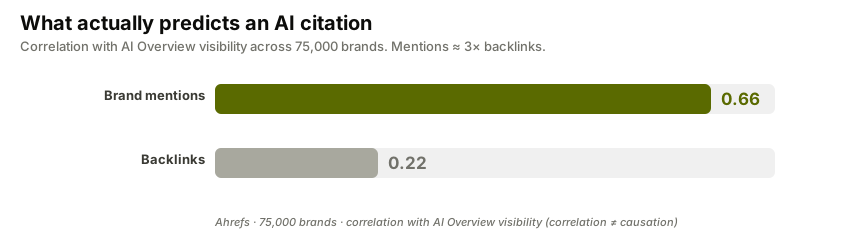
Ahrefs studied 75,000 brands and found branded web mentions correlate 0.664 with AI Overview visibility. Backlinks correlate at just 0.218 — roughly a third as strong. A link is still useful, but an unlinked mention of your brand name in a listicle, comparison post, or forum thread is doing more work for AI visibility than the same page linking to you.
Action: stop measuring outreach success purely by links acquired. Track branded mentions across review sites, "best of" roundups, and comparison posts in your category, even the ones that don't link back. A Google Alert is enough to start — or a visibility tool like FixAEO that tracks branded mentions and citations across the engines in one place.
Who this matters most for: agencies running client link-building should add "mentions won" next to backlinks in reporting — it's the stronger signal, and clients will ask about it soon if they haven't already.
2. Earned media is now an AI-citation channel, not just a reputation play
The biggest single lever in the data. 5W/PR Newswire's analysis of over 1 million AI prompts found 85.5% of AI citations reference earned media — news coverage, third-party writeups — not brand-owned websites, cited roughly 5x more often. Separately, Stacker's research — run with Scrunch across five leading LLMs — found distributing content through third-party outlets produced a 239% median lift in AI visibility versus brand-only content, up to 325% in some cases.
Action: treat PR pitching as an AI-visibility channel, not a separate line item. Pitch trade press with a specific stat, dataset, or expert take tied to your category — the goal isn't a link, it's a third-party outlet writing your brand's name into a piece a crawler will index.
Who this matters most for: enterprises and funded startups with a comms budget should prioritize this above nearly everything else here. Solo operators without that budget can run a scrappier version — pitching niche newsletters directly, HARO-style — slower to compound, but the same mechanism applies.
3. Build a real presence where the engines are actually reading
5WPR's AI Platform Citation Source Index found Reddit accounts for roughly 40% of aggregate citation share across more than 680 million citations analyzed, spanning ChatGPT, AI Overviews, Perplexity, Gemini, and Claude.1 It's a PR firm's rollup of six prior studies, so treat the exact number as directional — but the conclusion that Reddit dominates AI citation sourcing is corroborated by independent trackers of most-cited domains too.
Action: answer real questions in the two or three subreddits where your actual buyers hang out, from a real account, with real expertise — not a drive-by comment with a link. These engines appear to weight authentic, upvoted answers, and that's exactly what breaks if you fake it.
Who this matters most for: the cheapest tactic here in dollar terms, so it's the best starting point for solo operators with no budget. Agencies should be most careful with it — a client account posting here reads as inauthentic fast, and a caught-out fake does more damage than the mention was worth.
4. Write direct answers, but back every claim with evidence
Princeton's GEO paper tested nine content tactics across 10,000 queries at KDD 2024. Adding statistics, citing sources, and including direct quotes each drove 30-40%+ gains in citation rate on their own, with combined tactics performing best. But format alone isn't enough: a 2026 study of 602 prompts and 21,143 citations found that Q&A/FAQ formatting by itself is a weak signal — it only helps when paired with evidence density and genuine topical relevance.
Action: for any page you want cited, add three to five concrete, sourced numbers and at least one direct quote near the top — not just a restructured header. Reformatting into FAQ blocks without real evidence is close to wasted effort per the newer study.
Who this matters most for: agencies and in-house teams producing content at volume should build this into the brief template — an evidence checklist item, not something a writer remembers on the good days.
5. Track the citation-and-mention gap, not just "did I show up"
Semrush's study of 3,981 domain appearances across 115 prompts, 14 countries, and 4 AI platforms found that 61.7% of AI appearances were "ghost citations" — linked as a source but never actually named in the answer text — while 25.1% were named mentions with zero citation link. Only 13.2% got both. Most brands checking "am I visible in AI" by reading one ChatGPT response are seeing half the picture at best.
This is exactly the gap FixAEO was built to close — disclosed bias, I build it. It checks the mention-vs-citation split automatically across up to 9 AI engines (free tier is Gemini-only; the $29 tier adds ChatGPT, Perplexity, Copilot, and Google's two AI surfaces; Claude, Grok, and DeepSeek are Enterprise-only). The part that matters for accuracy: its tracking reads what a logged-in user actually sees in the chat UI, from residential IPs, location-aware by region — not a model API, which can hand back an answer no real buyer in your market ever gets. Most trackers ask you to take their capture method on faith; it's worth pressing whoever you evaluate. Either way, the underlying problem is real — teams eyeball one ChatGPT response and call it "visibility."
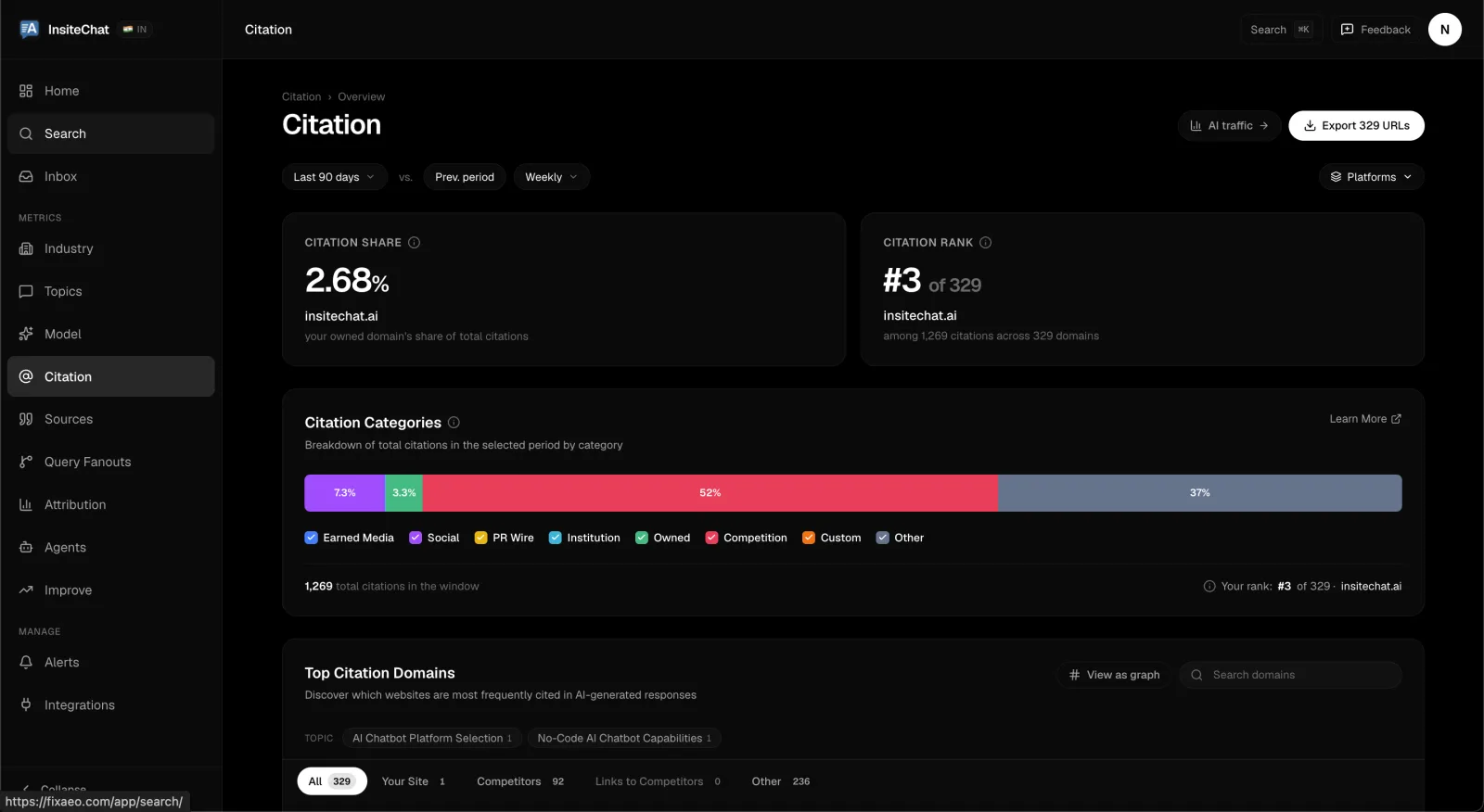
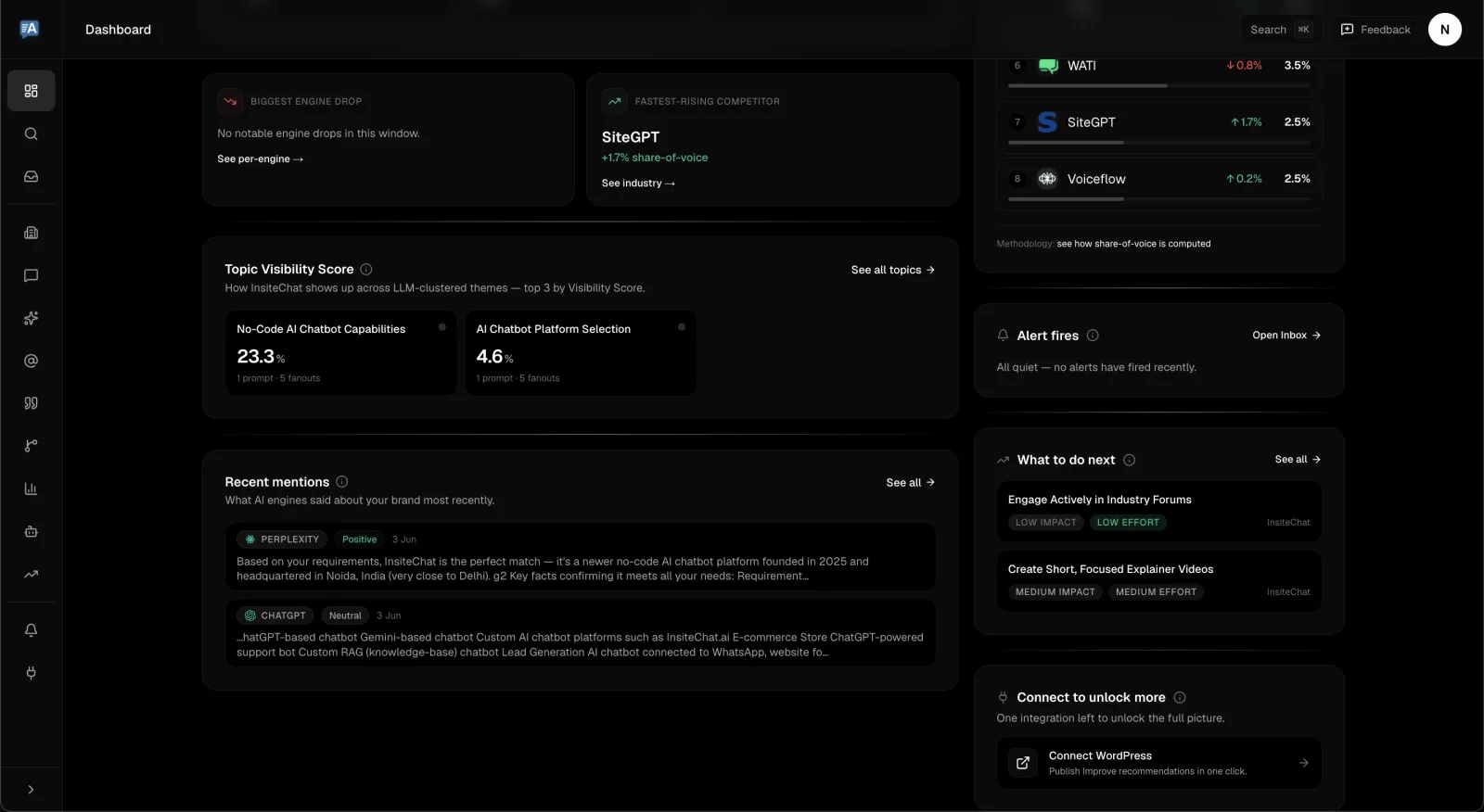
Tracking the split automatically: where you actually get cited across engines, ranked — not a one-off manual read of a single answer.
Action: whatever method you use, check each brand for three states weekly: linked-but-unnamed, named-but-unlinked, or both. Report the split, not a single "visibility" number.
Who this matters most for: all four segments, but especially startups, SMBs, and solo operators who can't manually re-run prompts across six-plus engines every week, and agencies who need a defensible weekly number to show clients GEO work is landing.
6. Check that your own robots.txt isn't blocking the crawlers you want to cite you
Ahrefs analyzed roughly 140 million websites and found rising block rates for major AI crawlers — GPTBot, ClaudeBot, and Google-Extended each blocked site-wide on roughly 5-6% of sites, ClaudeBot blocks up 32.67% year over year. Among high-traffic sites, Originality.ai's tracker shows GPTBot blocking risen from ~5% in 2023 to a quarter-to-a-third of top sites by 2026.
Action: audit robots.txt for User-agent: GPTBot, ClaudeBot, Google-Extended, and PerplexityBot disallow rules. These often get added silently by a CDN or WAF's default "block AI bots" setting. Cross-check server logs to confirm the crawlers you care about are actually reaching the site, not just technically allowed to. (FixAEO's Agent Analytics shows which AI crawlers actually reach your pages — GPTBot, ClaudeBot, PerplexityBot and the rest — and whether each visit succeeded, so 'unblocked' becomes 'verified reading you' without hand-parsing anything.)
Who this matters most for: enterprises running Cloudflare, Akamai, or similar are at the highest risk — those platforms increasingly ship AI-bot-blocking toggles on by default, and it's an easy setting for a security team to flip without looping in marketing.
7. Give AI engines explicit entity signals, not just good content
In one controlled Search Engine Land experiment, three near-identical pages were published with schema markup as the only variable. The page with well-implemented JSON-LD appeared in a Google AI Overview and landed at position 3. The version with no schema wasn't even indexed.2 That result reinforces the pattern from tactic #1: entity and mention signals now outweigh raw link signals for AI visibility.
Action: implement Organization schema with sameAs links pointing to your verified social profiles, Crunchbase, and Wikidata entry if you have one. A same-day fix for most sites.
Who this matters most for: solo operators and small teams can implement basic Organization + sameAs schema with a free generator in under an hour. Enterprises with multiple brands need a coordinated entity graph across every property — harder, but the payoff scales with the number of properties.
Old tactic vs. its zero-click-era replacement
| Old SEO habit | Zero-click-era replacement |
|---|---|
| Chase backlinks as the primary link-building KPI | Track branded mentions alongside links — mentions correlate ~3x stronger with AI visibility |
| Report "rankings" as the top-line metric | Report the citation/mention split per engine, since rank is a shrinking predictor of AI citation |
| Restructure content into FAQ blocks for "AI optimization" | Add sourced stats and direct quotes; format alone is a weak signal without evidence |
| Treat PR as a separate reputation function | Treat PR as a citation channel — earned media drives the majority of AI citations |
| Assume "not blocked" means "being crawled" | Confirm AI crawlers are both unblocked and actually visiting, via logs or a bot-traffic report |
Which tactics to prioritize, by team
| Segment | Prioritize | Why |
|---|---|---|
| Enterprise | Earned media (#2), crawler audit (#6), entity graph (#7) | Budget for PR and IT/security exists; multi-domain complexity makes crawler blocks and fragmented entity signals a real risk |
| Startup / SMB | Citation tracking (#5), schema (#7), brand mentions (#1) | Fast, cheap wins that don't require a comms team; catching a ghost-citation problem early avoids months of flying blind |
| Solo operator / freelancer | Reddit/community presence (#3), scrappy PR (#2) | Lowest dollar cost, highest leverage on time already spent being genuinely useful in a niche community |
| Agency | Evidence-based content templates (#4), mention tracking (#1), citation reporting (#5) | Needs to systematize across many clients and produce a defensible weekly number, not a one-off manual check |
"I think this is the biggest shift SEOs are undergoing right now." — Rand Fishkin, Co-founder & CEO, SparkToro
FAQ
Is zero-click search actually killing SEO, or just changing what it means?
Changing it. Ranking still matters for the shrinking share of searches that do produce a click, and for the roughly 12% of AI citations that overlap with top-10 organic results, per Ahrefs. But treating rank as your primary visibility metric misses the other 88%, plus the majority of searches that never produce a click at all.
Do I need to abandon keyword-targeted content?
No. Keep the content, change what you're optimizing it for. A page that ranks well and gets zero AI citations isn't failing at SEO — it's failing at a different, newer job. Add sourced evidence and direct quotes to existing high-ranking pages before writing new ones from scratch.
How fast do these tactics show up in AI answers?
It varies by engine and crawl frequency — there's no single verified timeline across ChatGPT, Gemini, Perplexity, and Copilot. Earned media and Reddit mentions tend to surface faster since those platforms get crawled often; schema and on-site changes depend on your own site's crawl cadence.
Can a small team really compete with big brands here?
The data says yes, more than in traditional SEO. Victorious's study found domain authority's correlation with AI citation rate was 0.017 — essentially zero. Brand mentions, earned coverage, and community presence don't require a decade of accumulated domain authority to work.
Which AI engine should I optimize for first?
Don't pick one. The tactics here — mentions, earned media, community presence, evidence-based content, entity signals — help across ChatGPT, Gemini, Perplexity, Copilot, and Google's AI surfaces at once, because they're mostly about what other sites say about you, not engine-specific tricks.
How do I know if I'm actually being cited, versus just mentioned?
Check whether you're linked as a source without being named in the answer text, named without a link, or both — Semrush found only 13.2% of brand appearances get both. Most manual spot-checks (reading one ChatGPT response) can't tell these apart reliably; you need to look across multiple prompts and engines to see the pattern.
In one paragraph
Zero-click search stopped being an edge case in 2026 — it's the default outcome for most Google searches, and AI Overviews are cutting into the clicks that remain. The response isn't to abandon SEO, it's to add a second target: getting selected as the source an AI model cites, which depends far more on brand mentions, earned media, community presence, and entity signals than on backlinks or rank alone. Enterprises should lean on PR and entity-graph work, startups and SMBs get the fastest wins from citation tracking and schema, solo operators win cheaply through genuine community presence, and agencies need to systematize evidence-based content and reporting across clients. Start by finding out where you stand: run a free FixAEO scan — 30 seconds, no signup.
Footnotes
-
5WPR: AI Platform Citation Source Index 2026. Read the report. This is a PR firm's aggregation of six prior studies — treat the exact 40% figure as directional, though the underlying "Reddit dominates AI citation sourcing" conclusion is corroborated by independent most-cited-domain trackers. ↩
-
Search Engine Land: How schema markup affects AI Overview visibility. Read the analysis. Sourced via search-result summary at time of writing; a direct fetch of the original article was blocked, so treat this single-experiment result as a lower-confidence data point relative to the other sources cited above. ↩
Related reading
AEO vs SEO: what changed and what to do about it
AEO vs SEO in 2026: AI answers and search engines reward different signals. The data, a plain comparison, and a 30-day migration plan your SEO team can run.
17 min readWhat is AEO? Answer Engine Optimization explained
Answer Engine Optimization (AEO) means getting AI assistants to recommend your brand. Learn what AEO is, why it matters more than SEO, and how to start.
18 min readAI Search Statistics 2026: How AI Replaces Google
20+ verified, source-linked AI search statistics for 2026 — who uses AI vs Google, how fast it's growing, and the viral stats that don't hold up.
16 min readThe 30-point AEO audit checklist (2026)
AEO audit checklist: 30 signals across 7 categories — from crawler access to per-engine verification. Copy it into Notion and run your audit today.
16 min readHow to measure AEO ROI: a copy-paste spreadsheet
Measure AEO ROI with attributable visits, conversion rate, gross profit, and cost. Includes a transparent worked example, spreadsheet layout, and limitations.
13 min readAgent Analytics: See Which AI Crawlers Are Actually Reading Your Site
Before ChatGPT or Perplexity can recommend you, an AI crawler has to read your pages. Agent Analytics shows which bots visit, what they read, and whether the visit worked — the top of the AEO funnel.
8 min read
Free AEO tools
Put this into practice with free FixAEO tools — no signup required.
AI Visibility Checker
Score your brand across 9 AI engines
AEO Audit Tool
Answer-engine readiness scan
Schema Generator
Build valid JSON-LD structured data
llms.txt Generator
Create a spec-compliant llms.txt
Sitemap Validator
Check your XML sitemap for errors
AI Content Grader
Grade content for AI citation readiness