How LLMs Actually Work — and Why It Decides Whether AI Recommends Your Brand
How does ChatGPT decide what to say about your brand? A plain-English guide to next-token prediction, retrieval, and why answers change every time.

On this page

Ask ChatGPT to recommend a project management tool. Write down the five names it gives you. Close the tab, open a new one, and ask the exact same question again. There's a real chance you get a different list — maybe your product is on it this time, maybe it isn't, maybe the order flipped. Nothing about your product changed in the ninety seconds between the two questions. So what did?
The answer is the actual mechanism behind these tools, and once you see it, a lot of confusing AI-visibility behavior stops being confusing. This post is the "how it works" layer underneath what AEO is — if you want the tactical playbook of levers to pull, that's AEO vs SEO: what's actually different. Here we're opening the hood: next-token prediction, training data versus live retrieval, and why the same prompt never guarantees the same answer.
1. The model isn't looking you up — it's predicting the next word
The single biggest misconception people bring to AI search is that somewhere inside ChatGPT or Gemini there's a lookup table with an entry for your brand. There isn't. A large language model is a transformer: a network trained on enormous volumes of text to get good at one narrow task — given everything written so far, predict the most statistically plausible next word (technically, "token"). Do that one word at a time, in a loop, and you get an answer that reads like a paragraph.
Anthropic put it plainly in their interpretability research: "Language models like Claude aren't programmed directly by humans—instead, they're trained on large amounts of data." Nobody wrote an if-statement for your product category. The model absorbed patterns — which words, facts, and associations tend to appear near each other — from the text it was trained on, and generation is that pattern getting replayed.
Google's own explainer describes the mechanism (self-attention) that makes this work: each token in a sentence gets weighted against every other token to figure out "how much does each other token of input affect the interpretation of this token," and the model uses that to "generate probability distributions for next tokens given previous context." Stack enough of these attention layers and the network moves from tracking grammar in the early layers to tracking theme, sentiment, and factual relationships in the deeper ones. If you want the visual, deeply-cited walkthrough of this architecture, Jay Alammar's Illustrated Transformer is one of the most widely assigned explainers in university ML courses, and it holds up.
One honest nuance worth conceding: "predicts one word at a time" makes the model sound short-sighted, and Anthropic's own research pushes back on that a little. Their tracing work found that when Claude writes a poem, it appears to plan the rhyming word several lines ahead internally, rather than purely improvising token-by-token — and when answering factual questions, it chains intermediate facts together rather than "regurgitating" memorized strings verbatim. The output mechanism is still next-token, but there's more structure inside the model than "guess the next word and hope" implies.
What this means for your brand: the model only "knows" you from what got written about you, publicly, somewhere the training data scraped from. If your category is thin on the web, if most of what exists is old, generic, or about a competitor with a louder footprint, that's what shaped the pattern the model learned — and that's what comes out when someone asks about your category. There's no admin panel where you correct this after the fact. The training data is what it is, frozen at whatever point the model's snapshot was taken.
2. How the model sees your brand name
Before the model can predict anything, your question and everything it "knows" about your brand get converted into numbers, in two steps. Both matter more for an uncommon brand name than most assume.
Tokenization. The model doesn't read letters or whole words — it reads tokens, chunks produced by byte pair encoding, an algorithm OpenAI's tokenizer library calls "reversible and lossless." Common patterns compress into single tokens; rare ones split apart. OpenAI's docs give a rule of thumb for English text: about one token per four characters, or roughly three-quarters of a word — "tokenization" itself splits into " token" plus "ization", while "the" stays whole.
A brand name that's also a real word often survives as one or two tokens. An invented, oddly-spelled, or rarely-mentioned name usually gets sliced into several subword fragments, each shared with whatever unrelated words contain the same piece. Check this with OpenAI's tokenizer tool: paste your brand name in and count the pieces. Several odd fragments instead of one clean whole is a concrete sign your name is rare in the text the model trained on.
Embeddings. Once text is tokens, the model turns them into a vector — OpenAI describes an embedding plainly as "a vector (list) of floating point numbers," where "small distances suggest high relatedness and large distances suggest low relatedness." A brand's position there is an average of every context its tokens showed up in during training: mentioned constantly, in consistent company, it gets a sharp vector; mentioned rarely or fragmented into unrelated contexts, it ends up blurrier, further from where it logically belongs — a mechanical reason the web needs to talk about you often, and in consistent company, not just occasionally.
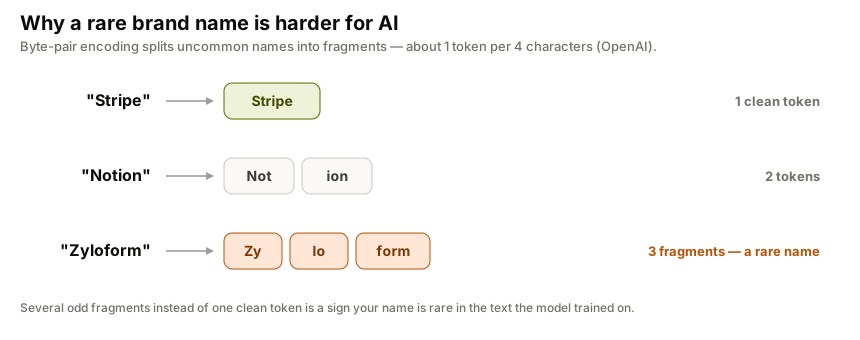
Common names survive as one token; rare or invented ones fracture into fragments the model has to reassemble — a mechanical reason a rare name is harder to surface.
3. Two different paths to being mentioned: baked-in vs. looked-up
Here's where it gets more useful, because "the model only knows what it was trained on" is only half the story for the tools people actually use today. A raw, offline LLM does answer purely from frozen training patterns. But ChatGPT, Gemini, Claude, and Perplexity as products increasingly don't stop there — they bolt on a live web search step before generating the answer. This is retrieval-augmented generation (RAG), and it changes the equation.
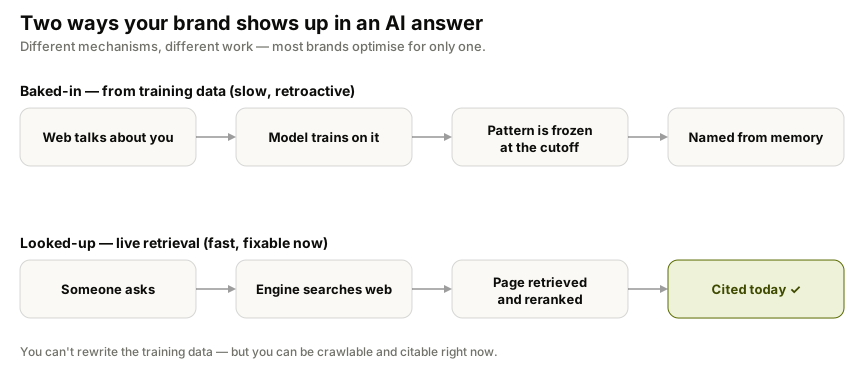
Two separate mechanisms, two separate jobs. Most brands only ever work on the first — the second is the one you can fix this week.
- OpenAI describes it directly: "ChatGPT can now search the web in a much better way than before. You can get fast, timely answers with links to relevant web sources" — and it triggers automatically whenever the question "might benefit from information on the web."
- Anthropic's web search tool makes citations non-optional: "Citations are always enabled for web search" — every retrieved result carries the source URL and the exact text cited, specifically so Claude can "answer questions with up-to-date information beyond its knowledge cutoff."
- Google's Gemini API grounding pipeline runs a full loop: the model decides search would help, generates its own search queries, runs them, then synthesizes an answer with inline citation annotations tied back to the retrieved pages — with the stated goal of helping "reduce model hallucinations by basing responses on real-world information" and surfacing citations so users can check the sources.
- Perplexity is built around this loop as its core product, not a bolt-on: it "searches the internet in real-time, gathering insights from top-tier sources" before writing a synthesized, numbered-citation answer.
So there are genuinely two separate paths for your brand to show up in an AI answer, and they call for different work:
- Be widespread enough to be in the training data. This is slow, expensive, and largely retroactive — you can't un-ring a bell that's already been rung across thousands of pages the model trained on months or years ago.
- Be retrievable and citable, live, right now. This is the path RAG opens up. If your page exists, is crawlable, answers the question clearly, and is technically reachable by the AI engine's crawler, it can be found and cited today — no waiting for the next training run.
Path 2 is why AI-crawler access is not a side detail. If GPTBot, ClaudeBot, or Google's crawlers can't reach or parse your page, you're invisible to live retrieval no matter how good the content is. It's also why coverage varies so much by engine — Claude's and Grok's approaches to live search aren't identical, and if you want the specifics, we've covered whether Claude actually searches the web and how Grok's live search compares in separate posts. Watching whether AI crawlers are actually hitting your pages is one of the more mechanical checks in FixAEO — it's a straight hit-log view, not a guess.
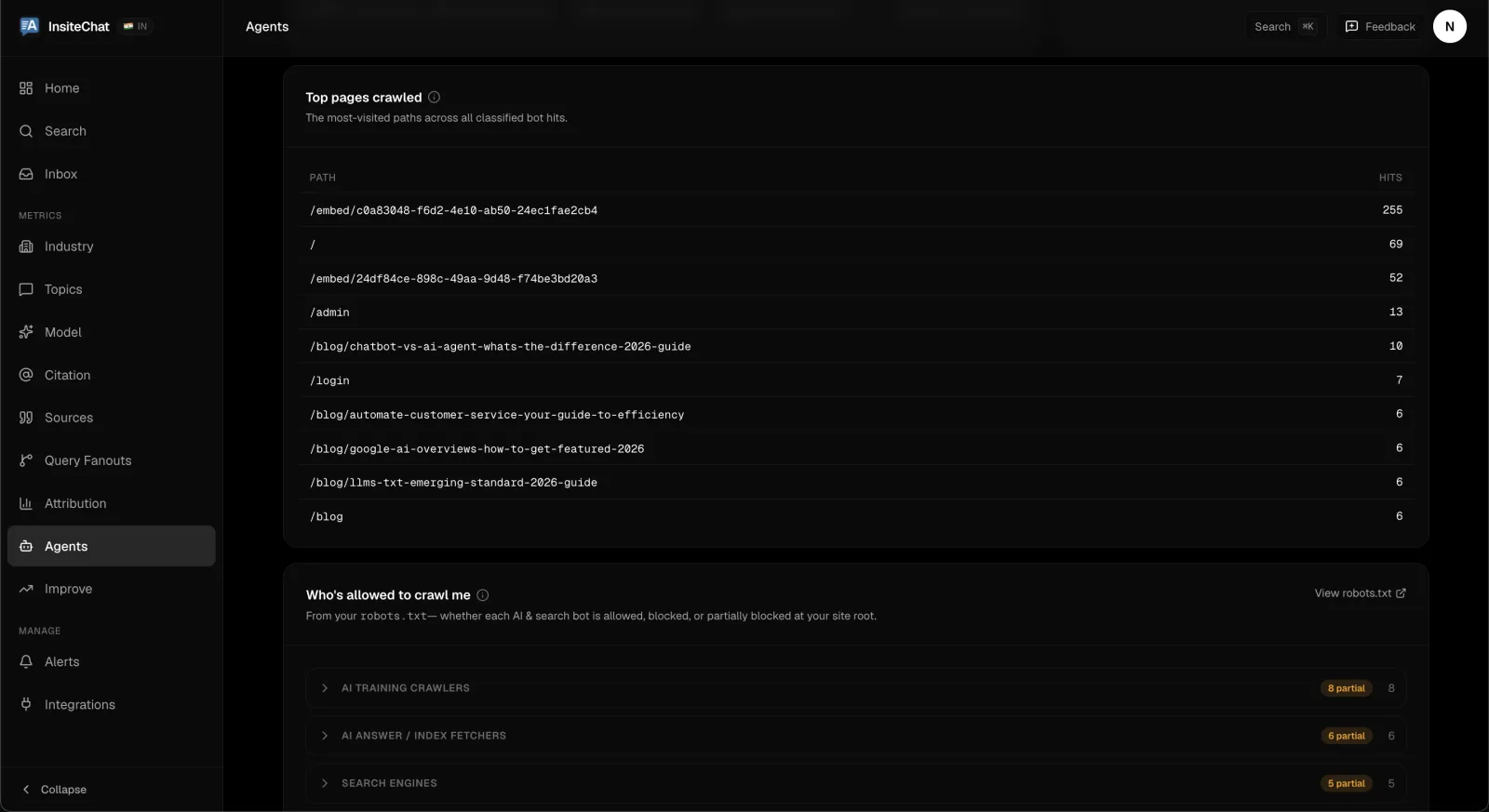
Which AI crawlers actually reach your pages — the line between "citable today" and "invisible to live retrieval."
4. What actually happens between your question and the answer
Section 3 named the two paths in outline. Here's what actually happens, in order, inside the retrieval path — the one that decides whether your brand gets pulled into an answer today.
- Interpret the question. The model works out what you're actually asking, including things unsaid — "best CRM for a 5-person team" implies price and setup time matter, even unstated.
- Decide whether to search at all. A judgment call, not a fixed rule. Google's Gemini API docs: "the model analyzes the prompt and determines if a Google Search can improve the answer". OpenAI's ChatGPT Search triggers the same way, when a question "might benefit from information on the web." Misfire here — frozen knowledge wrongly judged sufficient — and it never searches, so your current page never gets a chance.
- Generate search queries. The model doesn't just re-run your exact words. Google's docs on AI Overviews and AI Mode describe a "query fan-out" technique — issuing multiple related searches across subtopics and data sources". That's the real mechanism behind a page showing up for a question it never literally targeted.
- Retrieve a wide candidate set. Each query pulls back a batch of documents or chunks — Anthropic's own writeup on retrieval uses an example of the top 150 candidates at this stage. Retrieved means found, not used.
- Rerank down to a usable set. A separate model scores every candidate against the query and keeps only the top scorers — Anthropic's example cuts 150 to the top 20: "reranking provides better responses and reduces cost and latency because the model is processing less information." This is where found and used diverge — the next section is about it.
- Synthesize the answer. With a short list of high-scoring chunks in hand, the model writes the response one predicted token at a time (section 1), now conditioned on the retrieved text too.
- Attach citations. Not every retrieved or reranked source becomes a visible citation. OpenAI's web search docs draw the line: sources are "the complete list of URLs the model consulted," citations the subset surfaced inline — "the number of sources is often greater than the number of citations."
Seven steps, and your brand can fall out at any one: never searched for, not retrieved, retrieved but reranked out, or reranked in but still not cited. "We weren't mentioned" is several different failure points wearing one description.
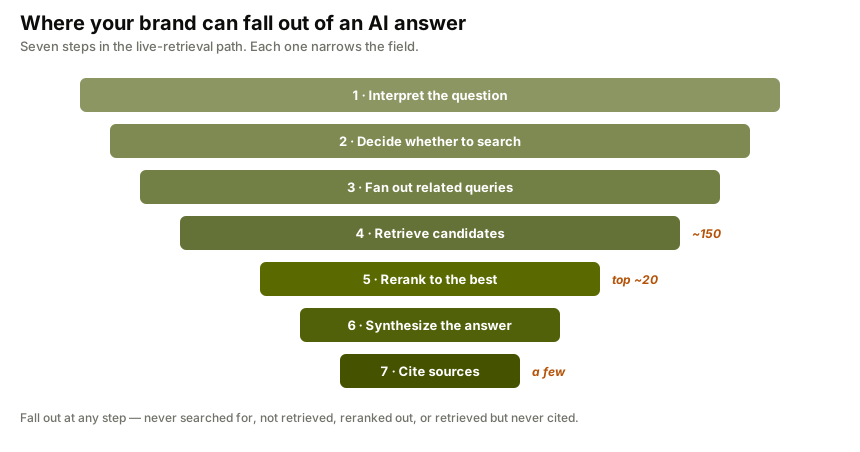
The field narrows at every step — roughly 150 candidates retrieved, about 20 kept after reranking, a handful actually cited. "Found" and "cited" are far apart.
5. Why the model cites one page and ignores another
Step 5 in that walkthrough — reranking — is where most of the mystery lives.
Chunking breaks context. Content about you gets split into pieces small enough to process — Anthropic's own description is "usually no more than a few hundred tokens" per chunk. Necessary, but costly: a chunk reading "the company's revenue grew 3%" is close to useless once separated from the sentence naming which company and quarter. The same happens to brand mentions — if the boundary falls between your name and the sentence explaining why it's relevant, the reranker scores what looks like an unrelated fragment, even though your full page clearly answers the question. Not hypothetical: in Anthropic's own published benchmark, adding reranking on top of retrieval cut their measured top-20 retrieval failure rate by 67% (5.7% to 1.9%) versus basic retrieval alone — Anthropic's own internal test, not a universal number, but a large enough gap to treat reranking as a real, mostly invisible factor in whether your page gets cited.
Relevance is scored, not assumed, and recency and authority feed in too, though no vendor publishes the exact weighting. The reranker scores how well each chunk answers the query, not whether the right keyword appears — a page broadly about your category that mentions your brand once, in passing, can lose to a shorter, more on-topic competitor chunk, even a worse page overall. Neither recency nor authority overrides relevance alone.
Crawlability is the gate before any of this. None of it matters if the crawler — GPTBot, ClaudeBot, Google's bots — can't reach or parse your page. Blocked by robots.txt, rendered client-side with nothing in the initial HTML, or hidden behind a login, and it never becomes a candidate at step 4. Not scored low — never scored at all.
The practical takeaway: put the fact and the reason it matters in one self-contained paragraph, not the claim in one place and the brand name three paragraphs up. Keep the content itself current, not just the "last updated" timestamp. Confirm crawlability from a server log, not the assumption that Google indexing it means every AI crawler can too.
This plays out differently by engine. ChatGPT separates "sources" from "citations" (section 4) and lets operators filter up to 100 domains. Perplexity splits it into an Agent API for "web-grounded answers with built-in citations in one call" and a Search API for "raw, ranked web search results with advanced filtering and real-time data." None of the four publishes its actual ranking algorithm. Google's AI Overviews and AI Mode aren't the same system: "AI Mode and AI Overviews may use different models and techniques, so the set of responses and links they show will vary," and the eligibility bar is simply being "indexed and eligible to be shown in Google Search with a snippet... there are no additional requirements." Gemini's API grounding, distinct from both despite sharing models, decides per prompt whether search helps and returns citations extending the model "beyond its knowledge cutoff."
6. Why the same question gives a different answer every time
This is the part that trips people up most, and it's also the part that makes "I asked ChatGPT once and we weren't mentioned" close to meaningless as a data point on its own.
LLMs don't deterministically output the single "best" next word by default — they sample from a probability distribution over plausible next words, and a setting called temperature controls how much randomness goes into that sampling. Google's own Gemini prompting docs are direct about it: "The temperature controls the degree of randomness in token selection... A temperature of 0 is deterministic, meaning that the highest probability response is always selected." Anything above zero — which is the default in most consumer chat products — means the model is intentionally choosing between several plausible next words each step, not just the top one. Ask the same question with five different competitor brands sitting at similar probability mass, and which one gets picked can shift run to run.
Here's the part that's genuinely surprising, and worth citing carefully because it's easy to get wrong: even at temperature 0, answers still aren't guaranteed to be identical between runs. Thinking Machines Lab (founded by former OpenAI CTO Mira Murati) published a technical breakdown of why, and the cause isn't what most people assume. It's not random noise from parallel GPUs — it's that production inference servers batch requests from many concurrent users together, and "the other concurrent users are not an 'input' to the system but rather a nondeterministic property" of the load at that moment. Most inference kernels aren't "batch-invariant," so floating-point rounding differs depending on batch size: as they put it, "(a + b) + c ≠ a + (b + c)." Different batch, different rounding, different final answer — even with the "deterministic" setting on.
The practical implication: a single ChatGPT answer is an anecdote, not a measurement. If you want to know whether AI actually recommends your brand, you have to ask the same set of prompts many times, across multiple engines, and look at the rate your brand shows up — a percentage, not a yes/no. That's the entire reason tools like FixAEO exist as a category: repeatedly sampling the same prompts across engines and reporting share of voice over time, rather than trusting whatever one screenshot happened to return. If you're still building intuition for why "visibility" needs to be measured this way at all, what AI visibility actually means is the companion read.
This plays out a little differently depending on who's asking:
- Enterprise teams need this measured per region and per product line — one aggregate number hides real gaps between markets.
- Startups and SMBs are often working with small enough mention volume that a handful of runs can look wildly different from each other; sampling more, not less, is what stabilizes the signal.
- Solo operators and freelancers are usually competing against generic category advice ("hire someone on a freelance marketplace") rather than a named rival — the question isn't just "did I win," it's "was I named at all."
- Agencies reporting this to clients need repeatable numbers, not a single lucky (or unlucky) chat transcript, to make the case credible.
7. Why the model sometimes refuses to name a brand
Predicting the next word (section 1) is the base layer. On top of that, every major assistant goes through a separate training stage that shapes how it behaves — including its willingness to flatly name a winner. OpenAI's own research documents the foundational version: supervised fine-tuning on human demonstrations, a reward model trained on human rankings, then reinforcement learning against that reward model — Ouyang et al.'s "Training language models to follow instructions with human feedback," the paper behind InstructGPT. This layer turns a raw next-word predictor into something that calibrates how confidently it states things.
That calibration cuts both ways. Anthropic's constitution names over-caution as a real failure mode, not a safe default — it lists "gives an unhelpful, wishy-washy response out of caution when it isn't needed" and "adds excessive warnings, disclaimers, or caveats that aren't necessary or useful," stating plainly that "unhelpfulness is never trivially 'safe.'" Claude is meant to be "diplomatically honest rather than dishonestly diplomatic."
But a competing instruction pulls the other way on "which brand should I use" questions. OpenAI's Model Spec says the model shouldn't pursue "revenue or upsell for OpenAI or other large language model providers" as a goal in itself, with a worked example of declining to push a paid upgrade the user doesn't need — noting also that "our production models do not yet fully reflect the Model Spec." Extend that principle and it explains hedged, multi-name answers: an assistant trained not to shill for any commercial party has a built-in reason to name several reasonable options with caveats rather than crown one winner. Say two project-management tools are both genuinely reasonable fits for a query — illustrative, not a measured case — the tendency leans toward naming both with caveats ("both are solid — X is simpler for small teams, Y scales further") rather than crowning one. Not a bug specific to your brand losing out; the same hedge applies to anyone in a close category.
What this means for phrasing monitoring prompts: a broad "what's the best X" invites exactly this hedge — a wider, softer, multi-name list. A narrower prompt tied to a use case, or a direct "X vs Y," tends to produce a more decisive answer, showing whether you're missing entirely or just buried in a hedged group of names.
8. When the model is confidently wrong about you
Everything so far assumes the model either knows something about your brand or honestly doesn't. There's a third case, and it should worry you more than not being mentioned: the model states something wrong about you with complete confidence.
Knowledge cutoff is the easy half — definitional, not a bug. Training data has an end date; anything after it, the model cannot know unless a retrieval step (sections 3 and 4) fetches it live. Cutoffs vary a lot by model — FixAEO keeps a monthly-refreshed list of what every major model's cutoff actually is if you want to check a specific engine.
The harder half is hallucination. Recent OpenAI research argues "hallucinations originate simply as errors in binary classification" — when training data can't cleanly separate a valid fact from a plausible-sounding invalid one, the model learns to guess instead of abstaining, because "language models are optimized to be good test-takers, and guessing when uncertain improves test performance." Standard evaluation rewards a confident wrong answer over an honest "I don't know."
Extending that mechanism to brand entities — reasoning by extension, not a separately measured claim — a brand with thin or inconsistent training-data coverage, true of most smaller companies next to a category leader, fits the case the paper describes: the model can't cleanly separate real fact from plausible-sounding wrong one, so it states a wrong price, founding year, or feature with the same fluent confidence it uses for something true.
Why presence isn't enough. A mention count tells you whether you show up, not whether what gets said is accurate. Getting your price or positioning stated wrong, confidently, can do more damage than not being mentioned at all — monitoring has to check what's actually being said, not just whether your name appears.
9. Why brand mentions beat backlinks — and why this isn't a coincidence
Put sections 1 and 3 together and a prediction falls out: if models learn from patterns in web text, and AI search grounds answers in whatever's currently retrievable about you, then the thing that should matter most is how often and how consistently your brand gets talked about across the web — not how many links point at your domain. That's a testable claim, and Ahrefs tested it.
Their study of 75,000 brands measured the correlation between various signals and how often a brand got mentioned in Google AI Overviews. The gap between the top and bottom of the list is not subtle:
| Factor | Correlation with AI Overview mentions |
|---|---|
| Branded web mentions | 0.664 |
| Branded anchors | 0.527 |
| Branded search volume | 0.392 |
| Domain Rating (DR) | 0.326 |
| Referring domains | 0.295 |
| Branded traffic | 0.274 |
| Number of backlinks | 0.218 |
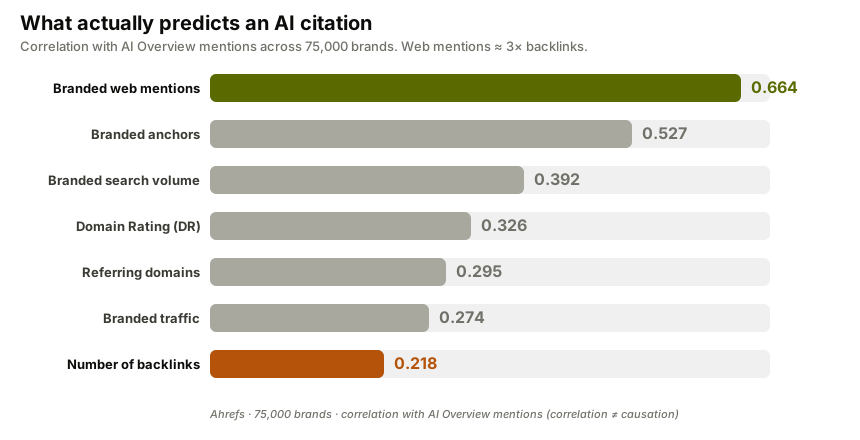
The same seven factors as a picture: branded web mentions (top, olive) versus backlinks (bottom, amber) — a roughly 3× gap. Correlation, not causation.
As the researchers put it: "web mentions (0.664) correlate much more strongly than backlinks (0.218)." A follow-up study broke this down per engine and the pattern held: web mentions correlated at 0.656 with AI Overviews, 0.709 with AI Mode, and 0.664 with ChatGPT — with YouTube mentions turning out to be the single strongest correlate of all, around 0.737, across every surface they tested. Search Engine Journal independently confirmed the figure, quoting Ahrefs' Ryan Law directly: "the strongest correlation... almost 0.67, was branded web mentions." (This post is about the mechanism behind that pattern; if you want the wider roundup of adoption and citation figures, that lives in our AI search statistics for 2026.)
To their credit, Ahrefs are upfront that correlation isn't causation here — piling up unlinked mentions on forums won't mechanically flip a switch. Their read is that brand authority is a composite signal, absorbed by both training data and live retrieval, not a single lever you can yank. That's an honest caveat and worth repeating rather than overselling the number.
But the mechanism explains why the correlation looks like this in the first place. A backlink is primarily a ranking signal for classic search — it tells Google's link graph your page is trustworthy. It says almost nothing to a language model deciding what to predict next, or to a retrieval system deciding what's worth citing right now. A mention — in a review, a forum thread, a comparison article, a YouTube transcript — is exactly the kind of raw text both mechanisms actually consume: pattern-learning during training, and retrievable proof-of-existence during live search. This is also where crawler access loops back in from section 3 — a mention that AI crawlers can't reach (blocked, JS-rendered with nothing in the initial HTML, gated behind a login) does neither job. FixAEO's AI-crawler-hit tracking exists to catch that specific failure mode: content that's fine, but effectively unreachable.
None of this makes backlinks worthless — they still matter for classic organic search, which still sends real traffic. It just means if your entire content strategy is optimized for link acquisition and nothing else, you're optimizing for the weaker of two signals for AI visibility specifically.
FAQ
Does ChatGPT "look up" my brand every time someone mentions it?
No, not by default. A base LLM answers from patterns learned during training — no database lookup happens. Products like ChatGPT Search, Gemini, and Perplexity add a separate live web-search step (RAG) on top, and that step does retrieve and cite current pages. Whether your brand shows up in a given answer depends on which of these two modes is active and what each one has access to.
We rank #1 on Google for our category. Why does AI recommend a competitor?
Google ranking is one signal fed by backlinks and technical SEO. AI mention rate correlates far more strongly with branded web mentions than with backlinks — 0.664 versus 0.218 in Ahrefs' 75k-brand study. You can be the technically strongest page in your niche and still be talked about less, in less citable form, than a competitor with more scattered reviews and forum mentions.
Why did ChatGPT cite my competitor's page instead of mine, even though mine covers the topic in more depth?
Most likely reranking, not a quality judgment on the whole page. Retrieval pulls a wide set of candidate chunks, then a reranker scores each against the query — Anthropic's own writeup describes cutting 150 candidates to a top 20. A shorter, on-topic competitor chunk can outscore a longer one if your key sentence got separated from your brand name by a chunk boundary.
If my brand isn't in any model's training data yet, is it too late?
Not for the live-retrieval path. Training data is frozen until the next model update, but AI search products increasingly answer via real-time web search — being crawlable, clearly written, and genuinely citable today can get you mentioned in an AI Mode or Perplexity answer without waiting for the next training snapshot to include you.
Does asking ChatGPT the same question twice always give the same answer?
Usually not, and the underlying research goes further than most people expect: even at a "deterministic" temperature-0 setting, answers can still differ between runs because of how requests get batched on shared inference infrastructure, per Thinking Machines Lab's research. Treat any single answer as a sample, not a verdict.
Do backlinks still matter at all?
Yes, for classic organic search rankings, which still drive real traffic. They're just a comparatively weak signal for AI mention rate specifically — Ahrefs' data puts backlinks near the bottom of the correlation list, well below web mentions, branded anchors, and branded search volume.
Why does AI sometimes state basic facts about my company confidently and get them wrong?
Because a confident wrong answer is a documented training-and-evaluation failure, not a random glitch. OpenAI's own research argues models are optimized to reward a confident guess over an honest "I don't know" whenever training data doesn't cleanly separate real facts from plausible-sounding wrong ones — see the paper. Brands with thin, inconsistent web coverage are more exposed than category leaders with lots of consistent, cross-referenced coverage.
What can I actually do with this, practically?
Split your effort across both paths from section 3: get genuinely mentioned across the web (reviews, forums, comparison content, YouTube — not just your own domain), and make sure your own pages are crawlable and citable by AI bots specifically, not just indexable by Googlebot. Then measure the result by sampling repeatedly across engines, not by asking once.
In one paragraph
An LLM doesn't look your brand up — it predicts the next word based on patterns learned from training data, which is why what the web said about you matters more than what your own site claims. Modern AI search products add a second path: live retrieval, running through query generation, candidate retrieval, reranking, and citation, so a crawlable, currently-citable page can get mentioned today even without training-data presence — but can also get retrieved and still not cited if it loses at reranking. A separate training layer decides how confidently the model names a brand at all, and it can name you confidently while getting your facts wrong, which is why presence, accuracy, and consistency all need watching. Either way, answers are sampled probabilistically, so one question to one engine tells you almost nothing — and Ahrefs' 75,000-brand study backs up why the real lever is broad, consistent brand mentions across the web, not backlink volume. Run a free FixAEO scan to see where you stand — 30 seconds, no signup.
Related reading
What is AEO? Answer Engine Optimization explained
Answer Engine Optimization (AEO) means getting AI assistants to recommend your brand. Learn what AEO is, why it matters more than SEO, and how to start.
18 min readAEO vs SEO: what changed and what to do about it
AEO vs SEO in 2026: AI answers and search engines reward different signals. The data, a plain comparison, and a 30-day migration plan your SEO team can run.
17 min readWhat Is AI Visibility (and Why It Matters in 2026)
AI visibility measures whether ChatGPT, Gemini, and other AI engines mention, recommend, or cite your brand — and why tracking it matters in 2026.
14 min readCan Claude Search the Web? How to Enable It (2026)
Yes. Enable Claude web search in three steps, fix a missing toggle on Team or Enterprise, and learn when Claude searches and cites the live web.
15 min readDoes Grok Search the Web? Yes — Here's How (2026)
Yes — Grok searches the web live and reads real-time X posts. How Grok's search and DeepSearch work, what index it uses, the xAI API, and how to get cited.
14 min readAI Search Statistics 2026: How AI Replaces Google
20+ verified, source-linked AI search statistics for 2026 — who uses AI vs Google, how fast it's growing, and the viral stats that don't hold up.
16 min read
Free AEO tools
Put this into practice with free FixAEO tools — no signup required.
AI Visibility Checker
Score your brand across 9 AI engines
AEO Audit Tool
Answer-engine readiness scan
Schema Generator
Build valid JSON-LD structured data
llms.txt Generator
Create a spec-compliant llms.txt
Sitemap Validator
Check your XML sitemap for errors
AI Content Grader
Grade content for AI citation readiness