What Is AI Visibility (and Why It Matters in 2026)
AI visibility measures whether ChatGPT, Gemini, and other AI engines mention, recommend, or cite your brand — and why tracking it matters in 2026.

On this page

Ask ChatGPT "what's the best project management tool for a 10-person startup" and watch what comes back. Three or four names, maybe five. Your product might rank #1 on Google for that exact phrase and still never show up in that answer. The person asking never sees a search results page, never scrolls past an ad, never clicks through ten blue links. They read the answer, pick one of the names in it, and move on. If you weren't in the list, you didn't lose a click — you lost the whole decision.
That gap between "we rank well on Google" and "AI engines actually mention us" is what AI visibility measures. This post defines it clearly, walks through why it's become urgent in 2026, and explains exactly how it's tracked — share of voice, mention rate, citation rate, sentiment. If you want the playbook for actually moving those numbers, that's a different discipline called AEO (Answer Engine Optimization), and I link to it below. If you want the full 2026 stat roundup, it lives here — this post only cites the handful of numbers that matter for defining the problem.
What "AI visibility" actually means
AI visibility is whether — and how often, and how favorably — AI engines like ChatGPT, Gemini, Perplexity, Copilot, and Google's AI Overviews and AI Mode mention, recommend, or cite your brand when someone asks a buying-relevant question in that engine.
Three words in that definition carry the whole idea:
- Whether — do you show up at all, even once, across the questions your buyers actually ask?
- How often — out of 20 relevant prompts run over a month, do you appear in 2 of them or 15?
- How favorably — when you do show up, are you the recommended pick, a neutral mention buried in a list, or a comparison point next to a competitor that's framed as the better choice?
Notice what's missing from that definition: nothing about whether the model "knows" your brand exists. A model can have your entire Wikipedia page memorized and still never surface you in an answer, because generating an answer is a selection process, not a lookup. Forbes Councils puts it well: a brand can be accurately recognized by a model and still be "effectively invisible" if it never gets pulled into the actual response. Recognition and selection are different things, and AI visibility only measures the second one.
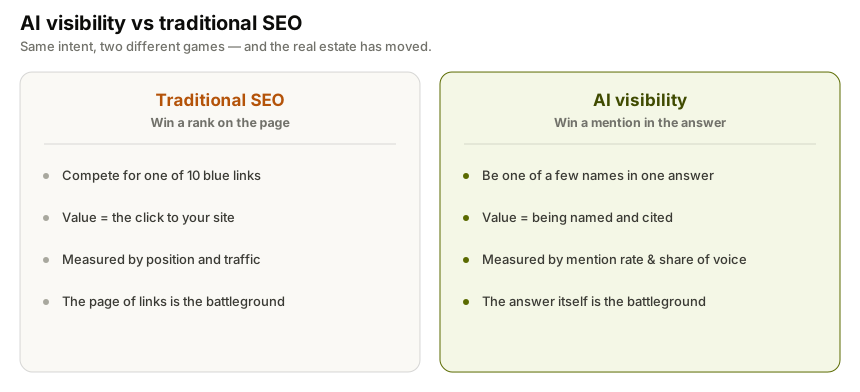
The real estate moved. SEO won the click; AI visibility wins the mention inside the answer itself.
Why it matters now
This isn't a hypothetical shift. Three things are true at the same time in 2026, and together they change what "being found" means.
Buyers are already asking AI first
ChatGPT alone reached 900 million weekly active users in late February 2026, TechCrunch reported — roughly double the 400 million it had a year earlier. That's not a niche audience of early adopters — it's a meaningful share of anyone who researches a purchase online.
On the B2B side, Forrester found 94% of business buyers used AI during their most recent purchase — up from 89% the year before — and buyers now name generative AI or conversational search as their most meaningful information source, roughly twice the rate of any single alternative. Worth being honest about the flip side, too: AI research can also leave buyers less confident when the information it surfaces is unreliable. AI visibility isn't pure upside — showing up inaccurately or unfavorably is its own risk.
Zero-click means the AI's answer often IS the decision
SparkToro's clickstream analysis (with Similarweb panel data) found that 68.01% of US Google searches between January and April 2026 ended without a single click — up sharply from 60.45% in 2024. SparkToro's write-up frames it plainly: of every 1,000 searches, only 276 now reach the open web, down from 374 two years earlier. When the AI Overview or the chat answer is the search result, being mentioned inside it isn't a nice-to-have marketing channel — it's the only channel for that query.
Most brands are already invisible
Victorious studied 177 brands across five industries against 8 AI systems (ChatGPT, Perplexity, Gemini, Google AI Overview, Google AI Mode, Copilot, Claude, Meta AI) in Q1 2026 and found 89.8% were largely absent from AI search answers — only 18 of the 177 registered any AI mentions at all — as reported by Search Engine Journal. That's recognition without selection, exactly the gap this post opened with: a model can know a brand exists and still never name it. Roughly 9 in 10 brands aren't in the room when the AI names names.
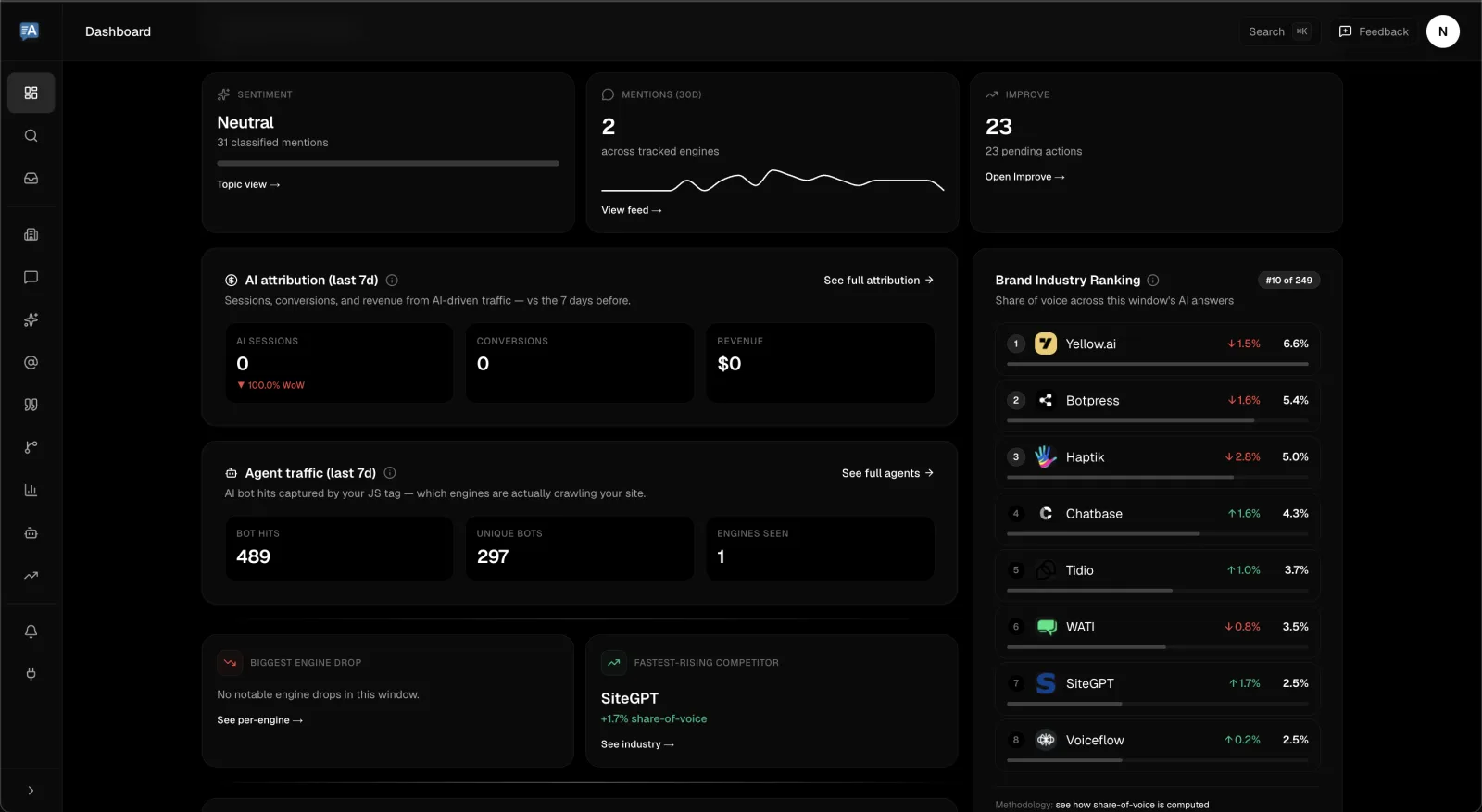
Who's actually in the room — a share-of-voice leaderboard across engines for one category. Most brands don't appear at all.
The traffic that does show up converts well
Similarweb's 2026 Gen AI report found ChatGPT referral traffic converts at 7.1%, second only to paid search at 7.8% and ahead of organic, direct, social, and email — based on clickstream data from April–May 2026, per Similarweb. Worth flagging honestly: an independent 78-site study by Siege Media pushed back on the "AI traffic converts several times better" framing that's floated around this stat, finding closer to a 1.26x lift over regular traffic in their own sample. Both can be true — the visitors who arrive via an AI answer tend to convert somewhat better than average, just not by the dramatic multiple sometimes claimed. Either way, it's traffic worth being visible enough to capture.
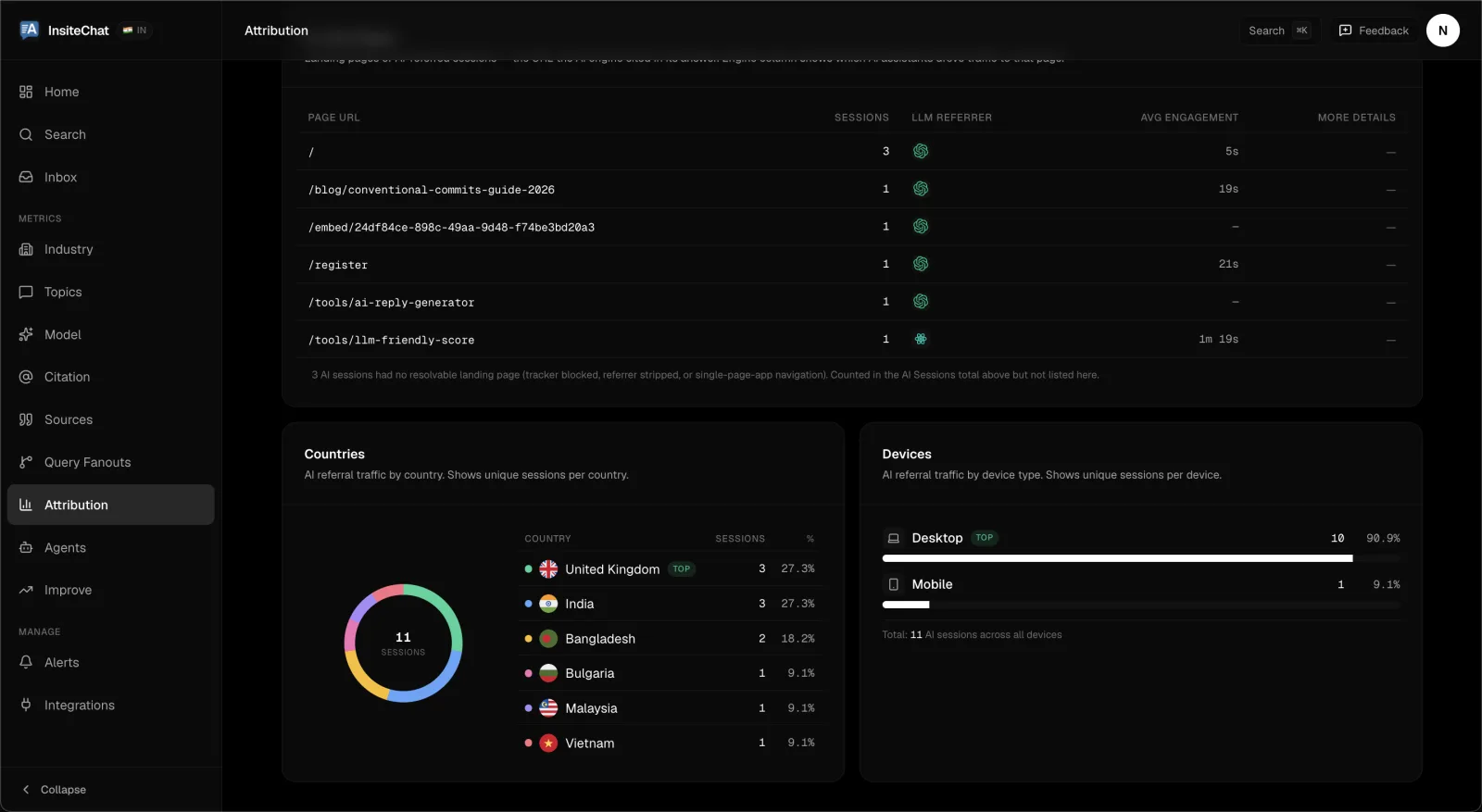
The traffic AI answers actually send, split by engine — the visits you can only earn by being named in the first place.
AI visibility vs. AEO/GEO — the outcome vs. the discipline
This is the distinction people mix up most, so I'll state it directly: AI visibility is the scoreboard. AEO and GEO are the plays you run to move it.
- AI visibility is a measurable outcome — a set of numbers (share of voice, mention rate, citation rate, sentiment) that tell you where you stand today, the same way "keyword rankings" told you where you stood in classic SEO.
- AEO (Answer Engine Optimization) and GEO (Generative Engine Optimization) are the practices — structuring content so it gets pulled into a direct answer, earning the third-party mentions and reviews that AI engines synthesize into a response — that you use to improve the scoreboard.
You don't optimize "AI visibility" directly, the same way you never optimized "rankings" directly — you optimize content, structure, and citations, and rankings (or visibility) is the result you check afterward. If you're looking for the practice guide, what AEO is and how AEO compares to SEO are the right next reads. This post stays on the measurement side.
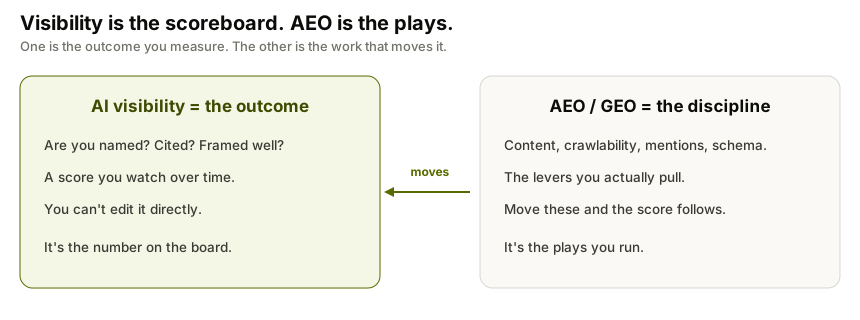
You watch the scoreboard; you run the plays. Move the plays and the score follows — you never edit the score directly.
How AI visibility is measured
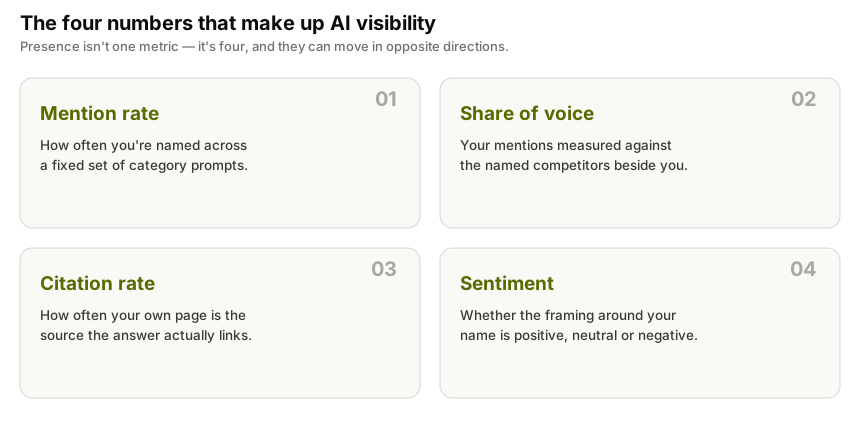
Presence isn't one number — it's four, and they can move in opposite directions.
To turn "are we visible" into a number you can track over time, run the same set of buying-relevant prompts across multiple engines, repeatedly, and score four things:
| Metric | What it answers | How it's calculated |
|---|---|---|
| Share of voice | Out of every brand mentioned for this topic, what % of mentions are ours vs. competitors? | Your mentions ÷ total brand mentions across all responses, per prompt set |
| Mention rate | How often do we show up at all? | % of prompt runs where your brand appears anywhere in the response |
| Citation rate | How often are we the cited source behind a claim, not just named in passing? | % of responses where your domain or content is linked/cited as the answer's basis |
| Sentiment | When we do show up, is it positive, neutral, or negative — and are we the recommended pick or a runner-up? | Qualitative scoring of each mention's framing, aggregated over time |
A few things make this harder than it sounds:
- One prompt run isn't a measurement. The same question asked twice can return a different answer, since these are generative models, not lookup tables. You need many runs across many phrasings of the same buying question before a mention rate means anything.
- Engines don't agree with each other. ChatGPT's answer to "best CRM for a 5-person sales team" and Gemini's answer to the same question routinely include different companies. Share of voice has to be tracked per engine, not blended into one fake average.
- API answers and real chat-UI answers can diverge. This is a genuinely underappreciated split in the AI-visibility-tracking category: some tools query a model's API directly, which can return different content than what a logged-in person sees in the actual ChatGPT, Gemini, or Perplexity app — different because of personalization, browsing/citation features turned on in the consumer product, or region-specific rollouts that the raw API doesn't reflect. If you're evaluating any AI-visibility tool, ask directly which one you're getting. It's a fair question and a reasonable vendor will have a straight answer.
For what it's worth, this is the specific problem we built FixAEO around: we run real browser sessions logged into the actual consumer apps — not just API calls — across 9 engines (ChatGPT, Claude, Gemini, Perplexity, Grok, DeepSeek, Copilot, Google AI Overviews, and Google AI Mode on the top Enterprise tier; 6 of those 9 on the Lite and Growth plans), with region-aware capture since answers change by location. That gives share of voice, mention rate, citation rate, and sentiment as an actual dashboard instead of a one-off spot check, plus a leaderboard against named competitors so you can see who's winning each prompt, not just whether you showed up. For reporting pipelines, the AI rank tracking API returns the rank, mention, and citation data as JSON.
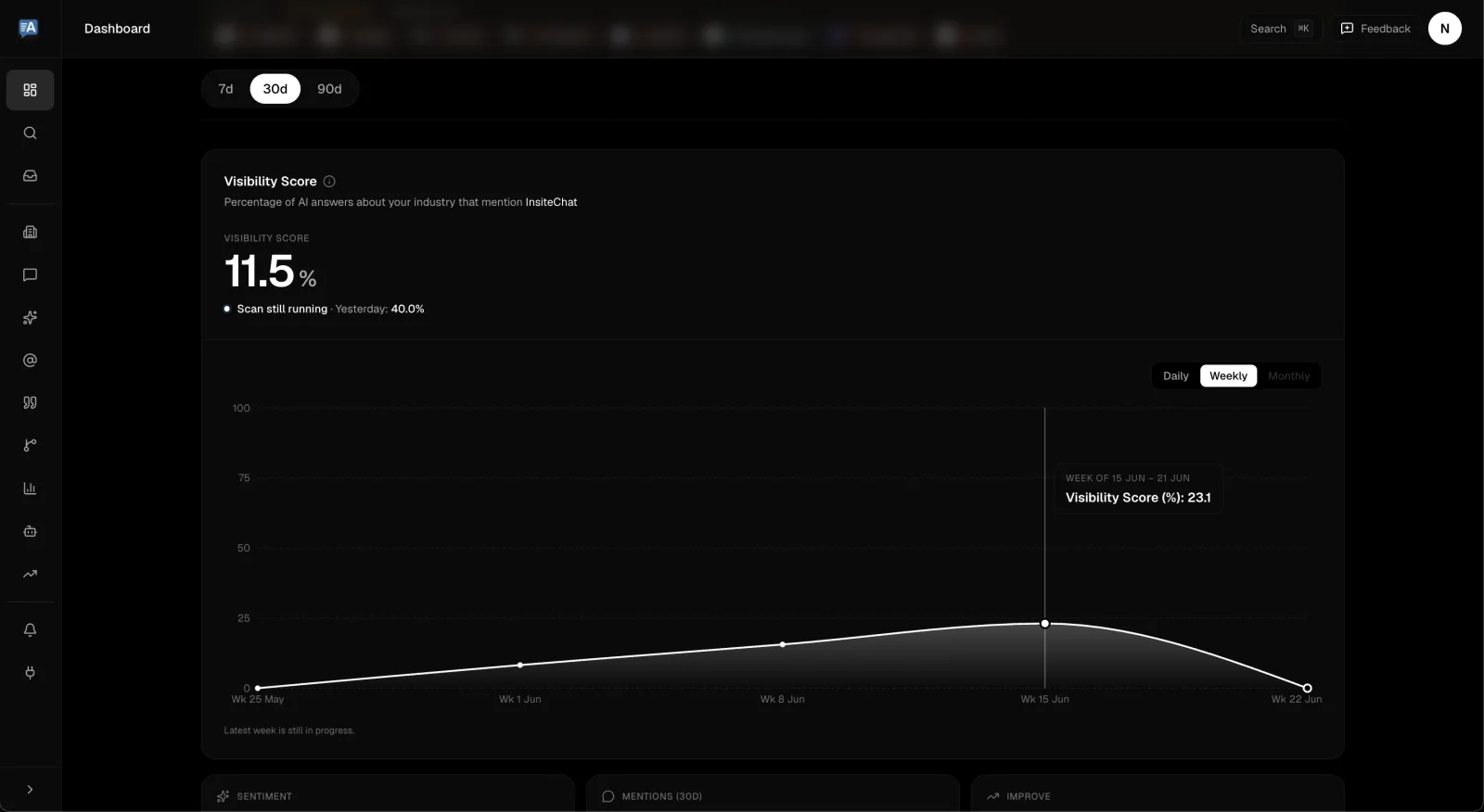
AI visibility as a number tracked over time — the scoreboard this whole post is about, not a one-off screenshot.
Who this actually matters for
AI visibility isn't only an enterprise-marketing concern. It shows up differently depending on where you sit:
- Enterprise brands have the most to lose in aggregate — established SEO rankings that took a decade to build don't automatically transfer to AI answers, and a competitor with cleaner structured content can leapfrog you in an AI recommendation even while you outrank them on Google. Enterprise teams also tend to have the internal case to justify tracking this properly, since a single missed RFP-stage mention can be worth more than a year of SEO tooling spend.
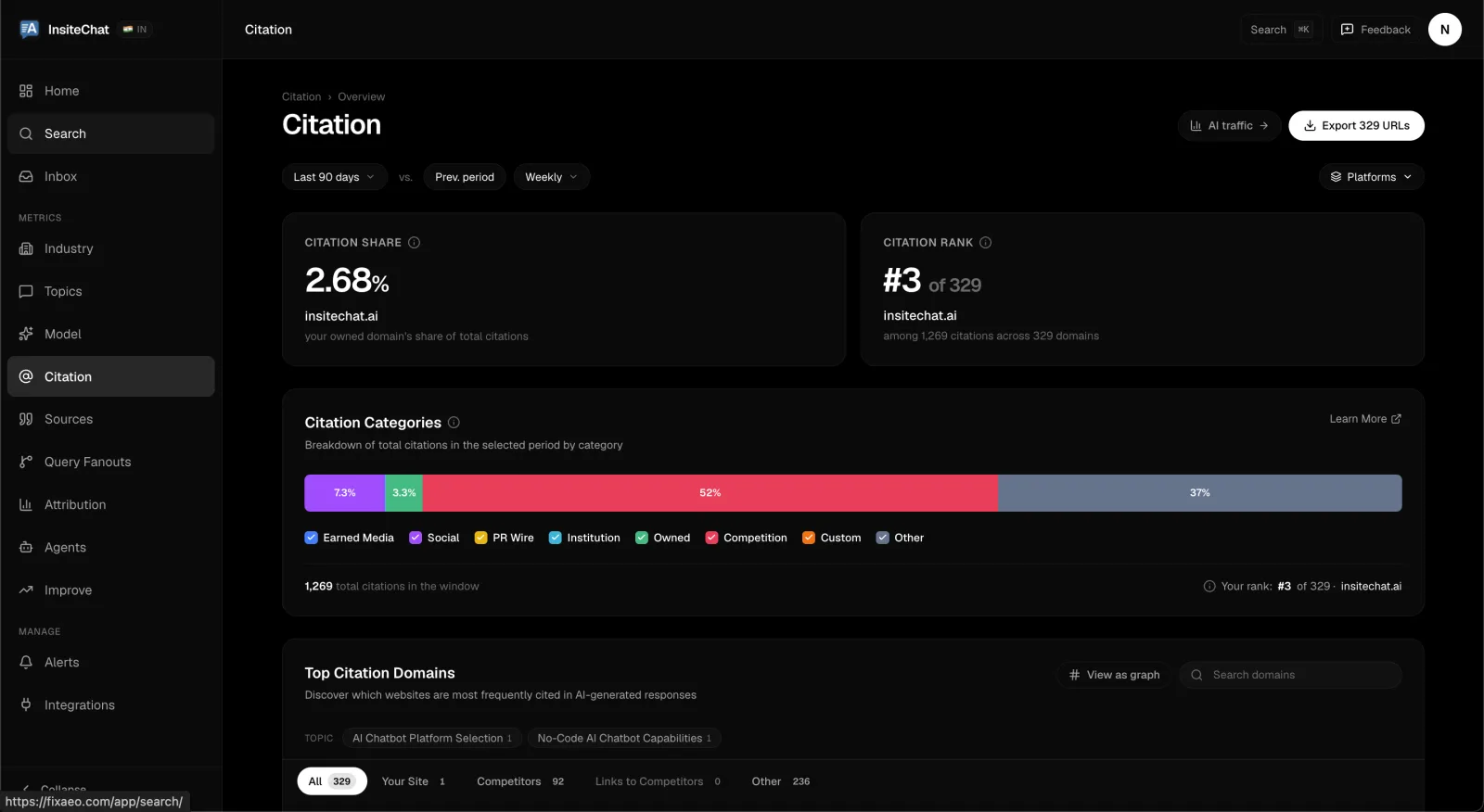
Citation rate made visible — which pages the answer actually links as its source, not just which brands it names in passing.
- Startups and SMBs are often invisible by default simply because AI engines lean on brand signals (reviews, press mentions, structured data) that a 2-year-old company hasn't accumulated yet — which is exactly why checking where you stand early, before a competitor locks in the "recommended" slot for your category, matters more than it might seem.
- Solo operators and freelancers — a consultant, an indie SaaS founder, a niche agency of one — are competing for AI-generated recommendations against companies with entire marketing teams, and usually have zero visibility into whether they're even in the running. A free scan is a reasonable place to start precisely because there's no budget case to build first.
- Agencies managing AI visibility for multiple clients need this as a repeatable, comparable metric across accounts — the same reason rank tracking became a standard agency line item a decade ago. Clients will start asking "are we showing up in ChatGPT" the way they used to ask about page-one rankings, and having a number ready beats guessing.
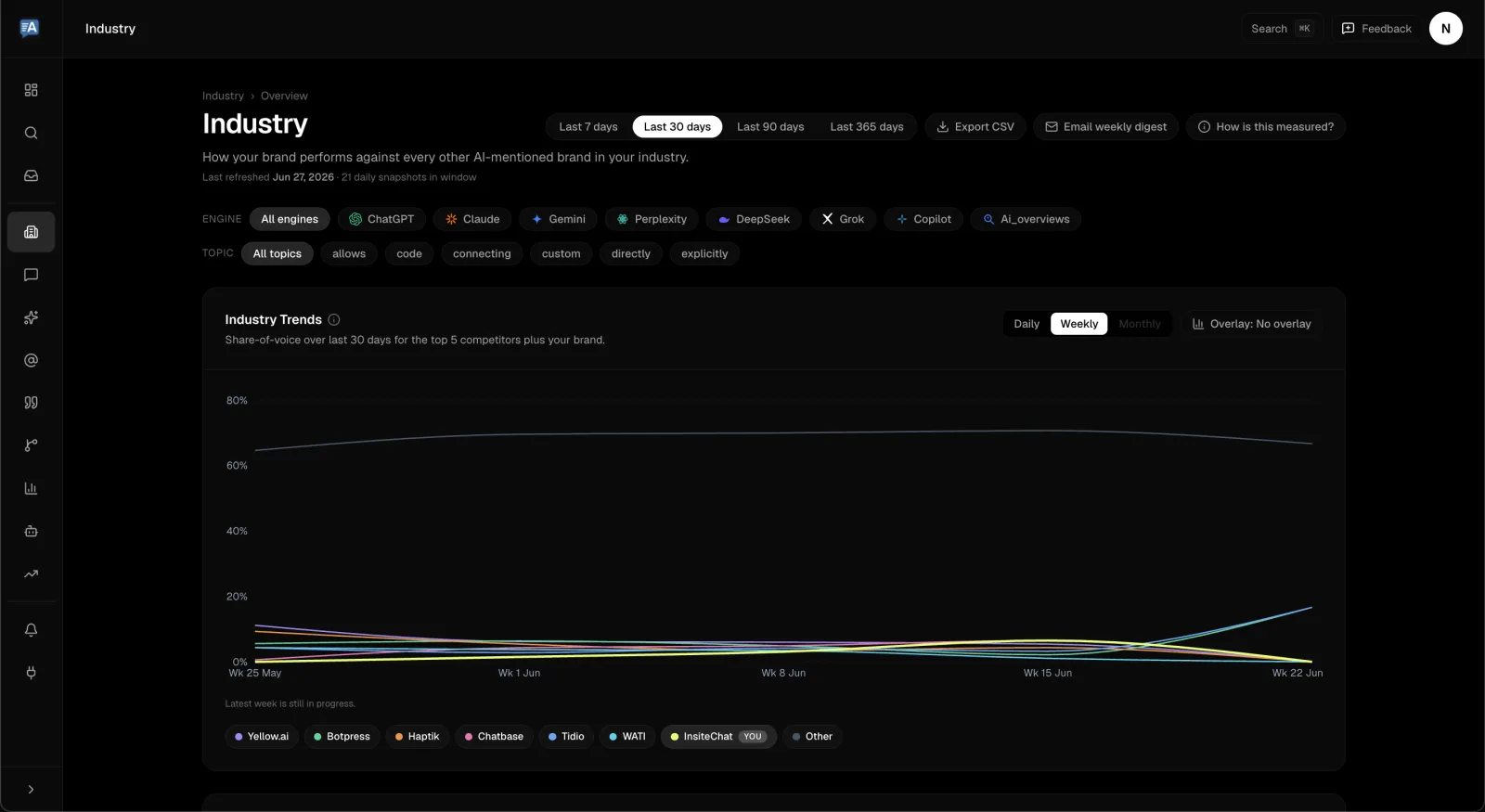
For agencies: the same visibility number, tracked and compared across every client at once instead of one dashboard per account.
FAQ
Is AI visibility the same thing as SEO?
No, though they're related. SEO measures and improves your position in traditional search results (blue links, featured snippets). AI visibility measures whether you're mentioned inside an AI-generated answer — a different surface with a different selection process. Good SEO fundamentals (clear structure, authoritative content, real citations) help both, but ranking #1 on Google doesn't guarantee you'll be named in the AI Overview sitting above it. See AEO vs. SEO for the full comparison.
Which AI engines actually matter for visibility tracking?
The ones with real usage: ChatGPT (900 million weekly users as of February 2026), Google's AI Overviews and AI Mode (rolled into the default Google search experience for most US users), Gemini, Perplexity, and Copilot. Claude, Grok, and Meta AI/DeepSeek matter more in specific verticals or regions. Which subset is worth tracking depends on where your buyers actually spend time — B2B software buyers lean ChatGPT and Perplexity heavily; consumer categories see more Google AI Overview traffic.
How is AI visibility different from just "getting mentioned once"?
A single mention doesn't tell you much, because generative answers vary run to run. Real AI visibility tracking runs the same buying questions repeatedly, over time, across engines, and reports a rate (mention rate, share of voice) rather than a yes/no. One good mention could be a fluke; a 40% mention rate sustained over a month is a signal you can act on.
Can a small company realistically improve its AI visibility, or is this only for big brands with a lot of existing citations?
It's improvable, and being small isn't disqualifying — AI engines pull from structured content, recent reviews, and clear third-party mentions more than from raw domain age or ad budget. That's the actual work of AEO/GEO: structuring content to get selected and earning the citations that feed generative answers. It takes deliberate work, not a marketing budget size.
Do I need to pay for a tool to check my AI visibility, or can I just ask ChatGPT myself?
Asking manually is a fine first gut-check, but it won't give you a rate — you'll see one answer on one day from one account, which tells you little given how much these answers vary run to run. A free scan (ours checks Gemini specifically, no signup) is a reasonable free starting point; a paid tool becomes worth it once you want that measured over time across multiple engines and against named competitors.
What should I actually do if I find out I'm invisible?
Start with the discipline built for exactly this: what AEO is and how it works walks through the specific tactics — structured, answerable content and earning the third-party citations AI engines pull from. Visibility tracking tells you where you stand; AEO is how you move it.
In one paragraph
AI visibility is whether, how often, and how favorably AI engines like ChatGPT, Gemini, Perplexity, and Copilot mention or recommend your brand when someone asks a buying question — a real and growing concern given that ChatGPT alone reaches 900 million weekly users, roughly 9 in 10 brands studied show up nowhere in AI answers, and AI referral traffic converts competitively once it does arrive. It's measured through share of voice, mention rate, citation rate, and sentiment tracked across engines over repeated prompt runs — a distinct discipline from AEO/GEO, which is how you actually improve those numbers. Run a free FixAEO scan to see where you stand — 30 seconds, no signup.
Related reading
What is AEO? Answer Engine Optimization explained
Answer Engine Optimization (AEO) means getting AI assistants to recommend your brand. Learn what AEO is, why it matters more than SEO, and how to start.
18 min readHow to Monitor Competitor Mentions in AI Search
A practical guide to tracking which competitors AI engines name for your category — why manual checks don't scale, and how continuous tracking works.
26 min readAI Search Statistics 2026: How AI Replaces Google
20+ verified, source-linked AI search statistics for 2026 — who uses AI vs Google, how fast it's growing, and the viral stats that don't hold up.
16 min readAEO vs SEO: what changed and what to do about it
AEO vs SEO in 2026: AI answers and search engines reward different signals. The data, a plain comparison, and a 30-day migration plan your SEO team can run.
17 min readHow to measure AEO ROI: a copy-paste spreadsheet
Measure AEO ROI with attributable visits, conversion rate, gross profit, and cost. Includes a transparent worked example, spreadsheet layout, and limitations.
13 min readWhy ChatGPT doesn't recommend your brand
ChatGPT SEO fix: six reasons ChatGPT names competitors instead of you, ranked by frequency across 1,000+ FixAEO scans — with a fix for each and a 30/60/90 day plan.
17 min read
Free AEO tools
Put this into practice with free FixAEO tools — no signup required.
AI Visibility Checker
Score your brand across 9 AI engines
AEO Audit Tool
Answer-engine readiness scan
Schema Generator
Build valid JSON-LD structured data
llms.txt Generator
Create a spec-compliant llms.txt
Sitemap Validator
Check your XML sitemap for errors
AI Content Grader
Grade content for AI citation readiness