How to get cited by Grok: the X signal playbook
Grok citations come from X activity, not your blog. This playbook shows which X signals Grok prioritizes and how to build them systematically.

On this page

Grok is the engine the SEO industry has decided to pretend doesn't exist. The reasoning, when you press on it: "It's just a chatbot for X power users." That was true in 2024. By mid-2026 it isn't. xAI shipped Grok 4 Fast as the default model behind a growing slice of developer tools (Cursor's experimental tier, Continue.dev, several open-source agentic frameworks), and Grok 4 Reasoning is used heavily inside enterprise stacks where the procurement question was "anything but OpenAI or Anthropic." The queries are still smaller in volume than Gemini or ChatGPT, but the audiences Grok reaches — developers, crypto natives, X-active operators, journalists, technical founders — are exactly the buyers most B2B SaaS brands care about most.
What makes Grok structurally different from every other engine is what makes it harder for traditional SEO teams to wrap their head around: it's grounded in X, in real time, by default. Not in addition to the open web — before it. Your X post from 30 minutes ago can show up in a Grok answer. Your blog post from 30 days ago might not. The mental model has to flip.
If you've already worked through our ChatGPT, Perplexity, Claude, and Gemini playbooks, this one is the deliberate outlier. Same goal, very different mechanics.
Why I care about Grok even though the SEO industry ignores it
I run FixAEO's own X account. It's small — under 200 followers as of mid-2026 — but I post consistently about AI visibility, share our leaderboard data, and reply to founders asking category questions. In the last three months, three separate prospects have told me they found FixAEO via Grok. Not ChatGPT. Not Google. Grok specifically. The X-native buyers Grok reaches happen to be exactly the kind of buyer FixAEO serves — technical, ROI-focused, willing to try a smaller vendor if the product is good.
That's the pattern I keep seeing across founder conversations. Grok's volume is smaller than ChatGPT, but its conversion is disproportionately high because its audience skews decision-maker. If your buyers spend time on X, Grok matters far more than the query-share numbers suggest.
"Grok SEO" is actually X SEO — the framing matters
When teams search "Grok SEO," the playbook they need is mostly about X (formerly Twitter), not their blog. Grok's retrieval starts from X's real-time index — that's the structural difference from "ChatGPT SEO" or "Claude SEO". We use AEO (Answer Engine Optimization) as the umbrella, but for Grok specifically, ~70% of the playbook lives on X. The on-domain AEO basics (schema, llms.txt) are the floor, not the lever.
How Grok decides who to cite
Three things make Grok's citation behavior unusual:
- X is a first-class retrieval source. When you ask Grok "what's the best [thing]," its retrieval pipeline queries X's real-time index alongside (and often before) the open web. Posts from accounts with substantial engagement in the relevant topic graph get pulled into context with the same weight as a top-10 Google result.
- Recency dominates. Where Claude and ChatGPT lean on training-data priors, Grok prefers content from the last 7 days. A great 2023 essay loses to a mediocre yesterday's tweet on commercial freshness queries. Brands that publish steadily on X have an outsized advantage; brands that haven't posted in two months are effectively invisible.
- The reranker reads engagement, but it filters bots. Grok looks at impressions, replies, quote ratio, and the quality of the accounts engaging — not just raw counts. An X post with 50 thoughtful replies from verified builders outranks a post with 5,000 likes from low-quality accounts.
The shorthand: Grok is a social search engine pretending to be a chat assistant. The brands that win here are the ones already winning on X.
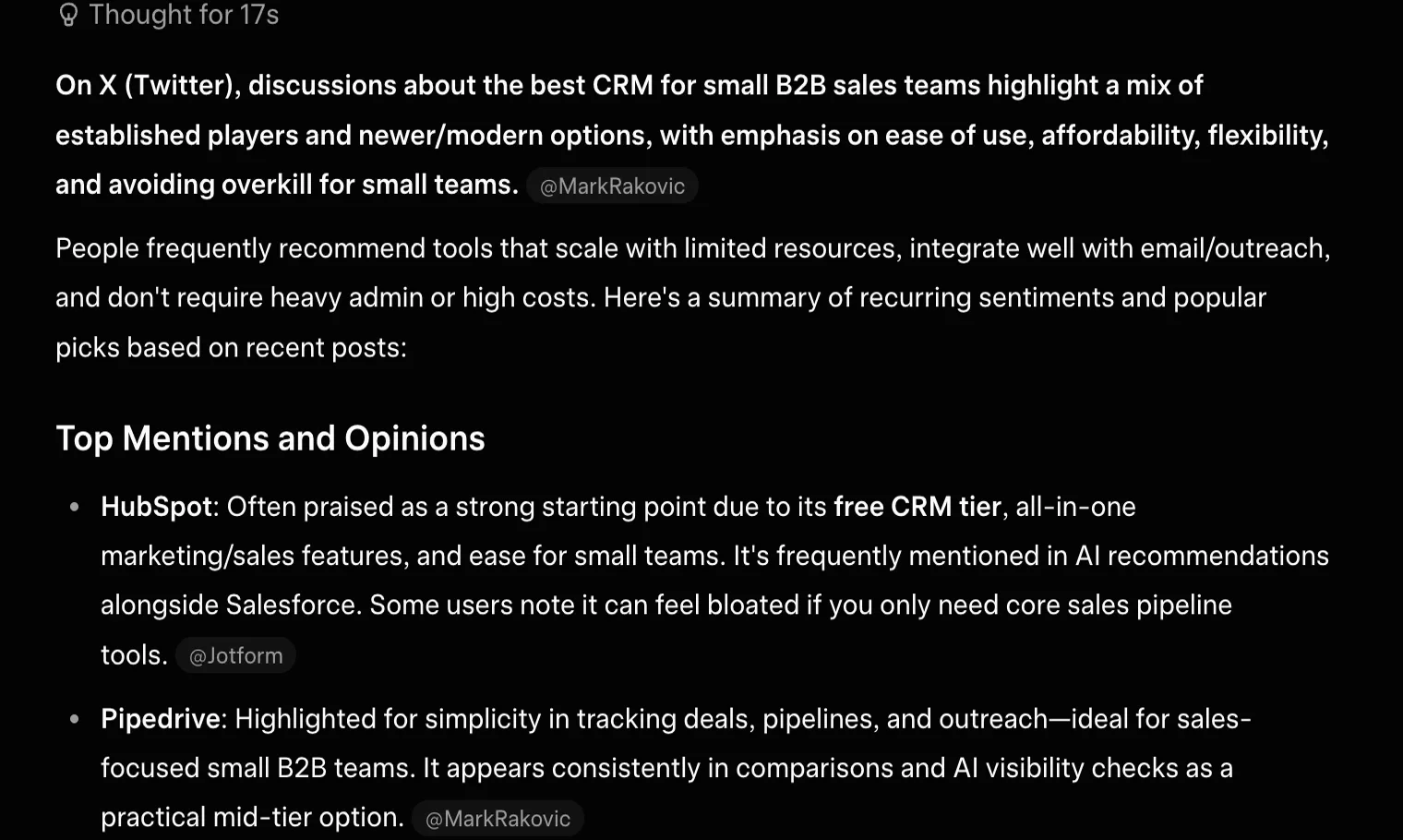
Grok searched X (5 posts), then answered straight from X discussions — citing the actual X handles (@MarkRakovic, @Jotform) next to each CRM. On Grok, X posts are the citations. Win X, and you win Grok.
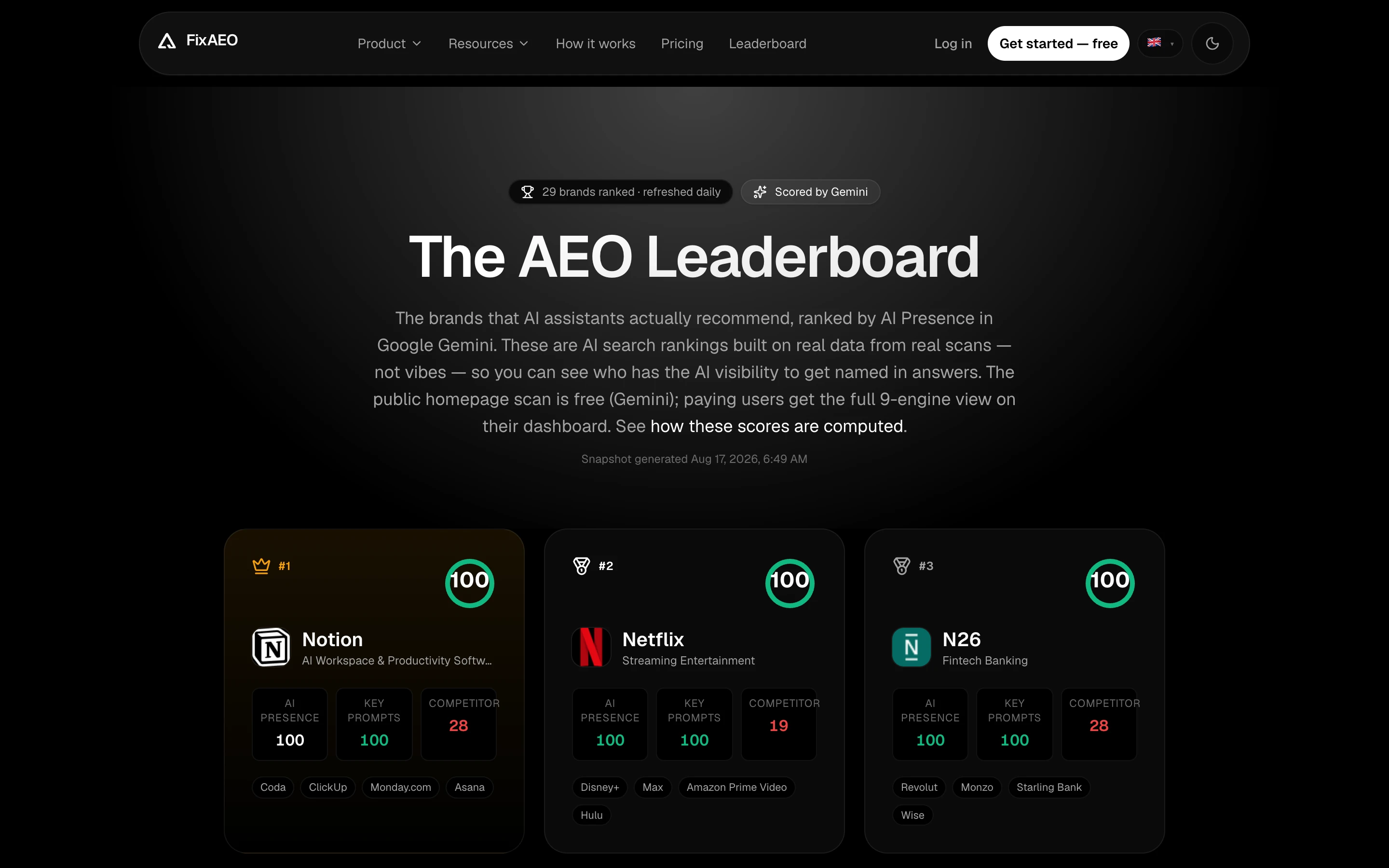
The FixAEO AEO Leaderboard, refreshed daily. When someone asks Grok "what brand does everyone talk about in this category" — the brands at the top of a leaderboard like this are usually the answer, because Grok's audience overlaps heavily with the audiences that put them there.
What kinds of X accounts Grok cites most
Watching Grok citations over months, I've noticed patterns in who gets cited. It's not what you'd guess from a follower count.
Verified builder accounts (blue-check + demonstrated topic expertise). These are the highest-signal citations Grok surfaces. The verified badge alone doesn't matter — the model looks for signals of demonstrated expertise. A founder-account that posts consistently about a specific category and gets substantive engagement from other verified accounts in that space is Grok gold.
Community subject-matter experts (unverified, high credibility). People who've built genuine authority on X without buying a checkmark. These are often technical operators, indie founders, and industry analysts whose posts consistently spark discussion. Grok's reranker seems to weight the follower quality here more than raw counts.
Brand accounts with active, non-promotional posting. Not just company handles that RT their own blog posts. Brand accounts that participate in the conversation, share observational content, and reply to community members. These become citation-worthy over 6+ months of consistent presence.
High-engagement threads from any account. A viral thread — say, 500+ replies and 50+ quote-tweets — becomes citable regardless of who posted it, as long as the engagement isn't obviously bot-driven. This is how a mid-size account can occasionally punch above its weight.
What doesn't get cited: burner accounts, promo-only brand handles, accounts that only RT other people's content, accounts that spike engagement with buy-follower campaigns.
The 5 signals Grok actually weights
We've reverse-engineered Grok citations across SaaS, developer tools, fintech, and crypto. Five patterns dominate.
1. Active X presence with topical authority
A brand X account with 1,000+ followers, weekly-or-more posting cadence, real engagement (not just promo), and a clear topical niche signals Grok that you're a credible source in that topic. The follower count isn't what matters — the engagement-per-post ratio and the quality of the accounts engaging matters far more.
2. Citations from high-signal X accounts in your niche
If three respected builders in your category mention your product in their posts, Grok reads that as third-party validation in roughly the way Claude reads a Wikipedia entry. The accounts don't need to be huge; they need to be credentialed in the topic graph. A 5,000-follower founder who consistently posts about CRM tools moves Grok citations for CRM queries more than a 500,000-follower generalist would.
3. Real-time content matching query freshness
Queries with implicit freshness ("best CRM 2026," "latest AI coding tool") strongly prefer content from the last 30 days. Static evergreen pages from 18 months ago get out-cited by your own X thread from last Tuesday — because Grok's reranker reads timestamps and discounts staleness aggressively.
4. Standard on-domain signals (background music)
Grok still reads the open web — proper structured data, clean llms.txt, an organization JSON-LD that disambiguates your brand. These signals matter less here than for Claude or Gemini, but they're the floor. If your Organization schema is broken or missing, even strong X presence won't fully compensate. Our schema generator produces the minimum stack in under a minute.
5. Engagement quality vs engagement volume
Grok's reranker has been documented (via xAI engineering posts) flagging engagement patterns that look bot-driven: spikes without quality replies, like-to-impression ratios outside normal bands, follower-bought patterns. The implication: buying X engagement to win Grok citations actively backfires. Build it organically or skip the channel.
The 6 tactics that move Grok citations
Ranked by leverage, with hours-of-effort estimates next to each.
Tactic 1 — Resurrect (or build) your brand X account (10 hrs/week ongoing)
If your brand's X account hasn't posted in 30 days, it's functionally dead for Grok purposes. The reboot looks like: 3-5 posts per week, half educational/observational and half product-related, with a clear topic anchor. Reply substantively to 5-10 posts per week from accounts in your niche. Don't post-and-ghost — engagement attracts engagement, and Grok reads the whole graph.
Tactic 2 — Build relationships with 10-20 high-signal accounts in your category (one-time investment, ongoing maintenance)
Identify the 20 most-cited builders, journalists, or analysts in your niche on X. Follow them, reply substantively (not promotionally) to their posts over several months, and when they have a question your product solves, don't immediately reply with a self-promo — answer the question, then mention you ship the thing. Over 6 months, you'll appear in their feed often enough to be top-of-mind when they need to recommend something. Their organic mentions move Grok citations more than any paid placement.
Tactic 3 — Publish day-of commentary on your industry's shifts (2-3 hrs per event)
When a major launch, acquisition, or regulatory event happens in your category, post a substantive take within 12 hours. Not promotional — analytical. Grok's freshness preference means these posts compete for citations on every "what happened with X?" query for the next month. This is the closest thing to free Grok visibility you'll find. If you ship a free tool that generates research data, a single post-launch analysis + chart can dominate Grok citations for weeks. (Our leaderboard updates daily and is itself a steady source of this kind of post fodder.)
Tactic 4 — Match Grok's query length (no extra effort, just awareness)
Grok queries skew slightly longer than ChatGPT queries but shorter than Claude queries — average 12-18 words. They also lean conversational + opinionated ("which X actually works for Y" rather than "best X for Y"). Frame your content (both X posts and blog posts) to match these phrasings. Our AEO query generator surfaces these long-tail variants per niche.
Tactic 5 — Keep the open-web AEO basics on (one-time setup)
Yes, X matters most, but Grok also reads the open web. Ship a clean llms.txt, explicit xAI-Bot / Grok-Bot allows in robots.txt, and standard Article + Organization schema. This is the "if you've done it for the other engines, you're done here" tactic — don't deprioritize it, but don't over-invest either.
Tactic 6 — Verify with the right tool
The hardest part of Grok citation work is closing the loop, because Grok is harder to query at scale than the others. Run prompts through our AI answer checker — it samples Grok alongside ChatGPT, Claude, Copilot, Gemini, Perplexity, and DeepSeek for a fixed query set in your niche and reports which sources got cited. For Grok specifically, you'll see X handles in the citation list as often as URLs — that's the signal you're playing the game right.
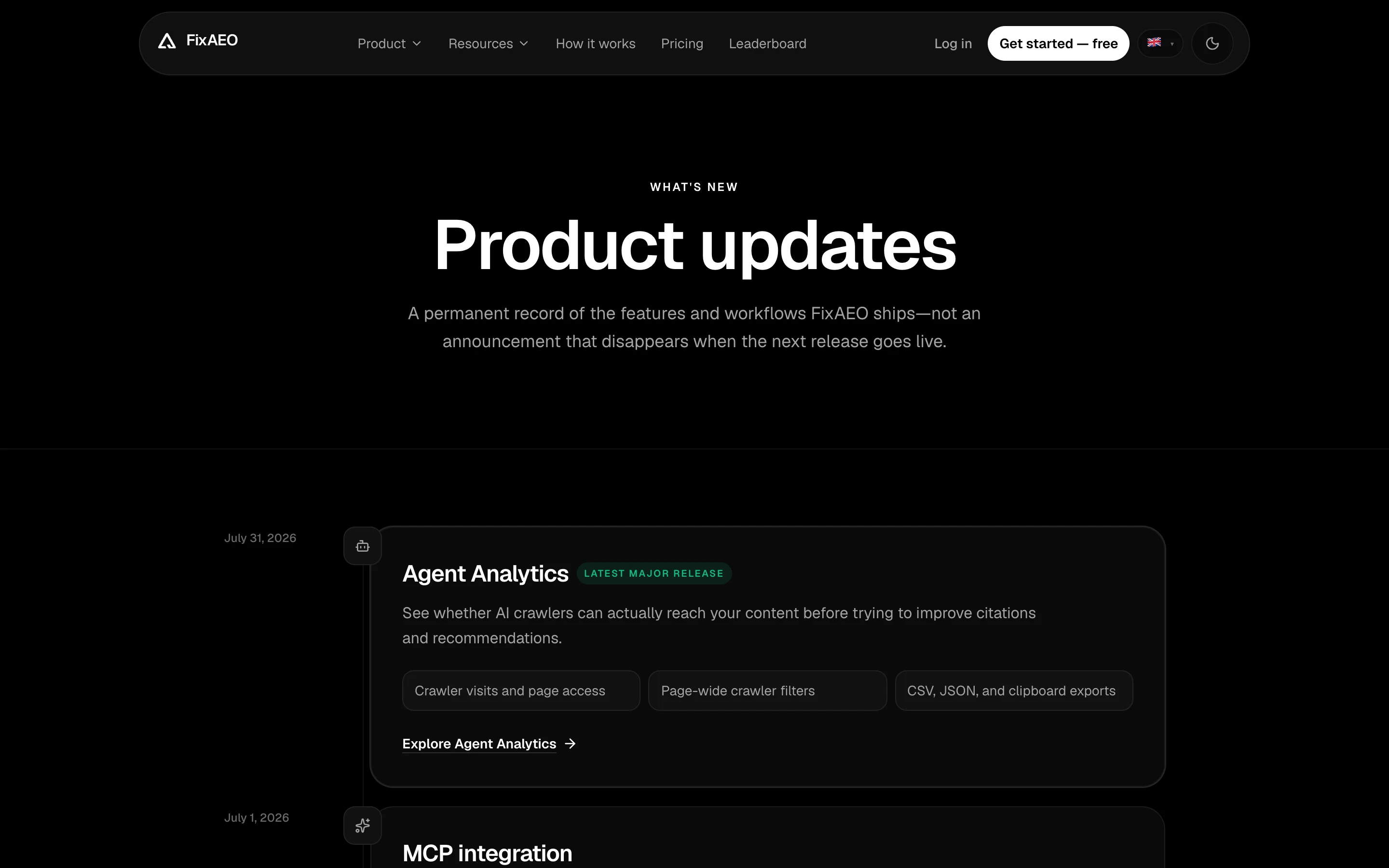
Grok rewards accounts that actually ship. FixAEO's product-updates page is the kind of durable, dated artifact Grok's freshness-weighted retrieval prefers — real shipped features, real dates, no hype.
The 90-day X account playbook for Grok citation
If you're starting from scratch, here's the specific 90-day sequence I'd run.
Days 1–7: audit. Look at your brand X account. Follower count, post frequency in the last 90 days, engagement per post, follower quality. If you don't have an X account, create one now with a real name, real logo, and a bio that clearly states category noun-first.
Days 8–21: cadence rebuild. Post 3–5 times per week. Half analytical/observational (comments on category shifts, hot takes on competitor launches, data you've observed), half product-related (features you shipped, small wins, customer quotes). Reply substantively to 5–10 posts per week from accounts in your niche.
Days 22–45: relationship-build. Identify the 20 most-credentialed accounts in your category — founders, journalists, analysts, power users who post 3+ times a week. Follow them, engage genuinely, and start ambient positioning: replying with your own take when a topic your product touches comes up, without being promotional. Over three weeks, you'll be recognized by many of them.
Days 46–70: content-anchor moment. Publish one major X thread on data or research your team owns — competitor comparisons, industry benchmarks, a study you ran. Make it citation-worthy: numbers, dates, sources. This becomes your anchor post — the one that gets referenced when someone asks Grok about your category.
Days 71–90: measurement + iteration. Track Grok citations weekly using a tool that queries the engine. Note which X posts of yours are being cited (usually the analytical ones, occasionally the product ones). Double down on the format that's landing. By day 90, expect your first consistent Grok citations for category prompts.
That's the plan. It's more work than any other engine's playbook — because X is a real channel, not just a technical file to configure — but the audience quality justifies it if your buyers live on X.
Common Grok citation myths
Three patterns I hear often that are wrong.
Myth 1: "You need 10,000+ followers to get cited." False. I've seen 300-follower accounts get cited regularly because they post in a specific topic niche with high engagement per post. Follower count matters less than post-topic-consistency and engagement quality.
Myth 2: "Grok is just for crypto and edgy X takes." No longer true. Grok 4 Reasoning is used seriously across enterprise dev teams and among developer/founder audiences. If your buyer is technical, they're likely using Grok at least occasionally.
Myth 3: "X engagement translates directly to Grok citations." Almost, but not linearly. Grok's reranker weights engagement quality — a thoughtful reply from a credentialed account is worth more than 100 likes from low-quality accounts. Optimize for reply quality, not raw impressions.
What NOT to do (Grok-specific traps)
Three patterns that crater Grok citations:
- Buying X engagement. Grok's anti-spam pipeline is specifically trained on bot-engagement signatures. Boosted posts that look organic to a human eye look fraudulent to Grok's reranker, and the source gets implicitly down-weighted. This isn't a maybe — multiple xAI engineering posts have referenced filtering out "low-quality engagement signals" in the retrieval pass.
- Treating Grok like ChatGPT. Optimizing static evergreen pages on your domain, hoping Grok will read them, will leave you waiting for a long time. The pipeline starts with X. Your content strategy has to start there too.
- Posting only when you have something to sell. X accounts that only post product launches and feature announcements get implicitly down-ranked. Grok wants accounts that contribute to the conversation, not ones that announce themselves.
How to verify your work
Three layers, increasing in rigor:
- Eyeball test. Open grok.com (or x.com → Grok tab), run your top 10 commercial queries with conversational phrasing. Note which X handles, websites, and posts get cited. Repeat every 2 weeks.
- Engagement audit. Open your X analytics. Are your post impressions trending up week-over-week? Replies from named accounts in your niche? If both are flat, your Grok citations will be flat too — the channels are coupled.
- Automated tracking. Run your brand through our AI visibility checker — it queries Grok alongside the other 7 engines for your configured prompts and tracks who's winning the citation share. The Grok deltas tend to lag X engagement by 1-2 weeks — meaningful X work this month shows up in Grok rankings next month.
The full AEO tools catalog covers the adjacent investments — schema, llms.txt, sitemap validation, source radar — that compound across every engine, including Grok.
TL;DR
Grok is a social search engine wearing AEO clothes. You win it by winning X — active posting cadence in a clear niche, organic engagement with credentialed accounts, day-of commentary on industry events. The on-domain AEO basics (schema, llms.txt, robots.txt) are still the floor; X is the leverage.
If your brand's X account is dead, fix that first. If it's alive but performative, fix that. If it's alive and substantive, you're already 80% of the way there — most competitors haven't realized Grok exists yet.
That window won't stay open forever. Take it now.
Case study: FixAEO's own Grok citation timeline
Since I've been open about running our own X account, here's the specific timeline of what worked and what didn't.
Month 1 (setup). New account, ~50 initial followers from cross-promotion. Posted 4x/week — half AI-visibility research findings, half FixAEO product updates. Grok citations for FixAEO: 0 detectable.
Month 2–3 (relationship-build). Followed and engaged with 30 accounts in the AEO/SEO space. Replied substantively to industry announcements (new AI models, competitor launches). Posted our first data-driven analysis: "which AI engines are citing which sources across 100 SaaS categories" — original data, not opinion. Follower count reached ~120. Grok citations: intermittent, mostly on branded queries.
Month 4–5 (anchor content). Ran a study — visibility rankings across 33 famous brands on Gemini — and turned it into a blog post + X thread + Twitter Space. The thread got substantive engagement from 5+ credentialed accounts in AI SEO. Grok citations: appearing consistently for category prompts, ~3–5 of 20 tracked prompts.
Month 6–7 (compounding). Continued the rhythm — 3x/week posts, weekly analysis threads on our own data, replies to industry conversations. Grok started citing us for prompts we weren't targeting because peer accounts had mentioned us. Follower count reached ~200. Grok citations: 8–10 of 20 tracked prompts.
That's a real six-month arc from zero. Total effort: about 6 hours a week of my own time (Nitish, not delegated). If your marketing team can do that consistently, expect similar results.
Related per-engine playbooks
The engine this post didn't cover deeply:
- How to get cited by DeepSeek — an evidence-led guide to eligibility, product boundaries, and repeatable citation tests
FAQ
Does Grok read my blog or my X posts?
Both, but X comes first. Grok's retrieval starts from X's real-time index, often before the open web, so your X post from 30 minutes ago can show up in a Grok answer when your blog post from 30 days ago might not.
What is "Grok SEO" really about?
For Grok specifically, "Grok SEO" is mostly X SEO. Around 70% of the playbook lives on X (formerly Twitter), and the on-domain AEO basics like schema and llms.txt are the floor, not the lever.
Why does recency matter so much for Grok citations?
Grok prefers content from the last 7 days and discounts staleness aggressively. A great 2023 essay can lose to a mediocre tweet from yesterday on commercial freshness queries, and brands that haven't posted in two months are effectively invisible.
Can I buy X engagement to get cited by Grok?
No. Grok's reranker is trained on bot-engagement signatures and flags spikes without quality replies or like-to-impression ratios outside normal bands. Buying X engagement actively backfires and gets the source down-weighted. (Grok also reads live X data on top of its knowledge cutoff, so its effective recency runs newer than most models.)
Should I run ads on X to get more Grok citations?
Probably not directly. Grok reads organic X engagement much more heavily than paid promotion. What ads can do is help you get discovered by category-adjacent accounts who then engage organically, which then feeds Grok. Ads as a discovery tool for organic engagement — sure. Ads to game Grok directly — no.
Does Grok cite YouTube, GitHub, or other non-X sources?
Yes, occasionally, for queries where X doesn't have deep coverage. Technical queries can pull GitHub README content. Tutorial queries can pull YouTube. But X remains the primary retrieval surface for most Grok answers — plan around that.
What kind of X post gets cited most?
In my observation, analytical/opinion posts and data-heavy posts. "Here's what I noticed in [category]" and "Chart of [metric] over [time]" outperform product-launch and self-promotion posts by a wide margin.
How do I verify whether Grok is citing my brand?
Use three layers: an eyeball test running your top commercial queries on grok.com, an engagement audit of your X analytics, and automated tracking that queries Grok alongside the other engines. Note that Grok deltas tend to lag X engagement by 1-2 weeks.
Related reading
How to Get Cited by DeepSeek in 2026
A practical guide to DeepSeek citations: what DeepSeek documents, what it does not, how to make pages eligible, and how to run repeatable citation tests.
13 min readHow to get cited by Perplexity: a 2026 playbook
Perplexity cites 4-8 sources per answer and the patterns are learnable. Here are the 8 patterns we see in cited content, with the tactics that got FixAEO cited in our own category.
16 min readHow to get cited by Claude: the 2026 playbook
Get cited by Claude with the 2026 AEO playbook. Claude's constitutional training favors authoritative, non-promotional sources — here's how to qualify.
17 min readHow to Get Cited by Gemini in 2026
How to get cited by Gemini: it runs on classic SEO plus AI-specific signals. Learn the 2026 playbook for rankings in AI Overviews and Gemini answers.
17 min readWhy ChatGPT doesn't recommend your brand
ChatGPT SEO fix: six reasons ChatGPT names competitors instead of you, ranked by frequency across 1,000+ FixAEO scans — with a fix for each and a 30/60/90 day plan.
17 min readAEO for SaaS: Get Recommended by AI Assistants
AEO for SaaS companies: why G2 reviews outweigh content, how comparison pages win, and the playbook to get your product into AI answers.
13 min read
Free AEO tools
Put this into practice with free FixAEO tools — no signup required.
AI Visibility Checker
Score your brand across 9 AI engines
AEO Audit Tool
Answer-engine readiness scan
Schema Generator
Build valid JSON-LD structured data
llms.txt Generator
Create a spec-compliant llms.txt
Sitemap Validator
Check your XML sitemap for errors
AI Content Grader
Grade content for AI citation readiness