AI Visibility: 11 Brands Gemini Names Every Time
33 brands tested on Google Gemini: 11 hit perfect AI visibility, but share of voice reveals the real gaps. See the data — then scan your own brand free.

On this page

We asked Google's Gemini a handful of plain buying questions about 33 brands. We never named the brand in the question. Eleven of them got named every single time. One got named in only a quarter of its questions.
That spread is the story. But it's only half of it. The more interesting number isn't whether Gemini names you. It's whether, when Gemini lists brands, it's you it keeps picking versus your competitors. That gap between being named and being chosen is the core problem answer engine optimization (AEO) sets out to fix.
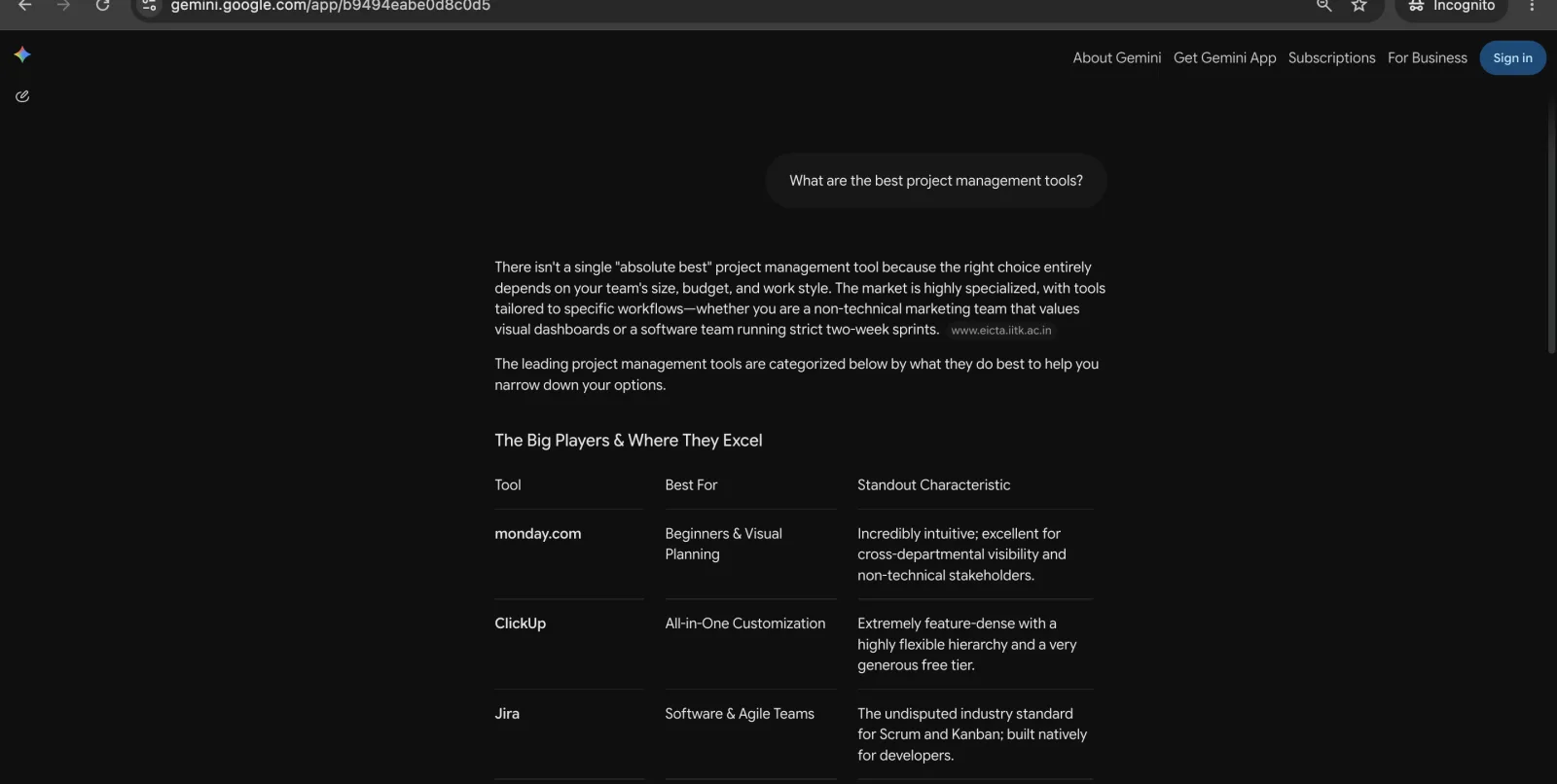
Example: Gemini answering a category query — monday.com, ClickUp, Jira, Asana. The study below measures which brands Gemini surfaces like this, across 33 names.
How we measured this
We ran real FixAEO free scans on Google Gemini only between 2026-06-01 and 2026-06-06, across 33 brands on FixAEO's curated public seed list. For each brand we asked 8 category questions that never mention the brand by name — 264 questions in total. Then we scored two things:
- AI Visibility — of those un-named category questions, the percent where Gemini named the brand.
- Share of Voice — of all the brand mentions Gemini made across those questions, the percent that were the brand itself. A low score means competitors got named more.
Both run 0 to 100. Both come straight from the scan. This is Gemini-only, and scores move week to week as Gemini's answers shift. If you want to move these numbers, our guide to getting cited by Gemini walks through the same engine we measured here. Full method is open at fixaeo.com/methodology.
These are measurements, not verdicts.
Why we ran this study
Studies like this exist because the industry conversation about AI visibility is heavy on speculation and light on data. I've read a dozen articles claiming "brand X dominates AI search" without the underlying scans to back it. So we ran the numbers on 33 real brands using our production scanner and published them.
The choice of Gemini specifically was deliberate. It's the engine where we see the most public-facing category questions handled well (thanks to Google's search index behind it), and it's the engine whose behavior most closely mirrors what a typical buyer encounters when they ask an AI a shopping question. If your brand wins on Gemini, it likely wins on other engines too — and if it loses on Gemini, the diagnostic is easier to run.
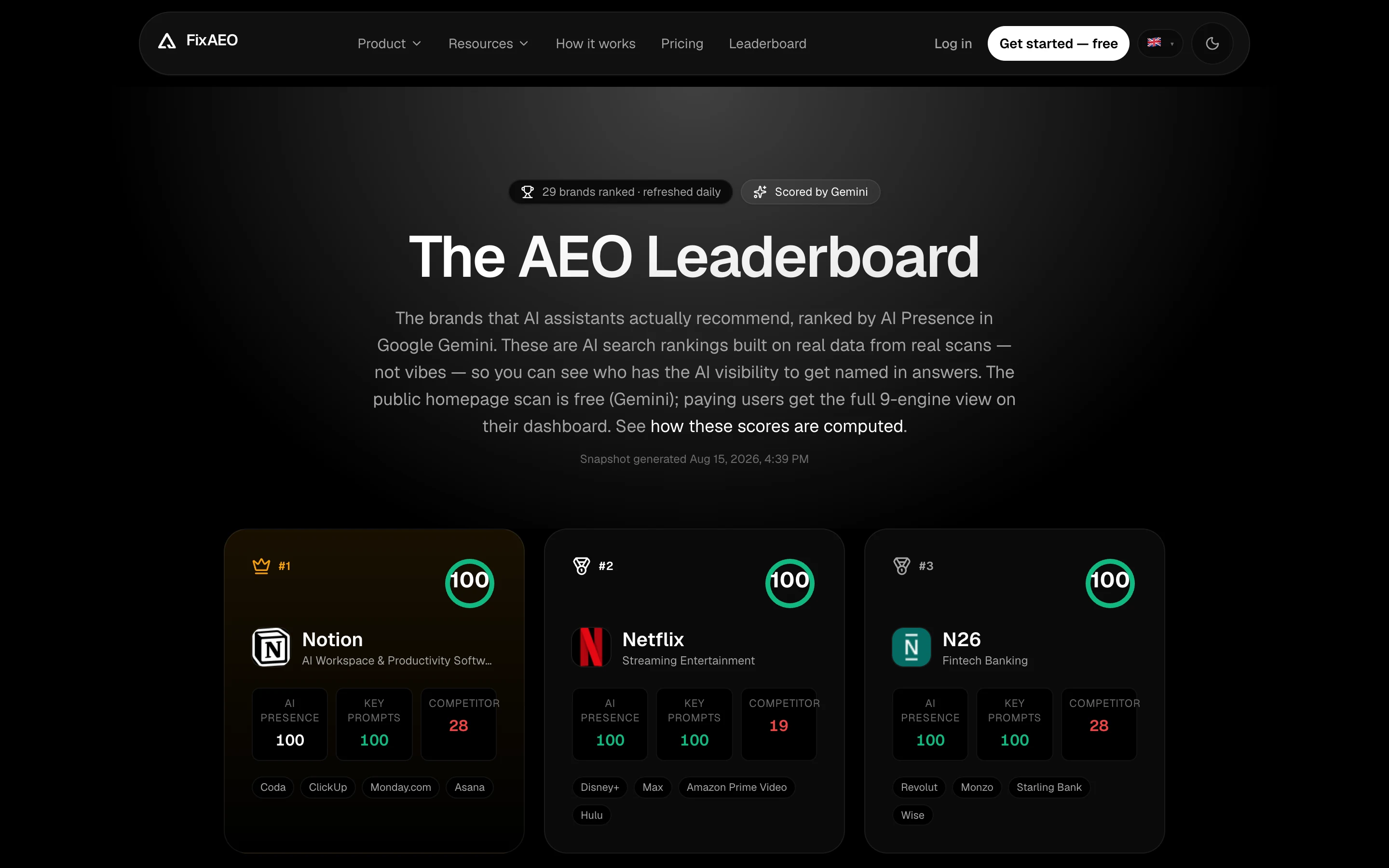
The live public version of this study: FixAEO's AEO Leaderboard refreshes daily and shows the current AI Presence ranking on Gemini across the tracked brands.
The full leaderboard
| Brand | AI Visibility | Share of Voice | Category |
|---|---|---|---|
| Wise | 100 | 36 | Fintech / money transfer |
| WHOOP | 100 | 28 | Wearable fitness |
| Shopify | 100 | 24 | E-commerce platform |
| Slack | 100 | 32 | Team collaboration |
| Spotify | 100 | 24 | Music streaming |
| Airtable | 100 | 47 | No-code / database |
| Vercel | 100 | 22 | Cloud dev platform |
| Figma | 100 | 27 | Design software |
| Y Combinator | 100 | 23 | Startup accelerator |
| Stripe | 100 | 34 | Fintech infrastructure |
| Oura | 100 | 21 | Wearable health (ring) |
| Notion | 87 | 30 | All-in-one workspace |
| Uber | 87 | 35 | Ride-sharing/delivery |
| Canva | 87 | 36 | Graphic design |
| OpenAI | 87 | 46 | AI research |
| Netflix | 87 | 20 | Streaming |
| New York Times | 87 | 26 | Media/publishing |
| G2 | 87 | 22 | Software review site |
| GitHub | 87 | 35 | Dev platform |
| Zoom | 75 | 20 | Video collaboration |
| Cloudflare | 75 | 31 | Internet infra/security |
| Hugging Face | 75 | 50 | AI/ML platform |
| PayPal | 75 | 22 | Online payments |
| Revolut | 75 | 31 | Fintech / neobank |
| Airbnb | 75 | 30 | Travel lodging |
| N26 | 62 | 17 | Fintech / neobank |
| Discord | 62 | 23 | Communication |
| Wikipedia | 62 | 55 | Online encyclopedia |
| Asana | 62 | 27 | Project management |
| Anthropic | 50 | 44 | AI safety/research |
| Linear | 37 | 9 | Product dev / issue tracking |
| Booking.com | 37 | 23 | Travel OTA |
| Zara | 25 | 18 | Fashion retail |
Gemini: AI Visibility vs Share of Voice (33 brands)
What stood out
11 brands got named every single time
Across category questions that never mention them, 11 of the 33 brands hit a perfect AI Visibility of 100: Wise, WHOOP, Shopify, Slack, Spotify, Airtable, Vercel, Figma, Y Combinator, Stripe, and Oura. Gemini named each of them in every key prompt we ran — the kind of result AEO for SaaS brands is built around.
The median across the whole set sits at 87.1 So getting named most of the time is common. Getting named every time is rarer. Eleven brands cleared that bar.
Visibility and Share of Voice are two different axes
Here's the catch. A perfect 100 on visibility tells you Gemini knows you exist and recommends you. It does not tell you how much of the conversation you own.
The highest Share of Voice scores went to Wikipedia at 55, Hugging Face at 50, and OpenAI at 46. None of those three scored 100 on visibility. Share of Voice and visibility are two different things — one is how often you're named, the other is how often you're the one chosen. They aren't named in every single question, but the questions where they do appear show a high share of their mentions going to them rather than competitors.
That's the whole point: being visible is not the same as owning the conversation.
A perfect visibility score still doesn't mean a dominant share
Look at the 11 brands at 100 visibility. Their Share of Voice ranges all over the map. Airtable holds 47. Vercel sits at 22. Oura sits at 21.
Same perfect visibility. Very different share of the conversation. Airtable gets named more than twice as often, relative to its competitors, as Oura does in its category. This is the clearest proof that the two numbers measure different things, and both are worth watching.
Linear scored 37 with the lowest Share of Voice in the set: 9
We asked Gemini: "What are the best project management tools for software development teams?" It named Jira, Zenhub, GitHub Projects, and Azure DevOps. Linear was not in that answer.
Its Share of Voice of 9 is the lowest of all 33 brands. In a category where competitors currently get named more, that reads as a clear opportunity to grow.
Zara scored 25, the lowest visibility here, and Gemini led with ASOS
We asked: "Where can I find trendy yet affordable women's fashion for everyday wear?" Gemini led with ASOS, not Zara.
Zara did surface — but only when the question was specifically about "popular global retailers known for up-to-date fashion collections," where it was named as a fast-fashion example. So Gemini knows Zara as a fast-fashion descriptor. It rarely recommends Zara for actual shopping intent. At 25 it's the lowest in this set, which reads as room to grow on buying-intent questions.
The EU fintech ladder: Wise 100, Revolut 75, N26 62
Among the EU neobank and money-transfer brands, the three step down cleanly on AI Visibility: Wise at 100, Revolut at 75, N26 at 62.
Gemini named Wise across money-transfer and multi-currency questions — "Services like Wise ... are frequently recommended," and "The Wise Multi-Currency Card is highly regarded" — often alongside Revolut. N26 also carries one of the lowest Share of Voice scores at 17, second only to Linear.
Europe shows up across the whole range
Eight of the 33 brands are EU-based, and they span nearly the full set: Wise (100), Spotify (100), Oura (100), Revolut (75), Hugging Face (75, US/FR), N26 (62), Booking.com (37, see caveat below), and Zara (25). Europe is well represented at the top of Gemini's answers, not just the bottom.
One note on Booking.com: its auto-generated questions drifted to flights, car rental, and airport taxis — beyond its core hotel business — which partly explains the 37. We mention it only with that caveat.
What the top 11 have in common
Look at the 11 brands with perfect 100 AI Visibility: Wise, WHOOP, Shopify, Slack, Spotify, Airtable, Vercel, Figma, Y Combinator, Stripe, Oura. What do they share? Five patterns emerged when we looked at their sites.
1. They own a category noun that maps to their name. "Stripe" = payments infrastructure. "Figma" = design software. "Airtable" = no-code database. When a category has a canonical noun and a brand owns it, AI engines can't help but name that brand in category answers.
2. Wikipedia coverage. All 11 have well-developed Wikipedia entries with clean category descriptions and citation links. Wikipedia is one of the strongest AI signals — the model uses it to disambiguate brands and slot them into categories.
3. Comparison-page coverage on third-party sites. Every one of these brands appears in "best of" roundups on G2, Capterra, Product Hunt, and industry pubs. When AI engines look for category leaders, they find these brands' names in dozens of third-party lists.
4. High-quality llms.txt or structured schema. We checked — the sites we could crawl had substantial Organization schema, and several had visible llms.txt files. The technical AEO floor was solid.
5. Distinctive product marketing that names the category. Their homepages don't try to be everything; they lead with a specific noun ("financial infrastructure," "sleep tracker," "collaborative design tool"). That clarity feeds directly into how AI engines describe them.
If you're not in this top tier, the takeaway is concrete: work on category-noun ownership, earn a Wikipedia mention, and get into third-party comparison pages. It's not glamorous, but it's what separates the 100s from the 62s.
The Linear puzzle: winning SEO, losing AEO
Linear scored 37 on AI Visibility with a Share of Voice of 9 — the lowest of any brand we tested. That's a brand with strong SEO, high-quality content, an active founder audience, and a clear category position (developer-first project management). Why does Gemini keep naming Jira and GitHub Projects instead?
Three likely reasons, in order of impact:
Reason 1: Third-party lists lag. Category comparison articles ("best project management tools for developers") are dominated by older sources that predate Linear's rise. AI engines pull from those lists, and until enough new lists reflect Linear's position, the old canonical answers persist.
Reason 2: Wikipedia entity thinness. Linear's Wikipedia entity is thinner than Jira's or GitHub's — less category context, fewer citation-worthy paragraphs. AI engines use Wikipedia heavily for category slotting.
Reason 3: Product-marketing clarity vs category taxonomy. Linear's positioning ("The issue tracker built for modern software teams") is strong but requires an extra inferential step from "project management" queries. Jira is named "project management software" in half its marketing; Linear positions itself in a slightly different vocabulary.
The fix for Linear (or any brand in a similar spot) would be a coordinated push: an updated Wikipedia entity, pitches to update the top 20 "best project management tools" articles that dominate AI retrieval, and a couple of high-signal comparison pages of Linear vs the incumbents. Six months of that work would likely move the score meaningfully.
What you can copy from Airtable, Wikipedia, and Hugging Face
The three highest Share of Voice scores were Wikipedia (55), Hugging Face (50), and OpenAI (46). What lets these brands own the answer even when they're not in every one?
Wikipedia: it's a canonical citation source for every answer, not just its own. When Gemini answers questions about anything at all, Wikipedia is often the top-cited link. That's not a marketing tactic — it's a structural advantage from being the most-trusted encyclopedia. The takeaway: your goal isn't to be Wikipedia, but if you can be cited by Wikipedia in your category, you inherit some of that authority.
Hugging Face: it dominates ML and AI category answers because the model treats it as the canonical hub for that category. There's rarely an "ML platform" answer that doesn't include Hugging Face. That's what category dominance looks like — the model doesn't answer the question without naming you.
OpenAI: it wins because "AI" as a topic disproportionately references OpenAI's models and research. The takeaway: if your brand is the reference for a category (not just a member of it), you can win Share of Voice without needing 100 AI Visibility.
What a low score actually means, and what to do
A low AI Visibility or Share of Voice score isn't a grade on your business. It's a signal about how a single AI engine currently describes your category — the same signal that explains why an AI assistant doesn't recommend your brand even when it knows you exist. Three things to take from it:
- A low Share of Voice means competitors get named more in your category. That's an opening. The brands Gemini lists ahead of you usually have clear, well-structured content that answers the exact buying question. You can build that too.
- A gap between visibility and Share of Voice is a content gap. If Gemini names you but rarely leads with you, the fix is usually about being the clearest, most-cited source for the specific intent — not just existing. Tracking AEO ROI over time tells you whether closing that gap is paying back.
- Intent matters more than the descriptor. Zara shows up as a "fast-fashion example" but not for "where do I shop." Make sure your content answers the buying question, not just the definition.
Scores move week to week. One scan is a snapshot. The trend over time is what tells you whether your work is landing.
FAQ
What is AI visibility?
AI visibility measures how often an AI engine names your brand in answers to category questions that never mention you by name. In this study we scored it 0 to 100 across 8 questions per brand. A score of 100 means Gemini named the brand in every key prompt we ran; the median across all 33 brands was 87. These figures are Gemini-only.
How is Share of Voice measured here?
Share of Voice is the percent of all brand mentions Gemini made across a brand's questions that went to that brand rather than its competitors. It also runs 0 to 100. In this set the highest were Wikipedia at 55, Hugging Face at 50, and OpenAI at 46; the lowest were Linear at 9, N26 at 17, and Zara at 18. A low score means competitors got named more. This is a measurement, not a verdict, and it is Gemini-only.
Which brands had the highest Gemini AI visibility?
Eleven of the 33 brands scored a perfect 100 on Gemini AI visibility: Wise, WHOOP, Shopify, Slack, Spotify, Airtable, Vercel, Figma, Y Combinator, Stripe, and Oura. They were named in every category question we ran. Scores are Gemini-only and move week to week as Gemini's answers shift.
Can a brand have perfect visibility but low Share of Voice?
Yes. Among the 11 brands at 100 visibility, Share of Voice ranged widely: Airtable held 47 while Vercel sat at 22 and Oura at 21. Being named in every answer does not mean owning the conversation in it. The two numbers measure different things. These figures are Gemini-only.
Is this the same as SEO?
No. This study measures whether Google's Gemini names a brand in its generated answers, not where a page ranks in classic search results. That is the focus of answer engine optimization rather than traditional SEO. All scores here come from Gemini-only FixAEO scans run between 2026-06-01 and 2026-06-06.
The methodological caveats worth knowing
Any study like this has caveats. Here are the ones I'd flag if I were reading this myself.
Gemini-only. These scores don't predict ChatGPT, Claude, or Perplexity performance directly. In our multi-engine studies, correlation between engines runs about 0.6 — meaningful but not deterministic. A brand at 100 on Gemini might be at 80 on ChatGPT or 55 on Perplexity.
Auto-generated category questions. We use FixAEO's default question set derived from real search demand for each category. The Booking.com caveat above is a good example — auto-generation can drift from a brand's core positioning. For a precise view, use custom prompts.
Snapshot in time. The scores reflect what Gemini said between 2026-06-01 and 2026-06-06. Model updates, new competitor content, and index refreshes can move a score 10+ points in either direction over 90 days.
Small sample per brand. Eight questions per brand is enough to distinguish "always named" from "sometimes named," but not fine-grained enough to catch subtle score movements. For a research view, the paid FixAEO tier runs 30–100 questions per brand daily.
Public seed list bias. We picked brands with public visibility (households/known SaaS/famous B2C). A random small business would score dramatically lower, so this data represents the top of the market, not the average.
Read the scores as directional evidence, not verdicts.
What to do with this data if you're not one of the 33 brands
If you're reading this and your brand isn't in the study, the takeaway is: run your own scan and see where you fit on this leaderboard.
Scan your brand. Type your domain at fixaeo.com and get a Gemini AI Visibility score in 30 seconds. Compare to the 33 above. If you land between 50 and 100, you're in the healthy middle. Below 50 = you have real work to do; the why ChatGPT doesn't recommend your brand diagnostics apply directly.
Scan your competitors. Run the same scan on 3–5 direct competitors. The gap between your score and theirs tells you which specific prompts to target and where to focus content investment.
Track over 90 days. Score changes over time are more informative than absolute levels. Upgrade to a paid plan if you want automated daily rescans, or come back and rescan manually monthly. Look for pattern shifts, not weekly fluctuation.
Pick your intervention. Based on the score, pick one of: (a) technical AEO fixes (schema, llms.txt, robots.txt) if you're below 40, (b) content restructuring if you're 40–70, (c) third-party citation earning if you're 70+. Match the intervention to the gap.
See your own score
Type a domain at fixaeo.com and get a live Gemini AI-visibility score plus the fixes, free. Browse all 33 brands on the public leaderboard at fixaeo.com/leaderboard. Or check any brand's AI visibility with the free extension right from the search results page. The full method is open at fixaeo.com/methodology.
The paid FixAEO product also covers nine engines — ChatGPT, Claude, Gemini, Perplexity, Grok, DeepSeek, Copilot, Google AI Overviews, and Google AI Mode — with daily re-scans, competitor tracking, alerts, and exports. This study, though, is Gemini-only.
Scores are Gemini-only and move week to week. If you're a brand in this set and want to be removed, email privacy@fixaeo.com.
Footnotes
-
Median AI Visibility across all 33 brands in this set is 87, which falls in the 75–87 band of the leaderboard. ↩
Related reading
How to Get Cited by Gemini in 2026
How to get cited by Gemini: it runs on classic SEO plus AI-specific signals. Learn the 2026 playbook for rankings in AI Overviews and Gemini answers.
17 min readGEO vs AEO vs SEO: a 2026 terminology breakdown
GEO, AEO, SEO — and now LLMO. A clean breakdown of what each acronym actually means, how they nest, and which one applies to your work in 2026.
17 min readWhy ChatGPT doesn't recommend your brand
ChatGPT SEO fix: six reasons ChatGPT names competitors instead of you, ranked by frequency across 1,000+ FixAEO scans — with a fix for each and a 30/60/90 day plan.
17 min readHow to measure AEO ROI: a copy-paste spreadsheet
Measure AEO ROI with attributable visits, conversion rate, gross profit, and cost. Includes a transparent worked example, spreadsheet layout, and limitations.
13 min readWhat is AEO? Answer Engine Optimization explained
Answer Engine Optimization (AEO) means getting AI assistants to recommend your brand. Learn what AEO is, why it matters more than SEO, and how to start.
18 min readAEO for SaaS: Get Recommended by AI Assistants
AEO for SaaS companies: why G2 reviews outweigh content, how comparison pages win, and the playbook to get your product into AI answers.
13 min read
Free AEO tools
Put this into practice with free FixAEO tools — no signup required.
AI Visibility Checker
Score your brand across 9 AI engines
AEO Audit Tool
Answer-engine readiness scan
Schema Generator
Build valid JSON-LD structured data
llms.txt Generator
Create a spec-compliant llms.txt
Sitemap Validator
Check your XML sitemap for errors
AI Content Grader
Grade content for AI citation readiness