How to Get Cited by DeepSeek in 2026
A practical guide to DeepSeek citations: what DeepSeek documents, what it does not, how to make pages eligible, and how to run repeatable citation tests.

On this page

DeepSeek can search the web and attach numbered sources to an answer. Getting cited starts with a public, crawlable page that answers the exact question and supports its claims with current evidence. No markup, translation, directory entry, or backlink guarantees selection.
This guide separates observations from DeepSeek's consumer search experience, capabilities documented for DeepSeek Harness, and assumptions DeepSeek has not confirmed. DeepSeek does not publish a citation-ranking formula, search-index specification, or dedicated DeepSeekBot crawler identity.
If you've worked through our ChatGPT, Perplexity, Claude, Gemini, and Grok playbooks, this final piece closes our per-engine series. FixAEO scans nine engines in total: these six conversational engines plus Microsoft Copilot, Google AI Overviews, and Google AI Mode.
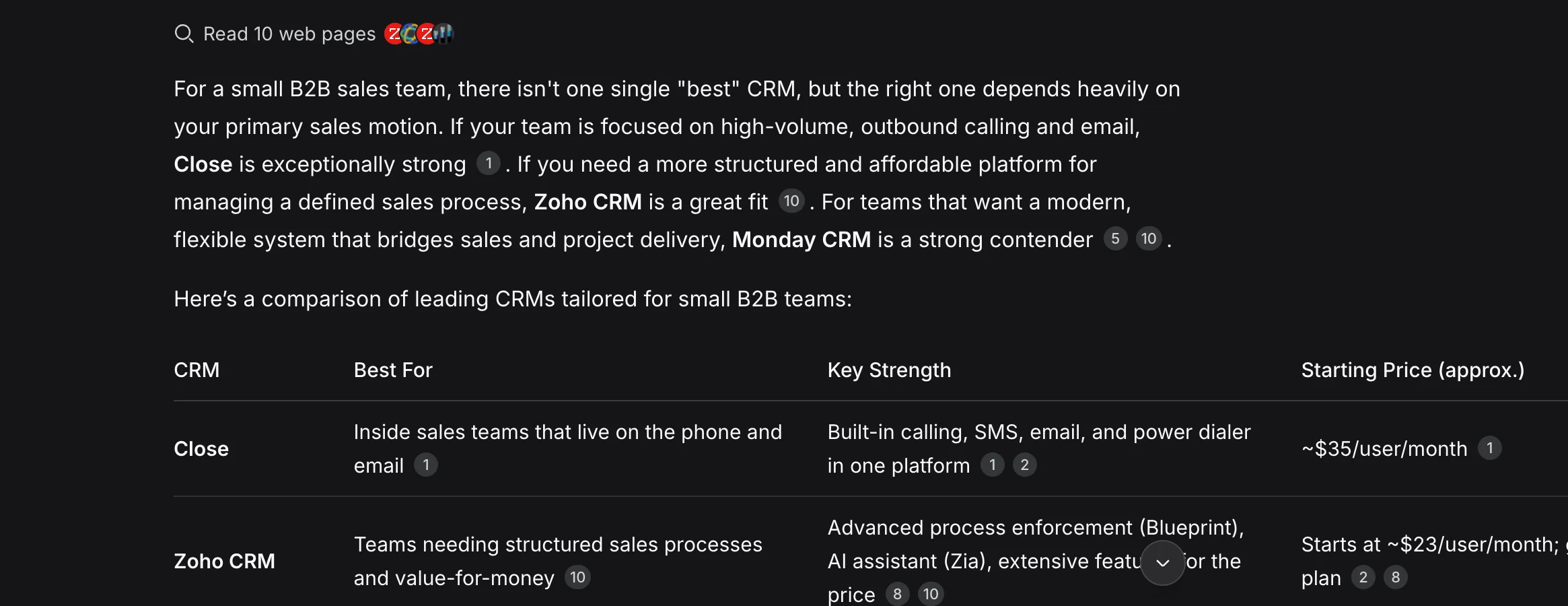
FixAEO observation: this consumer-search answer shows “Read 10 web pages,” named products, and numbered sources. It demonstrates the interface, not a universal ranking rule.
What can be verified about DeepSeek web citations?
DeepSeek's consumer product can return web-grounded answers with source links, as the captures on this page show. Separately, DeepSeek's official open-source Harness documents web_search and web_fetch tools that retrieve current information and return source URLs. The Harness can use different search providers, so its behavior is not a map of the consumer product's private retrieval system.
| Claim | Evidence status | Practical consequence |
|---|---|---|
| DeepSeek can show cited web answers | Observed in the consumer product | Test the actual buyer experience and save the cited URLs |
| DeepSeek Harness supports web tools | Documented by DeepSeek | Provider choice and configuration affect results |
| DeepSeek publishes current API models and prices | Documented by DeepSeek | Verify model names and prices at test time |
| A specific crawler or formula controls citations | Not publicly documented | Do not invent bot rules or exact signal weights |
DeepSeek's API model is not automatically a web-search product. An application developer must connect retrieval or other tools. Citations in a third-party product therefore depend on that product's search provider, prompt, configuration, and rendering—not only on the underlying model.
What DeepSeek does not publish
As of September 13, 2026, we could not find provider documentation for a dedicated consumer-search crawler token, a universal search-index partner list, citation ranking weights, guaranteed refresh intervals, or query-volume comparisons with other AI assistants. Treat claims in those areas as hypotheses until a controlled test or primary document supports them.
"DeepSeek SEO" is the search term — DeepSeek AEO is the practice
“DeepSeek SEO” is a common label for improving discovery in DeepSeek answers. The practice is better described as AEO: making useful pages eligible for retrieval, easy to interpret, and supported by evidence.
DeepSeek citation eligibility checklist
Use provider-neutral fundamentals first. They improve the chance that a retrieval system can find, understand, and trust a page without pretending to know DeepSeek's private ranking logic.
- Make the URL publicly fetchable. Return a stable
200response without login walls, consent gates, regional blocks, or script-only content hiding the answer. - Allow normal search indexing. Use a self-referencing canonical, avoid accidental
noindex, include the URL in a sitemap, and link to it from a relevant page. - Answer one clear intent. Put a self-contained answer near the top, then support it with steps, definitions, examples, or a comparison table.
- Show evidence ownership. Name the author or organization, expose publication and update dates, and link to primary documentation for changing facts.
- Keep claims auditable. Label estimates and illustrative examples. Avoid precise usage, market-share, or performance numbers without a source.
- Earn relevant corroboration. Independent reviews, reputable coverage, standards documents, and real ecosystem pages can confirm facts. Relevance matters more than a raw link count.
- Test the rendered page. Confirm that the answer, table, links, and metadata remain available in the delivered HTML.
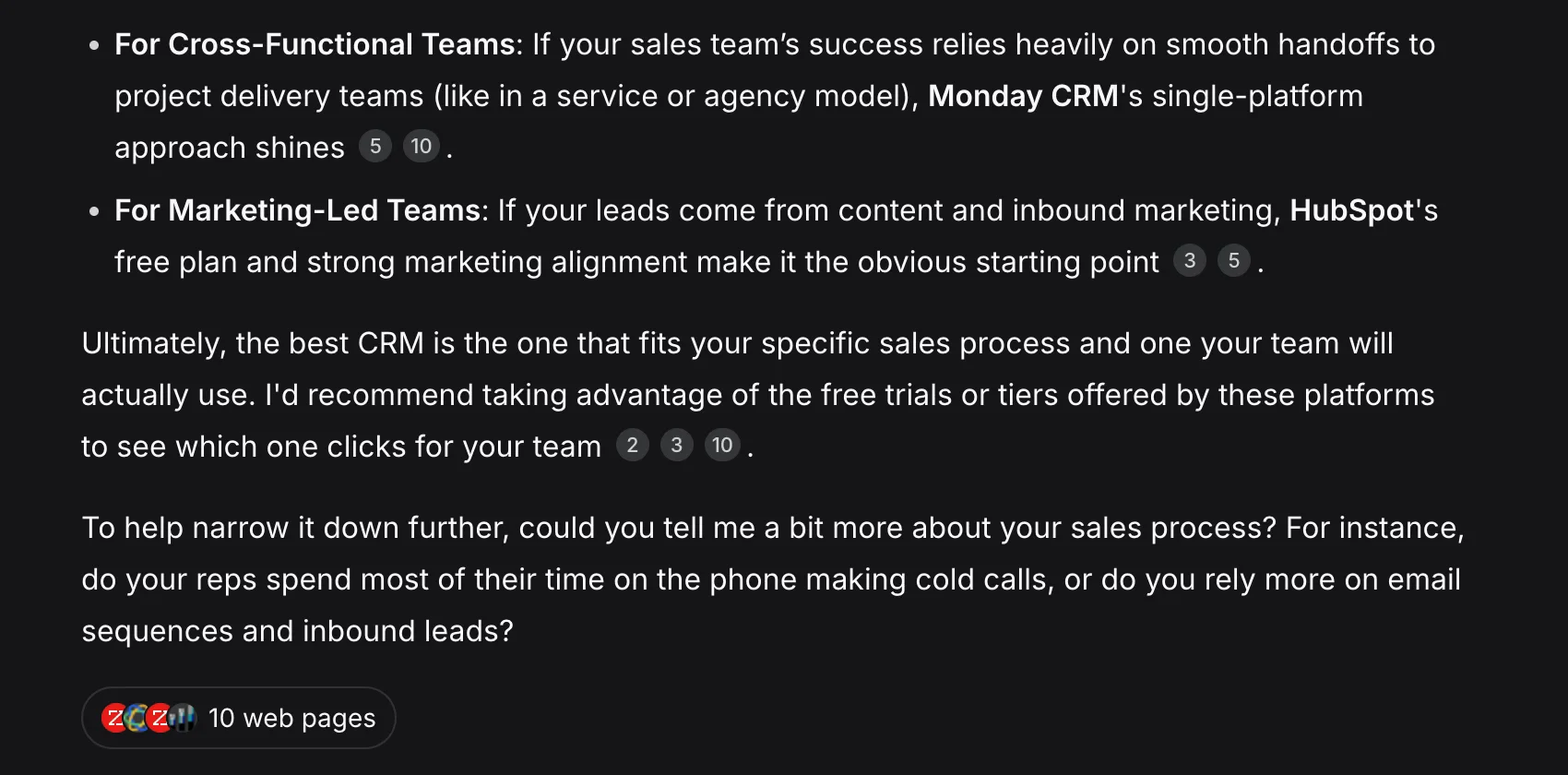
The same observed answer attaches sources to recommendations for different team types. Open each source before treating the recommendation as supported.
Who should invest in DeepSeek AEO (and who shouldn't)
To be clear about where DeepSeek matters, here's my honest priority-setting framework.
High priority (start today):
- Developer tools, dev SDKs, API-first products
- B2B SaaS with strong technical buyer audiences
- Products with any Asia-Pacific market presence
- Products whose buyers already use DeepSeek search
- Teams that can test English and Chinese buyer journeys accurately
Medium priority (do it after ChatGPT/Perplexity/Claude):
- General B2B SaaS with global ambitions
- Content platforms and media companies
- Any brand with existing Chinese-language SEO effort
Low priority (later or never):
- Pure US/EU consumer brands with no Asian market interest
- Local businesses (Gemini's a better fit for local)
- Brands whose buyers explicitly avoid Chinese-origin tools
Being honest: for many Western marketing teams, DeepSeek is number 4 or 5 in AEO priority behind ChatGPT, Perplexity, Claude, and Gemini. That's fine. The point is knowing where it sits, not treating it as either "essential" or "irrelevant."
Five page qualities worth testing
DeepSeek does not publish weights for these qualities. They are testable, provider-neutral ways to improve retrieval eligibility and evidence quality.
1. On-domain content depth, especially how-to and technical content
For procedural questions, use numbered steps, code that can be checked, prerequisites, expected output, and failure cases. This matches the user's intent and gives any retrieval system self-contained passages to quote.
2. Multilingual or zh-CN presence
Create Chinese-language pages only when you serve Chinese-speaking users and can maintain an accurate local experience. Test equivalent English and Chinese prompts; do not infer a general ranking boost from one answer.

FixAEO observation: this Chinese-language test returned a Chinese answer after reading 12 pages. It does not prove that Chinese pages receive a general ranking boost.
3. Structured data + clean entity graph
Valid JSON-LD can clarify the organization, author, product, language, and publication date for machines that consume it. Add only schema supported by visible content and validate it. Use our schema generator to create a starting point.
4. Independent corroboration
Use reputable sources that genuinely verify the claim: standards bodies, research, customer-review platforms, trade publications, or ecosystem documentation. Do not create or buy encyclopedia entries to manufacture authority.
5. Real signals of usage: GitHub stars, npm/pip downloads, Hugging Face profile
For a technical product, public SDKs, packages, changelogs, and documentation provide first-party evidence about supported behavior. Maintain them because users need them, not as thin citation bait. Non-technical brands should publish equivalent owner evidence such as current service details, policies, and independently verifiable claims.
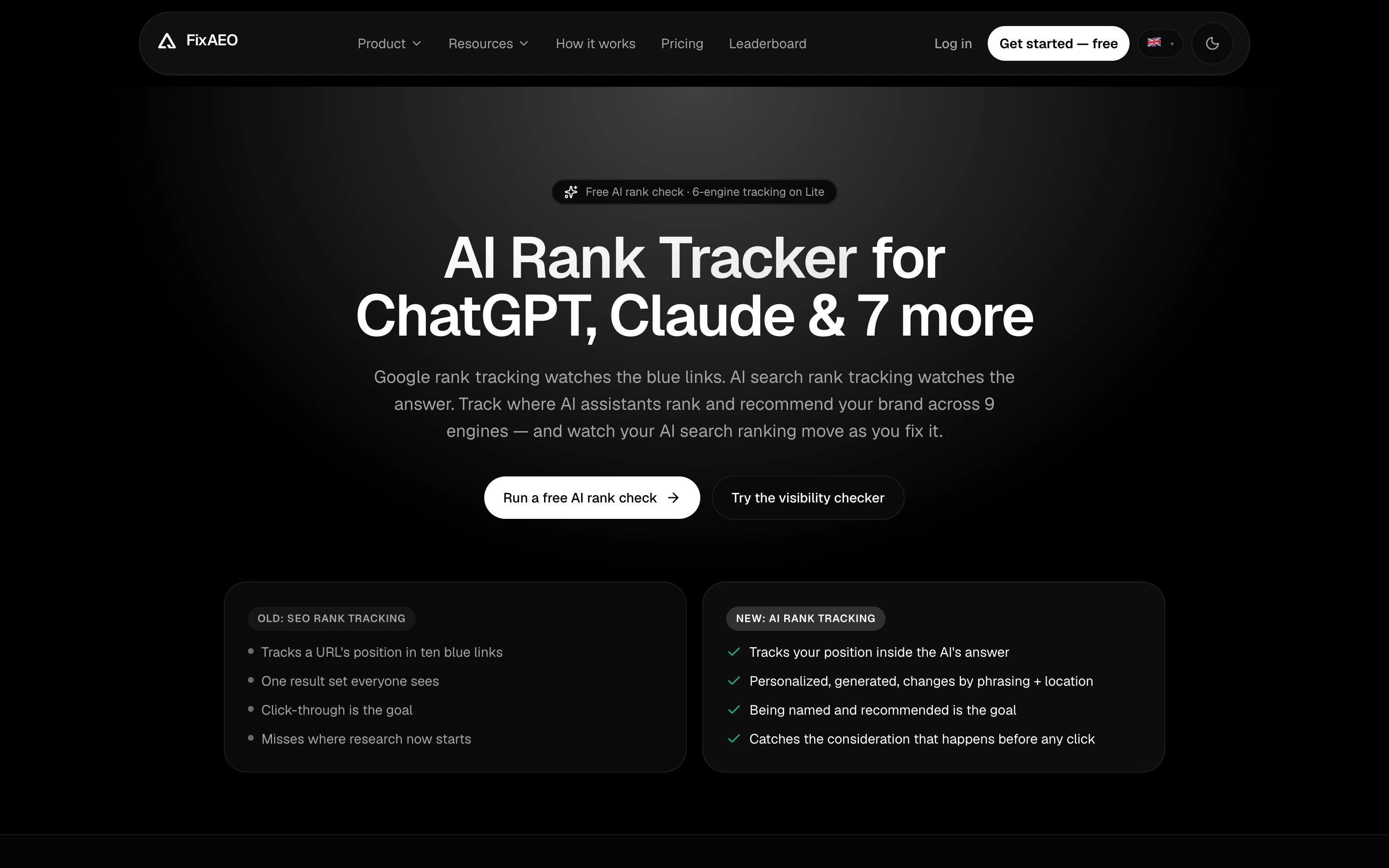
The FixAEO AI Rank Tracker — the tool I use to watch DeepSeek citations against the other eight engines. DeepSeek is one of nine engines tracked; you see its share of voice separately from the composite.
Six actions to make a page easier to retrieve and cite
These actions improve the page and make the result measurable; they are not guaranteed DeepSeek ranking factors.
Tactic 1 — Establish a recorded baseline
Choose five to ten real buyer prompts. Save the date, language, region, model or mode, full answer, and every cited URL. Mark your brand as cited, mentioned without a link, or absent.
Tactic 2 — Lean into procedural / how-to content
Match the page to the prompt. A how-to needs steps and validation; a comparison needs consistent criteria and sourced facts; a definition needs a concise answer and clear scope. Do not add code or tables when they do not help the reader.
Tactic 3 — Publish primary evidence
State current prices, limits, capabilities, dates, and ownership on the page that controls the fact. Link to research methods, public documentation, or changelogs. Label estimates and examples clearly.
Tactic 4 — Add relevant contextual links
Link to the owner page from content in the same user journey with descriptive anchor text. Consolidate overlapping pages when several URLs answer the same intent.
Tactic 5 — Standard AEO fundamentals (still the floor)
Keep important pages indexable in major search engines, use valid structured data, and maintain reasonable site performance. DeepSeek does not currently document a dedicated consumer-search crawler or a DeepSeekBot robots.txt token, so do not add invented bot rules. An llms.txt file can summarize high-value pages for tools that choose to read it, but it is not a DeepSeek submission protocol. Our AEO tools catalog walks through the provider-neutral fundamentals.
Tactic 6 — Repeat the same test
Change one material element at a time and repeat the baseline protocol. Use our AI visibility checker to organize repeated checks, but retain the raw prompt, response, date, and URLs behind every score.
Content formats to match to the query
Use the format that best answers the question: a reproducible build log for implementation queries, a comparison table with consistent sourced criteria for buying queries, or a postmortem with evidence and limitations for failure-analysis queries. The useful signal is whether the page resolves the intent, not whether it contains a preferred template.
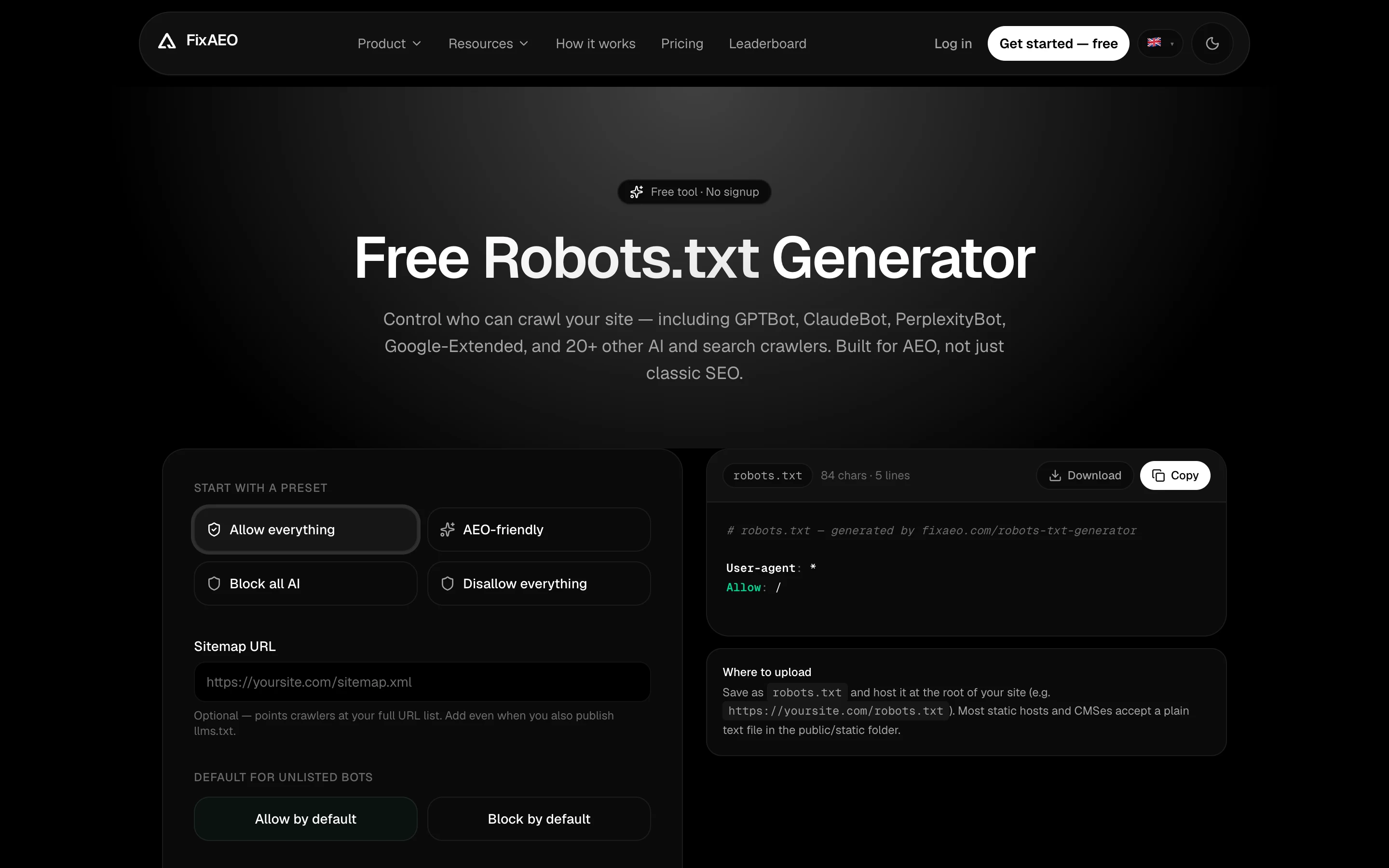
Use the robots generator to inspect standard crawler access. DeepSeek does not document a dedicated crawler token, so the tool should not be read as a DeepSeek submission mechanism.
What NOT to do (DeepSeek-specific traps)
Avoid these unhelpful or risky patterns:
- Blocking important markets without testing. Regional CDN or firewall rules can make localized pages unavailable to users and search systems. Test rendered pages from every market you serve. Do not treat ByteDance's
Bytespideras a DeepSeek crawler, and do not invent aDeepSeekBotrule that DeepSeek has not documented. - Auto-translating without local review. A poor translation can change product facts, buyer intent, legal meaning, and terminology. Publish only pages you can review and maintain.
- Treating every DeepSeek surface as identical. Consumer search, DeepSeek Harness, the base API, and third-party applications can use different retrieval tools and prompts. Test the surface your buyers use.
The leaderboard can help select competitors for a repeatable prompt test. Treat every engine result as a dated observation rather than proof of one universal signal.
What zh-CN localization actually looks like (a starter checklist)
If you decided to do the Chinese-language localization play, here's what a minimum-viable version looks like.
Prioritize by user need. Localize the pages Chinese-speaking customers need to evaluate or use the product. Do not translate pages only to create search inventory.
Start with the top 5. Don't try to localize 100 pages at once. Ship 5 high-quality pages first, measure, then expand.
Use proper hreflang. Add <link rel="alternate" hreflang="zh-CN" href="..."> and a reciprocal English alternate so supporting search systems can understand the locale relationship.
Use fluent human review. A reviewer should check terminology, claims, prices, screenshots, cultural references, and the buyer's intended meaning.
Add zh-CN JSON-LD. Update your Organization schema with a Chinese description in addition to the English one. Add inLanguage: "zh-CN" to translated pages.
Test in multiple browsers. After launching, test the Chinese pages from a browser with Accept-Language: zh-CN and confirm you're getting the right version. Also test from mainland China via VPN if possible — content-delivery networks sometimes vary responses.
Record translation and review ownership, then test the user journey. Effort and discovery time depend on page count, product complexity, crawl frequency, and the markets served.
How to verify your work
Use a fixed protocol:
- Select five to ten prompts tied to real buyer intent.
- Record the date, language, region, model or mode shown, and account state.
- Start a fresh conversation for each prompt and enable web search when the product exposes the control.
- Save the full answer, every cited URL, and whether your brand was cited, mentioned without a link, or absent.
- Repeat each prompt enough times to expose unstable answers.
- Change one material page element, wait for normal discovery, and repeat the same protocol.
| Date | Prompt | Language/region | Product mode | Brand status | Your cited URL | Other cited URLs |
|---|---|---|---|---|---|---|
| YYYY-MM-DD | [fixed prompt] | en / region | web search | cited / mentioned / absent | [URL or —] | [URLs] |
| YYYY-MM-DD | [equivalent prompt] | zh-CN / region | web search | cited / mentioned / absent | [URL or —] | [URLs] |
TL;DR
DeepSeek can return cited web answers, but it does not publish a citation formula, dedicated consumer-search crawler, or guaranteed refresh interval. Build one useful owner page, make it accessible, support its claims, link to it contextually, and measure a fixed prompt set before and after changes.
This closes our per-engine playbook series: dedicated guides for the six conversational engines (ChatGPT, Claude, Gemini, Perplexity, Grok, DeepSeek). FixAEO scans nine engines in total, adding Microsoft Copilot, Google AI Overviews, and Google AI Mode. The compound investment is real — most tactics in any one playbook help on multiple engines, and the floor-level fundamentals (structured data, llms.txt, real on-domain content) help on all of them.
FAQ
How does DeepSeek decide who to cite?
DeepSeek does not publish its citation-ranking formula. Observed answers show that consumer search can read pages and attach numbered sources; official Harness documentation shows configurable search tools. Test the product surface your buyers use rather than assuming exact weights.
Why does DeepSeek matter for AEO if Western brands ignore it?
DeepSeek matters when your buyers use its consumer search or a product built on its models. A third-party application's answers and citations depend on that application's retrieval provider and configuration, so test it separately.
What is the best first action to get cited by DeepSeek?
Pick one buyer prompt and one owner page. Make the page accessible, answer the prompt directly, support changing claims with primary evidence, add a relevant internal link, and record a repeatable baseline.
Is "DeepSeek SEO" the same as DeepSeek AEO?
“DeepSeek SEO” is a common search label. AEO is the broader practice of making pages eligible for retrieval and useful as evidence in generated answers.
Should I hire a native Chinese-speaking writer for zh-CN localization?
Use a fluent reviewer for every Chinese page that influences a buying or product decision. Create those pages only when they serve a real audience and can be kept accurate.
Does DeepSeek respect content licensing (no-follow, robots.txt)?
DeepSeek does not document a dedicated consumer-search crawler identity. Do not invent a DeepSeekBot rule. Protect private content with authentication and apply normal indexing controls to public pages.
Is DeepSeek used inside enterprise products in the West?
DeepSeek provides an API that developers can use in other products. Do not assume an unspecified “AI-powered” feature uses DeepSeek; verify the provider and retrieval configuration before making optimization decisions.
How do I verify my DeepSeek citations are improving?
Run the same recorded prompts in fresh conversations, save every cited URL, and report cited, mentioned, or absent by run. DeepSeek does not publish a guaranteed refresh interval, so avoid promising a fixed lag.
Related reading
Can DeepSeek Search the Web? How Smart Search Works
Yes, DeepSeek can search the web and cite sources. Learn how Smart Search works, what it shares, and why the API needs a separate search tool.
21 min readHow to get cited by Claude: the 2026 playbook
Get cited by Claude with the 2026 AEO playbook. Claude's constitutional training favors authoritative, non-promotional sources — here's how to qualify.
17 min readHow to get cited by Perplexity: a 2026 playbook
Perplexity cites 4-8 sources per answer and the patterns are learnable. Here are the 8 patterns we see in cited content, with the tactics that got FixAEO cited in our own category.
16 min readHow to Get Cited by Gemini in 2026
How to get cited by Gemini: it runs on classic SEO plus AI-specific signals. Learn the 2026 playbook for rankings in AI Overviews and Gemini answers.
17 min readHow to get cited by Grok: the X signal playbook
Grok citations come from X activity, not your blog. This playbook shows which X signals Grok prioritizes and how to build them systematically.
17 min readAEO for SaaS: Get Recommended by AI Assistants
AEO for SaaS companies: why G2 reviews outweigh content, how comparison pages win, and the playbook to get your product into AI answers.
13 min read
Free AEO tools
Put this into practice with free FixAEO tools — no signup required.
AI Visibility Checker
Score your brand across 9 AI engines
AEO Audit Tool
Answer-engine readiness scan
Schema Generator
Build valid JSON-LD structured data
llms.txt Generator
Create a spec-compliant llms.txt
Sitemap Validator
Check your XML sitemap for errors
AI Content Grader
Grade content for AI citation readiness