How to Monitor Competitor Mentions in AI Search
A practical guide to tracking which competitors AI engines name for your category — why manual checks don't scale, and how continuous tracking works.

On this page

Someone typed "best [your category] tool" into ChatGPT this morning. It named three competitors. You weren't one of them. Nobody on your team knows this happened — there's no referral link, no Search Console impression, no line item in any dashboard you own. The conversation happened, a shortlist got formed, and it just cost you a shot at a buyer who will never type your name into a search bar to find out you exist.
That's the new shape of competitive intelligence: it happens inside a chat window you can't see, in an answer that vanishes the moment it's read. This post is about watching it anyway — what to check by hand, what to automate, and where the effort actually pays off. It's a how-to about watching competitors specifically, so it assumes you already know the stakes; if not, what AI visibility means and what AEO is are the right primers to read first.
Why competitor mentions in AI answers are the new battleground
AI doesn't crown one winner — it lists a shortlist
Ask an AI assistant "best CRM for a small agency" and you don't get a single answer. You get a shortlist. Long Run Labs ran 2,200 unaided prompts — no brand names seeded — across 22 running-and-endurance categories on ChatGPT, Claude, Gemini, Perplexity, and Grok, and found the average answer names 6.5 brands, with 2,052 distinct brands and entities surfacing across all the responses combined1. It's one vertical, but the shape generalizes: the AI isn't picking a winner, it's assembling a consideration set — and if you're not in it, you don't get considered.
It's also not one consideration set per topic — each engine builds its own. Across the five assistants Long Run Labs tested, the brand one engine leads with for a query is routinely not the one another leads with. Watching a single engine tells you about a single engine; the shortlist that matters is the union across all of them.
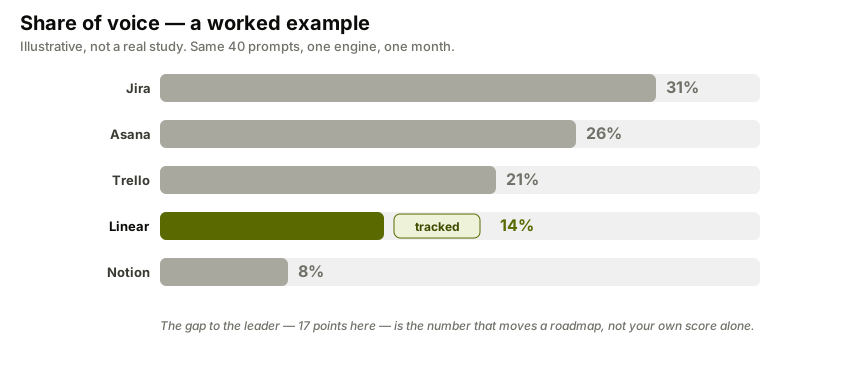
The AI assembles a shortlist, not a winner — and the gap to the leader is what actually moves a roadmap. Illustrative numbers, not a real study.
Buyers are already trusting that shortlist
This wouldn't matter much if buyers still did their own comparison shopping afterward. Forrester's latest Buyers' Journey Survey found 94% of business buyers used AI during their most recent purchase, up from 89% a year prior, and that buyers now name generative AI or conversational search as their most meaningful source of information — ahead of vendor websites, sales reps, and product experts, by roughly twice the rate of any single alternative2. The AI's shortlist isn't a footnote to the buyer's research. Increasingly, it is the buyer's research.
The shortlist changes every time you look — which is the actual problem
Here's the part that makes ad-hoc checking useless: the same prompt, run again, rarely returns the same list. SparkToro and Gumshoe.ai ran a set of brand-recommendation prompts 60–100 times each — 2,961 responses in total — across ChatGPT, Claude, and Google's AI Overviews, and found the identical brand list came back in fewer than 1% of repeat runs, and the identical list in the identical order in fewer than 0.1%3. Their own summary: "if you ask an AI tool for brand or product recommendations a hundred times, nearly every response will be unique."
That doesn't mean the data is noise — it means you need volume to see the signal. In the same study, Bose, Sony, Sennheiser, and Apple still showed up in 55–77% of 994 headphone-recommendation responses, despite no single run repeating exactly3. One screenshot of one answer tells you almost nothing. A few hundred runs tell you who actually wins the category, on average, over time.
And most brands never make the list at all
The baseline most companies are starting from is worse than they think. Victorious tested 177 brands across five verticals (healthcare, SaaS, financial services, ecommerce, legal) over 107,011 AI responses across 8 platforms and found 89.8% of brands had zero AI mentions — only 18 of 177 showed up at all4. The next quarter, testing 150 brands over 5,830 responses and 49,391 citations, the number held: 89% of brands never appeared in an AI category answer, even though 96% were correctly recognized when the AI was asked about them directly5. Read that gap again — the AI knows the brand exists, it just doesn't volunteer it. Recognition isn't recommendation. That's the gap competitor-mention tracking is built to close: not "does the AI know about me," but "does the AI name me when a buyer is comparing options."
Method 1: Manual per-engine checks
This is the honest starting point, and I'd rather tell you its real limits than pretend it doesn't work at all.
What it looks like: open ChatGPT, Perplexity, Gemini, Copilot, and Google's AI Mode by hand. Type the "best X for Y" and "X vs Y" questions your buyers would actually ask. Write down which brands get named, in what order, and whether you're one of them.
What it's good for: a one-time gut check. If you've never looked, spend twenty minutes doing this before anything else — it's the fastest way to find out whether the problem is "we're never mentioned" or "we're mentioned but ranked fourth of five."
Where it breaks down: given the SparkToro finding that a single prompt has under a 1% chance of returning the same list on the next run3, one manual check is a random draw, not a measurement. To get a stable read on your actual share of voice you'd need dozens of repeats per prompt, per engine, refreshed weekly — by hand. Industry write-ups on this describe the same wall in operational terms: manual tracking stays viable below roughly 50 prompts per week and five competitors, and needs automation above that threshold to stay consistent6. It also can't hold state over time — you won't notice a competitor's mentions climbing over six weeks if you're not logging every run in a spreadsheet nobody maintains past week three.
Manual checking answers "does this happen at all." It cannot answer "is it getting better or worse," and that second question is the one that actually changes what you do next quarter.
Method 2: Continuous share-of-voice tracking across engines
The methodology that scales looks less like spot-checking and more like a recurring measurement system:
- Define a competitive set. Most categories realistically compare against 4–8 direct rivals — the ones a buyer would actually shortlist against you, not every company that's ever competed for the keyword.
- Build a representative prompt set. 15–25 prompts spanning discovery ("best X"), comparison ("X vs Y"), and use-case queries ("X for [specific situation]"), phrased the way a real buyer would type them, not the way a marketer would.
- Run it repeatedly, across engines, on a schedule. Weekly is a reasonable floor given how much a single run can vary; more often if the category moves fast.
- Track three separate numbers, not one:
| Metric | What it tells you |
|---|---|
| Mention rate | % of responses that name your brand at all |
| Citation rate | % of responses that link to your domain as a source — moves independently of mention rate |
| Share of voice | Your mentions ÷ total mentions across you + your competitive set, for the same prompt set |
- Layer on sentiment. A mention isn't automatically a good outcome — "reliable but pricier than alternatives" and "the clear category leader" are both mentions, and only one of them helps you.
- Chart the trend, don't trust the snapshot. The entire value of continuous tracking is catching a competitor's share of voice climbing over three weeks, instead of finding out from a lagging pipeline report two quarters later.
This is close to what I built into FixAEO's competitor leaderboards — running your prompt set against your named competitive set on a schedule, then surfacing mention rate, share of voice, and sentiment side by side per engine, so a rising competitor shows up as a chart moving, not a surprise in a sales call.
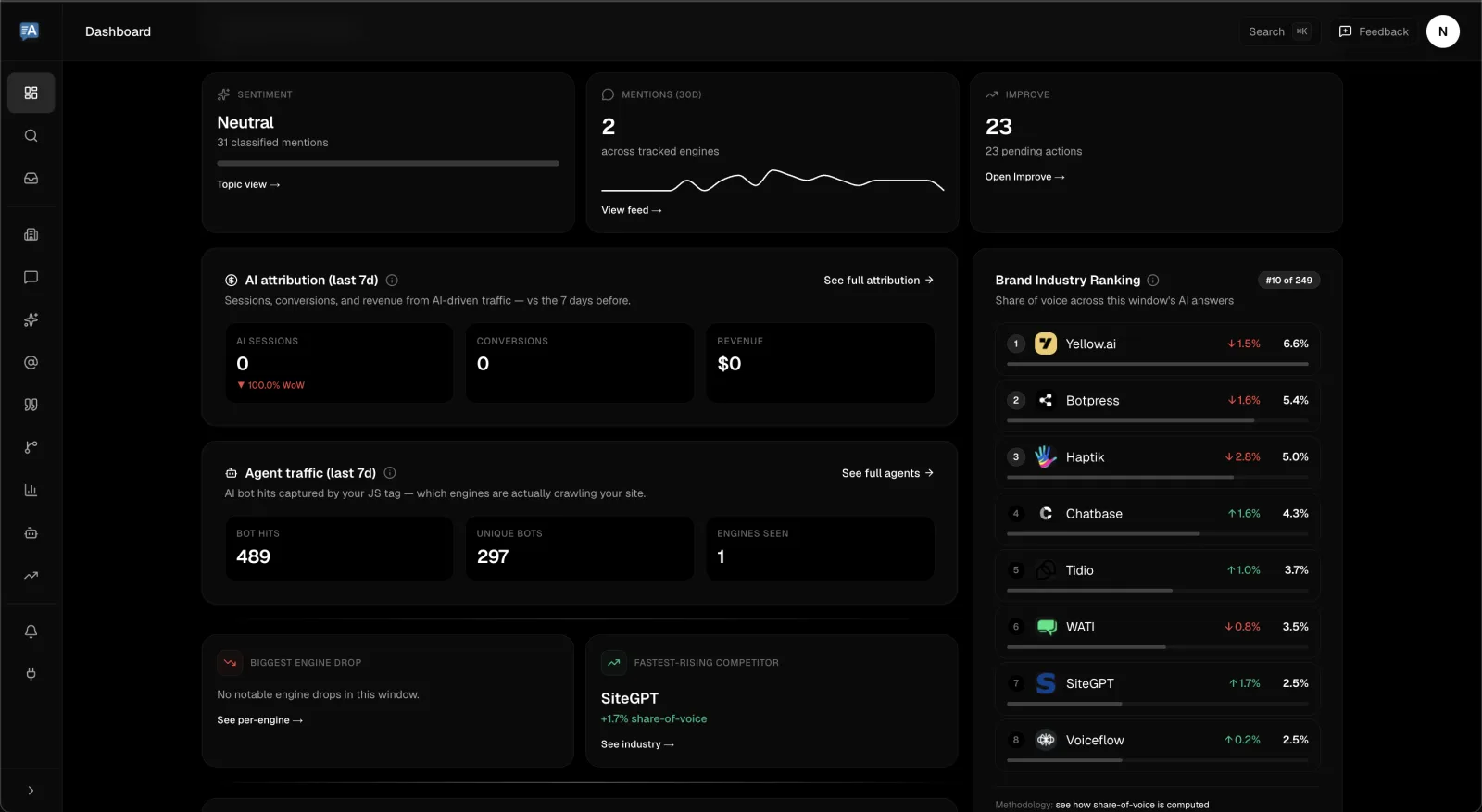
A share-of-voice view against named competitors — the "who's actually winning the category" read a single manual check can't give you.
One honest technical point worth pressing any vendor on, ours included: this category splits on how the prompt actually gets answered. Some tools query model APIs directly, which can return meaningfully different text than what a logged-in person sees typed out in the real ChatGPT or Gemini interface. FixAEO runs its prompts through real, logged-in browser sessions on residential IPs, region-aware, to capture what a buyer in that market would actually read in the actual product — not an API's approximation of it. That's a real architectural difference, not a marketing line, and it's worth asking any tool you evaluate which one it's doing, because the two approaches don't always agree.
Manual vs. continuous tracking
| Manual per-engine checks | Continuous tracking | |
|---|---|---|
| Setup time | Minutes | Hours, once |
| Statistical reliability | Low — one run has under a 1% chance of matching the next3 | High — aggregates across repeated runs |
| Scales past 5 engines | No | Yes |
| Scales past 5 competitors | Barely — viable only below ~50 prompts/week6 | Yes, by design |
| Catches trend shifts (competitor rising) | Only if someone remembers to check again | Automatic, chart over time |
| Sentiment per mention | Manual judgment, inconsistent | Structured, comparable across engines |
| Cost | Free (your time) | Time or a subscription |
| Best for | A first gut check | Ongoing competitive intelligence |
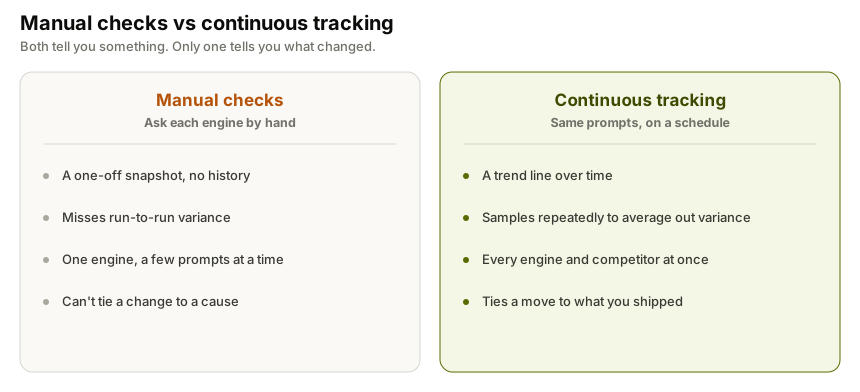
Both tell you something — only continuous tracking tells you what changed, and ties a move to what you shipped.
Building the prompt set that actually reflects buyer intent
Step 2 in Method 2 above says "build a representative prompt set" like it's a single afternoon task. In practice, it's the piece most teams get wrong, because it's tempting to write prompts the way you'd write your own homepage copy — your category, your language, your framing — instead of the way someone with no loyalty to your brand actually types a question at 11pm.
A useful prompt set covers six archetypes, each mapped to a different point in the buying process:
Discovery — "best X for Y." The buyer knows roughly what category they need but hasn't picked a shortlist. "Best project management tool for a 10-person startup." Write 3–5, one per buyer segment you actually serve — a discovery prompt aimed at nobody in particular tests nothing.
Comparison — "X vs Y." Named head-to-heads, either with your brand in the pair or two competitors and no brand at all. The second kind matters more: if you show up unprompted in a "Competitor A vs Competitor B" answer, that's the AI pulling you into a conversation you didn't ask to join — a stronger signal than a prompt where you seeded your own name.
Alternatives — "X alternatives." Arguably the highest-intent type you can track, because someone typing this already uses a product and is unhappy enough to look elsewhere. "Alternatives to [Competitor]." Absent here means missing the buyers most ready to switch.
Use-case — "X for [situation]." Narrower than discovery, filtered by industry, team size, budget, or workflow. "Project management tool for a construction company." A smaller, specialized product often beats the category leader here, since a use-case win is winnable in a way a generic discovery prompt isn't.
Pricing. Buyers ask about price conversationally now instead of opening a pricing page. "How much does [Competitor] cost for a 20-person team." Whether the AI states your price correctly, and whether it volunteers a competitor's free tier when you don't have one, is worth tracking on its own.
Integration. Tools live inside a stack now, not standalone. "Does [Competitor] integrate with Slack." As buying decisions hinge more on "does it fit what I already use," this archetype matters more than it used to.
Fifteen to twenty-five prompts across all six gives a broad enough net without wasting effort on edge cases nobody asks about. A startup with 3–5 real rivals should weight the set toward discovery, alternatives, and comparison — those carry the most buying intent per prompt.
The phrasing rule that matters more than the archetype list: write every prompt in the words of the problem, not your product page. A buyer doesn't type "enterprise-grade workflow orchestration platform" — they type "tool that stops my team from double-booking projects." Attach a realistic constraint (team size, budget, industry) where you can, since that's often what determines which competitor gets named. Keep branded and unbranded prompts in separate buckets, too: a prompt with your name already in it tests whether the AI recommends you once primed; one without tests something harder — whether the AI reaches for you on its own.
One more reason to write several phrasings of the same question rather than one "best" version: Google's documentation on AI Overviews and AI Mode describes a "query fan-out" technique, where a single question triggers multiple related searches across subtopics behind the scenes before the AI assembles a response7. You can approximate that by deliberately running several worded variants of the same question yourself.
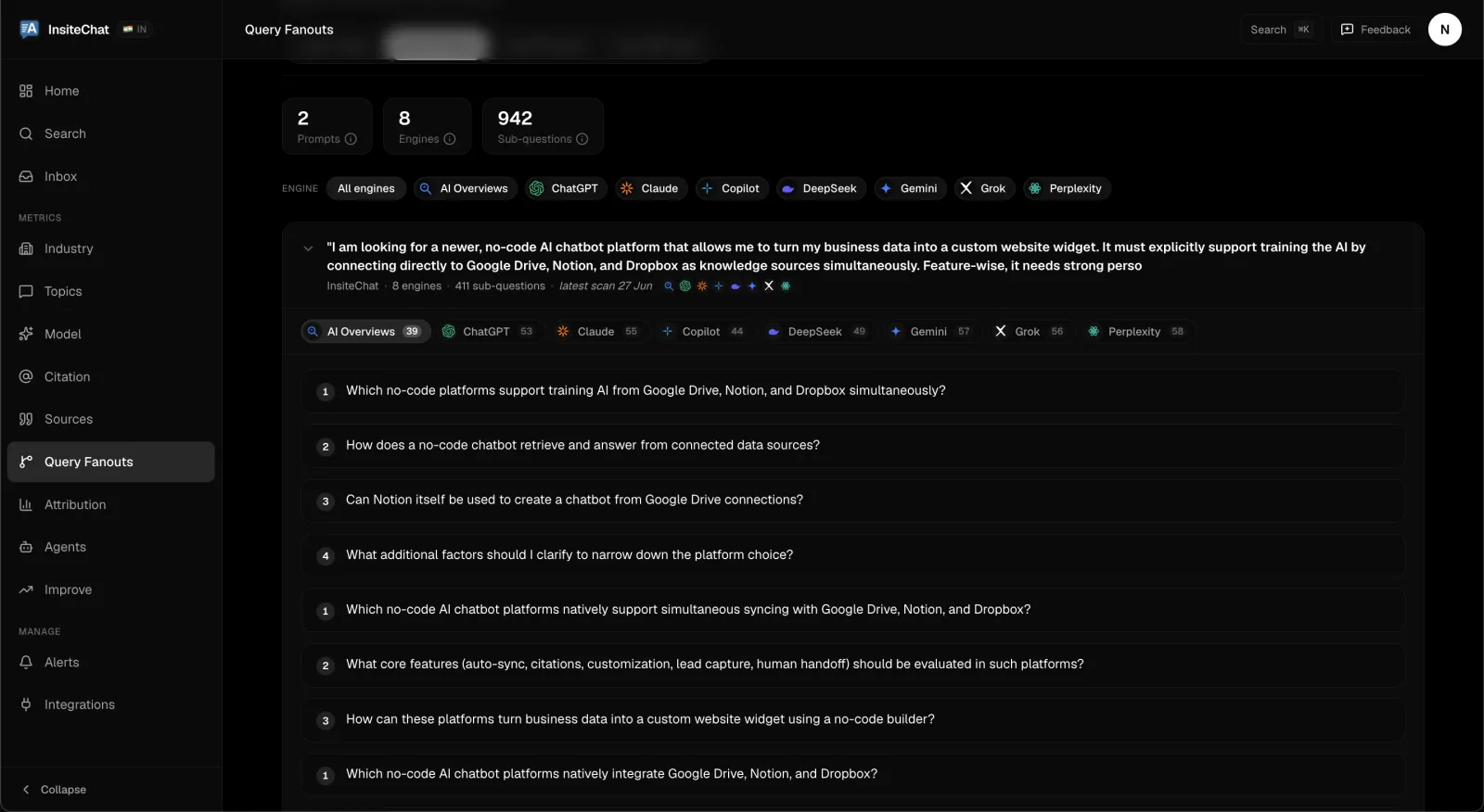
A prompt set built the way buyers actually type — discovery, comparison, alternatives, use-case — not the way a marketer writes homepage copy.
A worked example (illustrative — not a real study)
Here's what running this looks like end to end, with a hypothetical set of numbers so you know what a completed tracker should resemble once you build your own. None of the figures below are from a real study — they're invented to be plausible, not measured.
Say you sell project management software, competing against Asana and Monday.com, with ClickUp and Notion as the two that keep coming up unprompted and Trello as the free-tier comparison point. A 15-prompt set covering the six archetypes above might look like this:
- "Best project management tool for a 15-person marketing team"
- "Best project management software for a remote-first startup"
- "Asana vs Monday.com for a creative agency"
- "Monday.com vs ClickUp for a software team"
- "Alternatives to Asana for a small team"
- "What's a cheaper alternative to Monday.com"
- "Project management tool for a construction company"
- "Best project management software for a nonprofit on a small budget"
- "How much does Asana cost for a 20-person team"
- "Is there a free project management tool as good as Trello"
- "Does Monday.com integrate with Slack and Google Calendar"
- "Best project management tool that works with Microsoft Teams"
- "What project management software do agencies recommend"
- "ClickUp vs Notion for a product team" (no brand named — testing whether either gets pulled in unprompted)
- "Best Trello alternative for a growing team"
Run that set weekly across five engines, and — again, purely illustrative numbers, not a real measurement — a share-of-voice table after a few weeks of runs might look like this:
| Brand | ChatGPT | Perplexity | Gemini | Google AI Overviews | Copilot | Avg. |
|---|---|---|---|---|---|---|
| Asana | 80% | 73% | 87% | 67% | 73% | 76% |
| Monday.com | 73% | 67% | 80% | 60% | 67% | 69% |
| ClickUp | 60% | 80% | 53% | 47% | 53% | 59% |
| Trello | 53% | 40% | 60% | 53% | 47% | 51% |
| Notion | 47% | 53% | 40% | 33% | 40% | 43% |
| You | 13% | 7% | 20% | 7% | 13% | 12% |
Reading a table like this is the point of the exercise — the raw percentages matter less than what they tell you to go do next:
- Asana leads everywhere, but not by the same margin. Its lead over Monday.com narrows on Google's AI Overviews (67% vs 60%) versus a wide gap on Gemini (87% vs 80%) — a seven-point gap is a real opening, not a rounding error.
- ClickUp overperforms specifically on Perplexity (80%, ahead of everyone but Asana) despite trailing Trello and Monday.com elsewhere — a flag to go check why, since ClickUp is winning citations somewhere Perplexity's live retrieval favors.
- You're weakest on Google's AI Overviews and Perplexity (7% each), relatively strongest on Gemini (20%) — still a distant last, but the gap tells you where to start.
- Sentiment is the layer the table doesn't show. A 13% mention rate on ChatGPT could mean "solid pick if you're on a budget" or "less full-featured than Asana" — both count as a mention above, but only one helps you. Read a sample of the actual answer text, not just whether your name appears.
- Break it down by archetype, not just engine. If your average is mostly comparison prompts — where a human already seeded your name — and almost none of the alternatives or discovery prompts, that's the real finding: you're talked about when someone already knows you, invisible to everyone shopping cold.
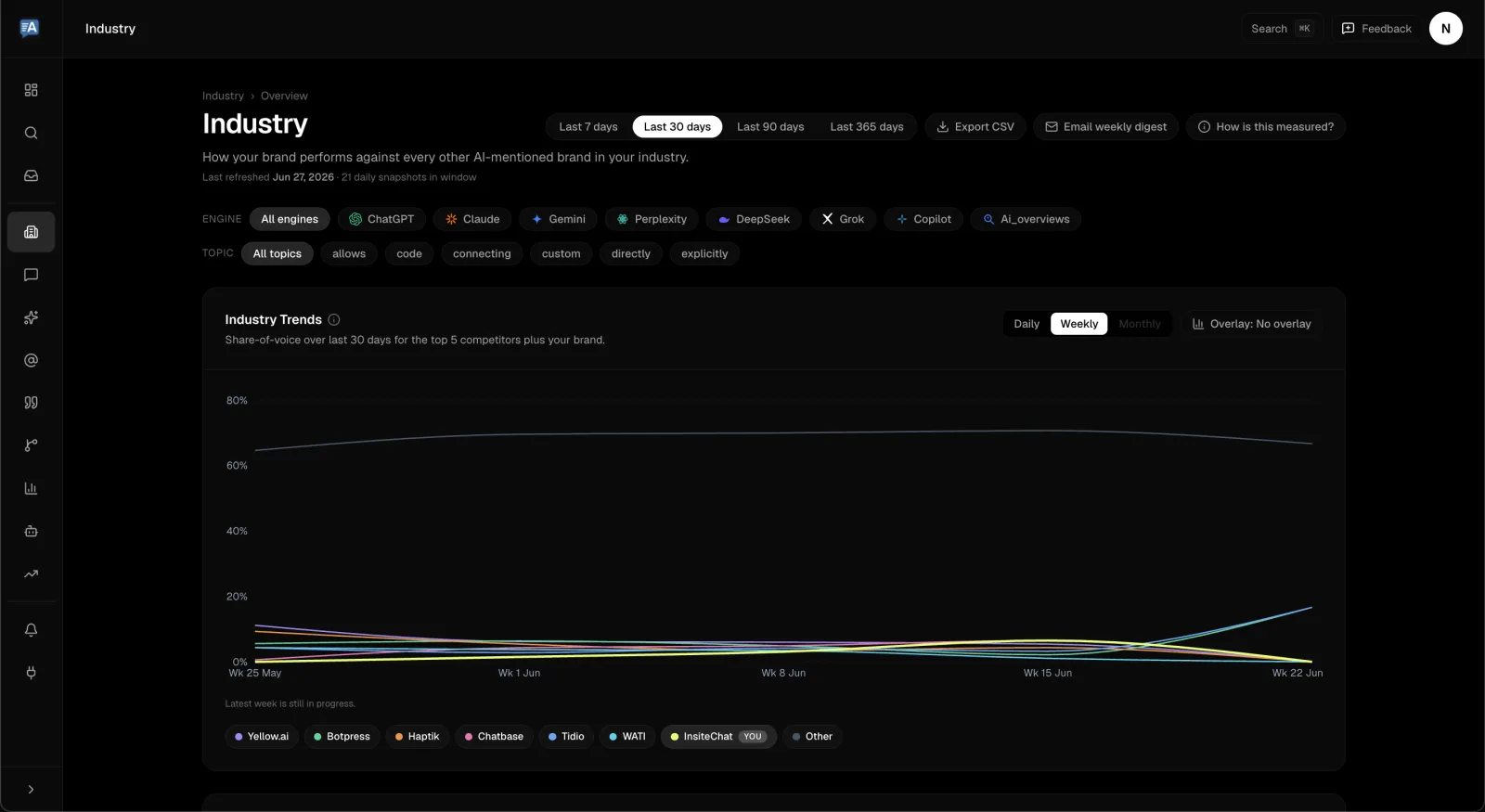
Charted over time, a competitor climbing shows up as a moving line — not a surprise in a sales call two quarters later.
Per-engine quirks worth knowing
Treating "AI search" as one thing when you monitor it will cost you real signal — each engine surfaces and structures citations differently.
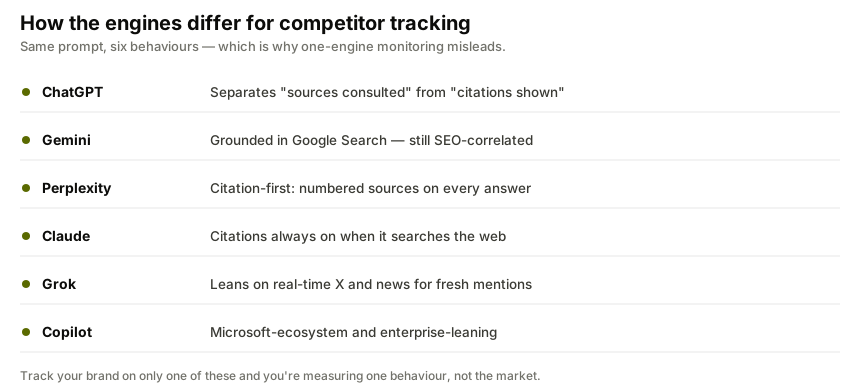
Same prompt, six behaviours — track only one engine and you're measuring one engine, not the market.
ChatGPT returns inline citations as structured url_citation annotations — a URL, a title, and the exact character span they support — but also returns a separate sources field listing every URL it actually consulted, often a superset of what's cited in the visible answer8. A competitor (or you) can be weighed by the model without ever appearing as a clickable source, so eyeballing only the visible citations will undercount what's actually being considered.
Perplexity always shows citations pulled from live retrieval — visible sourcing by default, not an optional layer. What it doesn't publish is exactly how it weights or ranks which sources make the cut; there's no official documentation on the algorithm, so treat any third-party blog claiming precise percentage weights for "content relevance" or "domain authority" with real skepticism.
Gemini and Google's AI Overviews / AI Mode are worth separating. At the API level, Gemini's grounding-with-search feature returns a structured object — the queries it ran, the results it pulled, and inline citations with character indexes9. Separately, Google's Search Central documentation confirms AI Overviews and AI Mode use "query fan-out" — multiple related searches across subtopics before composing an answer — and show a wider, more diverse set of links than classic search results for the same query7. Expect the same prompt to occasionally route to different sub-searches on different runs.
Claude attaches citations to web-sourced answers by default at the API level — no toggle to turn them off, and each cited span is capped to a short excerpt10. We've covered Claude's web-search behavior in more depth in a dedicated post, worth reading if Claude is a meaningful channel for your category.
Copilot / Bing has the one native exception worth knowing: Bing Webmaster Tools shipped an "AI Performance" dashboard in public preview in February 2026, showing total citations, the actual "grounding queries" AI used to retrieve your content, and page-level citation counts over time, for Copilot and Bing AI summaries11. The catch: it only covers domains you own and have verified there — it cannot show a competitor's citation data. A self-monitoring tool, not a substitute for tracking competitors.
From monitoring to action
Seeing a competitor win a prompt is only useful if it changes what you do next. Three moves actually close the gap, roughly in the order they're worth doing.
Follow the citation, not just the mention. Because ChatGPT and Gemini both expose the actual URLs an answer drew from89, a competitor showing up usually means you can click through to the specific source that put them there — a review site, a "best X" listicle, a comparison page, a forum thread. That source is now a known target, and getting your own product reviewed or mentioned there is a far more direct lever than generic content marketing aimed at nothing in particular.
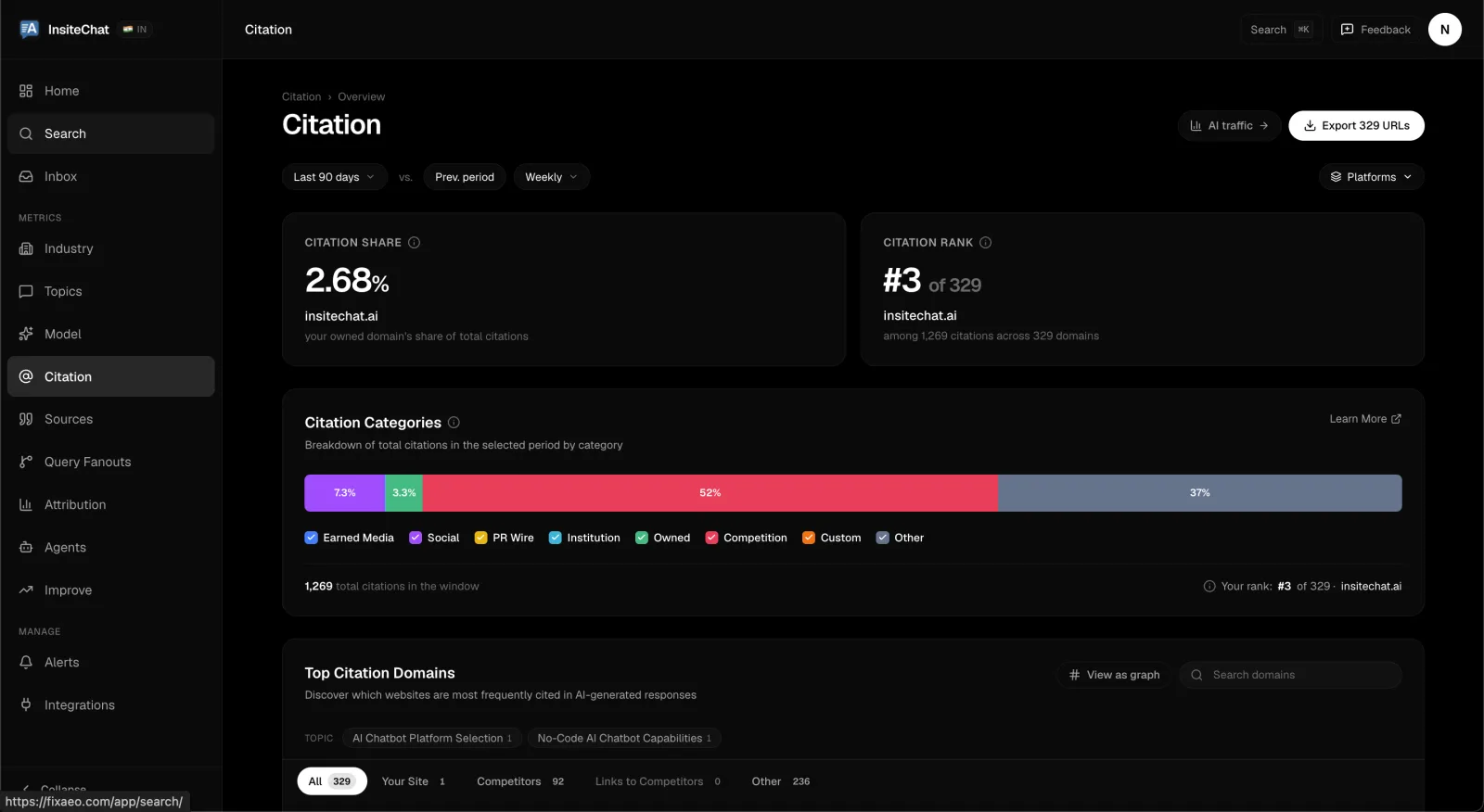
Follow the citation, not just the mention — the review or comparison page that put a competitor in the answer is a target you can go win.
Invest in the content types AI answers pull from for comparison and alternatives prompts. Third-party review sites, comparison posts, and community discussion are exactly the source type that answers "X vs Y" or "X alternatives" honestly, since that's what that content is built to do. If a competitor has reviews and a comparison page you don't, that gap is what the tables above are surfacing — go get reviewed and compared on the same sites.
Fix the basics that let a crawler cite you at all. A page that's hard to crawl, has no clear entity signals, or never states plainly what your product does and for whom, can't get cited even when it's the best answer. If competitor mentions are the symptom, what AEO is and how AEO differs from SEO cover the fix in full — this post is about finding the gap, those two about closing it.
Where available, use a self-monitoring surface like Bing's AI Performance dashboard to confirm your own content is being pulled as a grounding source11 — it won't show a competitor's data, but it tells you whether a fix you just shipped actually changed anything, faster than waiting for the next tracking run.
The mistakes that make competitor tracking useless
Most failed attempts at this fail for one of six repeatable reasons, not because the underlying idea is flawed.
Tracking too many rivals. Twenty "competitors" is a keyword list, not a competitive set. Pick the four to eight brands a real buyer would shortlist next to you — beyond that you're diluting every run's signal into noise.
Treating one run as a verdict. A single prompt has under a 1% chance of returning the same brand list on the next run3. "We checked and we're not mentioned" from one session is a hypothesis, not a finding.
Ignoring sentiment. A mention-rate number treats "solid but pricier than the alternatives" and "the clear category leader" as identical events. A rising mention rate paired with worsening sentiment is a warning, not a win.
Writing prompts like a marketer. A set built around your own category language will systematically overstate how well you do, since it tests whether the AI agrees with your framing, not whether a real buyer's question surfaces you.
Watching one engine and assuming it's representative. Each engine builds its own shortlist from its own sources — a strong ChatGPT showing tells you nothing about Gemini or Perplexity, and a set winning on one engine can be nearly invisible on another.
Not logging anything over time. The value here is catching a trend — a competitor's share climbing, your own mention rate recovering after a fix. A spreadsheet abandoned after week three has no baseline, and without one there's no way to tell whether anything you did worked.
Who actually needs this
Enterprise teams are usually watching a wide field — a dozen-plus named competitors across multiple regions, where a shortlist that looks stable in the US can look completely different in a market where the AI is trained on different local sources. At this scale, manual checking isn't a scaling problem, it's a math problem: 12 competitors × 25 prompts × 5 engines × weekly repeats is not a spreadsheet a person maintains.
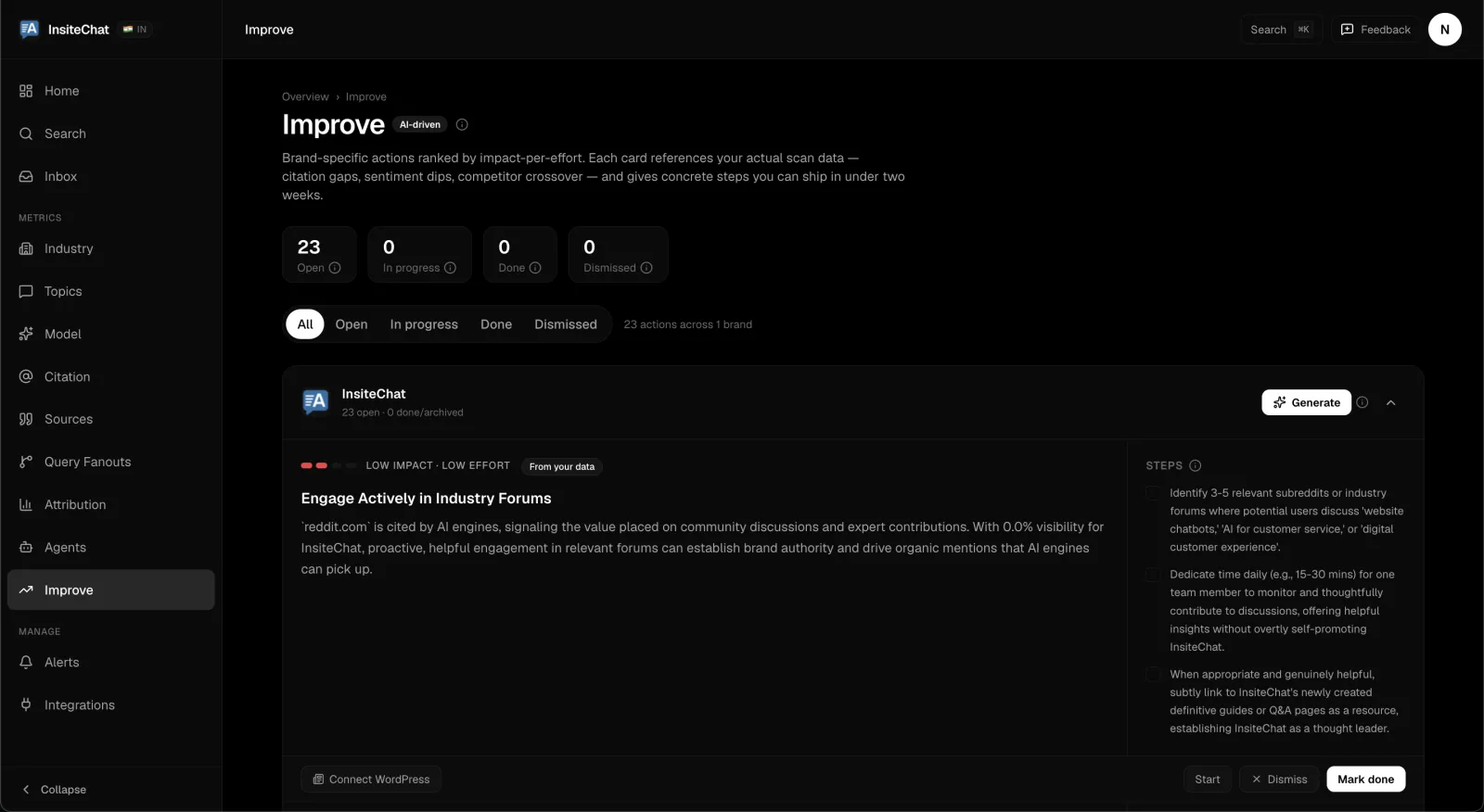
At enterprise scale the math beats the spreadsheet — dozens of competitors across engines and regions, tracked on a schedule instead of by hand.
Startups and SMBs don't need all of that — you likely have 3–5 real rivals a buyer would actually compare you against. The goal here is cheap, recurring visibility into whether you're even in the conversation, not an enterprise-grade competitive war room. A modest, focused prompt set run weekly beats a sprawling one run once.
Solo operators and freelancers rarely need ongoing tracking for a whole competitive set, but the underlying question — "does the AI mention me at all when someone asks for what I do?" — is worth answering once. That's exactly what a free scan is for: run a free FixAEO scan and see, in about 30 seconds with no signup, whether you show up.
Agencies are running this exercise per client, which means the prompt set and competitive set need to reset cleanly for each account without cross-contaminating data. If you're managing this for multiple clients, look at how a tool's plans handle multiple brands before committing — Lite is the entry paid tier, while Growth adds daily scans, a 50-prompt pool, and room for five brands, which is the more realistic starting point for a small agency roster.
FAQ
How many competitors should I actually track?
Most categories don't need more than 4–8. Pick the brands a real buyer would put in a shortlist next to you, not every company that's ever ranked for your keywords. Long Run Labs' 6.5-brands-per-answer average1 is a reasonable ceiling — beyond that you're tracking noise.
Do I need to check every AI engine, or is ChatGPT enough?
Checking one engine will actively mislead you — a shortlist that looks great on ChatGPT can look very different on Gemini or Perplexity for the same query, so track each engine separately.
What's the real difference between mention rate and citation rate?
Mention rate is whether the AI says your name in its answer. Citation rate is whether it links to your site as a source. These move independently — you can be named without a link, or cited as a source in text the AI never quite recommends you in. Track both; treating them as the same number hides a real gap.
How often should I re-run my prompt set?
Weekly is a sane floor for most categories, given how much a single run can vary run to run3. Fast-moving categories (anything with frequent product launches or news cycles) benefit from more frequent checks.
Is a one-time manual check ever enough?
For a first gut check, yes — spend twenty minutes seeing if you show up at all. But treat the result as a single data point, not a trend. One run has under a 1% chance of matching the next3, so a single "we're not mentioned" result is a hypothesis to keep testing, not a verdict.
Does sentiment matter as much as the mention itself?
Almost as much. Victorious's own data shows a 96% brand-recognition rate against an 89% zero-mention rate5 — the AI often knows plenty about a brand, positive or otherwise, that it doesn't volunteer unprompted. Once you are being mentioned, how the AI frames you (reliable-but-costly vs. category leader) is the next thing worth measuring.
Should I track branded and unbranded prompts separately?
Yes. A branded prompt ("is [your brand] good for X") tests whether the AI recommends you once it already knows to consider you. An unbranded prompt ("best X for Y") tests the harder thing: whether the AI reaches for you without being told to look. Weight unbranded prompts more heavily — that's closer to how most buyers actually start.
How do I find out which specific source got a competitor cited?
Check the engine's own citation data rather than guessing. ChatGPT and Gemini both expose the underlying URL and title behind a citation at the API level89, and clicking through the visible citation in the consumer product gets you most of the way there. Perplexity shows its sources directly by default. Once you have the URL, you know exactly which review site or comparison page to go get your own product onto.
In one paragraph
AI assistants answer "best X for Y" with a shortlist of roughly half a dozen brands, not a single winner, and buyers are already treating that shortlist as their primary research — which means share of voice inside AI answers is now a real competitive front, whether or not you're watching it. A single manual check tells you almost nothing because the same prompt rarely returns the same answer twice; what actually works is a fixed competitive set and prompt list — built around discovery, comparison, alternatives, use-case, pricing, and integration prompts phrased the way a real buyer talks, not a marketer — run repeatedly across engines, tracked as mention rate, citation rate, and share of voice with sentiment layered on top, charted over time instead of glanced at once. Run a free FixAEO scan to see where you stand — 30 seconds, no signup.
Footnotes
-
Jonathan Levitt, "How AI Recommends Running Brands in 2026: The Largest Study Yet," Long Run Labs, July 7, 2026. https://longrunlabs.substack.com/p/how-ai-recommends-running-brands ↩ ↩2
-
John Buten, Forrester, "B2B Buyers Make Zero-Click Buying Number One," January 22, 2026. https://www.forrester.com/blogs/b2b_buyers_make_zero_click_buying_number_one/ ↩
-
SparkToro/Gumshoe.ai research (Rand Fishkin, Patrick O'Donnell), reported by Search Engine Journal, "AI Recommendations Change With Nearly Every Query," January 30, 2026. https://www.searchenginejournal.com/ai-recommendations-change-with-nearly-every-query-sparktoro/566242/ ↩ ↩2 ↩3 ↩4 ↩5 ↩6 ↩7
-
Victorious Q1 2026 AI-visibility study, reported by Search Engine Journal, May 19, 2026. https://www.searchenginejournal.com/ai-seo-mentions-study-victorious-spa/575040/ ↩
-
Victorious Quarterly Search Report, Q2 2026. https://victorious.com/quarterly-search-report/ ↩ ↩2
-
Siftly, "How to Track Competitors in ChatGPT Shopping Recommendations." https://siftly.ai/blog/track-competitors-chatgpt-shopping-recommendations ↩ ↩2
-
Google Search Central, "AI features in Search." https://developers.google.com/search/docs/appearance/ai-features ↩ ↩2
-
OpenAI, "Web search," developer API documentation. https://developers.openai.com/api/docs/guides/tools-web-search ↩ ↩2 ↩3
-
Google AI for Developers, "Grounding with Google Search," Gemini API documentation. https://ai.google.dev/gemini-api/docs/google-search ↩ ↩2 ↩3
-
Anthropic, "Web search tool," Claude API documentation. https://platform.claude.com/docs/en/agents-and-tools/tool-use/web-search-tool ↩
-
Bing Webmaster Blog, "Introducing AI Performance in Bing Webmaster Tools (Public Preview)," February 10, 2026. https://blogs.bing.com/webmaster/February-2026/Introducing-AI-Performance-in-Bing-Webmaster-Tools-Public-Preview ↩ ↩2
Related reading
What Is AI Visibility (and Why It Matters in 2026)
AI visibility measures whether ChatGPT, Gemini, and other AI engines mention, recommend, or cite your brand — and why tracking it matters in 2026.
14 min read12 Best Answer Engine Optimization Tools (2026)
12 answer engine optimization tools compared — engines covered, entry price, free tier — with honest takes on which to pick by stage and budget.
19 min readHow to track AEO across multiple brands
Multi-brand AEO portfolio tracking — a practical framework for agencies, holding companies, and multi-product teams to measure AI visibility at scale.
17 min readHow to measure AEO ROI: a copy-paste spreadsheet
Measure AEO ROI with attributable visits, conversion rate, gross profit, and cost. Includes a transparent worked example, spreadsheet layout, and limitations.
13 min readWhat is AEO? Answer Engine Optimization explained
Answer Engine Optimization (AEO) means getting AI assistants to recommend your brand. Learn what AEO is, why it matters more than SEO, and how to start.
18 min readAEO vs SEO: what changed and what to do about it
AEO vs SEO in 2026: AI answers and search engines reward different signals. The data, a plain comparison, and a 30-day migration plan your SEO team can run.
17 min read
Free AEO tools
Put this into practice with free FixAEO tools — no signup required.
AI Visibility Checker
Score your brand across 9 AI engines
AEO Audit Tool
Answer-engine readiness scan
Schema Generator
Build valid JSON-LD structured data
llms.txt Generator
Create a spec-compliant llms.txt
Sitemap Validator
Check your XML sitemap for errors
AI Content Grader
Grade content for AI citation readiness