What is LLMO? Large Language Model Optimization explained
LLMO (Large Language Model Optimization) is the practice of getting your brand recommended and cited by AI assistants. Here's what it means, how it overlaps with GEO and AEO, and the steps that actually move your visibility.

On this page
Open ChatGPT. Type "best project management tool for a remote team of 15." You will get two or three names, a sentence about each, and a recommendation. No list of ten blue links. No scrolling. Just three brands that made the cut and everything else that didn't.
The brands inside that answer didn't get there by accident. They showed up because something about their web presence — their content, their reviews, their mentions on third-party sites, their structured data — made the model confident enough to name them. LLMO is the work of making sure your brand is one of those names.
This post covers what LLMO means, how it relates to the half-dozen other acronyms floating around, and the concrete steps you can take to move from invisible to cited.
Curious how your site does?
See how AI engines describe your site — free, about 60 seconds, no signup.
Why LLMO matters right now
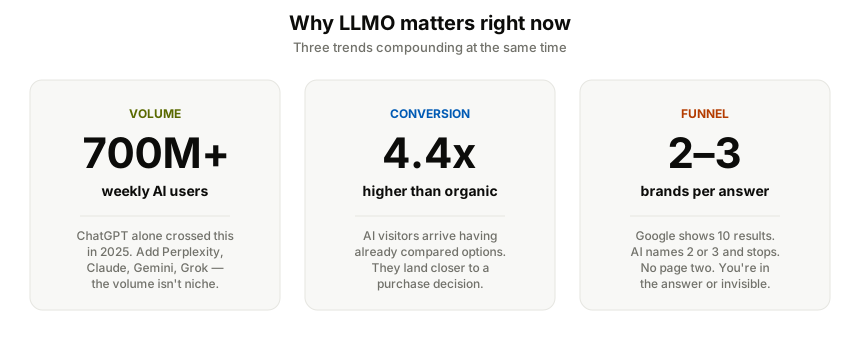
Three trends are compounding at the same time, and together they explain why this discipline exists:
AI assistants are eating search volume. ChatGPT crossed 700 million weekly active users in 2025.1 Google's own AI Overviews now appear on the majority of commercial queries, often with a recommended brand inside the synthesis. Perplexity, Claude, Grok, and Gemini all shipped first-party search-and-recommend experiences in the last 18 months. The volume isn't niche anymore — it's a significant share of how people discover products and services.
The consideration funnel is collapsing. Where buyers used to compare four to six vendors across blog reviews, YouTube videos, and comparison sites, they now ask one AI assistant a single question and trust the synthesis. If your brand is not in that synthesis, you lose the deal silently. There's no bounce metric for "the AI didn't mention you." You can't retarget a visitor who never visited.
Traditional SEO doesn't translate automatically. Ranking #1 on Google for "best CRM" does not guarantee ChatGPT recommends you. Different signals, different training data, different real-time retrieval sources. You can be the SEO winner and the LLMO loser at the same time — and plenty of brands are.
The conversion upside is real, too. Semrush found that AI search visitors convert 4.4 times better than traditional organic traffic, because they arrive having already compared options inside the chat.2 They land closer to a purchase decision. The brands that capture those visitors aren't competing with nine other results on a page — they're the only names in the answer.
What does LLMO actually mean?
LLMO stands for Large Language Model Optimization. It's the practice of getting your brand mentioned, recommended, and cited inside AI-generated answers — whether that's ChatGPT, Claude, Gemini, Perplexity, Grok, or DeepSeek.
The goal is narrow and measurable. When someone asks an AI assistant a question your product can answer, you want to be the brand it names. Not a competitor. Not "there are several options." You. By name.
Three things determine whether that happens:
- Content that AI systems can read and lift. If your pages are buried behind JavaScript rendering, blocked by robots.txt, or written in dense marketing copy with no clear answers, models skip you.
- Off-site presence that makes you trustworthy. The model cross-references. If only your own website says you're good, that's thin evidence. If Wirecutter, G2, three Reddit threads, and a trade publication all say you're good, the model treats that as consensus.
- Structured signals that remove ambiguity. JSON-LD schema, consistent entity descriptions, an
llms.txtfile — these tell the model exactly who you are and what you do without forcing it to guess.
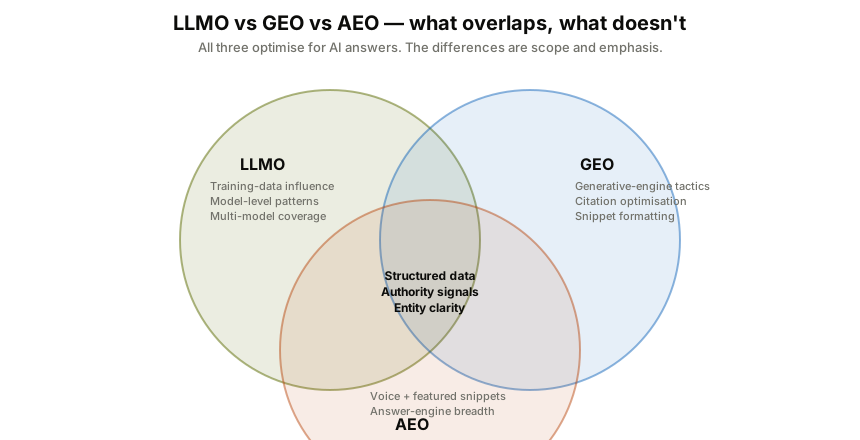
LLMO vs GEO vs AEO vs AI SEO — is there a real difference?
Short answer: not really. These are four labels for the same discipline, coined by different groups looking at the work from slightly different angles.
| Term | Stands for | Emphasis | Who uses it |
|---|---|---|---|
| LLMO | Large Language Model Optimization | The underlying models (ChatGPT, Claude, Gemini) | Teams who think in terms of the models themselves |
| GEO | Generative Engine Optimization | Generative engines as a category | The most widely adopted term in marketing |
| AEO | Answer Engine Optimization | Being the answer — includes snippets and voice | Teams who came from the featured-snippet era |
| AI SEO | AI Search Engine Optimization | An extension of traditional SEO | Teams who see this as the next layer of their existing SEO work |
We've written a full breakdown of GEO vs AEO vs SEO if you want the nuance. The practical reality: pick a label and focus on execution. The work is the same regardless of what you call it.3
One distinction worth noting. Ahrefs has argued the whole discipline is "just SEO under a new name." They're mostly right — the fundamentals overlap heavily. But a few signals have no clean SEO equivalent: unlinked brand mentions, the sentiment attached to those mentions, and your share of voice inside a specific AI answer. Each one moves your LLM visibility independently of your Google ranking.4
How do LLMs decide what to recommend?
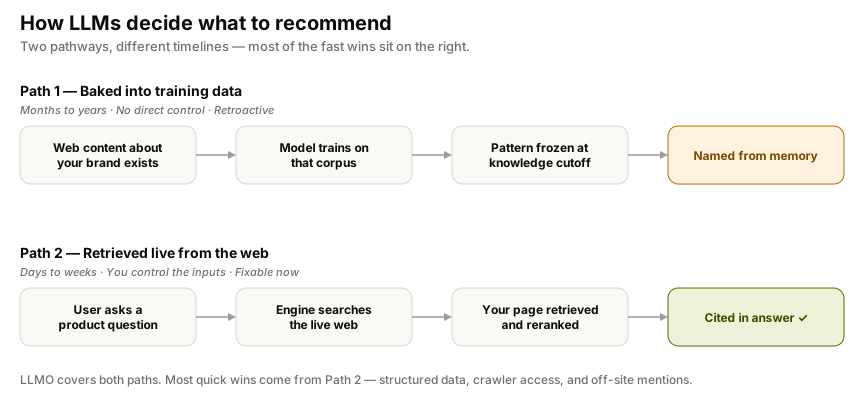
Two pathways. Understanding them saves you from wasting effort on the wrong timeline.
Pathway 1: Training data (slow, compounds over months)
Every LLM absorbs a massive snapshot of the web during pre-training. If your brand was consistently mentioned across authoritative sources before that cutoff, the model already has an internal picture of who you are. Brands like Stripe, Notion, and HubSpot show up in AI answers partly because they were everywhere in the training data before anyone was thinking about LLMO.
You can't change your training-data presence directly. But you can change it gradually by building authoritative citations now that will land in the next training cycle. This is the slow, compounding pathway.5
Pathway 2: Retrieval-augmented generation (fast, fixable this week)
When a user asks a real-time question — "best CRM in 2026" — most AI assistants don't answer purely from memory. They search the live web, pull back relevant pages, and write their response from that material. This is retrieval-augmented generation, or RAG.6
This is your biggest lever right now. The pages the model retrieves are the ones it summarises. If your page is retrievable, well-structured, and answers the query directly, you can appear in an AI answer within days of publishing — not months.
Most modern AI search experiences blend both pathways, but the mix varies by engine:
- Perplexity is almost entirely retrieval. It searches the live web for every query and cites its sources visibly. This means retrieval-side fixes show up in Perplexity answers fastest.
- ChatGPT mixes training-data knowledge with live Bing search. For factual queries it searches; for opinion-style queries ("what's the best X") it often blends both. The Shopping experience is fully retrieval-based, pulling from Bing and Google Shopping feeds.
- Claude uses retrieval when invoked with web access, and relies on training data otherwise. Training-data signals matter more here than on other engines.
- Gemini draws on Google's own search index and Shopping Graph. If you're visible in Google search, you have a head start in Gemini answers.
- Grok pulls from X (Twitter) data and web search, which means community signals and social mentions carry outsized weight.
- DeepSeek leans heavily on training data with limited retrieval capability, making it the slowest to reflect recent changes.
Knowing which pathway a tactic affects — and which engines lean on which pathway — tells you how fast to expect results and where to prioritise effort.
LLMO vs traditional SEO — what actually changes?
The mechanics you already know still apply underneath. But the target, the currency, and the success metric all shift.
| Traditional SEO | LLMO | |
|---|---|---|
| You're optimizing for | Ranking on a results page | Being named inside an answer |
| Primary currency | Backlinks | Brand mentions — linked or not |
| How you measure | Ranking position, CTR | Share of voice across AI answers |
| What winning looks like | User clicks your link | User reads your name in the synthesis |
| How many brands compete | 10 on page one | 2–4 in the answer |
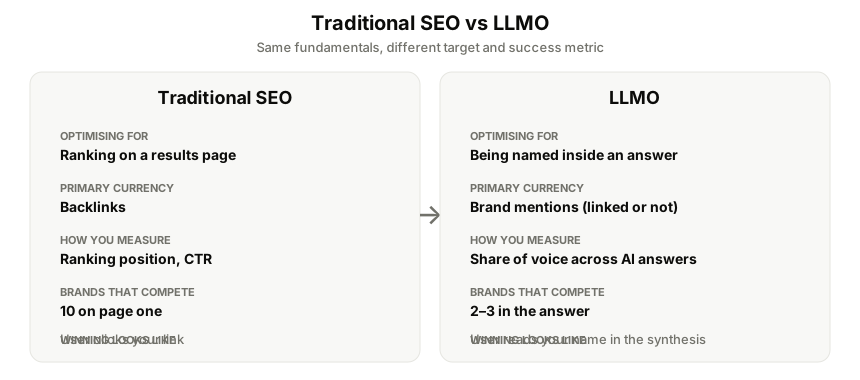
The last row matters most. A Google results page gives ten brands a shot at the click. An AI answer names two or three and stops. The brands inside that shortlist absorb most of the demand. Everyone else gets nothing — and there's no "page two" to scroll to.
The upside is real too. AI visitors convert significantly better than traditional organic visitors because they arrive having already compared options inside the chat. They land closer to a purchase decision.2
How to do LLMO: the four pillars
LLMO asks for one shift in mindset — from ranking pages to being named in answers — and then a concrete set of work to get there. Here are the four pillars, with the specific tactics inside each.
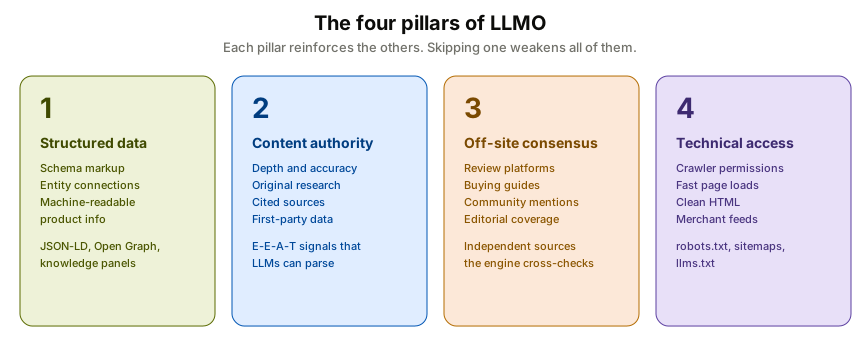
Pillar 1: Create content that LLMs can lift
This is the layer you control completely, and four things make your content liftable:
Answer-first formatting. Phrase your headings as questions. Answer in the opening sentence. Keep each answer self-contained so a model can quote it without needing the paragraph above.
Here's what this looks like in practice. Take any H2 on your site that opens with a noun phrase like "Our Approach to Customer Success" and rewrite it as "How does [your brand] handle customer success?" followed by a direct one-sentence answer. The noun-phrase heading gets skipped by retrieval because it doesn't match how people ask questions. The question-form heading matches the query pattern and the answer becomes liftable. That single structural change — repeated across every H2 on your site — is often enough to shift your retrieval visibility.
Original data and citable research. Stats, benchmarks, surveys, and research that only you have. Models reach for numbers that come with a source, and proprietary data is the highest-value content asset you can create. A survey finding like "73% of B2B buyers now ask AI before contacting sales" — if it's yours and you cite the sample size — will get quoted across AI answers for your category for months.
If you've run customer surveys, published industry benchmarks, tracked category trends, or compiled case-study data, surface it prominently on your site with clear attribution. Don't bury it in a PDF — put it in crawlable HTML with structured headings so retrieval systems can extract it.
Schema and clean structure. Article and FAQPage schema, comparison tables, and clean HTML. Keep your key content out of JavaScript that has to render — most AI crawlers do not execute JavaScript, so content inside React components, Angular templates, or dynamically loaded accordions is invisible to them. If your key product descriptions or FAQ answers live inside JS-rendered components, that content doesn't exist as far as the retrieval pass is concerned.
Use our schema generator to produce the right shape in 30 seconds, and test your pages with Google's Rich Results Test to confirm validity.
Crawler access. Allow GPTBot, OAI-SearchBot, PerplexityBot, and ClaudeBot in your robots.txt. Without this, the engines can't fetch your pages at all. A surprising number of teams discover they're blocked under a catch-all Disallow: / rule added years ago and never revisited — check yours right now.
Also add an llms.txt file. The standard is emerging and its weight is unproven, but it costs five minutes to set up and has zero downside. We wrote a step-by-step guide to adding llms.txt.7
Pillar 2: Get mentioned where LLMs look
Getting named in AI answers happens mostly through the sources the models cross-check. The work here is earning genuine brand mentions in the right places:
Editorial and PR mentions. These count even when the mention carries no link — which is the sharpest break from traditional SEO, where a linkless mention does nothing. If TechCrunch, a trade publication, or even a well-read Substack mentions your brand, that signal flows to the model.
Third-party roundups and listicles. Target the specific pages that models already cite for your category. The fastest way to find them: run five of your core category prompts in ChatGPT or Perplexity and check which sources appear in the answers. Those are the pages the engine already trusts. Earning a mention on one of them is more direct than generic outreach.
Review platforms. Keep a current profile on G2, Capterra, Trustpilot — whatever the review platform is for your niche. It feeds both the model's understanding of you and the sentiment attached to your name. Our best AEO tools guide covers the review platforms that carry the most weight per category.
Pillar 3: Participate in communities
Community participation feeds AI answers more than most teams expect.
Reddit and Quora. These threads are heavily weighted source material for most AI engines. Credible, genuine answers from established accounts carry real citation weight. We've written about this pattern in detail in our Perplexity citations playbook and how to get cited by Claude.
Niche forums. Industry-specific communities (Hacker News, IndieHackers, vertical Slack groups, Discord servers) have less competition and pull the same citation weight in domain-specific queries. A helpful answer on a 200-member niche forum can outperform a generic post on a high-traffic platform because it directly matches the vertical queries AI engines process.
A practical starting point for communities: Search Reddit for "[your category] best" and "[your category] vs" and filter by top posts from the last year. The threads that rank well on Google are the same ones being indexed and cited by AI engines. A genuine, useful answer in one of those threads — from an account with real history, not a fresh throwaway — is worth more than a new post with no audience yet.
One honest warning: astroturfing backfires. Manufactured praise gets detected, downranked, and sometimes permanently banned. It also poisons the exact sentiment signal you were trying to improve. Reddit's community detection is sophisticated, and AI engines have learned to weight account age and comment history. The only version of this that works is real participation with real answers from real accounts.
Pillar 4: Build trust signals (slow, compounds over time)
Trust signals shape how the model understands your brand over the long run. They move the training-data pathway:
Entity consistency. The same name, description, and positioning across your site, LinkedIn, directories, Crunchbase, and Wikidata. If ChatGPT describes your brand vaguely when you ask "What is [your brand]?", the gap usually traces back to conflicting information across your public profiles.
Author credibility. Named authors with visible credentials. Real About pages. Expert review where it applies. If your content comes from faceless "Staff Writer" bylines, it reads as less authoritative to models that cross-reference authorship signals.
Freshness. Dated updates and current stats. Both models and retrieval systems favour sources that look actively maintained. A page last updated in 2024 loses to an equivalent page updated last month — every time.
How to measure LLMO
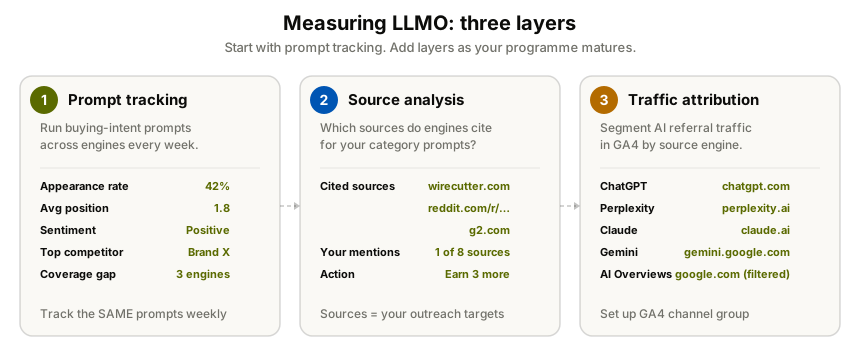
You can't improve what you can't measure, and LLMO measurement is still a younger discipline than SEO measurement. Here's the method that works:
Build a prompt set
Write 20–30 buying-intent prompts per category. Phrase them the way real buyers ask, not as keyword strings:
- "Best [category] for [use case]"
- "[Brand A] vs [Brand B]"
- "Is [product] worth it?"
- "What [category] should I use for [problem]?"
Source them from sales calls, support tickets, People Also Ask boxes, and autocomplete suggestions. These are the prompts your buyers actually type.8
Log the right things
For each answer across each engine, record:
- Whether your brand appeared
- Where you landed (named first, mentioned as an afterthought, or absent entirely)
- The sentiment (recommended, neutral, or warned against)
- Which competitors showed up
- Which sources the answer cited
Those cited sources are not just data — they're your action list. A source that keeps appearing in answers for your category is a source worth getting mentioned on. That closes the loop between measurement and action.
Track weekly, at minimum
AI answers are non-deterministic. The same prompt can return different brands across sessions. Only a fixed set run repeatedly separates a real trend from noise.
Track share of voice (your mentions vs competitors across the whole set) and source coverage (how many of the citing pages include you). Don't fixate on a single visibility number — it's the relative movement that tells you whether your work is landing.
Segment your AI referral traffic
Alongside prompt tracking, set up your analytics to identify traffic from AI sources separately. In GA4, you can create custom channel groups for AI referrals — traffic from chatgpt.com, perplexity.ai, gemini.google.com, and similar referrers. This gives you a downstream check on whether your visibility improvements are translating into actual site visits. We wrote a full GA4 setup guide for AI traffic that walks through the configuration.
The combination of prompt-set tracking (are we being mentioned?) and analytics segmentation (is it driving visits?) gives you the complete picture. Without both, you're either tracking visibility without knowing if it converts, or seeing traffic without knowing which engine or prompt drove it.
Automate when it stops scaling
The manual loop works, and we genuinely recommend starting there so you build intuition about how each engine behaves. But past one category, it stops being practical — running 30 prompts across six engines weekly is 180 queries to log by hand, every week. That's where a tool earns its place.
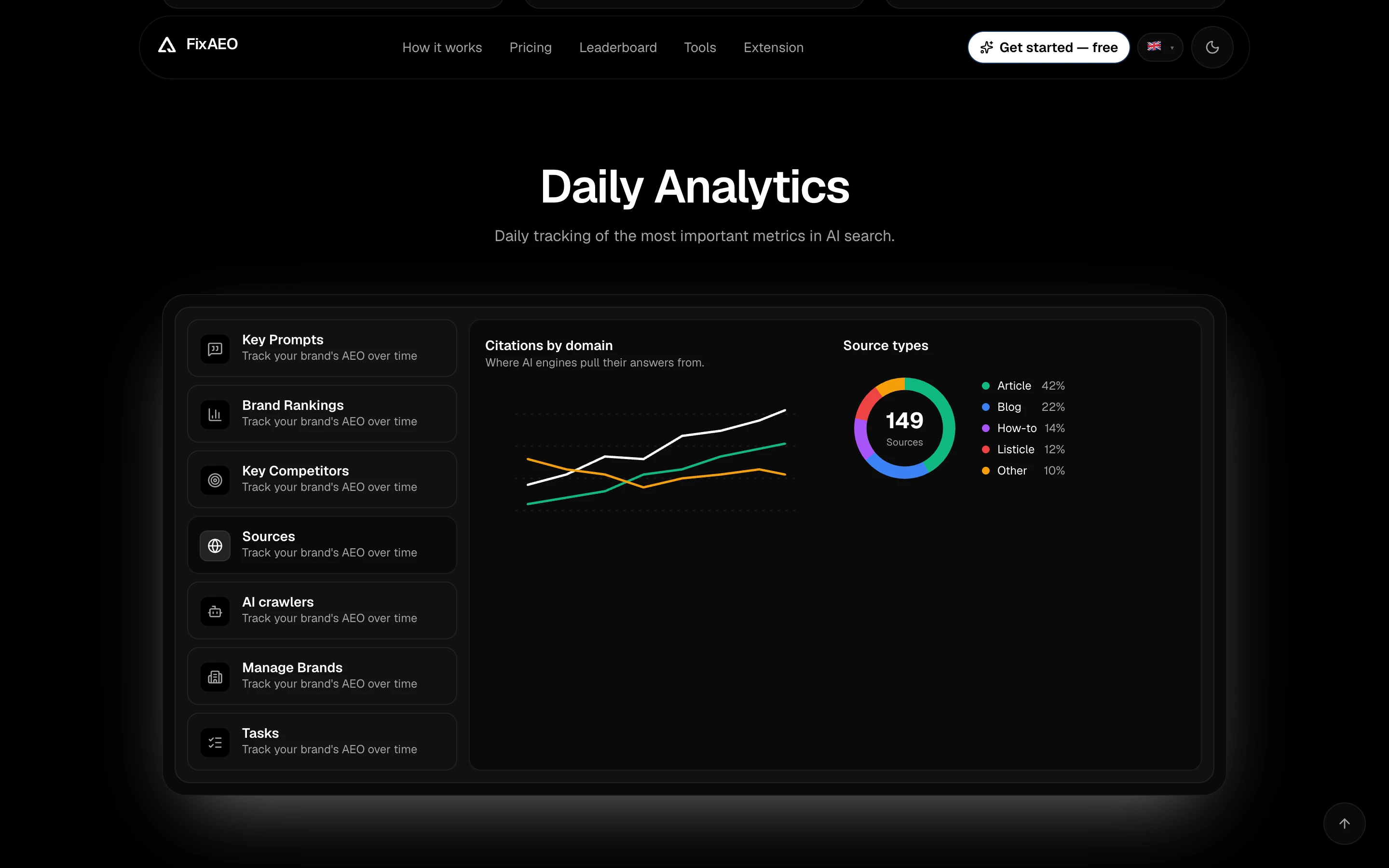
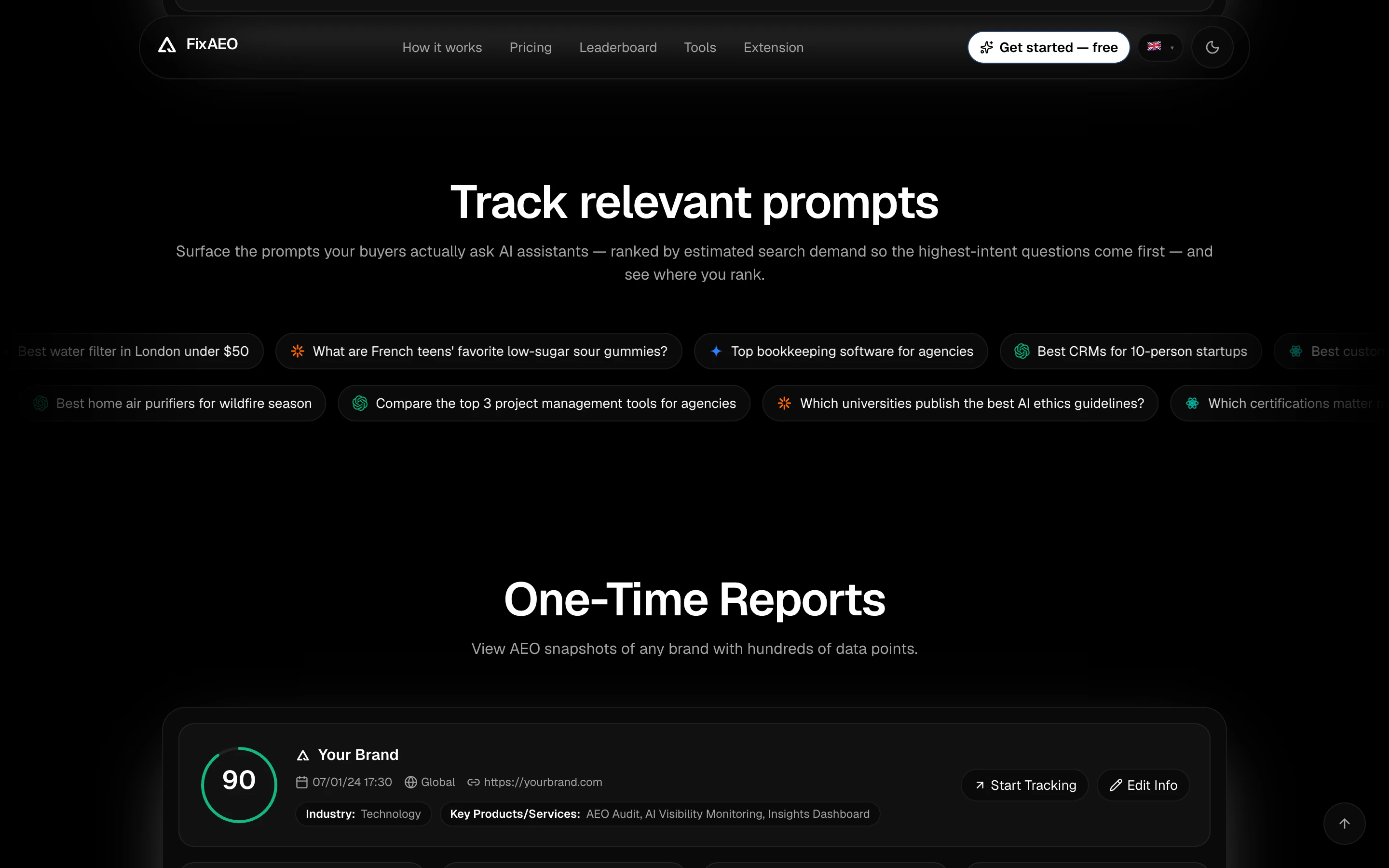
FixAEO runs prompt tracking across ChatGPT, Claude, Gemini, Perplexity, Grok, and DeepSeek continuously. It logs every mention, tracks share of voice over time, surfaces the citation sources each engine references, and flags when competitors gain or lose positions.
Run a free AEO audit to see where you stand today, or read our guide on how to measure AEO ROI for the full methodology.
A handful of other AEO tracking tools handle parts of this loop if you'd rather compare options. The method matters more than the tool — even a spreadsheet beats flying blind.
Common LLMO mistakes
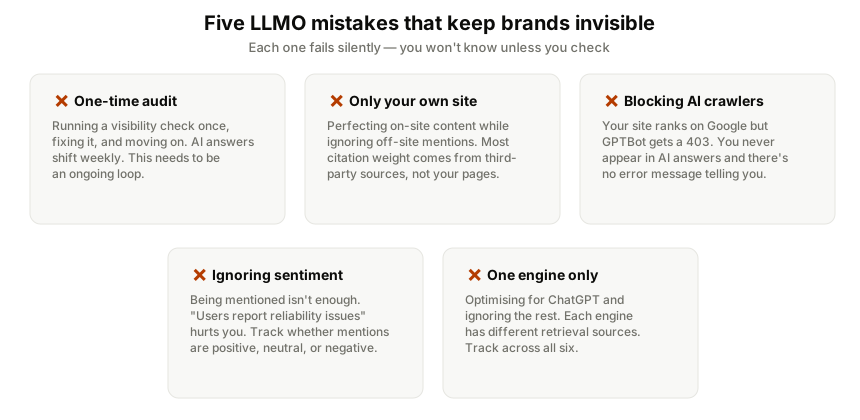
Five patterns that consistently keep brands out of AI answers:
Treating LLMO as a one-time audit. Running a visibility check once, fixing whatever it flags, and then moving on. AI answers are non-deterministic and the competitive landscape shifts weekly. The brands that win treat LLMO as an ongoing loop, not a project with a completion date. If you're not tracking monthly, you're not tracking.
Optimising only your own site. The most common trap. Teams spend months perfecting their on-site content and schema while ignoring the off-site signals that actually move recommendations. In our scans, the brands that dominate AI answers typically get more citation weight from third-party mentions than from their own pages. Your site makes you eligible; the web's opinion of you makes you recommended.
Blocking AI crawlers without realising it. This fails silently. Your pages still rank in Google, your site loads fine for human visitors, but GPTBot and PerplexityBot get a 403 or a Disallow and you never appear in AI answers. Check your robots.txt and your CDN settings — Cloudflare's bot protection sometimes blocks AI crawlers by default. Our AEO audit tool flags this automatically.
Ignoring sentiment. Being mentioned isn't enough. If ChatGPT says "[your brand] is an option, but users have reported reliability issues", that mention is hurting you, not helping. Track the sentiment attached to each mention — recommended, neutral, or warned against — and address negative sentiment at the source (usually a review platform or a community thread).
Focusing on one engine. ChatGPT has the most users, so teams optimise for ChatGPT and ignore everything else. But Perplexity, Gemini, Claude, Grok, and DeepSeek each have their own retrieval sources and citation patterns. A brand that dominates ChatGPT answers but is absent from Perplexity is leaving demand on the table. Track across engines, not just the biggest one.
The quick-start checklist
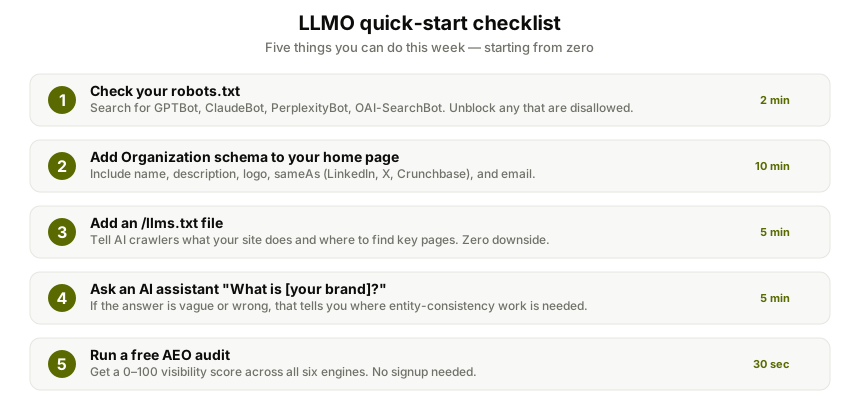
If you're starting from zero, do these five things this week:
-
Check your robots.txt. Search for
GPTBot,ClaudeBot,PerplexityBot,OAI-SearchBot. If any are blocked, unblock them. Many sites have a catch-allDisallowrule added years ago and never revisited. -
Add
Organizationschema to your home page. Includename,description,logo,sameAs(LinkedIn, X, Crunchbase), andemail. Use our schema generator. -
Add an
/llms.txtfile. Five minutes, zero downside. Our llms.txt guide walks you through it. -
Ask an AI assistant "What is [your brand]?" Read the answer. If it's vague, outdated, or wrong, that tells you where the entity-consistency work needs to happen.
-
Run a free AEO audit to get a 0–100 visibility score across all six engines.
The bottom line
LLMO is the work of getting your brand mentioned, recommended, and cited in AI answers. It runs on the same fundamentals as SEO — good content, earned authority, structured data — but with a different goal and a few signals that have no SEO equivalent (unlinked mentions, answer sentiment, share of voice inside a synthesis).
The brands that win treat it as a loop: create content that's liftable, earn mentions where models look, participate genuinely in communities, build trust signals over time, measure a fixed prompt set weekly, and feed what you learn back into the next round.
The teams investing in this now are the ones that will own those two or three recommendation slots in 2027. See where your brand stands today — run your free scan at fixaeo.com and get a visibility score in under 30 seconds, no signup required.
Related reading
- What is AEO? Answer Engine Optimization explained — the foundational primer
- GEO vs AEO vs SEO: which acronym actually applies? — the terminology deep dive
- AEO vs SEO: what changed and what to do about it — the strategy comparison
- Best AEO tools in 2026 — the tools landscape
- How to measure AEO ROI — making the business case
Frequently asked questions
Is LLMO the same as GEO?
In practice, yes. LLMO and GEO describe the same discipline — getting your brand cited and recommended in AI answers. The labels emphasise slightly different angles (the models themselves vs the engines built on them), but the tactics, the measurement, and the work are identical. Pick one label and focus on execution.
Is LLMO replacing SEO?
No. LLMO and SEO overlap heavily and work best together. Most of the SEO fundamentals — quality content, earned authority, clean technical setup — still matter, but for different reasons. LLMO adds a layer for the answer surfaces that SEO alone doesn't cover. We've written a detailed comparison of how the two relate.
How long does LLMO take to show results?
It depends on which pathway the tactic moves. Retrieval-based fixes — crawler access, schema, fresh content — can surface within days to weeks. Training-data presence built through consistent mentions and entity signals takes months to compound. The teams that win ship the fast fixes now and start the slow work in parallel.
Can you do LLMO without publishing new content?
Partly. Mentions on third-party sites, community participation, review profiles, schema improvements, and crawler access all move your visibility without publishing a single new page. New content helps — especially original data and comparison posts — but a meaningful share of the work is off-site.
How is LLMO different from regular content marketing?
Regular content marketing targets human readers on search engines. LLMO targets the same readers but through AI intermediaries that synthesise your content into recommendations. The craft of writing well still matters, but the format shifts: answer-first structure, machine-readable markup, and a focus on being quotable in a single sentence rather than driving a click.
Footnotes
-
OpenAI: ChatGPT — A year in chat. Read the usage breakdown. ↩
-
Semrush: AI Search & SEO Study. Found that AI search visitors convert significantly better than traditional organic. Read the study. ↩ ↩2
-
We covered the LLMO / GEO / AEO taxonomy in depth in our GEO vs AEO vs SEO primer. The consensus across practitioners is that the work is identical — only the framing differs. ↩
-
Ahrefs: GEO — Generative Engine Optimization. Read the analysis. ↩
-
Lewis et al.: Retrieval-Augmented Generation for Knowledge-Intensive NLP Tasks. Read the original RAG paper. The training-data pathway is the part RAG was designed to supplement. ↩
-
OpenAI Help Center: How ChatGPT search works. Read the help article. ↩
-
llmstxt.org: The /llms.txt file. Read the proposal. ↩
-
We detail the full prompt-set methodology in our AEO ROI measurement guide. ↩
Related reading
What is AEO? Answer Engine Optimization explained
Answer Engine Optimization (AEO) means getting AI assistants to recommend your brand. Learn what AEO is, why it matters more than SEO, and how to start.
18 min readCan DeepSeek Search the Web? How Smart Search Works
Yes, DeepSeek can search the web and cite sources. Learn how Smart Search works, what it shares, and why the API needs a separate search tool.
21 min readCan Microsoft Copilot Search the Web? How Bing Grounding Works
Yes, Microsoft Copilot searches the web through Bing and cites sources. Learn how Search mode, grounding, Researcher, privacy, and indexing work.
20 min read
Free AEO tools
Put this into practice with free FixAEO tools — no signup required.
AI Visibility Checker
Score your brand across 9 AI engines
AEO Audit Tool
Answer-engine readiness scan
Schema Generator
Build valid JSON-LD structured data
llms.txt Generator
Create a spec-compliant llms.txt
Sitemap Validator
Check your XML sitemap for errors
AI Content Grader
Grade content for AI citation readiness
Find the gap. Then fix it.
Check how AI engines find, describe, and cite your site. Free, no signup. On a paid plan, AI Marketer can turn the evidence into briefs, drafts, optimizations, and reports.