How to get your products recommended by AI
AI shopping answers name three or four products and stop. Here's how to be one of them — product data, off-site citations, tracking across ChatGPT, Perplexity, Gemini, and more.

On this page
A year ago, a wireless earbuds purchase started on Amazon or Google. In 2026 it starts in a chat box. A shopper opens ChatGPT and types "best wireless earbuds under $100 for running." They get three picks with prices, a short comparison, and a Shopping card with buy links. No scrolling, no ten blue links, no sponsored results at the top. Just three brands that made the cut.
If your product isn't one of those three, you didn't lose a click. You lost the entire consideration. The shopper never saw you. There is no page two in an AI answer.
This post covers how AI assistants decide which products to recommend, which engines matter for ecommerce, and the five practical steps that get your products into those answers.
Curious how your site does?
See how AI engines describe your site — free, about 60 seconds, no signup.
What are AI product recommendations?
AI product recommendations are specific products an AI assistant names inside a conversational answer. Instead of returning a list of links for you to sort through, the engine picks two to four options, explains why each fits, and often includes prices and buy buttons.
These answers show up across four main surfaces, each built on different plumbing:
- ChatGPT Shopping — returns product cards inside the chat, pulled from Bing's web index and Google Shopping listings1
- Perplexity — displays product cards with visible source citations and AI-written pros and cons, plus a Buy with Pro in-chat checkout2
- Google AI Overviews and Gemini — surfaces product units inside search and AI Mode, drawn from Google's Shopping Graph (tens of billions of listings, refreshed hourly)3
- Amazon Rufus — answers shopping questions inside the Amazon app, powered by Amazon's own catalog, reviews, and community Q&As
Same behaviour, four different data sources. That's why a single-platform playbook leaves visibility on the table.
Why do AI product recommendations matter?
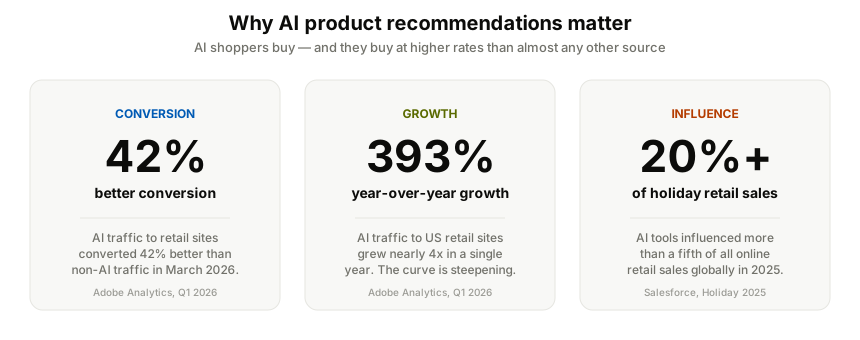
Because AI shoppers buy. And they buy at higher rates than almost any other traffic source:
- AI traffic to retail sites converted 42% better than non-AI traffic in March 2026 — a record high and a complete reversal from the year before, when AI visitors actually converted worse.4
- AI tools influenced more than 20% of all online retail sales globally during the 2025 holiday season.5
- AI traffic to US retail grew 393% year-over-year in Q1 2026.4
The structural reason it matters goes beyond conversion rates. AI answers create a winner-takes-most dynamic:
A Google results page gives ten brands a fighting chance at the click. An AI answer names three or four and stops. The brands inside that shortlist absorb almost all of the demand. Everyone else gets nothing because the shopper never sees a second page.
This is fundamentally different from traditional ecommerce SEO, where ranking on page two still meant some visibility. In AI shopping, there is no page two. You're either named or you're not. The shopper doesn't scroll, doesn't paginate, doesn't compare tabs. They read the three recommendations, click one, and buy.
That's why AEO for ecommerce has grown into its own discipline — the shortlist rewards the brands that did the off-site work long before the question was ever asked. And the gap is widening: as more shoppers start their product research in AI assistants rather than Google, the brands that aren't in those answers lose a growing share of discovery they can't recover through traditional channels.
How do AI assistants decide which products to recommend?
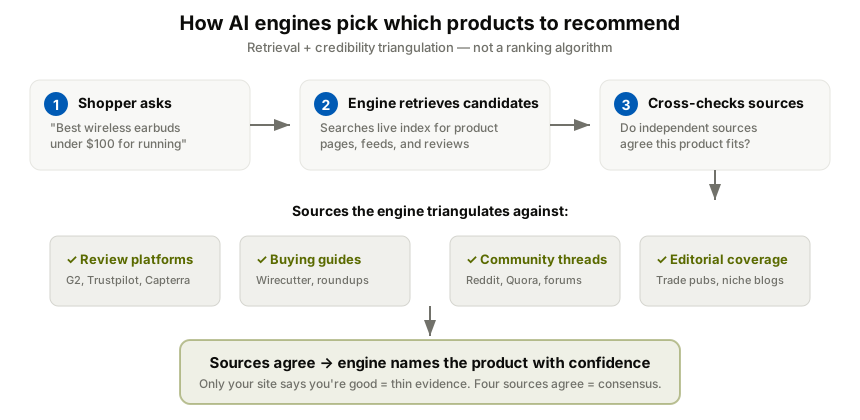
AI assistants don't rank products the way Google ranks web pages. They use retrieval plus credibility triangulation.
When a shopper asks a question, the engine retrieves candidate products and supporting documents from a live index. Then it checks your brand against what independent sources say about it before naming you. If your product page, three review platforms, a buying guide, and a Reddit thread all describe the same product the same way, the engine treats that agreement as confidence and surfaces you. If only your own site makes the claim, that confidence is thin.
Two things follow from this:
Recommendations are probabilistic, not fixed. The same prompt can return different products across sessions because retrieval timing, the shopper's location, and conversation history all feed the result. That's why you need to track recommendations repeatedly, not just check once.
Most of the work that moves recommendations sits off your website. The sources the engine cross-checks — reviews, roundups, community threads, editorial mentions — are where the real leverage is. That's the part the typical product page optimization checklist never reaches.
We've written about this mechanism in detail across our engine-specific guides: how to get cited by Gemini, how ChatGPT picks brands, and our Perplexity citations playbook.
Which AI engines recommend products?
Four engines drive most AI product discovery. They source their answers differently, which is why knowing each one matters.

| Engine | Where it gets product data | How it links out | Key detail |
|---|---|---|---|
| ChatGPT Shopping | Bing's web index + Google Shopping listings + OpenAI Merchant Program feeds | Organic product cards with retailer links; no ad bidding | 83% of carousel products matched Google Shopping's top listings in a March 2026 analysis6 |
| Perplexity | Live web sources cited in real time + free Merchant Program feed | Visible source citations; AI-written pros and cons on product cards | Buy with Pro enables in-chat checkout; Shopify catalogs can syndicate automatically |
| Google AI Overviews / Gemini | Google's Shopping Graph via Merchant Center | Product units with links; weighs merchant trust and store ratings | Owns the existing Google search demand; rewards complete Merchant Center feeds and Product schema |
| Amazon Rufus | Amazon's own catalog, reviews, and community Q&As | Recommends listings inside Amazon with "Buy for Me" and "Shop Direct" | A closed ecosystem; listing completeness and review depth drive inclusion |
The key takeaway: there is no single feed or single tactic that covers all four. What gets you recommended by ChatGPT (which leans on Google Shopping data and Bing) is different from what wins in Rufus (which reads your Amazon listing and reviews). A product that wins in one engine can be absent from another because its data there is thin.
A practical example: a DTC skincare brand we scanned was recommended by Perplexity for every relevant query because Perplexity heavily weights review-site citations, and this brand had deep Trustpilot coverage. The same brand was invisible on ChatGPT Shopping because their Microsoft Merchant Center feed was empty — ChatGPT couldn't find their products through the Bing pipe at all. Same product, same quality, two completely different outcomes based on which data pipe each engine reads.
This is why a multi-engine tracking approach matters. If you only check one engine, you're seeing one slice of your AI shopping visibility and making decisions on incomplete data.
How to get your products recommended by AI: 5 steps
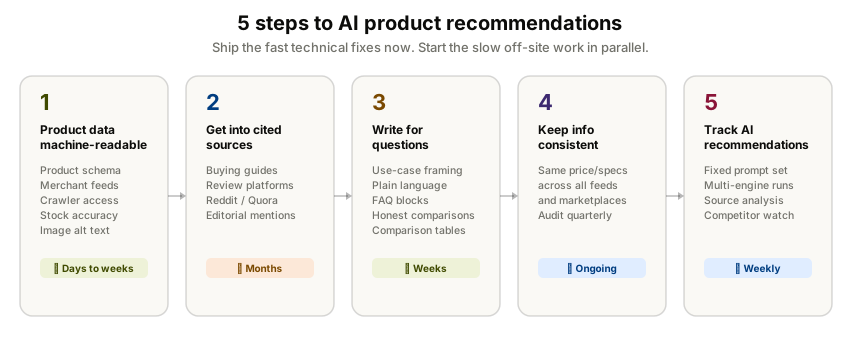
Step 1: Make your product data machine-readable
Start with eligibility. No amount of off-site work helps if an engine can't read your products. The fastest wins here are technical and you control all of them.
Add Product schema to every product page with the properties engines actually parse. We've audited hundreds of catalogs in our scans — the pages that get pulled into AI answers consistently have all five of these:7
offers— withprice,priceCurrency,availability, andpriceValidUntilaggregateRating—ratingValueandreviewCountreview— at least 3 individual reviews withauthor,reviewRating,reviewBodyavailability—InStock/OutOfStock(Perplexity demotes out-of-stock products hard)brand— as a nestedBrandentity, not a plain string
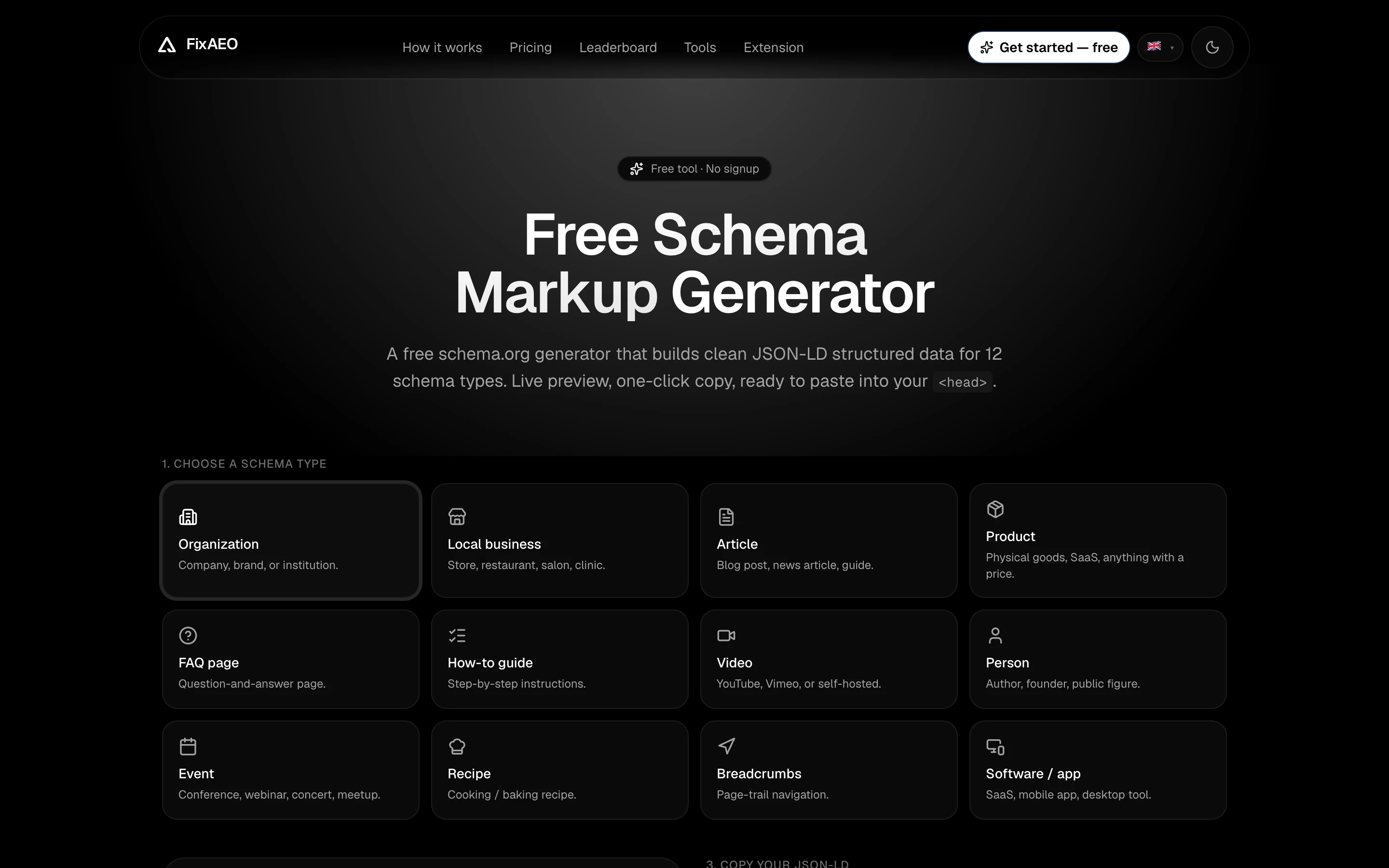
Most catalogs we audit have two of these. The ones with all five get pulled into AI context at a much higher rate. You can generate the right shape in 30 seconds with our schema generator.
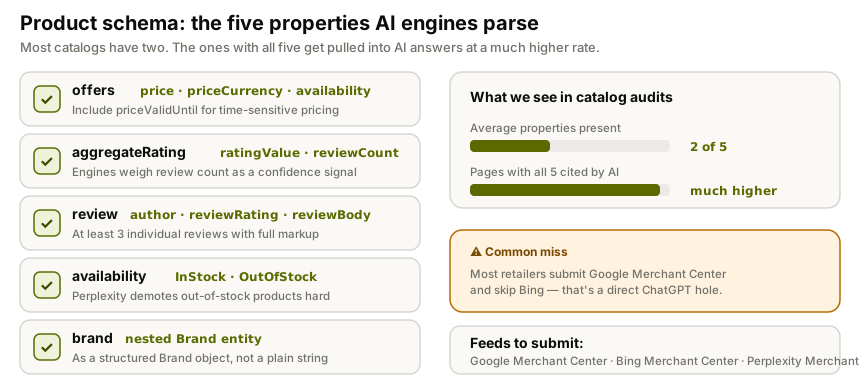
Submit feeds to where each engine looks. Google Merchant Center feeds the Gemini pipe. Microsoft Merchant Center (Bing Shopping) feeds the ChatGPT pipe. Most retailers we audit have the Google feed live and the Bing feed neglected — that's a direct ChatGPT visibility hole.
Allow the AI crawlers in your robots.txt. OAI-SearchBot and GPTBot for ChatGPT, PerplexityBot for Perplexity, ClaudeBot for Claude. This fails silently — you can check whether crawlers can reach your catalog with our free AEO audit before spending a month wondering why nothing surfaced.
Keep stock status accurate in real time. Retrieval is live. An out-of-stock product with no availability: OutOfStock flag signals data quality issues and gets demoted at the re-rank stage. If your CMS doesn't auto-update the JSON-LD when your inventory changes, that's the highest-leverage bug to fix in your catalog.
Optimise product images for multi-modal engines. Gemini, Claude, and ChatGPT can all read product images. Multi-modal engines extract product details directly from photos when page copy is thin. The bare minimum: descriptive alt text on every product image. Not "Product image 1" but "Sonos Move 2 portable speaker in shadow black, side angle, showing mesh grille and capacitive touch controls." The descriptive version gets parsed; the generic version contributes nothing.
Beyond alt text, make sure your primary product images are high-resolution, on a clean background, and show the product from multiple angles. Engines that process images are increasingly using them to verify claims made in the text — if your copy says "compact design" but the image shows a bulky product, that inconsistency registers.
Step 2: Get into the sources AI cites
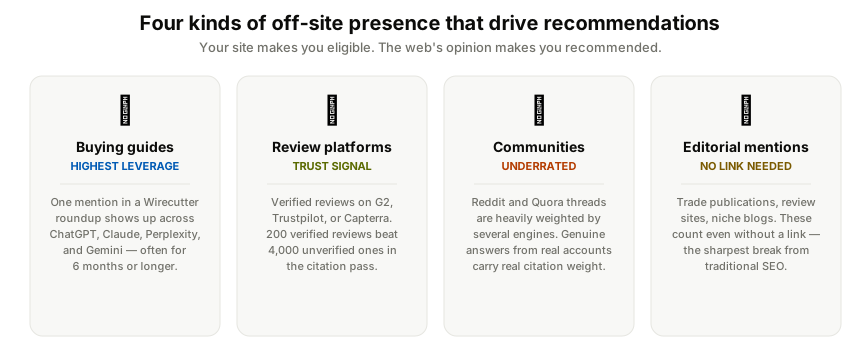
Eligibility gets you considered. Getting named happens in the sources each engine cross-checks. This is where most of the real work lives.
There are four kinds of off-site presence worth building:
Third-party buying guides and roundups. One mention in "The 5 best wireless earbuds for running" on Wirecutter shows up across ChatGPT, Claude, Perplexity, and Gemini for variants of that query — often for six months or longer. Find the roundups that matter by running five of your core category prompts in ChatGPT or Perplexity and checking which sources keep showing up in the citations. Those are your targets.
Review platforms. A well-populated, verified review profile on G2, Capterra, Trustpilot, or whatever the platform is for your category. Verified reviews (Trustpilot Verified, Bazaarvoice Authenticated, Google Customer Reviews) carry significantly more weight than unverified volume. A product with 200 verified reviews ranks higher in the citation pass than the same product with 4,000 unverified ones.8
Community participation. Reddit and Quora threads are among the most heavily weighted sources several engines pull from. Search for "[your category] best" and "[your category] vs" and filter by top posts. The threads that rank well on Google are the same ones being indexed and cited by AI engines. A genuine, useful answer in one of those threads is worth more than a new post with no audience yet.
Editorial mentions. Trade publications, review sites, niche blogs. These count even when the mention carries no link — which is the sharpest break from traditional SEO. We covered this dynamic in depth in our AEO for ecommerce guide.
One warning on communities: astroturfing backfires. Manufactured praise gets detected, downranked, and banned. It also poisons the exact sentiment signal you were trying to improve. Genuine participation is the only approach that works.
Step 3: Write product pages for questions, not keywords
AI prompts are conversational. They're closer to twenty words than the three or four people type into Google, and they're framed around problems and use cases rather than feature names.
Write your product pages to match:
Lead with attributes in plain language. "Stays dry in light rain and a quick downpour" does more work than "water-resistant nylon blend" because it directly answers what a shopper asked an AI assistant.
Frame around use cases. "For daily commuting," "for a first marathon," "for a team under 20 people." These are the structures AI queries follow. A product page that addresses the problem gets lifted into the answer; one that lists specs gets skipped.
Add an FAQ block. Build it from the real questions your support team and reviews surface. Engines extract FAQ blocks cleanly, and they generate automatic FAQPage schema that further improves your structured signal.
Write honest comparison content. A page that says who a product is and is not for reads as trustworthy. A page that always concludes "and that's why ours is best" gets treated as promotional. Engines cite honest comparisons more than uniform praise.
Before-and-after example for a product page rewrite:
A typical product description:
Lightweight running shoe. Breathable mesh upper. 10mm drop. Available in 6 colours. Free returns.
The same product rewritten for AI retrieval:
Built for daily training runs between 5k and half-marathon distance. The mesh upper keeps your feet cool on warm days but doesn't hold up well in heavy rain — choose the GTX version for wet-weather running. At 245g (men's size 10) it's light enough for tempo days without the trade-off you get with racing flats. The 10mm drop suits heel strikers transitioning from traditional trainers; forefoot runners may prefer our 4mm-drop trail shoe instead.
The second version maps directly to the questions shoppers type into AI assistants: "best running shoes for half marathon training," "running shoes for heel strikers," "lightweight running shoes that aren't racing flats." The first version answers none of those questions.
Include product comparison tables on category pages. Engines extract tables cleanly. A table with three or four of your products compared by use case, price, and key spec gives the engine a structured data block it can lift directly into an answer. We covered this pattern in our AEO for ecommerce guide with real examples from catalogs that get consistently cited.
Step 4: Keep product info consistent everywhere
This sounds like housekeeping, and it is. But it's the kind that silently decides recommendations.
When an engine cross-checks a product and finds your price is $49 on your site, $54 in a feed, and "unavailable" on a marketplace, it can't tell which version is true. Uncertainty reads as risk. The safe move for the engine is to recommend a competitor whose data lines up everywhere.
Keep your titles, pricing, specs, and availability identical across:
- Your own product pages
- Google Merchant Center feed
- Bing/Microsoft Merchant Center feed
- Amazon listing (if applicable)
- Review platform profiles (G2, Trustpilot, etc.)
The triangulation logic in step 2's retrieval process is looking for agreement. Mismatched data is the easiest way to fail it.
A practical way to audit consistency: search your brand name + product name in each engine and look at what data surfaces. If ChatGPT shows a different price than Perplexity, trace back to which feed each one is reading and fix the source. This audit takes 30 minutes per product line and frequently uncovers feed-sync issues that have been silently costing recommendations for months.
Step 5: Track whether AI actually recommends you
Everything above is invisible until you measure it. And measurement is the step that separates teams who improve from teams who guess.
Start manually. Write 20–30 buying-intent prompts per category — the real ones shoppers ask:
- "Best [category] for [use case]"
- "[Category] under $[price]"
- "What's a good [category] for beginners?"
- "[Product A] vs [Product B] for [scenario]"
Run each prompt across every engine you care about. For every answer, log:
- Whether your product appeared
- Where you landed in the answer (named first, mentioned later, or absent)
- The sentiment attached (recommended, neutral, or warned against)
- Which competitors showed up instead
- Which sources the engine cited
Repeat the same set weekly. AI answers are non-deterministic — the same prompt can return different products across sessions. Only a fixed set run repeatedly separates a real trend from noise.
Watch source patterns. The sources that keep appearing in citations for your category are the pages worth earning a mention on. The competitors' cited sources become your targets. That closes the loop between measurement and action.
Automate when manual stops scaling. Running this across four engines every week is real work. Once your prompt set grows past one category, a tool earns its place. FixAEO runs prompt tracking across ChatGPT, Claude, Gemini, Perplexity, Grok, and DeepSeek.
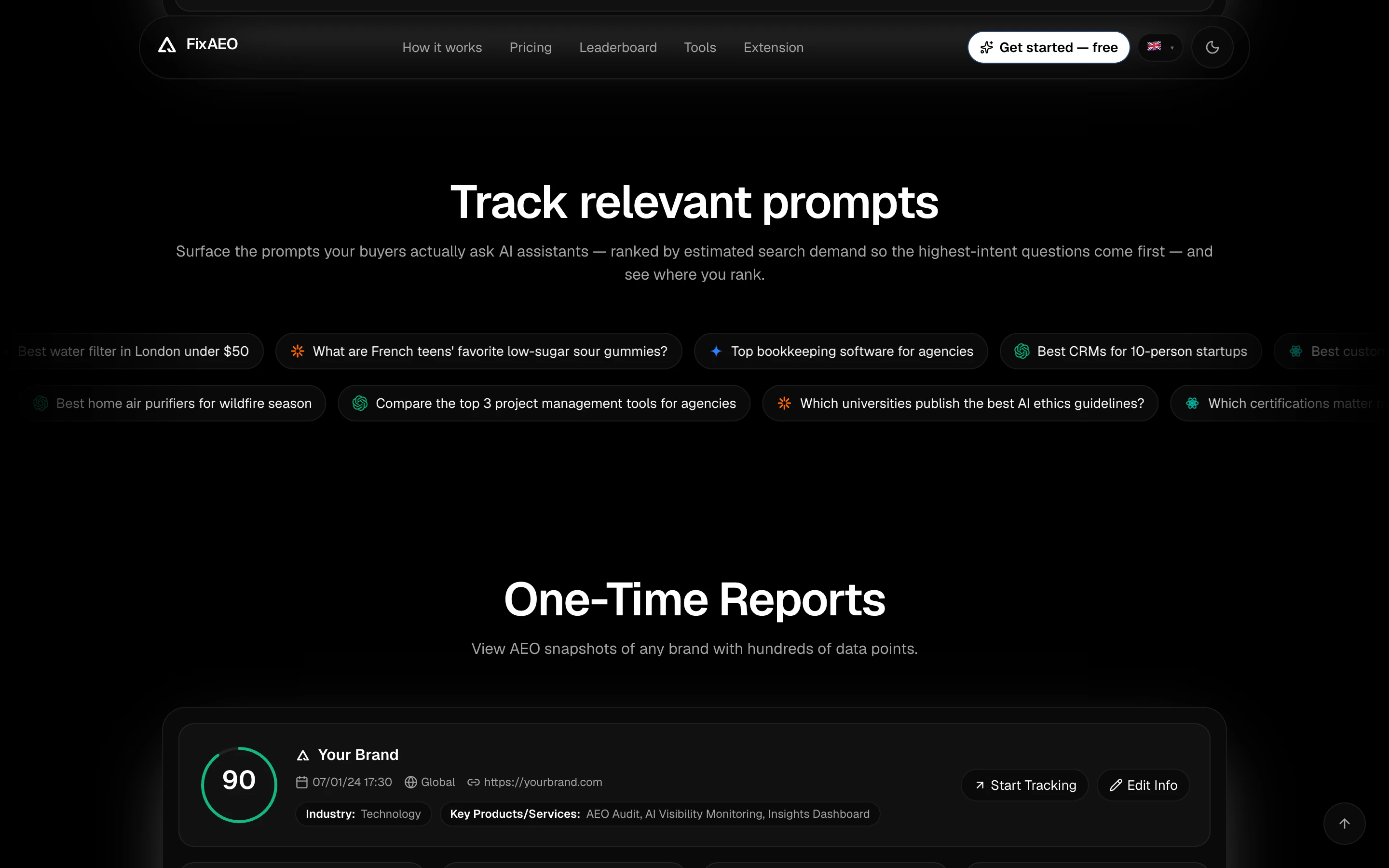
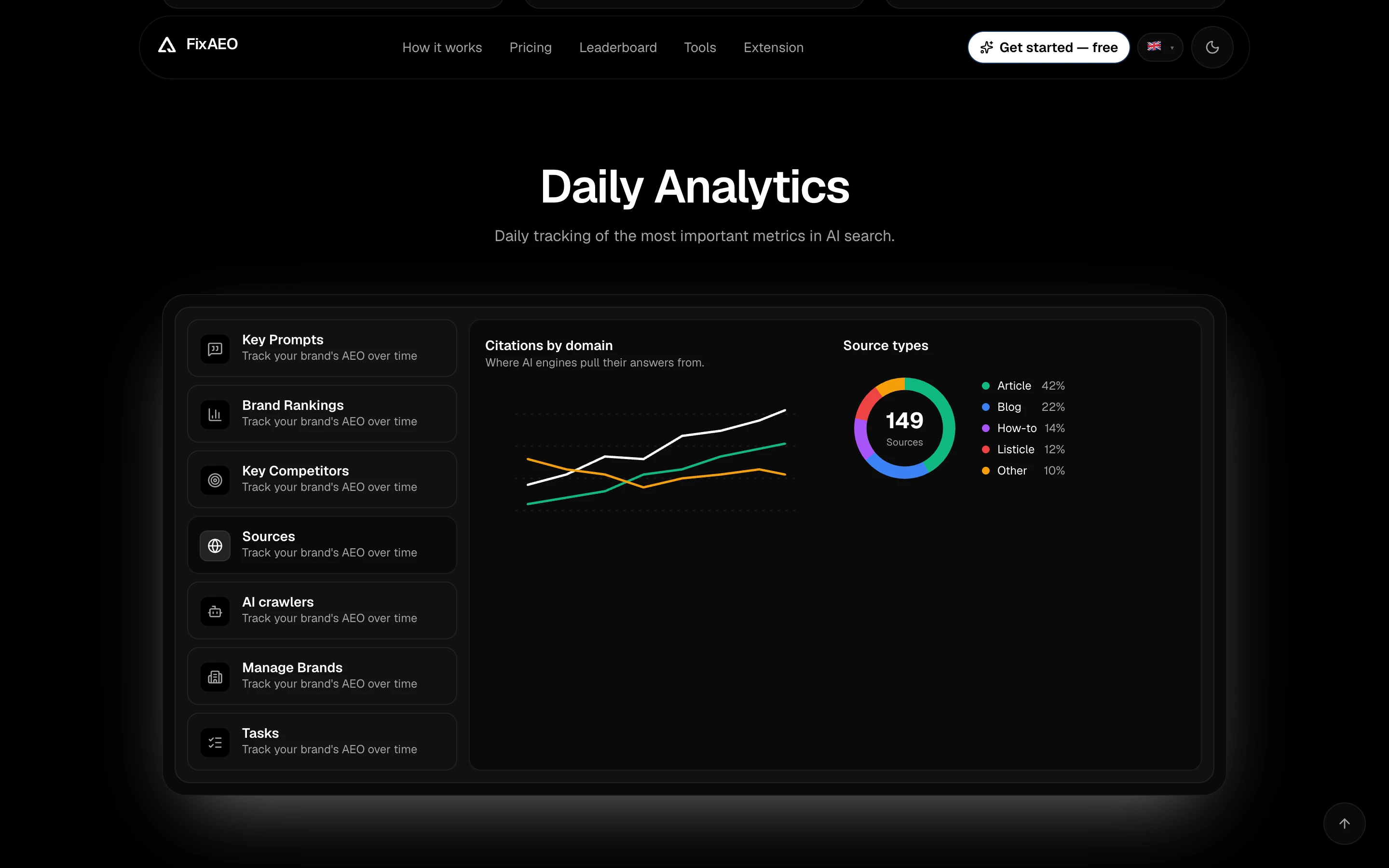
Start with a free AEO audit to see where your products stand today, or explore the full AEO tools landscape.
How long does it take to get recommended by AI?
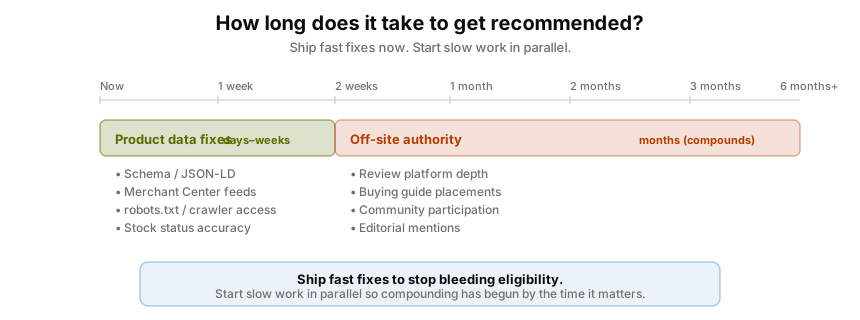
Some steps are fast and some are slow. Knowing which is which keeps expectations honest.
Product data fixes: days to weeks. Submit a clean feed, fix your schema, open crawler access. Retrieval is real-time, so the next time an engine searches for a relevant query, your corrected data is in play. We've seen technical fixes show up in answers within a couple of weeks.
Off-site authority: months. Earning mentions across review platforms, buying guides, and community threads takes time. There's also a lag between when a source publishes and when engines crawl, index, and start reflecting it in answers — typically a few weeks behind the event itself.
The winning approach: Ship the fast technical fixes now to stop bleeding eligibility. Start the slow off-site work in parallel so the compounding has begun by the time it matters. The teams that treat both timelines as one program are the ones that break into those recommendation slots.
What NOT to do
Three patterns that consistently hurt product visibility in our scans:
Fake reviews. The platforms detect them and filter them, and the engines cross-reference. A catalog with detected fake reviews gets a punishing visibility hit across all engines — not just on the affected SKUs but on the brand entity as a whole. Build genuine review depth instead.8
Blocking AI crawlers. Blocking GPTBot, PerplexityBot, or ClaudeBot removes you from the answers entirely. Those engines recommend products they can read. The tradeoff almost never favours blocking for a brand that wants to be discovered.
Assuming SEO-rich pages auto-translate. A product page optimised for keyword density — "best running shoes for flat feet plantar fasciitis 2026" — often loses to a cleaner page that answers the specific question with structured data. Citation extraction works differently from ranking. The page that wins position 3 in Google might not be the page that wins the AI recommendation.
Skipping image alt text. Multi-modal engines read images. A catalog of 500 products with "product-image-1.jpg" alt tags tells every engine nothing about what's in the photo. Descriptive alt text (material, colour, angle, size context) gives engines a second signal to match against shopper queries. This is the lowest-effort high-leverage fix we see missed across catalogs.
Neglecting your Bing / Microsoft Merchant Center feed. Most retailers have a Google Merchant Center feed and stop there. But ChatGPT Shopping sources heavily from Bing's index and Google Shopping data. If your Bing feed is empty or stale, you're invisible to the largest AI shopping surface by conversation volume. Setting up the Bing feed typically takes under an hour if your Google feed is already live — Microsoft's import tool pulls directly from your existing GMC account.
Treating Amazon as separate from your AI strategy. Amazon Rufus reads your Amazon listing — title, bullet points, A+ Content, reviews, and community Q&As. If your Amazon listing copy differs from your DTC site copy, engines get conflicting signals. Worse, if your Amazon listing is thin (generic bullets, no A+ Content, sparse reviews), Rufus skips you entirely for queries where a competitor has a richer listing. Keep your Amazon presence as sharp as your owned site, even if DTC is your primary channel.
TL;DR
AI shopping answers name a few products and stop. Getting your products into those answers takes three things running together: the eligibility work (schema, feeds, crawler access), the off-site work (reviews, roundups, communities, editorial), and the measurement that tells you whether either moved.
The brands winning AI shopping queries in 2026 got there on product data completeness, verified review depth, earned editorial placement, and consistent tracking — not on bigger content libraries.
See which products AI recommends in your category and which sources drive it — run your free scan at fixaeo.com. No signup required.
Related reading
- AEO for ecommerce: how AI assistants pick products — the catalog optimization playbook
- How to get cited by Gemini — Google's AI pipe for product queries
- Perplexity citations playbook — the strongest ecommerce citation engine
- Why ChatGPT doesn't recommend your brand — the diagnostic flowchart
- What is LLMO? Large Language Model Optimization explained — the broader discipline behind product recommendations
- Best AEO tools in 2026 — tracking and measurement tools
Frequently asked questions
Can you pay AI assistants to recommend your products?
Not in the organic recommendations. The major AI shopping surfaces select products through data quality, third-party signals, and retrieval — not ad bidding. Paid ad formats are starting to appear around these experiences, but the recommendations themselves are earned, not bought.
Which AI engine matters most for ecommerce?
It depends on your category and where your buyers are. ChatGPT leads on raw volume. Amazon Rufus owns shoppers already inside Amazon. Google AI Overviews captures the demand still searching on Google. Track all of the ones your customers actually use rather than betting on one.
Do Reddit mentions really influence AI product recommendations?
Yes, often more than brands expect. Community threads are among the most heavily weighted sources several engines pull from because they read as independent and unscripted. Genuine participation works. Manufactured praise gets detected and hurts you.
Does Product schema guarantee you'll be recommended?
No. Schema makes you eligible — it's the minimum for engines to read your product data correctly. Getting recommended requires the full stack: clean data plus off-site mentions plus tracked, consistent visibility. Schema without authority is eligibility without nomination.
How many products should I track?
Start with your top 20 SKUs — the products that matter most to revenue. Track each one individually, not just the brand. The patterns are usually clear: products with editorial roundup placement crush the ones without, even inside the same brand. That tells you where to direct the next PR or outreach effort.
Is this just SEO with a new name?
No. Traditional SEO optimises pages so Google's ranking algorithm places them higher in search results. AI product recommendations use a fundamentally different pipeline: retrieval, cross-source verification, and probabilistic generation. You can rank #1 on Google for a keyword and still never be mentioned in an AI shopping answer because the engine triangulates from review sites, community threads, and merchant feeds — not from your SERP position. The skills overlap (structured data, quality content), but the measurement, the surfaces, and the levers are distinct. We cover the broader discipline in our guide to LLMO.
Footnotes
-
OpenAI: Introducing ChatGPT Shopping. ChatGPT returns product cards from Bing's index and Google Shopping data. Read the announcement. ↩
-
Perplexity: Introducing Buy with Pro. Source citations visible on every product recommendation. Read more. ↩
-
Google: Shopping Graph. Tens of billions of product listings with billions refreshed hourly. Read the overview. ↩
-
Adobe Analytics: AI traffic to retail sites grew 393% YoY in Q1 2026. AI visitors converted 42% better than non-AI traffic in March 2026. Read the analysis. ↩ ↩2
-
Salesforce: 2025 Holiday Shopping Insights. AI tools influenced more than 20% of all online retail sales globally. Read the report. ↩
-
Search Engine Land: ChatGPT Shopping Analysis, March 2026. 83% of carousel products matched Google Shopping's top listings. Read the analysis. ↩
-
We cover the five-property Product schema requirement in detail in our AEO for ecommerce guide, with audit data from hundreds of retail catalogs. ↩
-
Our catalog audits consistently show verified reviews outperforming unverified volume on citation share. Covered in AEO for ecommerce. ↩ ↩2
Related reading
AEO for Ecommerce: Get Products Recommended by AI
Ecommerce AEO requires a different playbook. Learn how Product schema, buyer reviews, and comparison sites get your products cited by AI assistants.
12 min readCan ChatGPT Search the Web? How to Use Search
Yes, ChatGPT can search the live web and cite sources. Follow the current Search steps, fix a missing Search option, and verify cited answers.
22 min readWhat is a conversational search engine? Examples and how it works
A conversational search engine answers in plain language, not ten blue links. What it is, the top examples, how it works, and why it matters for brands.
16 min read
Free AEO tools
Put this into practice with free FixAEO tools — no signup required.
AI Visibility Checker
Score your brand across 9 AI engines
AEO Audit Tool
Answer-engine readiness scan
Schema Generator
Build valid JSON-LD structured data
llms.txt Generator
Create a spec-compliant llms.txt
Sitemap Validator
Check your XML sitemap for errors
AI Content Grader
Grade content for AI citation readiness
Find the gap. Then fix it.
Check how AI engines find, describe, and cite your site. Free, no signup. On a paid plan, AI Marketer can turn the evidence into briefs, drafts, optimizations, and reports.